Wednesday, May 19, 2021

A Flood of Kindness - Author Interview and Craft Chat with Ellen Leventhal by Kathy Halsey


I so enjoy featuring writers I've meet over my career who are now successfully published authors. My friend Ellen Leventhal has several published picture books to her credit, but A Flood of Kindness is extra special as she lived through three floods between 2015 -2017 at her home in Houston, Texas.  Like Charlotte, her main character, Ellen lost most everything, yet she focused on Mr Rogers and his advice to look for the helpers for hope and inspiration. That inspiration inspired her newest book.


Book Review

Yes, I am reviewing a friend's book that received my feedback early on, but my policy as an educator and K-12 retired librarian is that I only review books that I fully support and recommend. 

From a writer's perspective, I see a well-focused book with many elements to note and emulate in my own work. The beginning spread captures a river come alive and a hint of the danger ahead. The vivid verbs and short staccato sentences heighten the stakes for main character Charlotte and her family. The refrain, "But still it rained" and the modification of that refrain, "But still, water seeped in," and "But still, I shivered" shape the relentlessness of a flood with no end in sight and a through-line that propels the readers forward. 

With main character Charlotte, Ellen has created an emotional journey and internal arc. Charlotte knows she's too old to be comforted by her teddy, yet that's just what she needs.  The use of close third person for framing the story is perfect. Through a child's eyes we experience the fear, frustration, and anger that comes from uncontrollable disasters. Charlotte gains strength from the "helpers" and becomes one herself as she passes on her precious teddy to a younger child. 


From an educator and librarian's perspective, this is a book children need now whether it be for social emotional learning or to emulate Charlotte and pass on kindness in their own special way. The story gives children the agency to be "the helpers," too. With natural disasters such as floods and fires on the rise due to global warming or the pandemic we are living through, a book of empowerment like A Flood of Kindness can facilitate discussions on these issues.    

Ellen has also created a campaign, "The Kindness Challenge," found on her website with activities to promote kindness. Kids can create kindness chains, play kindness bingo and write group poetry. Find the projects here.


Craft Chat with Ellen Leventhal

First of all, thank you so much, Kathy, for having me on the Grog. I appreciate it a lot.   

Kathy: I was lucky enough to see early versions as A Flood of Kindness developed. What revision changes made the story stronger?  

Ellen: This is a fun question because I went back in my email and found what I sent you. EEK! So, thank you again for your help. There were a LOT of changes from the versions you saw. Some changes were major, and some were small tweaks.


One thing that made the story stronger was building a better arc. Charlotte’s emotional change came too quickly, so I spent a lot of time slowing the action down. I struggled with that because  it’s tricky in picture books. Don’t have the change happen too quickly, but don’t use too many words. I worry about word count, but my editor wanted me to add words to strengthen the arc. I did get rid of extraneous things that didn’t move the story forward. I spent a lot of time making Charlotte likable, but someone with flaws. I wanted kids to relate to her.


Kathy: Please share your favorite revision strategies.

Ellen: As far as my favorite revision strategies, I use the acronym CARE when I revise. CHANGE, ADD, REARRAGE, ELIMINATE. I don’t always do all of this, but it’s a good guide. When I do school visits, we use this technique with a little “dance” as we sing, “Put words in, take words out, turn words around, and look at it again.”


For most stories, I use the old story mountain to check if everything is there. Often, I find I must use the ADD component of CARE when I see that perhaps the climax isn’t strong or clear enough or something is missing. 

I do highlight the verbs to make sure they are strong, and don’t need the dreaded adverb to make the action clear. One trick I learned from a critique buddy is to try not to use “to be” verbs. That’s a clear sign of telling as opposed to showing. 


I did something different with a PB biography recently that worked. I read an editor’s remarks, but I was so caught up in what to put in and what to leave out, how to make her like it, and how many words it should be that I chucked all the drafts I was working from and started from scratch. I knew the character well and what I thought was important and related to my pitch, so it wasn’t hard. The essential info rose to the top. I haven’t tried this with fiction, but I may. It’s freeing.   


Kathy: You’ve said the themes of Flood are “kindness” and “empowerment.” Did the themes evolve as you wrote? This question goes to your writing process- do you set up certain parameters before you tackle draft one: theme, motif, obstacles? 

Ellen: The theme of kindness was there at the inception of the idea. I think “empowerment” came a bit later in the process. As I wrote, I began to realize that kindness and empowerment can be intertwined. I know the feeling of helplessness, and I wanted children to know that they don’t need to feel that way in the face of difficulties. They have the power to help themselves and others by passing on acts of kindness.


As far as setting up parameters, I do usually start with a theme, a “want or need,” and if my story is the traditional format (as opposed to a concept book), I list possible obstacles. But so many times I go back and look at early drafts, and they look like totally different stories. FYI…that didn’t happen with “Flood.” I knew where I was going, and the changes were just how I got there.   


Kathy: What were your experiences with illustrator Blythe Russo and editor Peggy Schaefer (WorthyKids)?  

Ellen: I had a wonderful experience working with Peggy Schaefer. We spoke on the phone after I signed the contract; she went over what I should expect. She answered my questions and was honest and transparent. She sent back some edits that made so much sense to me. I was shown the rough art, and Peggy asked me a question about a certain picture to make sure it was depicted correctly. I appreciated that since they knew I had experienced floods.


Blythe and I didn’t work together at all. She worked with the art director. As I said, I saw the roughs and really liked them, but I didn’t even know who did them for quite a while.  Once I found out who the illustrator was, I “stalked” her on Facebook  and messaged her about how much I love her work. Then, we communicated a lot, and became friends. She is amazing in so many ways. I feel lucky to have had her illustrate this book that means so much to me.


Kathy: Any advice for new authors regarding illustrators and editors?

Ellen: Let the editors and illustrators do their jobs.  It’s sometimes difficult to give up control (ok, it’s ALWAYS difficult), but it is important to remember that books, especially picture books, are a collaboration. In picture books, the illustrations are fifty percent of the story, so let the illustrator lend their creativity to your story.


When working with your editor, ask questions beforehand, but understand that editors know the market and have experience with how books will turn out. You editor will most likely give you some notes that will make your story stronger. Take notes graciously, but if there is something that concerns you, it’s fine to ask about it. If done well, the collaboration with author, editor, and illustrator can be magical. When your “book baby” goes to other people, know that they will begin to love it, just like you do.


Kathy: Ellen and I both belong to a cadre of writers called “The Caldecotts,” a group of writers 60+ . Many writers feel that they’re too late or too “old” for success. What do you say?

Ellen: That is definitely a misconception, but to be honest, I sometimes fall back into that belief. I think if it weren’t for the Caldecoots, I may have given up a few times. I am so thankful for the supportive and talented women who remind us that at our age, we are still have so much to give to the world.


So, my advice is to find a group of like-minded people who believe that age is just a number and lean on them when you’re feeling defeated. It happens to all of us. Remember at our age, we have the wisdom to understand life’s challenges and the experience to know that life is like a roller coaster. We’ve been around; things don’t knock us down as easily anymore.

Whatever you want to do -- write, sing, or start a new career, go into it with your eyes open, but with the confidence that your life experience will only help you. It is hard sometimes not to let the youth culture of this country intimidate us, but as someone recently told me, “You don’t have an expiration date, so do what you want until you don’t want to.” So, if you are 60+ and reading this, remember you are not a carton of milk and don’t have an expiration date! Do what makes you happy.


About Ellen and More on Her Process to Publication


Ellen Leventhal is an educator and writer in Houston, TX. Ellen is the co-author of Don’t Eat the Bluebonnets (Clear Fork Publishing/Spork 2017) the author of Lola Can’t Leap, (Clear Fork Publishing/Spork 2018) and A Flood of Kindness (Worthykids/ April 13, 2021). She has been published in magazines and newspapers, as well as in poetry and short story anthologies. Ellen loves school visits (in person or virtual)! When visiting schools, she coordinates with and supports literacy programs as well as diversity and anti-bullying programs. Ellen’s best days are when she can interact directly with the students and spread her love of literacy and kindness. To find out more about Ellen’s books and writing projects, please go to -www.Ellenleventhal.com

  • Cover reveal and interview with Ellen's editor and her by Manju Howard: https://tinyurl.com/4dw4tkpc
  • Ellen's advice for book launches and interview with Maria Marshall: https://www.mariacmarshall.com/single-post/the-picture-book-buzz-interview-with-ellen-leventhal


Wednesday, May 12, 2021

Children’s Literature Book Recommendations

By Suzy Leopold

    All across the globe the world has changed. Life is difficult to navigate during a global pandemic that includes many restrictions. Everyone is acquiring new knowledge and understanding of how we can be safe, happy, and even do our part.

“Children’s books can play a powerful role in helping 

kids navigate life’s challenges.”

—Caroline Bologna, Huff Post

    During this unprecedented time, many picture books were published to offer information and comfort to readers of all ages. These books include fiction and nonfiction picture books, middle grade, early readers, and more. 

    Additional children’s literature continues to be published and will soon be available for children of all ages. These timely books provide an  understanding of the world around us concerning the current situation with global health issues. 

    Many recently picture books offer facts and information about viruses and germs. Children’s mental and emotional needs are addressed, such as anxiety, stress, and separation from family and friends. These books support our youth to understand they are not alone in their feelings and how they can do their part—hand washing, social distancing, and mask wearing.

    As Mr. Fred Rogers said, “When I was a boy and I would see scary things in the news, my mother would say to me, ‘Look for the helpers. You will always find people who are helping.’”

    This first picture book recommendation is, COVID-19 HELPERS: A Story for Kids about the Coronavirus and the People Helping during the 2020 Pandemic is written by Beth Baker and illustrated by Kary Lee. It is published by Blair, November 2020. 


    This book provides comforting words for readers, ages 5-11, and includes positive, honest information. 

    And just like Mr. Rogers, encourages children to “look for the helpers.”
 
    Keeping the City Going, is written and illustrated by Brian Floca, made its debut in April 2021. The book is a heartfelt thank you to all essential workers during the stay at home orders of the pandemic and is written for ages 4-8. Back matter includes an author’s note.


    The publisher, Atheneum Books for Young Readers states, “An ode to the essential workers keeping the country operating during the COVID-19 pandemic.” Caldecott Medal Winner, Brian Floca’s words and illustrations speak to the reader while everyone is sheltering in place.

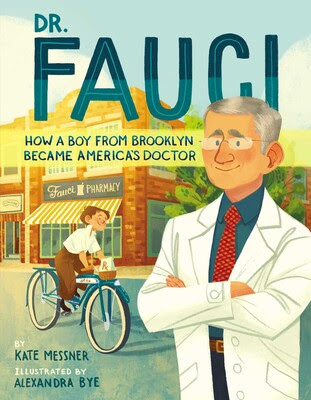
    Author, Kate Messner conducted interviews with Dr. Fauci to create the picture book narrative, Dr. Fauci: How a Boy from Brooklyn Became America’s Doctor. The book is illustrated by Alexandra Bye and published by Simon and Schuster, June 2021. 

    The story is about America’s loved doctor, Dr. Anthony Fauci, Director of the National Institute of Allergy and Infectious Diseases.

    This picture book biography is written for ages 4-8, and includes Dr. Fauci’s role of working with seven presidents. A timeline, facts, and more are included in the back matter.

    Written by Theresa Trinder and illustrated by Grant Snider, There is a Rainbow, is published by Chronicle Books, January 2021. The heart warming message is filled with hope for young readers, ages 3-5. The illustrations are vibrant and expressive.

    The following excerpt shares the uplifting message that makes the book perfect for a read aloud:

On the other side of the window, there is a neighbor.
On the other side of sadness, is a hug.
And on the other side of a storm, there is a rainbow.

    The fifth and final recommendation is a nonfiction book written by Suzanne Slade; illustrated by Elisa Paganelli. June Almeida, Virus Detective! The Woman Who Discovered the First Human Coronavirus is published by Sleeping Bear Press and released in March 2021. This biography is written for 6-9 year olds.
    June was 34 years old when she discovered the first human coronavirus. Her work continues to support researchers today. Sharing a book trailer of this Scottish internationally renowned virologist and woman pioneer.

    Many helpers are doing their part during this unfamiliar and sometimes scary time. As a parent, a grandparent, an educator, a story teller, and a children’s book writer I want to do my part to put these books in the hands of children and students. 

    Perhaps you, too, have read and shared recently published books about the COVID-19 pandemic health crisis with young readers. Share additional children’s literature titles that are timely and relevant during the global pandemic.

    Let’s all do our part to offer reassurance and let children know they are safe. Read to them. Listen to them. Hug on them.

To be eligible for a give away, share a title, including the author and illustrator of a recently published book that addresses the COVID-19 theme. Write it in the comment section. I will paint a watercolor bookmark for one lucky winner—US only. The winner will be announced on the GROG Blog on May 19th.

Additional resources and links for parents and teachers: 

School Library Journal

New York City School Library System

The Today Show on NBC

Helping Children Cope, NASP

Wednesday, May 5, 2021

Butterflies are Pretty Gross!

 by Sue Heavenrich

Tundra Books, April 2021

What with the days getting longer, insects are flitting and buzzing, whining and zipping about the yard. Among them are butterflies, pretty and – according to Rosemary Mosco – pretty gross! They taste with their feet. They lick salt from muddy puddles. Some of them even eat poop! And their kids! Butterfly larvae can be rude, stinky, and sneaky. 

Truth is, butterflies are complicated. And Rosemary and Jacob do a great job getting that information across to readers of all ages. They highlight the science and shenanigans of seven species, including the Monarch who narrates the book. And believe me, he’s none too eager to give up Secrets of The Order (Lepidoptera). Granted, this is a picture book, but it’s got enough humor in it to entice adults to read it again and again. Plus Back Matter!

I “met” Rosemary through her online Bird and Moon cartoons. I met Jacob at our regional SCBWI conference (west-central NY). So I am really happy they are able to join me here on the GROG blog today and share some of their secrets – which are not gross at all! Imagine that we are sitting around a table slurping coffee through our long, tubular butterfly tongues (Rosemary, do butterflies drink coffee?) and chatting about words and art.

Sue: So Rosemary, What made you want to highlight the gritty side of butterfly life?

photo by Adrianne Mathiowetz
Rosemary: I got the idea for this book when I overheard someone say "I like bugs, but not butterflies. They're just boring and girly." Well, I'm a girl (okay, a woman), and I know butterflies to be gross, funny, beautiful, and wonderful - just like us. I wanted to highlight the complexity of these familiar critters. I was hoping to show that everything is much more complicated and interesting if you take a deeper look.

Sue: What sort of research did you do?

Rosemary: I started with a big list of strange butterfly facts. Then I whittled it down to my favorites. I read books and papers, and I also spoke with two experts. I talked to Phil Torres, who is a true renaissance man: he's an adventurer, researcher, TV host, and butterfly expert. He has taken great tropical footage of butterflies eating jaguar poop and drinking turtle tears. Phil read an early draft of the book and provided footage that helped the fabulous artist Jacob Souva nail down the strangest scenes. I also talked to Professor Naomi Pierce of Harvard - she has a wealth of knowledge, and she's particularly interested in butterflies that let ants babysit their caterpillars. The facts about alcon blue butterflies in this book come from her research.

Sue: And you watch butterflies too, right?

Rosemary: Yes, enthusiastically! I even travel to other places to watch them. I've been to the National Butterfly Center in Texas twice for the Texas Butterfly Festival. It's hard to pick a favorite, but I love zebra swallowtails. They're these beautiful black-and-white-striped butterflies that like to drink from puddles in the middle of hiking paths. 

Sue: And Jacob, you did research, too for the illustrations.

Jacob:
This book took a lot more in-depth research than a normal project would. We cover a lot of ground. Tundra’s art director, John Martz, had me walking the fine line between fiction and non-fiction to weave the book into a whole. For example, Monarch Butterflies have small little legs that sit up near their heads. I made a run at it, but couldn’t make it look reassuring enough for young readers! So we compromised and pushed them down a bit to take on a more recognizable form. He also wears sneakers and drinks coffee …. Also, Rosemary pointed out a few inaccuracies here or there after I turned in the finals. There was a “butterfly” on the cover that turned out to be a sneaky moth! I am so grateful for her knowledge and was happy to make changes where needed. This book was a team effort in the truest sense.

Sue: one of my favorite spreads shows the “sneaky caterpillars”. How did you decide to turn this spread into a filmstrip?

Jacob: This book presented some unique storytelling challenges. The narrator (monarch butterfly) speaks directly to the reader and then takes them on a journey into the strange facts. How does that look? How do you weave the strange and gross details into a narrative that makes sense? The thumbnail stage for this book was very important.

I landed on the narrator using a few different devices as a narrative tool to get into a set of images. The first is binoculars, second an old retro film projector, and the third is a top secret room. The “sneaky caterpillar” illustration worked best as a series of images that show how the ants take in and adopt the caterpillar over time. We had some dialogue back and forth about whether a film strip would be clear enough to work. 


Sue: You create your illustrations digitally. Any pros and cons you’d like to share? 

Jacob: There are a lot of benefits to working digitally. I love how easy it can be to change things and tweak color or texture after the fact. It’s a bit like working in oil paint that never “sets.” I really enjoy working with color so Photoshop is a bit like a giant playground. Texture files can be reused! And no mixing paint! It really is great.

On the downside, you can easily overwork an image to get it ‘just right.’ Sometimes this can drain the life from the work and it can become kind of stale. I combat this by not using the undo button too much and living with the imperfect lines and bits of unintentional collage. It’s something I’m very aware of. I also sometimes miss getting my hands dirty or spilling paint water!

Bird & Moon comics

Sue:
Back to bugs. Rosemary, in one of your comics you listed animal body parts you wish you had. Do any butterflies have some superpowers – or body parts – you would like to have?

Rosemary: Butterflies can see ultraviolet, and they have special ultraviolet patterns on their wings that humans can't see. I'd love to be able to see even more butterfly colors. And of course I'd love a pair of big colorful wings. But they'd need to fold up for easy storage. It'd be hard to go through doors!

Sue: Any words of advice to readers?

Rosemary: I'd like to urge anyone reading this to go and explore their local insect populations. You'll be shocked, disgusted, and overjoyed by what you find - and you'll banish boredom forever.

Thanks for joining us today. Folks can find out more about Rosemary Mosco at her website, https://rosemarymosco.com  and Jacob Souva at his website, www.twofishillustration.com/my-work

Wednesday, April 28, 2021

How Social Media Can Benefit Writers

Tina Cho and Leslie Tribble are teaming up on this post to show writers why they should be on social media. 

From Tina:

Social media can benefit writers in wonderful ways if used responsibly! I’m on Facebook, Twitter, and Instagram. Twitter, especially, in its concise tweets has brought me lots of goodies. Here are my reasons why you should be on social media too.


You might find an agent. 

I found my agent through Twitter. I was following another agent from Martin Literary who tweeted about a new agent. Bingo! I submitted to her, and we’ve sold five books since 2016.

Adria Goetz is the best!


You might find story ideas.

Someone tweeted about haenyeo (South Korea’s diving women). I looked them up and knew I must write about them. The Ocean Calls: A Haenyeo Mermaid Story published in August 2020 from Kokila, an imprint of Penguin Random and received 4 stars and lots of other accolades. See my website for details.


You might get an animated special deal (i.e. short movie) for your book.

It all started with a Tweet, dear readers!! Because Twitter friends share book covers and book reviews, someone who works for a media company just happened to see the book cover of The Ocean Calls, told her company about it, who got a hold of my agency, who bought the rights to make it an animated special. So keep sharing those book covers & reviews!


You might find a writing tribe.

Because of my books and presence on social media, especially Twitter, the famous Newbery author, Linda Sue Park EMAILED me to be a part of her #kibooka team of Korean-American & diaspora writers. See https://kibooka.com/ 


You might discover your book being sold at a famous store.

One early morning as I was getting ready for school, Penguin Random House tagged me on Instagram. Pottery Barn Kids is selling my book along with other wonderful picture books on equity and inclusion. I was floored! And last weekend I did a video for them!


You will meet wonderful people.

I have met so many wonderful people on social media--authors, illustrators, editors, agents, parents, teachers, etc… All these connections are integral in helping you become a great writer and person. 


Librarians and book reviewers will want to tag you.

Each week I’m usually tagged by librarians or book reviewers or parents or readers who enjoyed my books. I’m humbled and enjoy meeting people around the globe. 


Your publisher will want to tag you.

If your publisher is marketing your book, they will tag you. 


From Leslie:

My social media platforms are Facebook and Instagram. Instagram is my favorite form of social media, and I’ve been posting my nature photos there since 2013 - that is hard to believe!


For me, social media is a way to connect with other like-minded folks. I follow authors, both adult and kid-lit but I also follow a lot of landscape and wildlife photographers who inspire me with their work. Seeing the beauty of their art makes me work harder at my own photography. I don’t have a huge following, but I’ve really enjoyed the connections I’ve made with some of these virtual friends and have even met a few in real life. 


It was the suggestion of some of my social media followers that prompted me to create a calendar. I have zero photo editing skills and didn’t know how to create a calendar at all, but I buckled down and finally produced something I was very proud of last year. It was a huge learning curve, but gratifying in many ways, and I’m already working on a new calendar for 2022. 


My SM platforms have also been a convenient way to promote my self-published outdoor recreation guide. With one quick picture and a few words, I can tell people about my book and have even have others expand my reach when they repost my photo. Free and instantaneous marketing! In fact, now that spring is slowly making its way to northwest Wyoming, I’ll be posting a photo of my book soon, reaching even more folks than last year.


Social media can be a huge consumer of your valuable time, but it can also bring personal friendship, engagement, creative inspiration, career success and overall enjoyment. It’s a good way to get your name out there in whatever field you’re interested in. 


Let us know what successes have come your way through social media!


Tina Cho is the author of four picture books-- Rice from Heaven: The Secret Mission to Feed North Koreans (Little Bee Books 2018), Korean Celebrations (Tuttle 2019), My Breakfast with Jesus: Worshipping God around the World (Harvest House 2020), and The Ocean Calls: A Haenyeo Mermaid Story (Kokila/Penguin Random House Aug. 2020). Her lyrical middle grade graphic novel, The Other Side of Tomorrow, debuts from Harper Alley in 2023. After living in South Korea for ten years, Tina, her husband, and two teenagers reside in Iowa where Tina also teaches kindergarten. 


website: https://www.tinamcho.com/ 

Twitter: @TinaMCho

Instagram: @Tinamcho

Facebook: TinaWheatcraftCho 


Leslie Colin Tribble is the author of Adventure Guide to Cody, 2019. She's written for Cody and Beyond, Cross Country Skier Magazine, Yellowstone Valley Woman, RootsRated, and Sunlight Sports - East Side Stories. Leslie lives in northwest Wyoming with her adventure dogs, Robbie and Milo.

Instagram: @Sagebrush_Lessons
Facebook: Leslie Colin Tribble


Wednesday, April 21, 2021

Books for Earth Day and Poetry Month ~by Christy Mihaly


Today let's explore poems about Earth! Tomorrow (April 22) is Earth Day . . . and of course . . .  

April is National Poetry Month. 

SO: Here's a quick round-up of ten Earth-themed books for kids. Of the many books out there I chose 5 outstanding poetry books and 5 favorite rhyming picture books. Please add your own in the comments! 

Nature-Themed Poetry Books

Poetry is an ideal way to encourage kids to explore nature: reading and writing poems makes us slow down, observe, and ponder the wonder and the connections.

The Wisdom of Trees: How Trees Work Together to Form a Natural Kingdom
(Roaring Brook, 2021).
This new picture book is written and illustrated by Lita Judge. It illuminates cutting edge science about how trees communicate and collaborate in communities. Judge uses heartfelt, evocative poems to convey the magical-seeming properties of trees. Gorgeous art complements the scientific sidebars and helpful back matter about each spread.

A Place to Start a Family: Poems about Creatures That Build (Charlesbridge, 2019).
David Harrison's dozen poems about animal architects, illustrated by Giles Laroche, provide a fun introduction to structures that animals build, from birds to fish, prairie dogs to king cobras and more. 

Sing a Song of Seasons: A Nature Poem for Each Day of the Year (Nosy Crow, 2018) is a gorgeous 366-poem anthology edited by Fiona Waters and illustrated by Frann Preston-Gannon. Though the selected poets tend toward the classical (Emily Bronte, Margaret Wise Brown, William Wordsworth, Robert Frost) with a smattering of traditional verses, it's a nice introduction for kids.

National Geographic Book of Nature Poetry: More than 200 poems with photographs that float, zoom, and bloom! (Nat Geo Kids, 2015). Whew, that title just about says it all. This book will engage young readers who love photos. It's filled with stunning Nat Geo images from around the world, paired with poems old and new. The poets here include Nikki Grimes, Langston Hughes, and Naomi Shihab Nye, and are collected by J. Patrick Lewis, a former children's poet laureate. 

Song of the Water Boatman and other Pond Poems
(HMH 2005) offers wonderful kid-friendly poems about the creatures and plants that live in and around a pond. Joyce Sidman starts with my favorites -- spring peepers, those tiny heralds of spring --  and moves through the seasons with poems and informational sidebars. Striking woodcuts by Beckie Prange bring the pond ecosystem to life.

Rhyming Picture Books about Earth

Chase the Moon, Tiny Turtle: A Hatchling's Daring Race to the Sea (Page Street Kids, 2021). In rhyming verse, Kelly Jordan captures the drama of a loggerhead turtle's post-hatching sprint across the sand to the safety of the ocean. The lyrical text and Sally Walker's engaging illustrations are sure to delight young readers as they learn about sea turtles and their struggle to survive.

Ocean Soup: A Recipe for You, Me, and a Cleaner Sea
(Sleeping Bear, 2021). Meeg Pincus's clever rhymes explain plastic pollution in the ocean, using the metaphor of soup -- how we threw all the ingredients in and let it simmer for years -- and includes specific actions kids can take to help. Bright illustrations by Lucy Semple keep the tone upbeat. 
 
Anywhere Farm (Candlewick, 2020) by Phyllis Root, illustrated by Brian Karas, stands out for its inclusivity. It encourages kids by letting them know you can start a garden on a city vacant lot ... or really anywhere: 
"But a pan or a bucket,
a pot or a shoe, 
a bin or a tin 
or a window will do." Empowering and inspiring.

One Earth
(WorthyKids, 2020) is a rhyming counting book that does it all! In addition to teaching the numbers, text by Eileen Spinelli and art by Rogerio Coelho share the wonder of Earth, and may inspire kids to want to take care of it.

Compost Stew: Recipe for the Earth (Dragonfly Books, 2014) puts a different spin on the "ocean soup" concept. It's a zippy rhymer that explains compost to kids. With clever rhyming verse by Mary McKenna Siddals and fun pictures by Ashley Wolff, this book is a great way to get kids excited about composting. 

Bottom line: Nature inspires great writing! This post just scratches the surface -- what other great books do you recommend?