Showing posts with label #poetryforall. Show all posts

Wednesday, April 15, 2026

Celebrate Poetry Month With Roberto Germán ~ Christy Mihaly


This April is the 30th anniversary of National Poetry Month, a time to celebrate the important role poetry plays in our lives and well-being. Today GROG is pleased to welcome poet Roberto Germán to share some poetry insights.

Many people assume poets must be "special" people, but Roberto believes that anyone can be a poet. He points out that writing poetry connects us with our innermost emotions and thoughts, and helps us make order of the chaos. That's something we can all use!

Educators

Roberto and his wife Lorena Germán founded and run Multicultural Classroom, which offers schools and other organizations training in social justice and inclusivity. They travel nationwide to bring their programs, workshops, and wisdom to educators and students, seeking to bring a diversity of perspectives to education.

Roberto and Lorena Germán
Poetry Workshops
Roberto also runs poetry workshops in schools. These are designed to help students find their voices through poems. Poetry, Roberto points out, is a powerful tool to help young people tell their stories. Writing poetry helps kids process their experiences and emotions as they develop their identities. He tells students of his own turbulent early years as a Black Dominican-American, the son of immigrants.


In 2023, Roberto published Blue Ink Tears, a bilingual collection of poems interspersed with handwritten notes and photographs.  Roberto wrote the poems over many years, starting when he was still a teen. He tells students that if he could do this, they can, too. His poems explore themes of immigration, race, family, masculinity, love, and loss.

In reading his work to students, Roberto models how poetry helps tap into our emotional truth. He teaches young people to honor vulnerability rather than burying their feelings. He told me he didn't have a mentor to share these lessons when he was growing up, but eventually he realized that writing could be a tool to process his thoughts and feelings. He hopes his poetry workshops help students do the same.

Poems from Blue Ink Tears

I've chosen some shorter selections from Roberto's collection to share today. Enjoy! 
Roberto addresses themes of love ... 
... and immigration, heritage, and metaphorical belonging (also, there's a food thread) ...
... with some haiku exploring themes of history and heritage: 
                                   

For more of Roberto's poetry, you can hear him recite his work here. To see a student reading his own poem after one of Roberto's workshops, check this out. 

Profound thanks to Roberto for sharing.

And Happy Poetry Month to all. 

Wednesday, April 2, 2025

Poetry Month 2025: You Can Be a Poet! Poet Libby VanBuskirk talks about her debut poetry collection ~Christy Mihaly

Greetings, GROGgers. It's National Poetry Month! 

How will you celebrate? Let us know in the comments! And for more poetic inspiration, check out these  prior GROG posts: here, here, and here.

You may be feeling that you're not a poet, or that it's too late for you to learn to write poetry. Today I have the enormous pleasure of introducing someone who proves that you are wrong: poet Libby VanBuskirk, who at 91 years young is currently anticipating the publication of her first poetry collection, Living With Time, by Kelsay Books.

Libby VanBuskirk

Libby and I have been writing partners for many years. Her feedback is always kind and wise. She models a whole-hearted embrace of living authentically, and has dedicated herself to continuing to practice and grow in her writing, finding fresh inspiration in each new decade.  

Libby took a few moments out from her writing regimen to share some thoughts on poetry and on her soon-to-be-published collection, which was inspired, in part, by the loss of her husband in 2019.

GROG: Libby, your forthcoming poetry collection takes its title from your poem "Living With Time." Tell us a little about the book. 

LIBBY: Most of the poems in the book take place at a northern New England lake which feels almost holy to me. Through poetry and living close to the natural world, I have observed and explored the changes that time brings—present, past and future. I am intrigued by the movement of time, how it shapes our lives.

GROG: I found the title poem deeply moving -- you can read it here. Libby, why do you write poetry?

LIBBY: I love the sounds in poetry. I also have seen that the beauty and power of poetry can help us explore themes we sometimes avoid. Poems can lead to thought-provoking discussions about our changing lives, aging, and death.

GROG: Agreed those are topics we sometimes want to avoid. What inspired you to write the poems in your collection?

LIBBY: I was inspired by growing older, by the increasingly common experience of loss, and especially by the sudden loss of my husband by drowning. As some of my poems describe, loss can bring us terrible, shocking moments.

GROG: I'm so sorry that happened, Libby. I think you convey these feelings, moments, and images so beautifully in your poetry. What do you want readers to gain from reading your collection of poems?

LIBBY: I hope my poems help readers see the beauty in life at all ages. And maybe the collection, "Living with Time," can be helpful as a gift to mark an advanced birthday or to give to a relative or friend suffering a period of loss.

GROG: I like that, "an advanced birthday." Tell us about the poems in the collection.

LIBBY: The book includes about 65 poems. Some are lyric and others are formal poems, in forms that I’ve been learning over the past few years. I have loved reading and experimenting with these forms.

GROG: Yes! Poetry forms can be really fun. And how did you select and arrange those 65 poems?

LIBBY: The poems in Living with Time fall into three parts, all centered on the theme of time’s power to change our lives.

Part one probes life’s changes as I see them reflected in the natural world.

In the Part two poems, monumental change comes with my husband's sudden death. These poems address themes such as: How can I live without him, when our lives were so intertwined? Through metaphor and imagery and the clarity of poetry, I reflect on loss as I look for him everywhere and try to bring him back in odd ways, re-visit incidents in our lives together, or want to escape alone to a spot by the sea.

In Part three, the poems are about how I feel ready to grow again, and strive to build a new life through poetry.

GROG: So, it's not about loss only, but time, and living, and growing, and beauty. What steps did you take to get your collection published?

Libby's drafting process: "To Recycle"
LIBBY: It is very hard to get a poetry collection published! But, once I focused on wanting to write and publish poetry, over the last five years, I started submitting and publishing in poetry journals and anthologies.

My publisher, Kelsay Books, publishes both books and The Orchards Poetry Journal. Twice in recent years, the editors there accepted poems I wrote for the journal. I especially appreciated their kind words when they said they loved my work. Their enthusiasm encouraged me to submit my collection to Kelsay for publication, and I am so relieved they accepted it. 

GROG: And of course it takes a village, right?

LIBBY: Right! I am grateful to the many people who helped me make this book happen. I was lucky that a good friend, the poet Jeanne Svensson, served as my editor as I’ve worked on the book. In the very beginning of my dream to collect the poems into a book, she chose which poems to include and even helped to shape their order. Other friends have read and critiqued the poems.

I learned a great deal from Vermont poet David Weinstock, the leader of my weekly poetry group, and from studying with another Vermont poet, Rebecca Starks. With her, I have explored poetic forms—the sonnet, the villanelle, haiku and haibun, a beautiful Arabic form, the ghazal, and others.

GROG: Thank you for sharing these insights, Libby. I'm so excited that your book is on its way, and can't wait to hold a copy in my hand!

***

And here's more from Libby about her colorful life -- including that she once interviewed TS Eliot (!!) and has a passion for the indigenous textiles of the Andes:

I began my avid years of writing at Wheaton College in Massachusetts, studying with the poet Gray Burr. Since then I have studied writing at Radcliffe Seminars, the University of Vermont and recently in weekly intensive poetry seminars with Vermont poet Rebecca Starks.

Soon after college, I won a national writing award from Mademoiselle Magazine which led to an interview with T.S. Eliot. (GROG: !!!)

I received a Barbara Carlin grant from SCBWI (Society of Children’s Book Writers and Illustrators) for a picture book text, and won a poetry prize from Writers’ Digest.

My poetry has appeared in Beloit Poetry Journal, Orchards Poetry Journal, Quartet, Blueline Literary Review, and elsewhere. I published a book of short stories for children, Beyond the Stones of Machu Picchu, in 2013 (Thrums Books, Colorado). The stories offer a close-up look at Inca families today and their powerful ways of celebrating the natural world.

I have also followed my interests as an educator and a fiber artist, traveling to Peru eight times to research and write about indigenous Andean textiles and their meanings. My husband and I helped a Peruvian Inca weaver to found the Center for Traditional Textiles of Cusco. I co-taught courses on Inca history and culture at the University of Vermont, and guest-curated the exhibition, “Weaving the Patterns of the Land” at the Robert Hull Fleming Museum.

Currently, I am focused on poetry, my long-term love.

***

Visit Libby's beautiful website to read some of her poetry. 

You can also peruse the entire Summer 2024 issue of The Orchards Poetry Journal, here.   

Why not try a poetic form today? See this post for some ideas. And leave a comment about your own poetry practices.

Happy Poetry Month to one and all! 

Wednesday, April 3, 2024

Celebrating Poetry Month ... and Civic Engagement ~by Christy Mihaly

2024 Poetry Month poster:
Art by Jack Wong, words from Lucille Clifton poem

Happy National Poetry Month! It's time to celebrate poetry again!

Many poetry-loving writers, educators, and organizations post suggestions for elevating poetry this month. Reading Rockets has a great collection of resources here. Of course, we can celebrate poems all year long -- but it's nice to have a whole month to focus on bringing more poetry into our lives. 
Music-themed poetry in music store window

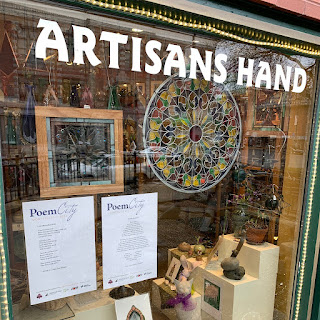
One of my favorite celebrations is "Poem City," a month-long event in Vermont's capital, Montpelier, during which the shop windows are filled with poems and libraries, coffee shops, and general stores resound with poetry readings. I'm so pleased to have one of my poems included in the collection, along with many others by poets from near and far. More about Poem City here.

Poetry can engage learners, not only in learning reading and writing, but in lessons about history, science, math, and my personal passion: civics. In Free for You and Me: What Our First Amendment Means, I turned to writing poems as a way to simplify constitutional concepts and make reading about them fun. 

It has turned out to be an effective way to communicate the concepts. Recently, on one hand, an editorial in a local paper reiterated the importance of teaching civics in our schools, and cited my books; and I did a read-aloud of this book with an engaged 5th-grade class as part of a workshop on civics and poetry -- more on that below. 

Spread from FREE FOR YOU AND ME on Freedom of Assembly

Of course you can find and write poems for all kinds of kids and all kinds of interests. 

In their anthology Hop to It: Poems to Get You Moving, poets Sylvia Vardell and Janet Wong collected 100 poems by 90 poets (including me!) that incorporate movement. Many of the poems relate to STEM themes. But this book, published in 2020, also includes several poems about civic engagement. Here's mine: 

STAND UP

by Christy Mihaly

Be a friend when someone's hurting
Give a smile or helping hand
Don't be shy about asserting
what is right: just take a stand.
Stand up!

If you want to make things better,
think of things that you can do.
Make a call or send a letter.
Illustrate your point of view.
        Stand up!

In a tizzy, feeling nervous?
Know your rights and learn your laws.
Join a march or day of service.
Find some friends to join your cause.
                STAND UP!

Don't just sit there on the sidelines 
when you know there's work to do.
If you think we need new guidelines,
write them up--it's up to you!

                                    STAND UP!

Lisa Powell created a fun video to go with this poem, posted here.

And yes, this month I've been working with an amazing fifth grade class to explore poetic forms and write poems in a series of workshops exploring freedom of expression and engagement in our democracy. Big concepts -- but we make it concrete through writing haiku, Fibonacci poems, and other poems about topics of concern to the students. 

Poetry can be magic! 

For more ideas and resources, check out GROG's Poetry Month posts from years past: here, or here, or here. (You can search for past poetry posts for lots more good stuff from 10 years of GROG archives!)

And happy month to all!


Wednesday, February 15, 2023

The CYBILS winners: Poetry and Verse Novel ~by Christy Mihaly


The Cybils Awards for 2022 books were announced on Feb. 14, 2023.  

Congratulations to the winners -- and to the finalists, and all the nominees. So many good books were nominated.

The Cybils Awards seek to recognize the books (and their creators) that best combine awesome writing and kid appeal. The goal is to make kids love reading! As one of the founders of this award said, "Between the brussels sprouts of literary merit and the gummy bears of popularity contests, we are the organic chicken nuggets -- both yummy and nutritious!"

I was honored to be a Round 2 Judge for the Cybils in the Poetry and Verse Novels categories, and I can't wait to tell you about the winners. (I know, by the way, some readers would quibble with the relative yumminess of  brussels versus gummies, but ... on with the show!)  

And the winners are:

Verse Novel

Wave by Diana Farid

Wave is everything a verse novel for young readers should be. In this novel by Diana Farid, illustrated by Kris Goto, first-generation Iranian-American Ava is caught between her mother’s expectations and her own love for surfing, singing, and friends (including a best friend dying of cancer). Prejudice, divorce, parental pressure, and grief are balanced beautifully by the brightness of poetry, mixtapes and music, and most of all friendship's bonds and the joy of riding the waves. This is historical fiction, based on the author's experiences growing up in Southern California in the 1980s.

Poems carry the story with language like this:
 
I fall with the song
into the hollow 
of the wave, 
as it covers me with its curl. 
We ride the barrel toward the light.

In addition, the narrative also features the ancient Persian poet Rumi and his poems are effectively woven into the book. With such poetry, Farid creates a moving novel that speaks to the universal theme of growing up while still being a story of one unique, captivating heroine. 

Poetry

The 1619 Project: Born on the Water 
by Nikole Hannah-Jones & Renee Watson

In this powerful poetry collection/picture book, Journalist Nikole Hannah-Jones of the 1619 project teams up with poet Renee Watson and illustrator Nikkolas Smith to tell a story that is at the heart of the American identity. When, in response to a school genealogy assignment, a young Black girl struggles to identify where her ancestors came from, her grandmother “gathers the whole family, says…let me tell you our beginning.” 

The poems Grandma recites use strong cadences and refrains to tell the story starting on African shores. She evokes the people in Central West Africa: “Their hands / Their hearts / Their minds had a knowing.” The poems follow the people's kidnapping and forced ocean crossing, on which

These many people 
became one people
a new people 

"born on the water." 

Once arrived in America, the people

planted prayers into the heavens
praying, praying, praying
for freedom. 

The poems use representative events, images, and motifs to carry the epic story -- “Ours is no immigration story” -- of the millions of Black people who kept on living despite being “brokenhearted, beaten and bruised,” and who built a legacy of joy, excellence, and resistance under inhuman conditions. Gorgeous illustrations enhance this moving work, conveying the violence of the story without being too graphic for the youngest audience.

If you haven't read these, I highly recommend them both.

And if you're looking for other great poetry and verse novels, below are the Cybils finalists in these categories. 

Happy reading!
 
Marshmallow Clouds, by Ted Kooser
& Connie Wanek, illustrated by Richard Jones

   
Poetry collections: 

Zoobilations, by Douglas Florian
My Name is Jason. Mine Too, 
by Jason Reynolds & Jason Griffin
(Re-release of their 2009 work)


At the Pond, by David Elliot, 
art by Amy Schimler-Safford

Novels in verse: 

African Town
by Irene Latham
and Charles Waters
Odder
by Katherine Applegate


Singing with Elephants
by Margarita Engle
The Hope of Elephants
by Amanda Rawson Hill


Wednesday, April 6, 2022

Celebrate Poetry Month ~by Christy Mihaly

April has arrived

bringing sunshine and poems.

Welcome! Celebrate!

April took me by surprise this year. (The passage of time seems to have stopped following the rules of order ... but that's another topic.) But here we are ... so welcome to Poetry Month! 

The Academy of American Poets created National Poetry Month in 1996. As they (poetically) put it, the goal is to remind us "that poets have an integral role to play in our culture and that poetry matters." 

I've been thinking about poetry's power. My nonfiction writing often involves sifting through piles of notes, sources, facts, and figures. When I'm stuck, one way out of the "stuckness" is to write a poem. 

A poem is an antidote to writer's block in two ways: First, it can be completed quickly (I mean a draft ... polishing a poem is a different story). Completing a poem helps me restart my writing momentum.

Second, a poem helps me find the heart of my topic. A poem boils down a complex idea into its essence. I've written poems about the First Amendment, for example. A poetic metaphor, an image, a figure of speech, or a silly rhyme might show me a new way to illuminate my topic, a path around writer's block.

For similar reasons, I love sharing poems with kids. A poem is short -- a plus in these days of short attention spans. And a poem gets right to the heart of a topic, often right into a young reader's heart. 

This photo shows me getting some elementary school students excited about a poem from the wonderful anthology, "Hop to It: Poems to Get You Moving." Created by Sylvia Vardell and Janet Wong, it's full of lively verse guaranteed to get readers on their feet.

So, whether for yourself or for some young people in your life, here are a few ideas to celebrate Poetry Month!


CELEBRATING POETRY MONTH: some ideas

❤ Begin each day with a poem.
Read an old favorite from a dog-eared anthology or surf online for a new favorite. Or, join one of the poetry projects that blossom this month. For example, poet Michelle Schaub hosts a delightful blog, Poetry Boost, offering many resources and poems. Every weekday this month she'll post a video of a poet reading a poem they wrote. Check it out -- you may spot several GROG poets this year.

❤ Take your poetry outside: write poems in chalk on your driveway or sidewalk or playground. (Get permission first ...) Poems should be out where they can be seen -- not stuck in dusty books, right?

❤ Memorize a poem
Montpelier's PoemCity celebration
. Recite it for fun, or for a group. This is a nice way to internalize the meter, the feeling of poetry--and to share it.

❤ Join public Poetry Month events. Find out what's happening in your area. Montpelier, the capital of Vermont, hosts a PoemCity celebration, posting poems city-wide on walls and windows of local businesses. (I'm excited that one of mine was accepted this year.) Many libraries host April poetry events. Attend a poetry slam! Find a poem-writing workshop! And if you can't find an event ... post your own poems. Or create a poetic celebration with your classroom, friends, or family.

❤ Pair pictures with poems. Choose one or more poems to illustrate. Or use a poem as inspiration for another art project. Your images can show what the poem describes, or respond to the poem by illustrating the feelings it invokes. Or anything else! Or, reverse the process: use a photo or work of art to inspire a new poem. That's an ekphrastic poem!

❤ Put a poem in your pocket. Carry it with you and share it with folks you meet. This year's "Poem in Your Pocket Day" is April 29. You can share a poem in socially distanced ways, too: post it, read it aloud and share the video, or add it to your email footer.

Finally, my personal favorite:

❤ Try writing a poem each day. Capture the magic of Poetry Month by writing a poem a day! Explore different forms. Some formal poems quite brief. You probably know about haiku. Why not experiment with a fibonacci poem? (Following the fibonacci sequence, this 6-line poem has lines of 1, 1, 2, 3, 5, and 8 syllables.) Or a list poem, a diamonte, an acrostic, a limerick.... You can find explanations of many poetry forms online. The Writer's Digest listing is a good starting point.

More online poetry resources: 

Poetry Daily offers a contemporary poem each day.
Poetry 180, a Library of Congress poem-a-day hosted by Billy Collins.
The Poetry Foundation: so much stuff here!
Poetry Out Loud: student-oriented poems and programs.
Poetry4Kids: funny poems and more.
Poem Generator: generates poems in different forms from words you suggest.

Happy Poetry Month! May poetry make your heart glad, this month and always. ❤