Showing posts with label Calkins Creek. Show all posts

Wednesday, March 16, 2022

Guest post: The Power of Imagery by Beth Anderson

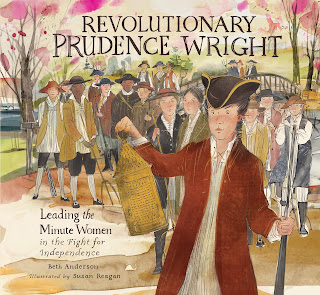
Beth Anderson is back with us this time with another new picture book biography--Revolutionary Prudence Wright: Leading the Minute Women in the Fight for Independence, published by Calkins Creek, February 1, 2022. Beth shares her expertise, this time, in the area of imagery. 

I’m a big fan of imagery – as a teacher, reader, and writer! Imagery elevates the narrative, invites lyricism, strengthens theme, and enhances heart. It’s a much used tool in my writer’s toolbox.


What exactly is imagery? Literarydevices.net defines it this way:


Imagery is a literary device that refers to the use of figurative language to evoke a sensory experience or create a picture with words for a reader. By utilizing effective descriptive language and figures of speech, writers appeal to a reader’s senses of sight, taste, smell, touch, and sound, as well as internal emotion and feelings. Therefore, imagery is not limited to visual representations or mental images, but also includes physical sensations and internal emotions.


Wow! Makes you just want to pour it on! But…imagery should be subtle and not waste words. It should flow naturally and not feel contrived. It should be sprinkled, like spices or herbs, to enrich what’s already there. 


In AN INCONVENIENT ALPHABET, I placed “battle” words throughout to reinforce the idea that a revolution is more than a military battle. “Breaking free of old ways” involves many areas of our lives.


The imagery in TAD LINCOLN’S RESTLESS WRIGGLE was also in word choice. I powered the story with his wriggle as an irrepressible force of energy. This doesn’t rob him of his dignity or impose a negative judgement for the reader. 


In SMELLY KELLY AND HIS SUPER SENSES, I interwove super-hero imagery with details, words, and phrases. Sensory images abound for this character with super senses.


In LIZZIE DEMANDS A SEAT!, imagery went deeper than word choice. Footsteps echo through the story—a ticking clock, heartbeats, a stranger’s approach, and, in the culmination of the heart thread, others stepping up to carry forward social justice.


I think everything I write uses alliteration, onomatopoeia, and sensory language. But when a story lends itself to using a metaphor, that’s something special! And REVOLUTIONARY PRUDENCE WRIGHT invited the opportunity…  


When I dive into a story, I try to think about the different angles I might tell it from, or look for something in the setting that might ring through the story. Then I consider those ideas along with themes and the heart thread, and I start generating word lists that I can draw from as I write. This preps my brain and frames my thinking.  


As I researched Prudence Wright, I collected words and phrases in my spiral, beginning with those related to revolution and independence.  One of the first items I wrote was the Thomas Paine quote that starts the story: “These are the times that try men’s souls.” I saw it as a truth, but also as leaving out women. Thus, the addition of “and women’s” seemed to fit Prudence and her story perfectly. That’s where her voice first emerged.
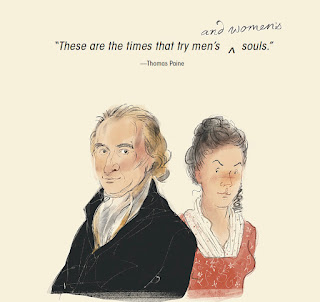

I created a word bank of military and revolution words. I wanted to show that the women’s actions were as powerful as the men’s.


Since the main event occurs in April, one of my first ideas for the “big picture” imagery of a metaphor was that of spring, gardens, and planting the seeds of independence. But, though it fit the home front idea, I knew immediately that it didn’t fit the concepts and had the wrong tone.


One of my Pepperell contacts had shared photos of a few artifacts from Prudence’s life, including her love box and lantern that could easily be used in the story. Prudence designed and created beautiful quilts, but there were no pictures available. Learning about and seeing personal items from my subject’s hands connected me in a special way. Could I use them in the story?


I listed words associated with a lantern and fire, and I also jotted down words about quilts. Could either serve as a metaphor? The idea of quilts really fit the story, not only because Prudence made them, but because they are from the hands, often involve a community of women, are made from remnants of lives, and handed down as family history.


Metaphors fall into place as I write. Lizzie’s footsteps came through during the revision process when I realized I had the pieces and just needed to connect them better. Prudence’s story was about women bound together as community and breaking old patterns. And as I worked to transition scenes, I realized that their boycott actions were like scraps for a quilt, of little consequence until joined with others. Organizing the pattern of resistance was like the larger design of a quilt. Suddenly the quilt idea popped and became powerful! And paired with the scene of the women quilting, it emphasizes that this rebellion is coming from homes. Yahoo! Don’t you just love it when it all comes together!
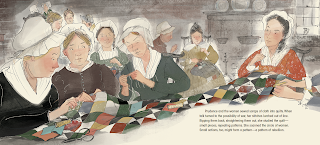

Illustrator Susan Reagan brought back the quilt image in the art at the end, reflecting the simile on the page, “The women weren’t organized and trained like the men, but they were bound together, like blocks of a quilt.” Use of imagery also opens up potential with illustration, and the merging of art and text tightens and strengthens the story.
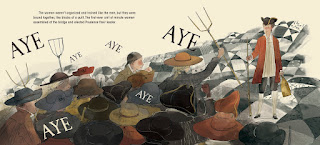

 The image of a quilt fit every aspect of the story. The metaphor brought abstract concepts “home,” comprehensible in a concrete and beautiful way.


Though we think of imagery as evoking images, as the definition above says, imagery is more than visual or sensory. It touches us internally, emotionally. No wonder it’s so powerful! 
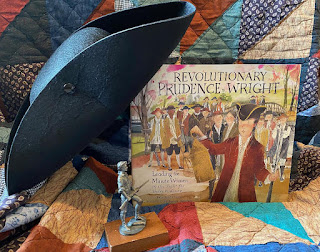
Thank you, Beth! I love this new story and the image of the quilt since my mom quilts. I love how you find unique angles on all your picture book subjects.

You can find more about Beth here! And more blog posts from Beth here and here.
Bio: Beth Anderson, a former English as a Second Language teacher, has always marveled at the power of books. With linguistics and reading degrees, a fascination with language, and a penchant for untold tales, she strives for accidental learning in the midst of a great story. Beth lives in Loveland, Colorado where she laughs, ponders, and questions; and hopes to inspire kids to do the same. She’s the award-winning author of TAD LINCOLN’S RESTLESS WRIGGLE, “SMELLY” KELLY AND HIS SUPER SENSES, LIZZIE DEMANDS A SEAT!, and AN INCONVENIENT ALPHABET. Beth has two more picture books on the way in 2022: FRANZ’S PHANTASMAGORICAL MACHINE, illustrated by Caroline Hamel, and CLOAKED IN COURAGE: THE STORY OF DEBORAH SAMPSON, PATRIOT SOLDIER, illustrated by Anne Lambelet.


Wednesday, October 21, 2020

Guest Post by Beth Anderson: Being There: In Search of Setting + a Give-away!

Beth Anderson is no stranger to the Grog Blog. She offers wonderful picture book biography wisdom. Her new book, "Smelly" Kelly and His Super Senses: How James Kelly's Nose Saved the New York City Subway debuts October 13th from Calkins Creek, & it is fabulous! Today Beth shares about setting in picture book biographies. 

Setting is one of the basic elements of story, and when a story is set in a different time or place than our own, it calls for research. Searching out clothing, technology, buildings, transportation, and more, we aim to avoid anachronisms and make our characters’ world come to life. But setting is more than a “costume” or façade to make a story look right. Setting creates conflict, brings meaning, and is a vital part of point of view. So how can you “be there” as a character when you can’t travel to a place or time?

When I researched Elizabeth Jennings for Lizzie Demands a Seat, I pored over maps to get the lay of the land and locate her home, streetcar route, church, and courthouse. Putting myself in 1854 New York City, I imagined her footsteps clicking…wait…was there pavement? Basic questions like this lead us to seek out and examine images. Details on daily life, clothing, and weather help enhance scenes. 

But as I got to the heart of Lizzie’s story, I needed information on social aspects of life like class, gender, race, traditions, “unspoken rules,” and attitudes. How did she fit in her time and place? How did setting clash with her character? We can understand segregation on transportation being unjust, but how did it impact black lives? And Lizzie as a teacher—an educated, African American female who likely loved children—isn’t unusual today. But when we embed that fact in setting, we see her as exceptional. And when we look deeper, Lizzie as educator indicates she’s part of the abolitionist movement to secure equal rights and end slavery. Looking at her world through her eyes intensifies the emotions and adds meaning. Learning about the social fabric came from reading widely beyond her immediate surroundings, and about what happened before and after her actions. 


“Smelly” Kelly and His Super Senses called for setting research with a different focus. James Kelly’s story was more dependent on understanding the physical setting. I studied photographs of New York City from the 1930s to 1950s. I pored over subway maps to find locations of various incidents. And to “be there” as a character with super senses, I had to perceive his world as he did—through his senses. What would he have smelled with his super sniffer? What sounds would’ve bombarded his ears? I found some amazing historical maps— stench, sound, and industry maps! The sound map linked to newsreel clips! Though I didn’t use much of what I discovered, I could immerse myself in his sensory world. 


I’ve always wondered what was beneath those sidewalk grates and manhole covers. I needed to know about subway tunnels and access to infrastructure beneath the street. You Tube is a treasure trove! From teens exploring abandoned tunnels to workers building the subway, I learned about the underground world. [And let me add a special shout out to You Tube. I’ve used how-to videos, re-enactments (musket shots!), tours, historical footage, videos of animals, street sounds, drives through the countryside, and so much more.]

 Kelly’s radio crackled…” Wait a minute—would he have had a radio? How did he get messages to go check out clogs or leaks? An expert answered my question. No radios. He would have used phones marked by blue lights in the tunnels. Note for illustrator. 


Skyscrapers went up…their foundations went down. The city grew. How did that impact Kelly? Broken lines and mains, more miles of track to inspect [museum records]. Drips and leaks threatened cave-ins and explosions. Kelly could be electrocuted by the third rail. Inherent dangers inspire fear, tension, action.

 Why did he investigate a leak in a hotel and a stink in a tavern? Ahhh, everyone blamed that new-fangled, mysterious underground subway. Articles revealed attitudes.

 Media and trends influence how people see their world and sometimes offer interesting possibilities for imagery and writing. Smelly Kelly’s time, the heyday of detective stories and the emergence of superheroes, inspired me to play with both, and I ended up with a superhero thread that tied into the special heart that framed my telling. 


Different stories and characters require you to dig into different aspects of setting. In An Inconvenient Alphabet, I needed to delve into education, reading, writing, and language of the Revolutionary War period. Primary sources revealed traditions, attitudes, implications, and plenty of odd spellings which provided conflict and helped me take readers into the mix.  


It’s important to get the details of setting right and present your character’s world accurately. Even if you’re writing fiction, setting details make your world real and enhance the telling. There are plenty of online tools to gain access to a character’s world: maps of all kinds, Google Earth, You Tube, photographs, images, personal narratives, first-hand accounts, town records, digitized archive materials, varied media of the time, and EXPERTS! But to get past merely “dressing” your story in setting, consider the impact of all you’ve learned about the time and place on your character and the deeper meanings that emerge. Setting isn’t a backdrop and props, it’s sort of a living entity that affects character decisions, actions, and emotions. Some of the most important parts of setting involve aspects you can’t see.

 Dig deep and wide. Wrap yourself in the social fabric. Visualize physical details. Take in the sensory world like Smelly Kelly. But don’t just “stand” in that time and place. Immerse your heart in it. Be there. So your reader can be there, too. 

Thank you, Beth! To win a copy of "Smelly" Kelly & His Super Senses, please leave a comment for Beth by October 31. (U.S. addresses only)

Beth Anderson, a former English as a Second Language teacher, has always marveled at the power of books. Armed with linguistics and reading degrees, a fascination with language, and penchant for untold tales, she strives for accidental learning in the midst of a great story. Beth lives in Loveland, Colorado where she laughs, wonders, thinks, and questions; and hopes to inspire kids to do the same. Author of AN INCONVENIENT ALPHABET (S&S 2018), LIZZIE DEMANDS A SEAT! (Calkins Creek, 2020), and “SMELLY” KELLY AND HIS SUPER SENSES (Calkins Creek, Oct. 2020), Beth has more historical gems on the way.

Book Trailer for Smelly Kelly: https://www.youtube.com/watch?v=EfUyhYJbJBk


Signed copies of my books available at Old Firehouse Books https://www.oldfirehousebooks.com  
and Boulder Book Store https://www.boulderbookstore.net


Wednesday, May 4, 2016

SCBWI Rocky Mountain's Nonfiction Picture Book Summit

by Leslie Colin Tribble


On the last day of April while writers were gathering at various venues across the country for spring SCBWI events, I was sitting in an historic meeting hall at Chatauqua Park in Boulder, Colorado attending the first ever Nonfiction Summit, hosted by the Rocky Mountain Chapter of SCBWI.


This workshop was a one day event, but the amount of information packed into those nine hours was amazing. I took 10 pages of frenetic notes, until sometime around 3:00 I realized I couldn't write any more so closed my notebook and just absorbed the goodness.

The faculty was stellar - Carolyn Yoder of Calkins Creek Books; David Meissner, winner of the 2014 Golden Kite Award for his nonfiction book, Call of the Klondike; Terri Farley author of multitudes of Phantom Stallion books and recently published Wild At Heart: Mustangs and the Young People Fighting to Save Them; and Laura Perdew who has written a number of books for the educational market plus a nonfiction activity book, Kids on the Move! Colorado. I learned something from each of them and the workshop was small enough there was a chance to chat with nearly all of the faculty at some point during the day.

Here are some summit highlights:


Carolyn Yoder spoke about the climate being good right now for nonfiction, and how wonderful that is for writers. She said this isn't the "old style" nonfiction that you remember from grade school. Instead, today's nonfiction creates a vision for readers; it's fun and interesting. Carolyn emphasized the need for very high quality research with many sources, back matter and documentation of your research process. She said writers better have two sources for each fact and that your bibliography needs to support your cover letter and show your passion for your topic.


As an editor, Ms Yoder said she reads the cover letter then goes straight to the bibliography - if no bibliography is included, then she doesn't continue reading the submission. For a 600-800 word magazine article your bibliography needs at least 3 or 4 books (adult and children's books), articles, websites, photos, etc. Calkins Creek is an imprint of Boyd's Mill Press and Highlights so part of Carolyn's job is reading magazine submissions dealing with American and World history. Also, since she is the entire staff at Calkins Creek, it could take 6 months for her to respond to your book submission.


David Meissner spoke of his research process for Call of the Klondike. He asked the group, "Can you write a great nonfiction book if you aren't an expert?" Ultimately the answer was yes, but you have to do authentic research and pretty much become an expert. For his research on the Klondike Gold Rush, David went to Alaska and hiked the same trails, walked through the same towns and talked to everyone he could find. His take home message was, "Don't Be Shy! Talk to everyone and ask them who else you should talk to." He also said it doesn't hurt to ask your publisher for help paying for onsite research.


Terri Farley talked about transitioning from fiction writer to nonfiction writer. She walked us through an exercise designed to help us fine tune some topics we might be interested in pursuing. I appreciated this effort because it did help show that yes, I do know a little bit about some really interesting topics and it showed me how to delve deeper into them. All the presenters spoke about needing a sense of "You Are There" in your story - developing the scenes with inciteful details including colors, smell, and sounds that transport your reader to the time and place.


Laura Perdew has been on a mission to write books for the education market and she did a great job of showing us through that process. There was a subtle collective gasp from the group when she talked about having 8 weeks to write a 14,000 word book. I was impressed by her ability to write so much as well as take care of her family (10 year old twin boys!). This is one organized lady - she has a submission chart and sends status inquiries to publishers she hasn't heard back from. Laura also stressed that you absolutely can't do too much research for these books otherwise you'll never make your deadlines. Another tip - send a real, honest-to-goodness thank you card to your editor when the project is finished.

All in all it was a great day and I'm fired up to dust off some manuscripts and get back to writing. Carolyn Yoder reminded us that "Someone needs your writing. It's a great time to be into nonfiction."