Wednesday, June 28, 2023

What is Leveling, and Should I Worry About It?


As part of the children's books community, you've probably heard the terms "leveling" and "leveled books," and wondered -- what the heck is that? Fiction and nonfiction are familiar, but leveling, not so much.

"Leveling" means writing (or rewriting) a text to meet a child's ability to read, or reading level. The reading level of a text depends on a variety of factors, including but not limited to vocabulary and sentence length and complexity.

 Vocabulary

There are a number of resources that are used to determine the reading level of a text – or, conversely, to make sure that a text can be read by students. One of these resources is the word list. These lists group words by grade level. Checking the list will let you determine if a word is likely to be understood by your readers.


The list most often used, in my experience, is the EDL Reading Core Vocabulary. Compiled by Stanford E. Taylor, this list was originally published in 1979 and updated (with a new copyright) in 1989. It includes hundreds of words – but because of its age, some classifications may be questionable; for example, it classes “computer” as a grade 8 word. And don’t even look for iPhone. In general, though, it’s handy.


Another alternative is the Children’s Writer’s Word Book by Alijandra Mogilner. This excellent resource is available in several editions.


Would you use the word "disdainful" in a story for kindergarteners? Generally speaking, no. Some words involve concepts that are too complex for the potential reader.


In other cases, though, the concept is accessible. Take "happy" as an example. The concept of happiness is something that we understand from a very early age (even if we don't have the words for it). Think about  . . . 

  • happy -- grade 1
  • merry -- grade 2
  • elated -- grade 8
  • ecstactic -- grade 9
  • delighted -- grade 3
  • thrilled -- grade 4

 To me, these words illustrate different points on the spectrum of happiness, as well as reading ability.


Sentence Length and Complexity

Short sentences are simple. They are easy to read. They have a subject-verb-object structure. 

Longer sentences, especially those that contain additional phrases and clauses, demand more of a reader. They carry more information and, as a result, require more mental effort to read and comprehend. 

Even more challenging, though, are compound-complex sentences, such as:

        Although my father first said we did not need a cat, he did go with us to the animal shelter, and chose a little gray fluffball that he named Bruce. 

You may find that your natural writing style leans toward longer, more complex sentences -- that it's your natural "voice" to produce sentences like the one about the father and the cat. And that's fine if you're writing YA, and you can even use them in MG. But remember, we're here to write to share our thoughts and ideas; if we make them too hard to access, we'll lose that chance -- and the reader, too.


Okay, So How Do I know?

 Some people seem to be born with an understanding of readability. For the rest of us, there are tools!

If you have MS Word, you have a built-in leveling tool at your fingertips. The Editor tool in Word will give you a measurement on the Flesch-Kincaid Scale, which provides results on a grade/month scale. F-K uses the average number of words per sentence and the average number of syllables per word to generate a result. Here's a screenshot of its analysis of the fluffball sentence:


You'll see that the grade level is 10.6: that means grade 10, month 6. 

So, what if you had the job of making this sentence more accessible? To lower reading level, look at the factors we discussed above. Then, make the changes. 

Here's what might happen:

Down to first grade! I chopped up the long sentence into short ones. I replaced furball with kitten. Notice that I used the word "yet" to start the second sentence, rather than "nevertheless." These words do similar jobs, but "yet" doesn't involve such heavy lifting on the reader's part.

ATOS and Lexile are other readability measures you may be asked to use.
ATOS (Automated Technical Order System) levels are used by the Accelerated Reading program (Renaissance Learning). Lexile is produced by MetaMetrics. Both of these are generally used for longer texts. 

How do they differ? 

 Lexile

vsentence length
vword frequency
 
ATOS
vaverage sentence length,
vaverage word length,
v vocabulary grade level,
vthe number of words in the book
 

Out of curiosity, I picked some children’s books and compared their ATOS and Lexile scores, and here's what I found:

  • Little Bear, by Else Holmelund Minarik, ATOS level 2.3, Lexile 370
  • The Wind in the Willows, by Kenneth Grahame: ATOS book level 8.2, Lexile 1140 
  • Sara, Plain and Tall, by Patricia MacLachlan: ATOS book level 3.4, Lexile 660L.


(Despite their very different leveling results, the last two are classified as middle-grade by their respective websites.) 

Should I Worry About It?

No. Do not lose sleep over this. Writing a first draft is hard enough!

However, you should be aware of it.

You should keep the level in the back of your mind as you write, just to make sure you haven't swerved off the rails. You can use the tools mentioned to check your work. If you're writing for a client (such as work-for-hire assignment), this will be more important that if you're writing to submit to a traditional publisher. 

Links: https://hub.lexile.com

https://www.renaissance.com/products/accelerated-reader/atos-and-text-complexity/


And one more thing . . . 

Enjoy the summer! The Grog Blog team is taking some time off, but we'll be back in mid-August. If there are topics that you want us to discuss, please leave them in the comments section!

In the meantime, enjoy!


Wednesday, June 21, 2023

Summer Camp The "Write Way" by Kathy Halsey


Welcome to nErdcamp!
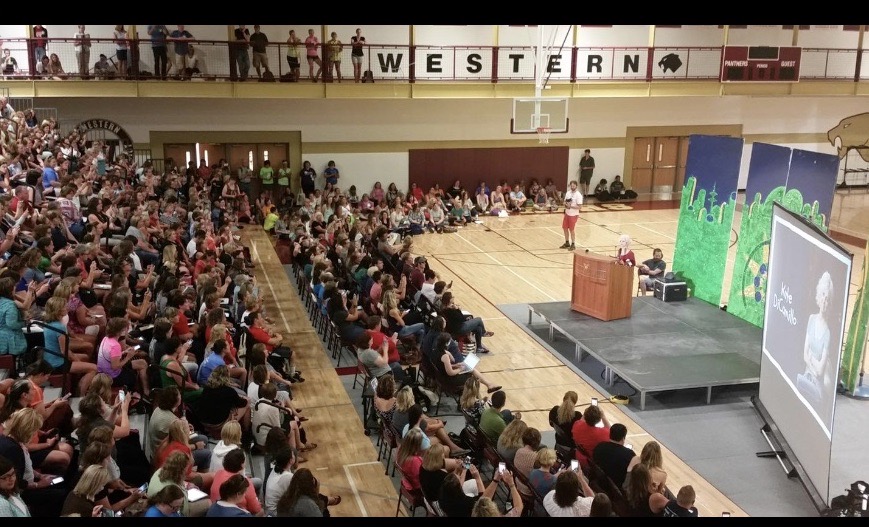
As you look at your summer schedule, you might want to add camping to your bucket list for fun. Not just any camp . . .nErdcamp! Nerd camps have been around for quite a few years now, and they're a great way to connect with librarians, educators, other authors and illustrators in a more relaxed manner. After all you might run into a bear like we did last year at the inaugural nErdDCamp Ohio!
nErDcampOH features friendly bears!

From the officlal NerdCamp site, these “free professional development and literacy events” are held virtually or in-person. They’re “organized independently and they are hosted all over the country.” For authors they are a great way to soft launch a new presentation one might be tweaking, or a way to mingle and connect with dedicated educators and even pick up few school visits.


Perhaps one of the longest running nErdcamps is in Parma, Michigan. My partner in all things kid lit, Lindsay Bonilla and I have attended both the last camp in Michigan and Ohio’s first camp last summer. More established events attract hundreds of literati (We met Jason Reynolds, CeCe Bell, Josh Funk, Miranda and Baptiste Paul) while newer camps may suit first-timers better. Sadly, nErDcampMI disbanded but the crowds and energy were palpable! ( Shoutout to Colby Sharp and Donalyn Miller, the founders of  the MI event! Thank you for all the years!) All staff are volunteers and camps are usually located in larger school districts in the summer.

The Last nErDcamp MI
Besides the bear, Lindsay remembers “a special synergy that happens when so many people who love children AND books come together! Like a conference, there are many different sessions happening concurrently. But, at nErD camp, if you start in one session and discover it’s not a good fit for you or if there are two sessions happening simultaneously that you really wanted to attend, you are encouraged to leave, and no one is offended. There are usually SO many great sessions happening that this is very freeing!
Kathy and Lindsay & Photobomber Bear

Attendees Recall the Benefits of Nerd Camps
Patricia Newman remembers attending a Vermont nErdcamp where the participants voted on the topics in the morning. She says, “The sessions were informal - no slides, no panels - and all attendees contributed. I'd call each session more of a discussion than a presentation. For most of the sessions, we sat in a circle. I liked the whole vibe of a mutual sharing of ideas.”


Sherry Hyberger Howard shared her experiences, recalling,”a guaranteed audience of people interested in books and authors. Unlike, say, a bookstore event where you may get only a few people not even super interested. The enthusiasm is palpable with Nerd Camp—you’re with soulmates who love you.”

Ohio author Keila Dawson has presented at virtual nErDCamps in different states, but she plans to attend Ohio’s in-person this summer.  For virtual camps, Keila says, “ I've never received feedback from viewers, so there's no way to tell if educators found panels informative. However, organizers always send their appreciation! I do recall one of the camps shared a survey of topics educators were interested in before the event and that was very helpful for me as an author when assembling a panel.”

Nancy Churnin’s attended Pennsylvania's camp a couple of times and will be doing two panels for nErDCampPA July 14 (both online). She enjoyed nErDCampLI ( Long Island) in person, remembering “lots of fun, lots of camaraderie, a chance to bond and connect with educators and fellow kidlit creators in a relaxed and informal way!”

Have you attended a Nerd Camp yet? Or will you this year? Name the camp and share your experience in the comments below!


Wednesday, June 14, 2023

How to Land a 2-Book Deal by Tina Cho

I recently landed a 2-book deal, so I wanted to share my process in the hopes that maybe one of you will also land a deal with a publisher. Below is the cover of my forthcoming picture book from Waterbrook, Penguin Random House's Christian imprint.


   1.Get to know who the editors are.

Since I belong to the writing organization, SCBWI (Society of Children’s Writers & Book Illustrators), I read their bulletins and newsletters that feature editors. I also follow editors on Twitter. One editor I paid close attention to was Bunmi Ishola of Penguin Random House’s Christian imprint, Waterbrook Multnomah. She was looking to build up their children’s books. I read an interview of her in the SCBWI Insight which gave her wish list around March 2021.


   2.Tailor a manuscript or query that fits the editor’s wish list.

Bunmi said she wanted a baby series for theology, along the lines of the Nerdy Baby series. Back in 2002 when my daughter was born, Baby Einstein was huge. We listened to Baby Mozart over and over with the hopes it would help her brain. Since then, Ruth Spiro developed her Baby Loves Science series and many others created similar series. I always wanted to write a board book, so I ran with this idea. Author Nancy I. Sanders taught me years ago, how to come up with a query of ideas, so I give her full credit.


   3.If you have an agent, check with her/him, to see if they agree with your idea, rather than wasting time on all the research and writing. Since I’d love to see a faith-based science baby series, I came up with Baby Astronomy. I ran the idea past my agent, Adria Goetz. She loved the idea and had even met Bunmi in person! Adria suggested to write this one manuscript first with descriptions for two others for a series.


   4.Write the story tailored to the editor’s wishes in your own unique style.
May 12, 2021 my agent sent the story to Bunmi. June 17th, Bunmi wrote back that she loved it! Wanted a proposal. She also would like to make this a picture book series instead of board books because of the rising cost of paper.


   5.Revise the story according to the editor’s guidance.
I revised the story to be a picture book, rather than a board book, which meant I had to add more pages, which meant more research.


   6.Graciously receive contract.
October 27, seven months after seeing Bunmi’s interview in the SCBWI Insight, I signed the contract for two books.


Bonus!

It’s been great working with Bunmi and the team at Waterbrook. They ask for my insight. I helped choose the illustrator, cover, jacket copy, and more. The wonderful Marta Álvarez Miguéns, who is well-known for her illustrations in Shark Lady, has done a superb job with the illustrations. I just finished the copyedits for book #2, God’s Little Oceanographer which swims to stores in 2025. But first, God’s Little Astronomer blasts into bookstores February 20, 2024.

So there you have it! Go stalk, I mean, follow editors! Find out what they publish, like, and want. May you be blessed with contracts!

Description of God's Little Astronomer:

Blast off to space and discover how every part of the universe--the planets, the stars, asteroids, meteoroids, and more--display God's glory, creativity, and, most important, his love for you and me!

In 
God's Little Astronomer, author and educator Tina Cho invites young readers to blast off to see God’s creation in the heavens. From the sun, moon, stars, constellations, and comets, this out-of-this-world introduction to space will teach budding astronomers new words, facts, and concepts, while also encouraging them to see God throughout the universe, and reinforcing the message that the same God loves them too.

Each page includes fact-filled sidebars plus an accompanying Bible verse, making 
God's Little Astronomer the perfect combination of faith and science for budding scientists.

Available for preorder!


Bio: Tina Cho is the author of Rice from Heaven: The Secret Mission to Feed North Koreans (Little Bee Books 2018), Korean Celebrations (Tuttle 2019), My Breakfast with Jesus: Worshipping God around the World (Harvest House 2020), The Ocean Calls: A Haenyeo Mermaid Story (Kokila/Penguin Random House 2020), and God’s Little Astronomer (Waterbrook 2024) & God’s Little Oceanographer 2025. Her lyrical middle grade graphic novel, The Other Side of Tomorrow, debuts from Harper Alley in 2024. After living in South Korea for ten years, Tina, her husband, and two kids reside in Iowa where Tina also teaches kindergarten. 

www.tinamcho.com

@TinaMCho

Wednesday, June 7, 2023

Writing with Pride!

 by Sue Heavenrich

June is Pride Month and I thought: wouldn’t it be fun to kick off the month with a post about books that celebrate the diversity of families and who we are. Then I got to thinking ... why do we write the stories we do?

So I asked my friend and critique partner, Rowen MacCarald about their writing life. Rowen is a biologist who writes about science (and history and a lot of other topics) and we connected years ago while writing about nature for local newspapers. Since then, Rowen has authored more than forty nonfiction books for the educational market, including Getting Smelly to Survive (Abdo, 2022),  Eleanor Roosevelt: Progressive Reformer (Momentum, 2018) and soon-to-be-released The Weirdest Animals in the World (BrightPoint Press, August 2023).


Me: Forty nonfiction books! What made you decide to go from writing articles to writing books for kids?

Rowen: Honestly, my main reason for turning to writing for children (young adults specifically) was to write a story in which a kid like myself got to be the hero. I'm still working on that goal.

For me, nonfiction is about exploring the magic of the real world and finding the unexpected in real life. My favorite nonfiction is about animals, because I've loved animals as a kid and have amassed a fair amount of knowledge about wildlife and ecology over the years. So anytime I have an animal topic to write about, it's like visiting with an old friend. The Animal World series that I did recently was particularly fun. For The Weirdest Animals in the World, I got to delve into bizarre creatures like hagfish, a fish with no bones, no eyes, and the ability to make buckets of slime when threatened, and the platypus, an egg-laying mammal with a leathery bill and the ability to sense electricity. 

Me: In the past couple years, you’ve started writing  picture books that celebrate queer joy, pride, diversity, and inclusion. It’s been fun watching these stories come alive, but I wonder if you can talk about what nudged this change in your writing life.

Rowen: I remember listening to the Aru Shah book series (the Pandava Quintet by Roshani Chokshi) with my daughter, and there was a part where one of the characters was divorcing. Aru started thinking about all the different kinds of family structures the people she knew were part of. I loved that my kid got to hear that. Since she grew up with two moms, it was always important for me to feel like that was normal, and seeing it in books was a great way to do that.

I started writing picture books because they're short, honestly. Not because they're easier than longer books, because they're in some ways harder to write. No, the great thing about their length is that you can easily rewrite them multiple times, trying out different approaches and seeing what works and what doesn't work.

Once I started writing picture books, though, I ended up doing what I always do, which is try to take my unique perspective and share it on the page. So I wrote what I know about--queer parents, neurodivergent kids--and made sure to give my characters agency. That's really what wanting to be the hero is all about. It's not about slaying the dragon (who maybe would rather go on an adventure with you) or getting the girl (unless the girl is also getting you, because love interests deserve agency too). It's about having the power to influence your own fate. It's about having a voice to tell your own story.

I think the important point to remember about people with marginalized experiences is that we've had other people telling our stories for a long time. That's disempowering – even when they get things right. It's worse when they get things wrong, and it can feel dehumanizing. So I love that not only are many people with marginalized experiences getting the chance to share their own perspectives, people outside those identity who include marginalized characters are more motivated nowadays to try to get things right. 

Is this process perfect? No. Is there a lot of work still left to do? Yes, and what seems like progress can be a mistake that needs to be corrected. But I have to believe it's work worth doing. 

I want to show queer kids and kids with queer people in their family that they can take charge of their own story. And for kids who aren't queer, if they see queer kids having agency in a book, maybe that will help them support the queer kids around them. I think maybe the best thing a writer can do is remind us that we're all human, and our differences don't change the fact that we all need love, respect, and the chance to be the main character of our own story.
 
Me: I’m going to copy that last line and tape it to the wall above my desk! Thank you so much, Rowen, for sharing your story.

No matter what kind of family you live in, there’s a good chance that you’ve had to face issues with a new sibling, wanting a pet, going to school, fighting dragons… okay, maybe not the last, but the thing is, books that celebrate LGBTQ pride are about everyday things. 

Here’s a baker's dozen picture books suitable for Pride Month or any time of the year:

And Tango Makes Three, by Justin Richardson and Peter Parnell; illus. by Henry Cole 
Heather Has Two Mommies, by Leslea Newman; illus. by Laura Cornell 
Julián Is a Mermaid, by Jessica Love 
They're So Flamboyant, by Michael Genhart; illus. by Tony Neal 
Bathe the Cat, by Alice B. McGinty; illus. by David Roberts 
Not Yet a Yeti, by Lou Treleaven; illus. by Tony Neal 
When Aidan Became a Brother, by Kyle Lukoff; illus. by Kaylani Juanita 
Patience, Patches! by Christy Mihaly; illus. by Sheryl Murray 
Mama and Mommy and Me in the Middle, by Nina LaCour; illus. by Kaylani Juanita 
Prince & Knight, by Daniel Haack; illus. by Stevie Lewis 
Neither, by Airlie Anderson 
My Mommies Built a Treehouse, by Gareth Peter; illus. by Izzy Evans 
Worm Loves Worm, by J.J. Austrian; illus. by Mike Curato

Want more? Check out this list of LGBTQ+ Picture Books for Kids by Children's Services Librarians of the Seattle Public Library, and these links to the New York Public Library: New Books for Kids & Teens to Celebrate Pride Month and Great Board Books & Picture Books to Celebrate Pride Month. If that’s not enough, Allison McDonald has her own Ultimate Pride Book list of 90 books .

Wednesday, May 31, 2023

Tap the Synergy: Writers Helping Writers ~ by Julie Phend


There’s a common perception that writers tend to hole up with their computers and rarely interact with others, or that they're so afraid of copyright theft, they jealously guard their secrets. Nothing could be further from the truth. Despite the solitary hours that go into developing and penning our ideas, writers are generous people who freely offer their time and talents to help one another.


Let’s look at some ways to tap into the creative synergy of this vibrant community.


Critique Groups:

When I interviewed writers on how they help one another, critique groups topped the list. In such groups, writers offer advice to one another by pointing out unclear passages, overused words, point of view and grammar errors. They hold each other accountable by expecting work to be submitted on a regular basis. They share tips about agents, publishers, comp titles, and more. Critique partners offer moral support and provide encouragement when the going gets rough, and cheer for each other when good news is shared. Writers often develop lasting friendships over years of meeting with a critique group. 


First Readers:

Writers frequently act as first readers for other writers. Drawing on their own experience and expertise, they can point out places that still need revision and suggest ways to market the work. There’s no better first reader than another writer.  


Joint Marketing Efforts:


Groups of writers can extend their success by engaging in joint marketing efforts. I belong to a group of local writers, Lake Authors of the Wilderness. Because we all write in different genres, we don’t critique, but our monthly meetings still offer support, encouragement, writing and publishing tips. Our joint marketing efforts include purchasing space at book festivals and craft fairs. We take turns manning the booth and making sales. The diversity of our offerings helps to bring in customers.  It's a win-win for everyone!


Conferences:

At conferences, writers network and present, sharing their expertise. Conferences are great opportunities to pick up helpful tips, meet and mingle with new and old friends. They can be large or small--often organized by professional organizations such as Mystery Writers of America (MWA) and Society of Children's Book Writers and Illustrators (SCBWI). These conferences can be good sources for finding critique partners, and help to fill a writer’s creative cup.


Podcasts and Webinars:

There are a plethora of podcasts and webinars through which writers reach out to other writers. These presentations, targeted toward specific needs and interests, serve as ongoing training for writers and help introduce listeners to important developments in the publishing industry.


Write-ins/Virtual Writing Spaces:

Many writers find it helpful to write with others. This can be in an actual location, such as a coffee shop, or a virtual writing space. These groups offer structured time to write, with breakout sessions to discuss, ask for feedback, and offer insight. Writer Carol Nissenson works with a Virtual Writing Space hosted through Instagram. 


Other groups that offer online meetings include:

Blogs:

Many writers volunteer their time and talents to write blog posts on topics of interest to other writers.

There are many, many more! Beth Schmelzer, who sent me a marvelous list, says, “So many blogs, so little time. Each blog has a different style, perspective, and appeal to readers and writers.”  Find one that speaks to you.


Spread the word:

One of the most important ways writers help each other is by spreading the word about each other’s books. We can all join this effort. When someone you know publishes a new book, attend their launch party and review the book on Amazon and Goodreads. Buy the book, give it as a gift, and ask your library to stock it on their shelves.


Linda Acorn Budzinski sent an inspiring story of how a writer friend helped spread the word about her book, Em and Em. The writer and her daughter co-reviewed the book for Your Teen Magazine. The daughter’s friends all read the book, and one of the friends' mother, who is a TV producer, brought the book to her company’s attention. As a result, the book was optioned for television.


Suzi Weinert in my Lake Authors group had a similar experience. A writer friend recommended Suzi’s book, Garage Sale Stalker, to Hallmark, where she worked. As a result, Suzi’s book and characters became the basis for Hallmark’s popular Garage Sale Mystery series.


Writer Natalie Rompella reminds us of the Golden Rule. “Whatever you’d like others to do for your book, do it for theirs.”


Tap the Synergy:


Linda Acorn Budzinski sums it up: “Writers help me all the time through moral support, friendship, feedback, and just plain understanding the life of a writer when no one else seems to!”


Tapping into the expertise and energy of the writing community is well worth the effort. You’ll learn much, form lasting friendships, and find support for every step on your writing journey.


A Shout-Out:

Finally, a big thank you to the generous writers who shared their stories and tips for this article: Linda Acorn Budzinski, Dana Wilson Easley, Barbara Ellen, Pam Evans, Kathryn Gaglione Hughes, Jennifer Loizeaux, Sharon Lyon, Carmela Martino, Eileen Meyer, Carol Nissenson, Natalie Rompella, Joyana Peters, Beth Schmelzer, Debra Kempf Shumaker, Ann McCallum Staats, Amy Thernstrom, and Suzi Weinert.


Wednesday, May 24, 2023

Chapter Books: What's That All About, Anyway?


You’ve probably heard the term “chapter books,” and been mystified. Don’t most books have chapters? What is it about these titles that sets them apart from novels?


According to the Canadian Children's Literacy Foundation, children between 2 and 5 are learning that words in print represent the words we speak, and the letters stand for sounds. Between 5 and 8, children move from the novice stage to the decoding stage (using their knowledge of sound-letter relationships to figure out words), and finally, to fluency.  (Click here for more: link)


Picture books are an important part of that first step -- learning to associate words and sounds. Chapter books are for readers who are becoming independent and will still benefit from illustrations in the story.


Remember Frog and Toad? These classic books by Arnold Lobel were meant for beginning readers, coming in at a length of 2281 words. Even though the vocabulary and sentence structure was simple, the story and emotions were fully realized. That’s a key for all chapter books: the stories are engaging and compelling while being accessible. They give readers between ages 5 and 8 relatable stories -- and a sense of accomplishment, too. Success reading these books puts them on the path to reading longer works when they get older.


Chapter books come in a variety of lengths to suit their readers. Generally speaking, the longer the book, the older the reader. 


A survey of some chapter books turned up these word counts:


Jasmine Toguchi series, by Debbie Michiko Florence

         Super Sleuth, 10,047 words

         Flamingo Keeper, 9929 words


My Furry Foster Family, by Debbie Michiko Florence

         Truman the Dog, 4,049 words

         Apple and Ani, the Hamster Duo, 3875 words


The Ballpark Mysteries by David A. Kelly

         The World Series Curse, 12,975 words

         The Triple Play Twins, 10,658 words


The Chicken Squad by Doreen Cronin

         The First Misadventure, 3689 words

         Bear Country, 5522 words


Franny K. Stein by Jim Benton

         The Invisible Fran, 4,177 words

         Attack of the 50-ft. Cupid, 4,209 words


(This is by no means an exhaustive list! A visit to your children's librarian or bookseller will give you a chance to see the range of chapter book series currently in print. )


Chapter books usually are published in a series, for a couple of reasons:

📕  Because they are usually 48 to 128 pages, these published books have narrow spines, which can make them hard to find on the shelves. Multiple titles in a series make the books more visible to readers and buyers.

📕  Kids love them! When a kid enjoys a book, they want more – and as soon as possible!


That brings up a practical point about submitting chapter books: You need to have at least a couple of finished manuscripts and a set of ideas ready when you submit. You’ll send the two manuscripts and the summaries of at least four ideas. This allows the editor to consider how the characters carry through, from one book to the next, and what additional adventures they may have.


Now, the bad news. Chapter books are a hard sell. However, if you have characters that you love, who are having adventures that your readers will relate to, go for it. Tell their stories.

Be warned, though: If a publisher does decide to pick up your chapter-book series, you’ll need to write fast and well to keep up with your fans’ demands for more books! And what a terrible problem to have, eh? 


To learn more, I suggest the Highlights Foundation's excellent courses about writing early readers and chapter books.