Showing posts with label Craft of Writing. Show all posts

Wednesday, June 21, 2023

Summer Camp The "Write Way" by Kathy Halsey


Welcome to nErdcamp!
As you look at your summer schedule, you might want to add camping to your bucket list for fun. Not just any camp . . .nErdcamp! Nerd camps have been around for quite a few years now, and they're a great way to connect with librarians, educators, other authors and illustrators in a more relaxed manner. After all you might run into a bear like we did last year at the inaugural nErdDCamp Ohio!
nErDcampOH features friendly bears!

From the officlal NerdCamp site, these “free professional development and literacy events” are held virtually or in-person. They’re “organized independently and they are hosted all over the country.” For authors they are a great way to soft launch a new presentation one might be tweaking, or a way to mingle and connect with dedicated educators and even pick up few school visits.


Perhaps one of the longest running nErdcamps is in Parma, Michigan. My partner in all things kid lit, Lindsay Bonilla and I have attended both the last camp in Michigan and Ohio’s first camp last summer. More established events attract hundreds of literati (We met Jason Reynolds, CeCe Bell, Josh Funk, Miranda and Baptiste Paul) while newer camps may suit first-timers better. Sadly, nErDcampMI disbanded but the crowds and energy were palpable! ( Shoutout to Colby Sharp and Donalyn Miller, the founders of  the MI event! Thank you for all the years!) All staff are volunteers and camps are usually located in larger school districts in the summer.

The Last nErDcamp MI
Besides the bear, Lindsay remembers “a special synergy that happens when so many people who love children AND books come together! Like a conference, there are many different sessions happening concurrently. But, at nErD camp, if you start in one session and discover it’s not a good fit for you or if there are two sessions happening simultaneously that you really wanted to attend, you are encouraged to leave, and no one is offended. There are usually SO many great sessions happening that this is very freeing!
Kathy and Lindsay & Photobomber Bear

Attendees Recall the Benefits of Nerd Camps
Patricia Newman remembers attending a Vermont nErdcamp where the participants voted on the topics in the morning. She says, The sessions were informal - no slides, no panels - and all attendees contributed. I'd call each session more of a discussion than a presentation. For most of the sessions, we sat in a circle. I liked the whole vibe of a mutual sharing of ideas.”


Sherry Hyberger Howard shared her experiences, recalling,a guaranteed audience of people interested in books and authors. Unlike, say, a bookstore event where you may get only a few people not even super interested. The enthusiasm is palpable with Nerd Camp—you’re with soulmates who love you.”

Ohio author Keila Dawson has presented at virtual nErDCamps in different states, but she plans to attend Ohio’s in-person this summer.  For virtual camps, Keila says,I've never received feedback from viewers, so there's no way to tell if educators found panels informative. However, organizers always send their appreciation! I do recall one of the camps shared a survey of topics educators were interested in before the event and that was very helpful for me as an author when assembling a panel.”

Nancy Churnin’s attended Pennsylvania's camp a couple of times and will be doing two panels for nErDCampPA July 14 (both online). She enjoyed nErDCampLI ( Long Island) in person, remembering “lots of fun, lots of camaraderie, a chance to bond and connect with educators and fellow kidlit creators in a relaxed and informal way!”

Have you attended a Nerd Camp yet? Or will you this year? Name the camp and share your experience in the comments below!


Wednesday, March 8, 2023

BIG TRUCK PLAYDATE Written by Laurie Carmody

By Suzy Leopold

Welcome to the GROG Blog, Laurie. I’m pleased to chat with you about your debut book. 

Big Truck Playdate

Written by Laurie Carmody

Illustrated by Jennica Lounsbury

Beaming Books, March 7, 2023

Happy Book Birthday!

Let’s begin . . . Your heartwarming book, Big Truck Playdate, shares a story from the perspective of Corey who is diagnosed on the autism spectrum. 

Big Truck Playdate

Rudine Sims Bishop, a professor, is referred to as the “Mother of Multicultural Literature.” She coined the words, “Mirrors, Windows, and Sliding-glass Doors.” It is important for children to see themselves reflected in books and for all to understand differences and similarities to equal compassion and empathy for one another. 


Was it necessary to research facts and information about a disorder diagnosed on the autism spectrum? What surprised you the most as you wrote the story?


When I began writing, Corey was very clear in my mind - a truck-loving, passionate child that struggles to connect with his peers. Like so many children, Corey is neurodiverse. My sister-in-law has autism and my mom used to work as a teacher’s aide with neurodiverse students in an upstate New York school district, so I am familiar with some of the many ways autism can be present in the world. Always striving to represent Corey with authenticity and respect, however, I did research and worked closely with my editor at Beaming Books. And I’ll always be learning, especially regarding how to choose appropriate language that is inclusive and celebratory. 


Often writers are told to “Write what you know. And to add to this thought, the often-asked question, “What was your inspiration for this story idea?” Please tell us more about the inspiration for Big Truck Playdate and how your story came together.


So many different memories and experiences inspired Big Truck Playdate. First, the truck: New neighbors moved in next door and parked a huge semi-truck in the driveway. This inspired me to write a story about a truck as a neighbor. After working with critique partners, the manuscript morphed into a story about a truck coming to school instead.


Second, the main character: Corey is partially inspired by a friend that my brother and I used to play with who was passionate about garage door openers. We had the best time when we combined our interests and just played! Corey is also inspired by my sister-in-law, Ashley, who has autism. She loves teddy bears like Corey loves trucks. Her love is so strong and pure, and it’s something that I admire about her.


Tell us about yourself and your writing journey. When did you become interested in writing children’s literature?

In 7th grade, I wrote and illustrated a picture book called ANDY THE ARMADILLO but it wasn’t until I became a mom and started checking out bags of books each week from our local library that I decided to try writing picture books for publication. I am absolutely in love with the picture book form. It is beautiful to see how text and art come together to shape a story. And the fact that it’s for children and adults to share is the icing on the cake.  


Do you write a first manuscript draft with pen or pencil and paper or do you type on a keyboard?

I almost always type on my laptop. Sometimes I’ll cut up sticky notes and arrange them into “spreads” in my notebook. Then I’ll write little thoughts and ideas and see how they fit. But most of my work is digital and I’m a huge fan of using google docs to track critique feedback.


Was your manuscript for Big Truck Playdate a submission

opportunity from a writing conference or webinar or was it

sent through a slush pile (aka sifting through gems)?


I had an Above the Slushpile Pass through the “Children’s Book Insider” magazine.


Complete this sentence. Laurie is an author and kid lit creator

who . . .


. . . is grateful every day for the support of friends, family, and kidlit community members.


Did you have any input on the bright, colorful illustrations by illustrator Jennica Lounsbury?


When I first saw Jennica’s online portfolio I think my entire family came running because I was shrieking so loudly! I was blown away by her ability to show love and connection through her sweet characters. I instantly knew she was the one to bring Corey, his truck, and his class to the page.

Share some recommended picture book titles. Are there recently published books on your To Read stack?

My debut group, the PB Sunrays, released so many great books released in the last year, and there are many more upcoming releases that I’m excited about!


Share a piece of advice or craft of writing tip that is helpful when writing for young readers.


Here are my top 5 tips!


1. READ other picture books. Write out the text. Walk around in them for a while; ask yourself why you love a certain part.


2. LISTEN to creators. Like, all creators. Read diverse books.


3. JOIN a community. SCBWI, Mighty Kid Lit, Critique groups, Facebook groups,

12 X 12, etc. Find your people and lift each other up. Ask all the questions so you'll be able to answer them someday.


4. PLAY with your manuscripts. Don't be afraid to revise! Someone told me to try Big Truck Playdate from the POV of a talking monster truck. I wrote it! And it made me realize I needed to stick with my original path.


5. PERSEVERE. When you want to give up, do one more thing. Then do the next thing. String them along and you'll get there. I promise.


Share your thoughts on the best way to market a picture book. What are some activities and events you are doing (or plan to do) to launch and promote your book?


The best thing I did was join a debut group. I’m part of the PB Sunrays--Picture Book Launch Group and they have helped me learn so much about marketing my own work as well as how to support other published authors. Some of the promotional activities I’m looking forward to include speaking at my children’s preschool, elementary school, and middle school, doing Storytime Sprint and working with my local bookstore Curious Iguana, and to do an event at one of my favorite libraries.


Any words of encouragement you’d like to share with book creators?

Don’t be afraid to get messy. Those times when your manuscript is a jumble? That’s OK. Keep going! Think of it like putting sand in your sandbox. Each revision gets you closer and closer to your sand castle. But it’s impossible to get there without getting sand in your suit! 


Are you prepared for some fun rapid-fire questions?

  • Tell us something about yourself that we may not know.
I can eat any level of spicy food without a problem!
  • What is your writing super power?
I come up with some strange connections that I try to put into a story format.

  • Share a favorite bedtime story from when you were a kid.

The Big Orange Splot by Daniel Manus Pinkwater

  •  Do you have a favorite snack and beverage?

Pita chips with hummous and a diet Coke.

  •  What item(s) displayed on your desk gives you inspiration?

Lately I’ve been working from my couch. I sit right next to my Grandma’s fern (his name is Dennis Fronds). She died a few years ago and this is a cutting from a fern that was around when my dad was young. It reminds me that our stories grow and connect generations together. 

Thank you, Laurie, for sharing your debut book, Big Truck Playdate, with the followers of the GROG Blog. 

Where can the readers of the GROG Blog find out more about you?

Instagram

Twitter

Read Across America Day
"It was one of the best experiences
to see how the kids would react to
Big Truck Playdate."

Wednesday, December 21, 2022

Welcome to A Mysterious World: Lydia Lukidis' Deep, Deep Down: The Secret Underwater Poetry of the Mariana Trench by Kathy Halsey


Deep, Deep Down Book Review


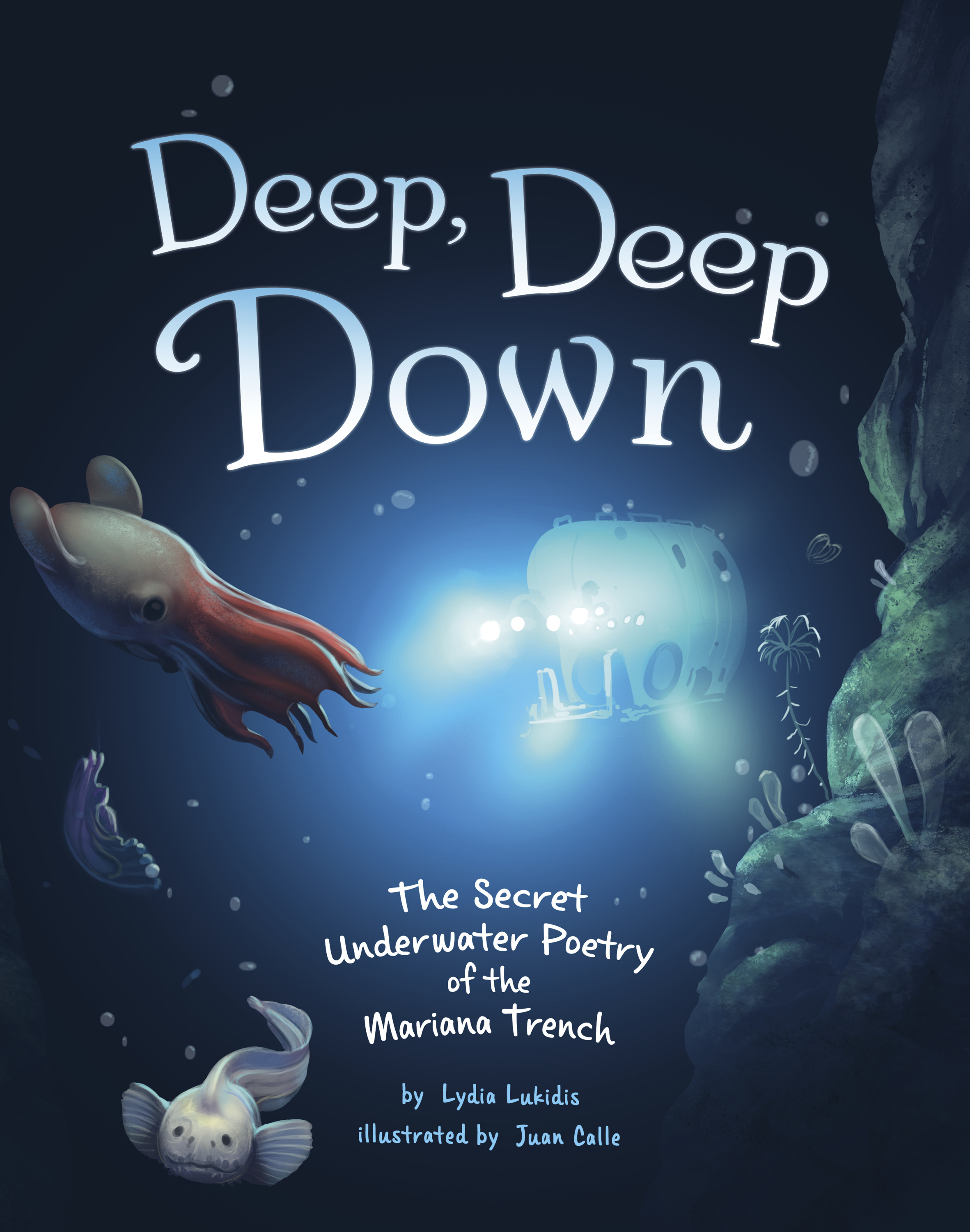
Lydia Lukidis has created a mesmerizing nonfiction picture book that is also poetry– a hard feat for a writer to execute. The Secret Underwater Poetry of the Mariana Trench is so lyrical, I felt the dance of the underwater creatures on a journey to the ocean depths. Repetition, onomatopoeia, and diction that directs the movements of the submersible gives a realistic experience of the trench that is still being explored by scientists today.


Realistic and atmospheric illustrations by Juan Calle, a former biologist now science illustrator, draws readers into a dark but illuminating space as these creatures are introduced in all their amazing quirkiness. Back matter includes a glossary, thoughts on why studying this mysterious world is important, and interesting facts. Curious kids, teachers and librarians will enjoy a deep dive into this fascinating wonder hidden at the bottom of the Western Pacific Ocean. 


Craft Chat with Lydia

Kathy: Deep, Deep Down: The Secret Underwater Poetry of the Mariana Trench is written as poetry and nonfiction. Yet, since it’s an imagined voyage that “debunks scary myths,” according to the CIP in the introduction and it’s cataloged as nonfiction in the Dewey Decimal system as 577.7. Was any version straight nonfiction? (So many writers are concerned about how their books will be categorized.)


Lydia: Great question! This is always a concern, specifically with nonfiction. I assumed DEEP, DEEP DOWN would be placed in the nonfiction section of stores and libraries since it’s based on facts and doesn’t insert an invented character as informational fiction does. I think it falls in the expository nonfiction category as its purpose is to explain, describe, or inform readers on a certain concept or idea. Debunking incorrect myths while shining a light on the truth seems to connect to this category. But it’s also true the book asks readers to imagine themselves inside the submersible, journeying to the depths of the Mariana Trench. That angle wasn’t in the initial drafts, but as edits progressed, we thought it would be fun to speak to the reader directly, although I never actually use the pronoun “you,” which was deliberate.
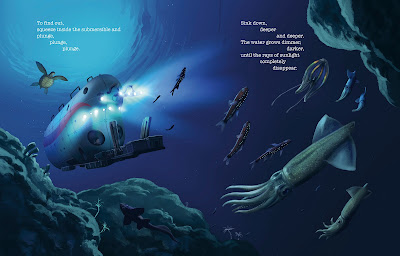
The reader is invited to imagine going on this voyage, too.


Kathy: The creatures of the Mariana Trench are so unusual! What is your favorite creature? Why?


Lydia: I fell in love with all of them! And I confess I had never heard of amphipods before. While all the creatures are fascinating in their own right, I fell madly in love with sea cucumbers and learned so much more about them. I literally spent hours watching real footage of them drifting and floating through the deep sea like underwater ballet and was instantly mesmerized. Their graceful and rhythmic movements made them appear poetic to me and that’s when I understood that the trench itself is a poem.


Kathy: As a nonfiction writer myself, I’m interested in the sidebars for each spread. Why two sidebars? Were they always in the text proper or in the back matter at some point? When you queried this book, how did you distinguish the sidebar sections? (This again can stymie writers.)


Lydia: I’m going to be honest: I spent SO MUCH time obsessing over sidebars!! In my initial drafts, I included some as they contained useful and interesting information. At that point, I had written dozens of nonfiction books for the educational market but had yet to make the leap to trade nonfiction. In an attempt to make this book less “educational” and more “commercial,” I decided to remove all sidebars and place the information in the backmatter (though I kept the depth indications on each page as I felt they were important).


I was resolute about this decision but my editor saw it differently. Capstone publishes so much trade nonfiction that appeals to the library and school market, so sidebars are a norm for them. Every author needs to make certain concessions and I ultimately agreed to keep the sidebars. What I learned is that trade nonfiction CAN feature sidebars, but the structure, language, and voice are what make it more commercial.

Language and voice capture the reader at the beginning.


Kathy: I noticed in your acknowledgements that you thanked six experts. At what point in the writing and research of Deep, Deep Down did you consult experts? How did you find them? What process do you suggest for writer new to contacting experts?


Lydia: This book could not have been written without all six experts. Each one brought their expertise to the table, although Dr. Gerringer was the main consultant. She’s a truly remarkable scientist and person!


Part of the issue was that a lot of the information on the internet was false and even the scientifically accurate details from reliable sources were always changing since our understanding of the trench itself is evolving. I wrote ten versions of the manuscript when I finally got in touch with experts who study and have visited the trench, and then realized most of my facts were wrong. It was a wakeup call for me. I had to completely rewrite the manuscript and edited it over fifty-five times but it was worth it.


I reached out to Schmidt Ocean Institute in 2019 (they study the deep sea, including ocean trenches) and it snowballed from there. I highly encourage all nonfiction writers to seek out experts as they write their books. It could be as easy as doing an internet search and finding scientists or professors in the field as well as those who wrote articles on topics you’re researching. These experts are usually more than willing to share their knowledge, and to date, each one I reached out to agreed to help.


Kathy: What draws you to writing nonfiction? What writing techniques do you use to engage readers in nonfiction?


Lydia: I’m eternally curious about our world and equally mesmerized by it. I find every fact interesting (like, I’m obsessed with tardigrades, still trying to fit them into a book!) I also love reading nonfiction, so it naturally follows that I write it as well.


Writing engaging expository literature is tricky, at least for me. Narrative nonfiction tells a story and it’s easier to infuse the text with conflict, tension, and emotion. But expository literature is based on facts and concepts, and it’s harder to infuse the text with emotion. For me, the key is to connect to my own passion and excitement, and let that shape my words and tone.


Kathy:What are you working on now?


Lydia: I just announced my second nonfiction STEM trade book, DANCING THROUGH SPACE: Dr. Mae Jemison Soars to New Heights, illustrated by Sawyer Cloud and published by Albert Whitman. I’m excited!


And right now, I’m working on something totally different and unexpected. It’s a fictional graphic novel based on my life and it’s forcing me to dig internally at some difficult periods in my teen years. It’s been challenging and who knows if it will ever get published. But as we all know, writers write because we feel compelled to, not because we have any guarantee the manuscript will ever be published. We move forward out of love for our craft!


BIO

Lydia Lukidis is the author of 50+ trade and educational books for children, as well as 31 e-Books. Her titles include DEEP, DEEP, DOWN: The Secret Underwater Poetry of the Mariana Trench (Capstone, 2023) and THE BROKEN BEES’ NEST (Kane Press, 2019) which was nominated for a Cybils Award. A science enthusiast from a young age, she now incorporates her studies in science and her everlasting curiosity into her books.


Lydia is an active member of SCBWI, CANSCAIP, 12 x 12, and The Authors Guild. She's very involved in the kidlit community and also volunteers as a judge on Rate your Story. Another passion of hers is fostering love for children’s literacy through the writing workshops she regularly offers in elementary schools. Lydia is represented by literary agent Miranda Paul from the Erin Murphy Literary Agency.


Social Media Links

Website & preorder links here.

Twitter: @LydiaLukidis

Facebook: https://www.facebook.com/LydiaLukidis

Blog: https://lydialukidis.wordpress.com/

Watch the trailer now.


Wednesday, December 14, 2022

A Slippery Slope of Sledding Stories

 by Sue Heavenrich

One year during StoryStorm (aka: slap-story-ideas-down-on-the-page-as-fast-as-you-can month) I came up with what I thought was the perfect sledding story. It involved a red sled, a big hill, and a bunch of assorted animals. I scribbled and sketched and was pretty impressed with my Wonderful Cool Sledding Story …

…until I did what I should have done back at the beginning: check to see what other sledding stories were out there. Turns out there are a lot. Tons, in fact. When I typed “sled” into the World Cat search bar (World Catalog, for the proper folk), I got thousands of sled books. So I added some filters: print books, in English, written for kids. That narrowed it to 1,985 titles – still too many to look at. I wondered what had been published over the past five years – yes! there is an option for that (in case you are ever looking for comp titles!) – and got the list down to 392 titles. Granted, some of those were about sled dogs, and a whole bunch had nothing to do with sledding down a hill. But one thing was clear:

there’s more than one way to tell a sledding story!

Part of me was thinking: wow! is there anything unsaid? Another part was thinking: yay! editors are open to different approaches to a winter story about sliding down a slope. 


Lots of books feature friends heading to a slope for some fun. Or in some cases, friendly competition. In Peep and Ducky, the friendly sled outing turns into a race which results in a crash and two very unhappy - not to mention cold and wet - friends. Mr. Putter & Tabby is a series of easy readers, each with a handful of short chapters. Mr. Putter and Tabby share a comfortable life and are usually not adventurous. But all that snow looks so fun, so they borrow a sled and head to the top of the local hill. After a cold, eventful slide, they realize that one run is plenty, and retire to a cozy chair and some warm treats.

Some books feature adventures with animals. Even then, there are many ways to approach the story. Red Sled poses the question: What happens when you leave your sled outside at night? In this case a bear borrows it to slide down a hill. Then other animals want to join… Go, sled! Go! follows a similar story, but includes  a snowman and a baker (with cakes!). In both of those, the number of riders increases from one page to the next. Ten on a Sled goes the other direction. Caribou is off for a run with his friends, but the sled is too crowded. So he says “move over”… and just like the song, one slides off and there are nine on the sled.


Maybe you have a story about wanting a sled. That's the core of A Sled for Gabo. Gabo watches other kids sliding down the hill. He wants to join them but doesn’t have warm boots (bread bags over his socks will work). More importantly, he doesn't have a sled… until a neighbor comes up with an idea. Penny and Her Sled takes a different approach. Penny has a sled. What she doesn't have is snow. But she finds a way to play on her sled anyway.


Some stories are set in time and place. When you open the covers of The Iciest, Diciest, Scariest Sled Ride Ever! it's clear you're in New England. New Hampshire, to be exact. And like any kids who've grown up hearing tales about sledding down Mountain Road, these kids decide it's their turn.  Sleds on Boston Common presents a slice of life from the American Revolution. When Henry wakes up on his ninth birthday, the snow is perfect for sledding. But British soldiers have put their tents and cook fires right in the middle of the sled runs. What's a kid to do? True or not, it's based on the local lore of Boston.

So this winter, if you're tempted to write a story about sledding, take a few minutes to think about what sort of story you want to tell. Check out the books in your library and then, after researching World Catalog, do a little bit of hands-on research: grab a sled and head to the nearest snowy slope. After all, you might have an adventure to share.