Showing posts with label Jane Yolen. Show all posts

Wednesday, August 21, 2019

Teresa Robeson, The Queen of Physics, and a Swag Giveaway! by Kathy Halsey


Teresa Robeson has long been drawn to science, writing, and creative pursuits. So kismet, her talent and hard work paid off in her debut picture book, The Queen of Physics: How Wu Chien Shiung Helped Unlock the Secrets of the Atom, illustrated by Rebecca Huang. The book drops October 8, 2019, but you can pre-order here https://www.teresarobeson.com/my-books.html, Meanwhile you can find out more about Teresa and possibly win a cool "Women in STEM" bag if you leave comment on the blog. (My rescue boy Wiley Corgi will pick the winner.) 

Book Review
The Queen of Physics has already received a starred review from Booklist and praise from Teresa's We Need Diverse Books mentor, Jane Yolen. "A wonderfully written biography of an important woman scientist hardly known outside her field." Jane goes on to say, "Not just for little girls, but for children of all ages. About achievement, honesty, hard work that follows a passion. Do not miss this one."

As a layperson who doesn't know my neutron from my proton, this book lays out physics concepts in an enjoyable and even lyrical way. For example, she explains beta decay (a seminal part of Wu's life work) like this: ". . . where a neutron inside an atom broke into an opposite nucleon . . . It was like opening one present and getting three different gifts inside." With four pages of back matter, we learn more about Wu Chien Shiung's story as well as science terms used in the biography. Robeson includes tidbits of humor in these definitions, too. ("Positron - the antiparticle of an electron—sort of like the electron's opposite evil twin, except it's not evil.")
Madam Wu protesting
This 48-page picture book biography, designated for grades K-2, can easily be used as an introduction to physics to older students, too. Teachers and librarians will appreciate the historical context of Wu Chien Shiung's life over the decades from protests against warlords, then against Chiang Kai Shek, to Madam Wu's struggles in the 20th century gaining acceptance as an Asian woman in the male-dominated world of science. Readers will root for Chien Shiung, the courageous hero, who proved herself in every arena in China, the United States, and the world. 

Q & A with Teresa Robeson
Teresa Robeson
K: Queen of Physics and your 2020- release, Bicycles in Beijing, both feature diverse characters or settings. How do your own life experiences work to influence your books and what you write?

T: Being an Asian American who is an immigrant gives me an outsider’s view of this society--I feel like I can see both the forest AND the trees. But, primarily, my culture is the lens through which my experiences are filtered. It permeates pretty much everything I write. My very first published piece was a short story in Ladybug Magazine about my kindergarten graduation in Hong Kong. Since then, nearly everything I write has had a Chinese touch or influence…even the adult works (I have received very good reviews on Amazon for a short story I wrote called Unfillable Void with a Chinese woman as the central character. It was published in an anthology called “Out Of Time” by my sci-fi group, the Minnows Literary Group).

Since I mentioned the Minnows’ anthology, I want to add that every penny earned from the anthology goes to Doctors Without Borders!


K: Tell us a bit about your WNDB mentorship with Jane Yolen. What did you learn that best helped you on your writing journey?
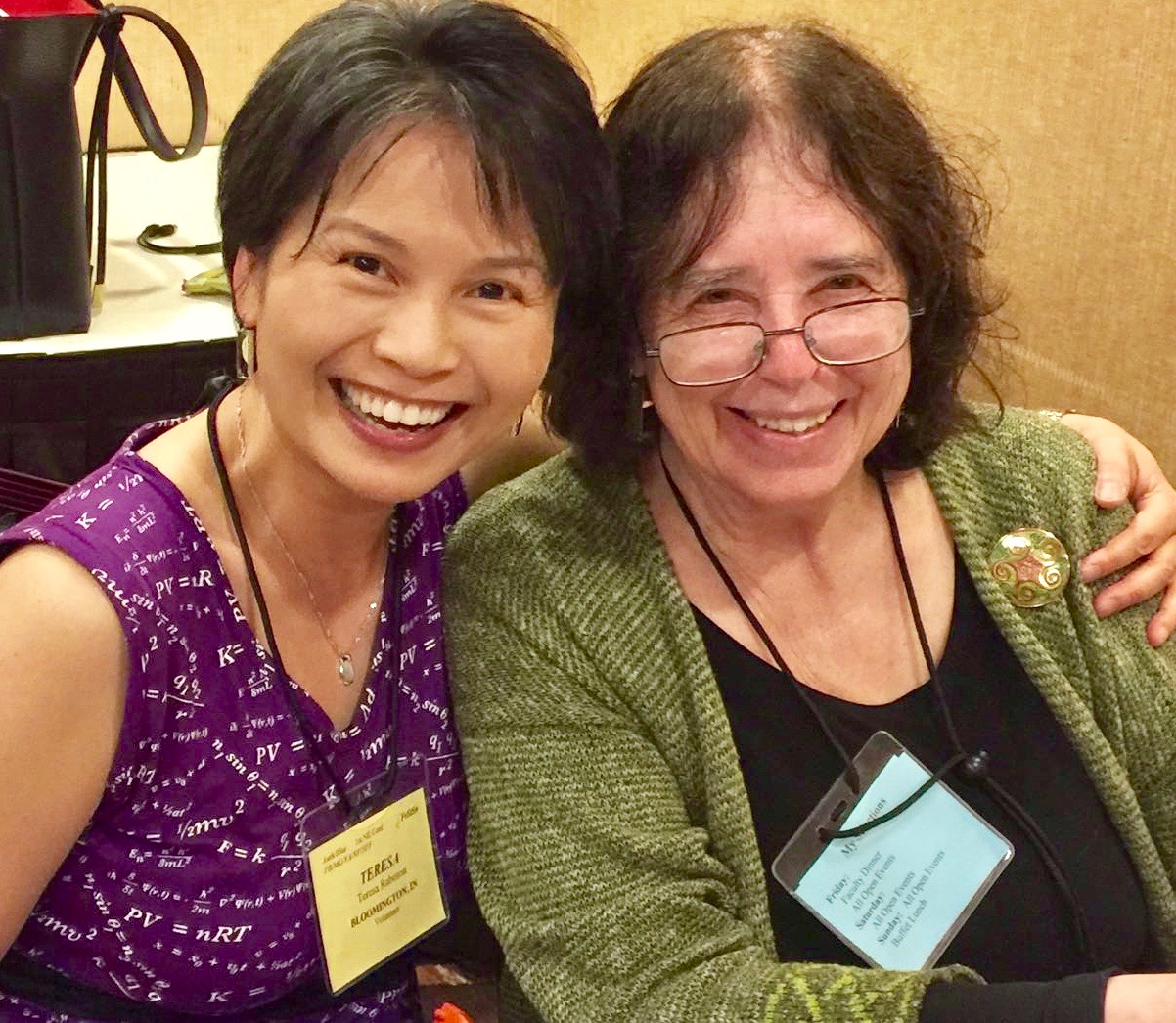
Teresa and her amazing mentor, Jane Yolen!!!
T: The Penguin Posse, my wonderful picture book critique group, convinced me to apply to the We Need Diverse Books mentorship. I didn’t think I would get it so imagine my surprise (and joy) when Miranda Paul called and told me that Jane Yolen picked my manuscript to work with!

Jane, as you know, is the consummate professional. She taught me through example how to put BIC (butt in chair) and focus. She also taught me how to paginate pages to get a sense of the rhythm and pacing for the story, as well as how to take a piece of prose and make it more lyrical. Those are strategies that I am still using.  

K: I know you have many interests and talents – illustration, soap-making, and gardening to name a few. How do these pursuits inform your writing?

This is only part of Teresa and her husband's garden!
T: They don’t inform my writing so much as distract me from my writing…LOL! I do sometimes work gardening and my love of nature into stories. Illustrating has also inspired me; I’ve drafted several stories based on drawings I’ve done (though, sadly, none of those stories have sold yet). 

K: Your critique group, The Penguin Posse, was recently featured in a Mid-Atlantic  SCBWI publication. What tips do you have for writers on critique groups? How did you find your group?

T: I’m actually in more than one critique group. The Penguin Posse was founded when some of us in 2013’s 12x12 Picture Book Challenge decided to form a group. My in-real-life SCBWI critique group, the Scribblers, was formed in 2011 and encompasses writing from PBs up to NAs. The third one is the Minnows Literary Group, also formed in 2011. That’s my critique group for science fiction and fantasy for older kids to adults. 

For anyone thinking about forming or joining a critique group, I highly recommend the book, The Writing & Critique Group Survival Guide: How to Give and Receive Feedback, Self-Edit, and Make Revisions by Becky Levine. It has pretty much everything one needs to know to be a part of a successful group. 

I learned critiquing rules from taking classes through Gotham Writer’s Workshop. I want to give a shout-out to Michaela Rossner who taught the SF I and SF II classes I took, which were truly amazing.

The key to having a long-lived critique group is having committed members who are also flexible as the group grows and changes directions. It may sound heartless, but it helps to have firm rules about kicking out members who continually shirk their duties. The group cannot grow intellectually if the members don’t take it seriously.

I'd also like to give a shoutout to these debut groups who have helped me in my journey to publication: The Notable 19, Picture Book Buzz, and the 19 PB Bios (not a debut group but a group for biography PBs.)

K: You write across genres – fiction, nonfiction, from PB to YA.What skills transfer from one type of writing to another?

T: Jane Yolen’s evergreen advice of BIC (butt in chair) is a skill that everyone should learn and that can be used no matter what you write. Another skill I am still trying to master is making my words sing: writing lyrically yet with lightness. That is something that can elevate any piece of writing for any age and genre.

K: What’s up next for you? Book launch, author visits, what else?

T: Oh, my goodness, I have a lot of things going on! Yes, a book launch, some author visits, plus doing a small blog tour, and setting up a pre-order contest. (K: YOU can order now!)


Enter to win at the address above.
I have to make time for actual writing, too, since I am in the midst of revising a couple of picture book manuscripts. I’m writing a nonfiction MG proposal and a contemporary MG. On top of that, I just started my term as the Illustrator Coordinator for the Indiana chapter of SCBWI. My predecessor, Sharon Vargo, did an incredible job and I want to live up to her legacy. 

K: Hey, readers, here's a shot of the cute tote bag that Teresa and Wiley Corgi will give away to one lucky person who comments on this post. The winner can choose a bag with a white handle or a blue handle.
Comment below to win one of these two bags. 


Teresa Robeson's Biography and Newest Book Deal
Teresa Robeson, a transplanted West-Coast Canadian lives with  her professor/scientist husband, quirky kids, and even quirkier chickens on a moderate-sized hobby farm in the Midwest, U.S.
Born in Hong Kong in 1964, she was lucky enough to view the first lunar landing and be raised on a healthy dose of Star Trek. This series of fortunate events turned Teresa into a total nerd/geek-girl who loves to write and read science fiction, science, and modern fantasy. She also have a life-long love of children’s lit, having never really grown up. The Queen of Physics: How Wu Chien Shiung Helped Unlock the Secrets of the Atom is her debut picture book.  

Teresa's newest picture book, Bicycles in Beijing, illustrated by June Wu, is set to release spring 2020. Connect with Teresa here on her web site, Twitter, and Facebook.
Wiley Corgi and I are ready to ready to read comments and pick a swag winner. 


Wednesday, January 9, 2019

Bustin' Out with 2019 - Make It Your Year - by Kathy Halsey

Nothing but blue skies at the rodeo today. The year is still fresh, your intentions are good; you have saddled up your pony for a successful ride up the writing road. Hold your horses, writer gals and guys. I rounded up some help for you while you mosey down the trail.  

Anti- Resolutions Revolution
Back at the ranch house, Julie Foster Hedlund gave us some provisions for the trail. You might call it "food for thought." Back in 2014, I began participating in Julie's 12 Days of Christmas for Writers. (web site here and FB group here) From December 26 -January 6, we come together to review/reflect on our writing year to refresh/renew ourselves for a new year. The Facebook group closes January 10, 2019, but circle Dec. 26, 2019  on your calendar so you can join us at the year's end. Julie believes that most resolutions come from a place of negativity so we began with surprises, successes, move to challenges and disappointments, what we learned from both and then build goals from last year's achievements. This year 503 children's writers joined the fun. 
I'll share my illuminations from the process and the ripples of change that are already coming to fruition for me and others writers.   
Surprise
“A surprise is an extra gift over and above what you set out to achieve.” -Julie Hedlund 
One of the best surprises that continues this year is that Beth Stilborn and I became accountability buddies. Every Monday we email our weekly accomplishments and our intentions for the coming week. We're not critique partners; we don't even write for the same age group! Beth lives in Canada and I'm in the Midwest, but we were surprised by this great motivator and wonderful friendship. You might try this, too.
Guiding Word/Motto for 2019
Some writers created vision boards; many of us came up with  a word/phrases to guide our writing and goals. Words like "Power," "Treasure" "Fearless" were claimed. One writer said, "I want to treasure what has been given to me, like friends in the writing community, opportunities, ideas, and time to write. I want to treasure the process and let ideas grow organically into the stories they were meant to be." Beth came up with this formula: FOCUS plus FOLLOW-THROUGH leads to FRUITION.
The cover page to my 12 Days features my guiding phrase.
   

Ripple Effect
Most of my critique group participated in this challenge and we've revised and renewed some of our procedures. During our first online 2019 meeting we came up with these ideas.
  • Post a calendar on Google docs and sign up for a critique. Commit to the date.
  • Commit to writing sprints every first Thursday of the month.
  • Create our own missions statements for the year and share online for greater accountability.
  • Change up our critique style by using Manuscript Magic. Look at big picture items first. Give themes, motifs, goals for the manuscript. 
Another writer friend and member of 12 Days, Beth Gallagher   and I decided we wanted to submit more in 2019. With accountability as a key, we created the Facebook group 100 Rejections Are a Good Thing. Join us and go big in this year's writing rodeo. 

Finally, some folks were inspired to write poetry and share with the group. Derick Wilder reminded us that small steps lead to success with this poem.

The Mighty Teeny Tiny

Teeny Tiny isn’t much— 
shy, timid, brittle.
But Teeny Tiny 
can become,
possibly,
a Little.
Now Little’s also 
no big deal,
but better
than before.
And if you add 
those Littles up,
you get 
a little More.
More is less
than you would like,
but treasure 
what you’ve got.
Just lay some Mores
end-to-end
and then you’ve got
a Lot.
So dream delightful, 
vibrant dreams— 
make them 
sheeny shiny.
But don’t forget
each begins
with but a
Teeny Tiny
Gratitude
Julie had us end our 12 days with a list of gratitude. The gratitude attitude is one we can all cultivate as we grow into 2019. I am grateful to Julie and all the writers who shared so much over these 12 days. 
"Remember to illuminate your writing life, shine a light on the dark places, but even more, the light places, those where we excel." Julie Hedlund 
As Jane Yolen reminds us in her book Sister Fox's Field Guide to the Writing Life, "The joy is in the process."


Wednesday, February 28, 2018

The First Fifty Words--Make Them Count

     You've probably heard from different sources how important the first fifty words are, especially of a picture book. In a recent webinar, THE Jane Yolen mentioned that openings are critical. She mentioned having been a Golden Kite judge, and how much she enjoyed doing that. Jane gave special notice to the stories' beginnings. A successful opening, she says, comes within the first fifty words of the book. She enjoys playing around with her own openings until she feels she's got it just right. She suggests we do the same---type up the first fifty words of a number of picture books. Then, type up the first fifty of your own manuscripts. How do yours stack up? What's lacking that you could add to spice things up? How are you hooking the reader with your opening words?
     I decided to type up the first fifty words of four different books. What did it tell me? Did I want to read on? How did it hook me? So, here are my four, starting with Owl Moon by Jane Yolen:


     "It was late one winter night,
       long past my bedtime,
       when Pa and I went owling.
       There was no wind.
       The trees stood still
       as giant statues.
       And the moon was so bright
       the sky seemed to shine.
       Somewhere behind us
       a train whistle blows,
       long and low,
       like a sad, sad song." (53 words)

     The scene draws us in...late at night, wintertime, with a child and her father on a special adventure. Children will love the out-of-the-ordinary nighttime experience, feeling secure with a loved parent. The language is lovely and lyrical, drawing you in to the story. "Stood still as giant statues" brings the poetic use of alliteration as well as "long and low," which evokes melancholy. The use of alliteration of the words "somewhere," "sad," and "song" is lyrical language at its finest. The long vowel sounds throughout slow us down as we read. We are hooked by the sights and sounds as we join these two on their fascinating journey to see what they will find on this cold winter's night.


     The second manuscript is Banjo Granny by Sarah Martin Busse:


     "When Owen's Granny heard he was a baby who went wiggly, jiggly, all-around giggly, and tip over tumble for bluegrass music, she packed her banjo in its trusty old case with the taped-up handle. She put on her thousand-mile shoes. And she started out to cross one river, one mountain, and a desert." (52)

     This story has a totally different feel to it from Owl Moon. You can tell it's going to be a fun romp. Will she make it safely to baby Owen's? What obstacles might she face as she crosses one river, one mountain, and a desert? The language is fun, and who doesn't like a Granny with moxie and determination? Her thousand-mile shoes tell you she's been around a while and is rich in experience, which helps her navigate the three obstacles. The refrain of "wiggly, jiggly, and all-around giggly and tip over tumble for bluegrass music" is used successfully to help move the story along. Not to mention it's so much fun to say!


     The third story beginning is from Take a Picture of Me, James Van Der Zee! by Andrea J. Loney:


     "Deep in the heart of Lenox, Massachusetts, in a white frame house nestled between his aunts' home and his grandparents' house, lived a boy named James VanDerZee. James was the oldest boy of three sons and two daughters. At the Van Der Zee's, the children learned about music and art, and kindness, too." (51)

    What do we learn from the first words of this biography? We learn that family is important, kindness is emphasized, and that the Van Der Zee  children were introduced to a variety of artistic pursuits. How will those facts feed into the story? Of the five "W's", we learn the WHO--James VanDerZee. We learn the WHAT-what he wants is to capture each person's uniqueness through art,(even though his art turns out to be photography). The WHEN is hinted at in that cameras were cutting edge at that time. The WHERE is Lenox, Massachusetts. Kindness is fleshed out in the story as he takes extra pains to portray each person at his or her best when he photographs them. Even when the photography business dries up, there is a bright spot for James when his many photos taken over the years are used for a Metropolitan Museum of Art Harlem exhibit. He has succeeded in his quest.

     The last manuscript is Fearless, by Barb Rosenstock:


     "In those days it was pretty tough to be a girl. You had to follow the rules. You couldn't speak your mind. You had to ask permission. There were games you couldn't play. You weren't allowed at the best schools. You were supposed to stay clean, quiet, and obedient." (49)

     This takes place in a time when a woman was not expected to act like anything other than a refined lady. From this, we get the idea that someone is not going to fit the description of "clean, quiet, and obedient." Who is it, and how does she push the boundaries? In the next sentence we learn her name---Louise.  First, she was not CLEAN when the car she borrowed hit a chicken coop, wood splinters covered the seats, and chicken feathers filled the air. She was not QUIET when she crunched into a troublesome driver, scraped a car into the wall, and va-roomed past all to the finish line. She was not OBEDIENT when she tells her husband (who has told her to never race again) she is going on a vacation, but goes instead to Daytona to race. Louise spent her life fast, faster, flying, free, and FEARLESS!

     I hope you will find this exercise helpful in your own writing. Those first fifty words---make them fabulous and make them count!


Monday, October 30, 2017

Todd Burleson Teacher, Librarian, & Technology Specialist Extraordinaire


By Janie Reinart


Give three cheers for our own Todd Burleson, a passionate educator and librarian/technology specialist. Todd was recently named as the 2016 School Library Journal's School Librarian of the Year!  He started the Grog Blog and is now adding author to his list of accomplishments.

Be excited people! There is a raffle (Rafflecopter will pick the winner) to win one copy of Todd's book,
The Green Screen Makerspace Project Book launching November 24,2017.  There is info toward the bottom of the interview about how to get the book for 20% off and free shipping!


Without further ado, here is the interview.


1. Who is your agent? 

I actually don’t have one!  I did for about a year and a half and it wasn’t the right fit, so I decided to explore other options. 

I was lucky enough to have become friends with Colleen and Aaron Graves.  They wrote the highly successful, Big Book of Makerspace Projects, also through McGraw Hill/Tab.   

When their publisher asked them to write a book about using a green screen in maker spaces, they said that they weren’t experts, but knew someone who was-me!  So, they asked me if I would want to write it.  The rest, as they say, is history!

2. How did you get the idea for your book?

As I mentioned above, the push came from my friends Colleen and Aaron Graves.  Once they set the idea into motion, I had to come up with a full book proposal for my editor.  That was a process in and of itself.  

I had to sum the book up in one concise paragraph.  Next, I had to create a table of contents. The meat of the project is the 24 step-by-step projects. I didn’t have to include all the steps, but I did have to share an overview of each of them.   

Once that was accepted, the book was a go. I received several deadlines to help the process stay on track. My editor, Michael McCabe, proofed each stage, gave feedback and guidance and encouraged and affirmed me along the way.

3. What is your favorite part of the book?  

Like choosing your favorite child, that is hard, but I would say I enjoyed writing the section about the history of visual effects in film the most.   

I am a huge history nerd and being able to immerse myself in some of the earliest historical films and study how filmmakers made ‘magic’ happen in their creations was mesmerizing.   

My favorite of these early filmmakers is Georges Méliès. He was a genius!  Some of the work he did ‘inside the camera’ still baffles viewers of his films today. 

The best example of this genius is his The Four Troublesome Heads (FrenchUn homme de têtes). In this film, he creates the illusion that he removes his own head several times and all sorts of craziness ensue. 

He had an incredible understanding of how the actual medium of film could be used and stretched to make the magic happen in his movies. 

I also enjoyed reaching out to colleagues around the world who were using green screen.  Many of their project ideas are in or inspired the projects in the book.

4. How long did it take to write?  

The book took about a year to write from start to finish.  Once the book was written, the post-production took about six months.  I had prepared myself for enormous amounts of work in post-production, but my editors made it a fun process.

5. What is your writing routine? 

I’ve discovered that I CANNOT write from home.  I am incredibly distracted and it is easier for me to go shine my shoes, iron my shirts or do dishes; anything other than the hard work of writing.   

My favorite table at our local public library and my trusty sketchbook and water bottle!

SO, I essentially claimed a table in my local library. I went there each weekend for about 3-4 hours on both Saturday and Sunday.   


While I was there, I cued up my playlist of ‘tunes.’  My tunes aren’t what you might think of as typical music.  In fact, I use something called ‘Binaural Beats’ to help me focus and drown out all other thoughts and distractions.  It might sound weird, but it truly works for me.  I’ve since learned about a smartphone app called Insight Timer

 
This free app is categorized as a meditation app, but there are thousands of tracks of all different lengths and arrangements.   

Some are purely binaural beats while others include guided meditations or simply musical selections for focus and meditation. 

I’ve since discovered that there are different frequencies related to different types of activity from sleep to study. I highly encourage other writers to give it a try.  


Another part of my ‘process’ is that each spring I take a writing retreat. I've stayed at a variety of hermitages, which offer me complete and utter isolation and peace.   

Typically I find locations that are surrounded or close to large forests or bodies of water as I find time in nature to be incredibly rejuvenating.   

After about a week I start to go stir crazy and need to ‘talk!’  One last thing I’ve done that has helped me a better writer and a lot more ‘present’ in my life was to remove the social media apps from my phone and desktop computer.

The hermitage I wrote at last spring break.

If I REALLY want or need to post something I still have my accounts, but not having them in my face all the time has eased that sense of ‘anxiety’ that the “FOMO” or Fear of Missing Out generates in me.

I also found that I much preferred writing in Google Docs than using Word.  Of course, the industry standard is Word, but while I was drafting for myself, I stuck to Google Docs because it autosaved and was available to me on every device I own.  I know there are purists out there that LOVE Word.  I am NOT one of them.

6. What is your favorite writing craft book? 

To be honest, it depends on what type of book I’m writing.  While I haven’t had any of my picture books published yet when I’m writing them, I immerse myself in the books I ‘see’ like my book to gauge where it will fit into the market.  

That being said, I spend the vast majority of my writing life pouring over authors like Barb Rosenstock, Jacqueline Briggs Martin, and Jane Yolen.  I am bewildered by the way they make every single word count and how the illustrators seem to squeeze the visual details that are implicit in the words.  

When it comes to writing non-fiction book projects like mine, I look to those who have successfully done it and I don’t have to look much further than my friends Colleen and Aaron Graves.  Their highly successful book helped me see how to effectively organize and then explain projects.  I wanted the projects to be accessible to teachers and students of all experience levels.

Huge thanks to my writing idol, Barb Rosenstock!

Barb's newest book about one of my all-time favorite artists!

7. What inspires you to write?  

The biggest inspiration for me is the desire to share and express my creativity.  With my green screen book, I wanted to demystify the process of using green screen.   
It truly is as simple as downloading an app, hanging a green Dollar Store tablecloth, yelling action and then doing minimal editing.   

Once the hurdle of the technology is bridged, the students will begin pushing the materials and technology to do exactly what they want; much like Georges Mélie´s did back in 1898!  

When it comes to some of my picture book projects, I am eager to share the lives of little-known individuals or tell stories in interesting ways.  I hope I can bring their stories to new generations so that their stories will live on for generations to come.


8. What are you working on now? 

I am currently working on re-writing a manuscript from another perspective about Orville Wright.  I’ve uncovered some new artifacts and interviews that have given me a fresh perspective to enter the ‘event’ I’m writing about.  


My hope is now that I’ve ‘delivered’ on one substantial project, I can land a book deal for some of my other work.  

I will be in The United Arab Emirates the first week of November.  I’ll be there presenting as part of the American Library Association Conference which takes place during the world’s largest children’s book festival.  Who knows?  I hope to meet some niche publishers and get my books out into the world!  Wish me luck!


9. Words of advice for writers.  


I have two things I recommend.  First, if you want to be a writer, read, reread and reread people who are doing it well.  I’ve found that literally copying their words by hand helps me connect and think in a unique way.  Sometimes I’ll do this several times to ‘see’ how they pace their story.   

After doing this, I try to imagine how I might illustrate the book in a different medium or from another perspective.  While I’m not an illustrator, even rough sketching the different page spreads helps me explore the complexity of the words and the ‘voice’ of the author.   

The second thing I recommend is that writers write, write, write and write. Seems elementary, but you won’t grow without practice. It’s also beneficial to put a draft away and let it simmer.  I have multiple projects going at the same time.  While I work on one, others are ‘cooking.’  I’ve actually found that the longer I keep them ‘away,’ the more capable I am to be re-explore it.   

I try to change the perspective of my stories in subsequent drafts to use alternative approaches to getting the story across.  When I’ve done this several times, I look at the work in totality and explore what really ‘sings’ and what strikes me as strong.  

I’ll go through and mark up the physical print out of the drafts and then file it away for another chunk of time allowing the drafts to ‘cure.’  

I work with several freelance editors who I pay to give me their gut reaction and thoughts about how I might tweak the piece. Then, I share with people whom I value and trust and let their thoughts permeate a bit.   

To me, it’s very important to keep in mind that the essence of the story should be fairly simple.  How you craft and tell it is the hard part. The next step is the loneliest: submitting to publishers. 

I think you just have to have a thick skin and believe in the project or story.  Another reason to have multiple projects in motion is so that you can distract yourself from the lonesome act of waiting for feedback. 

Every once in a great while, you get a morsel of advice. These are like garnets found in a mountain stream.  Use those to encourage you through the long, solitary process. 

Want to win a FREE Copy of Todd's new book?  You have several ways to enter to do so.  The drawing will take place on November 6th and Todd will send an autographed copy to you as soon as it is published!

a Rafflecopter giveaway

Can't wait? I don't blame you!  You can take advantage of this special offer to get 20% off the purchase price and FREE shipping.  Just use the info below!


Thank you, Todd, for a fascinating interview. Best wishes on your book launch. Pre-order here or use the info above for the special offer!


Todd Burleson
Todd Burleson is a Teacher-Maker-Librarian at the Hubbard Woods School in Winnetka, IL. The community helped develop, as part of their school library, a makerspace they call The IDEA Lab.  Todd's passion is the awakening of curiosity in learners of all ages and maintaining a balance of books and bytes.   @todd_burleson