Showing posts with label multicultural. Show all posts

Wednesday, April 30, 2025

Catch of the Day: A SEASON FOR FISHIN': A FISH FRY TRADITION with Pam Courtney by Kathy Halsey

Imagine Pam Courtney and I having a sit down on our virtual porch in Louisiana looking at the Cane River as we chat about her debut book, family, and fishin’. I've known Pam for about 15 years as a friend and  critique partner, and I’ve manifested this day since her debut book was a small fry! It is a thrill to be able to share Pam’s story with you all after all these years. Settle in for awhile and share your family tradtions with us in the comments!

Book Review: A SEASON FOR FISHIN': A FISH FRY TRADITION

I have on my librarian-teacher hat to share my thoughts on this picture book that I’ve known through many iterations as one of Pam’s critique partners.I might be a bit biased, but  A SEASON FOR FISHIN’ is a delight, from illustrator Toni D. Chambers’ engaging illustrations to the thoughtful backmatter author Pam has provided a dictionary of terms of endearment from Louisiana parishes. 

The fresh, active illustrations married to Pam’s poetic, unique Louisiana-influenced words make this the perfect book for a new season, summer and fish fry Fridays.

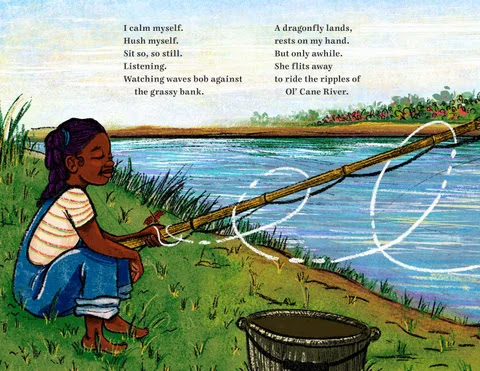
Main character Cher is excited to become part of her family tradition as she joins her Papere on the Ol’ Cane River along with uncles and a desire to bring in a mess of bream for her Mamere to fry up. 

Young readers will identify with that desire to “measure up” to a family ritual . . . are they ready, can they do it?  All readers will feel immersed in the loving family fun inspired by Pam’s Louisiana upbringing. Educators and librarians will appreciate this joyful read aloud with oodles of onomatopoeia and fresh phrases. As Cher would say, “Howwwwweee, get you a copy of this book and some crispy bream now!

Craft Chat with Pam Courtney

Kathy: Pam, I'm interested in the origin story for this wonderful debut picture book. Please share where this story came from, how it's changed, and what you've learned from “catching this big fish” of a book!

Pam: Actually, this story started as a poem in Renee LaTulippe’s Lyrical Language Lab class in 2014, or maybe 2015. Anyway, it was initially called Fish Fry Friday. Then Fish Fry Friday, A Cane River Upbringing. Then Fish Fry Friday, A Cane River Tale until it had to be changed.

It was initially being groomed for a NIV. It was Renee who nudged me and said, “Why not think about a young protagonist, cut some words, and make this a picture book?” I didn’t want to but I got feedback from other kidlit professionals that were certain this would make a better picture book. 

But as you know, it is a page out of my own childhood. I didn’t go fishing often. Actually, I can count on one hand the number of times I actually fished. I just like going, being with family and friends; eating the snacks that were packed. Like my Uncle Teddy Boy’s home-roasted peanuts. There were a few versions of Fish Fry.

Kathy: Lucky us! Pam’s sharing a few stanzas of an early version!  

Fish Fry on Fridays? 

Let Grand-mere tell it, down on the Cane River,

everybody fries fish on Fridays.

Matter of fact, just travel down any

dirt road in any rural town in

Louisiana on any Friday and

everybody who’s anybody worth

their weight in mudbug is cleaning,

frying, and eating fish. Buffalo fish.

Alligator Garfish. On special

Fridays, Redhorse. 

Fish Fry onFridays?

That’s bayou upbringing

not catholic upbringing.

Down on this river, people been

criss-crossin, speakin and livin like

ta’ otherin forever." says Grand-mere. 

Down on Cane River is the

safe place, the birthplace of my

Grand-mere, my Pa-ran, my Na-nan, 

and my Tante'. 

Yessir. Lot of mystery 

in the history down the road, 

down on Cane River.
Kathy: Oh, I love the roll and rhythm of this language. I can feel your setting and picture the characters! Thanks, Pam!


How did your hometown, Natchitoches, LA, inspire your story? I know you share poignant childhood memories in your author's note. (Readers make sure to check out the Author's Note when you get this book.) What makes Natchitoches unique?

Pam: The story takes place on Ol’ Cane River. Cane River is actually a man-made lake and it runs smack through the middle of our town. Nearly all of our outdoor events happen on that riverfront. Cane River is also a place within Natchitoches, where the most interesting and complicated history resides. I went fishing down on Cane River. Everyone did. You’d find people casting lines off of the bridge or wrangling for their prized spot on the riverfront. 

But the Friday fish fries is where the magic of my childhood lives. Folks would leave out early morning, return late afternoon with their catch. By early Friday evening everyone was out front in their yard scaling, cleaning fish, and frying fish. Our entire street was perfumed with the aroma!! Oh and the music that accompanied this scene! While I grew up with Prince and Funkadelic, the adults in control of the music had Marvin Gaye, Smokey Robinson, and, of course, gospel music rang out. Howweeee, what memories I have of that time.


Kathy: So what's the best way to cook up a mess of fish and why bream? 

Pam: Well, bream is my mom’s favorite fish. I can’t tell you the number of times our doorbell rings and someone has dropped off freshly caught bream. What’s even sweeter, they’ll also clean and filet them for my mom. But that’s just our way down here in the boot. As for the best way to fry bream. I cheat. I use Zatarain’s fish fry season to coat our fish. It’s the spice in that breading for me. I pan fry. So only quality oil will do. I test the temperature of my oil by sticking the handle of a wooden spoon into the oil. If it bubbles immediately, the temperature is just right for frying up a batch of bream.

Kathy: Yum! I’m hungry now. And to think I grew up with fish sticks as a Catholic! What's the best way for you to cook up a story? Can you share a bit of your process?

Pam: A story idea springs from anywhere. The idea for A Season For Fishin’ came from a specific childhood experience. Anything can inspire an idea. Once I have an idea for my story, it lives in my head (longer than it should) as I think about the “promise of the premise.”  

It takes me an awfully long time to get the idea on paper. I sit at my mom’s dining room table, aka my office, and stare out the glass patio doors smiling at the wildlife that entertain themselves in the backyard. I consider why I’m choosing to share this particular story or experience with readers. 

When inspiration hits me to pull out the laptop I ask myself, what will be the intimate moments that moves my story forward? For that matter, what moves my character to respond as they do? I’m all about creating intimacy in a scene. For me, it’s important to create specific emotional incidents that set up the reader’s relationship with my main character and the people who’ll share the character’s stage. 

In each scene, I consider the purpose of pacing because I want to, on purpose, use language, rhythm, and sentence length to hold a reader in a moment. I’m still in the process of accurate pacing. In a lesson I learned from an amazing teacher on pacing, if it’s done well, it informs tempo, encouraging that effective page turn. 

And yes, I do all of this in my first draft. THIS is why it takes me so very, very long to get my first draft down. I’m learning y’all.

Kathy: You talk a lot about being a good critique partner. How does that skill enhance your own writing and ability to create new stories.

Pam: I’ve had the GREAT fortune to be in the company of some amazing writers in my critique groups. The idea for new stories is always front and center each session whether we actively discuss story ideas or not. Someone will say something that sparks an idea, or someone will have an idea they think is perfect for your brand of storytelling. This is just one small part of a great critique group. 

Being able to look at a story and ask its creator what exactly is their intent for their story is something I always ask. I ask more questions rather than give advice. However, I’m the oldest sibling and we think we know everything, so being slow to offer feedback is still a work in progress. 

What I find is the more questions I ask, out of genuine curiosity for the “promise of the premise,” the more everyone is able to hear specifics about the writer’s intentions for their stories. Many times I’ll ask the writer about their story’s promise. I’ll then ask, “Show me where that lives on the pages of your story?” 

It might be that I’ve completely missed it, or the writer might visualize a scene or moment in their head and that is where it lives. These questions inform how I move through the pages of my story. Though it is much harder questioning your writing strategies than others. LOL

Kathy: Pam, that is a juicy piece of advice about how to critique. Folks, I’ve been a recipient of Pam’s skillful critiques for years! Blessed by it. 

Where can we find you online, on podcast, on blogs as you celebrate this season of your debut book? 

Pam: You can find me on the following artist’s blogs: Susanna Leonard Hill, Sara Holly-Ackerman, Black Voices, and KidLit Works.

Find Pam on the River or Here: Social Media Contacts

 Instagram https://www.instagram.com/pam_is_mylmnop/

Bluesky https://bsky.app/profile/pamismylmnop.bsky.social

Threads https://www.threads.com/@pam_is_mylmnop

Tik-Tok https://www.tiktok.com/@pam_is_mylmnop?lang=en

Now join Pam and me on our virtual porch and share YOUR family tradition in the comments! Mine has to do with my Hungarian grandmother, Otelia Wolslagel and her spicy sausage and paprika. My mouth is burning now!


Wednesday, May 3, 2023

Marzieh Abbas Loves her Dupattas

 by Sue Heavenrich


A Dupatta Is . . . 
by Marzieh Abbas; illus. by Anu Chouhan
32 pages; ages 3-6 years
Feiwel & Friends, 2023

One of the best things about reviewing kid’s books is that I often get a chance to connect with some of the authors whose books I fall in love with. Usually it’s because the author and I share a passion for something, and this time it’s a passion for textiles. As a weaver, I love the feel of a fabric, the color and design, the functionality of the cloth that comes off a loom.

Marzieh Abbas shares these fabric feelings as well. But when she starts thinking about her dupatta, it is so much more than a beautiful fabric. In her new book, A Dupatta Is… Marzieh shows how these shawls, traditionally worn in various cultures in South Asia, are integral to her life. 

In addition to color and shape, a dupatta is sound. Imagine the swooshing and flitting and flapping of a superhero cape as you leap and fly in the wind! A dupatta can protect you from sun or wind, carry a baby, be a picnic blanket or part of a pillow fort. It is art, beauty, and so much more.

So I was thrilled that Marzieh had time to answer a few questions about her book.

Me: In Storystorm you talked about inspiration from a family photo. I love that. Can you share what dupatta means to you? (I imagine it’s the whole book!)

Marzieh: Haha. No spoilers here, but…yes—my answer is literally the last spread of the book! In my recent Storystorm guest blog I also shared the inspiration behind this topic, and what the dupatta means to me. Here’s an excerpt: 

A few years ago when my mom was cleaning out her storeroom, I found an old picture of us sisters wrapped in a dupatta, an oversized South-Asian scarf, that had been tied like a sari. It was from the time we were visiting Karachi to see my Dadi, my grandma. She always wore saris and loved to dress us girls up in pseudo-saris, using fancy dupattas. She was a quirky grandparent who was married off at 16 and widowed at 28. She, herself, was a treasure trove of stories. A few years ago she passed away. My father, the youngest of three sons, had moved back to Pakistan to be with her in her last years. A few weeks after she passed, we noticed my dad had been sleeping with her dupatta tucked beside his pillow. He had asked my mother never to wash it, as it held her scent and helped hold her memory close. 
Not only did this stay with me for a long time, it was the spark of an idea for my debut picture book, A Dupatta Is… (you can read the entire post here)  

By penning this book, I wanted to capture all that a dupatta means to me. It’s served me differently through different phases of my life, and continues to inspire me when I hear fellow-desi writers talk about it! It truly is so much more than just a piece of cloth!

Me: Was wearing a dupatta part of your life as a kid? As an adult? 

Marzieh: It’s been a part of my life ever since I can remember, and continues to be an integral one! When I was little, we wrapped ourselves in dupattas to replicate the grown-up look. We also spread them like canopies over cushion towers, and as picnic mats. When I was a tween, I enjoyed accompanying my mother and grandmother to bazaars to find the perfect dupatta to match my Eid Shalwar Kameez! I also began taking a hijab when I was nine, and as I grew older, and more able to manage a larger shawl, I began taking the dupatta as a head-covering, in place of my hijab. As a mom, my kids have used the free-end of dupattas in place of hand-towels and handkerchiefs (eww!). It’s an important part of my culture and faith.

Me: How did you come to the structure for your book: a dupatta is shape, is fabric, is place? What led you to this? And - did you try different ways of presenting your story before alighting on this as a way to share?

Marzieh: I was reading Fry Bread (by Kevin Noble Maillard) for the first time with my daughter one day, when I fell in love with the structure! It was so simple and yet so lyrical. I’d been struggling to write a story about my culture; I wanted it to be joyous and a celebration of my Pakistani culture and identity, but I kept gravitating towards an issue story approach. When I read Fry Bread, it hit me like a lightning bolt—I had to try this structure! As I continued to play with my daughter after reading the book in her room, I scribbled words and headings on chits of used paper. Once I had the headings down, it was just a matter of choosing which bits to keep and which bits to cut and/or consolidate. I later added the refrain, ‘But a dupatta is so much more…” I don’t think I’ll ever be able to write a story that’ll burst forth so effortlessly again! 

Me:  In the author’s note you mention that dupatta designs are different from one place to another. Can you talk about some of the designs/colors? Do you have favorite colors/designs/fabrics? 

Marzieh: Diverse fabrics from different regions of Pakistan are used to make dupattas. The patterns and techniques used to create each style is so distinctive that I can easily tell where a dupatta has originated. As for favorites, I do love my silk dupattas—they look so regal, especially when draped over solid (not patterned) tunics. When it comes to colors and designs, I have to say my favorites really depend on my mood. These days I’m loving my chunris and phulkaris!

Me: If someone wanted to make their own dupatta or scarf, how would they go about doing it? Is it as simple as getting fabric and hemming? Adding lace? Making some prints (wood block or potato or linoleum print) or tie-dying?

Marzieh: Yes! You can first choose an embroidered fabric, or go with a plain cotton, silk, or georgette base piece of cloth, and cut it to size. Dupattas are usually about 8 feet long and 40-ish inches wide (for a full-sized dupatta). Some dupattas are dyed (either one shade or tie-dyed) to match an embroidered tunic. In Pakistan, bridal dupattas are heavily worked with six-inch- broad embroidered borders. Others are embellished with sequins. lace, and tassels. Block-printing is a popular art here with flowers, vines and paisleys being the most popular motifs. 

You are the artist and your dupatta is your canvas! There’s really no limit to your creativity --It’s up to you how you wish to wear yours! The last step is hemming the edges. If you want to be fancy, the options are endless; adding a few rows of crochet along the edges is common as is adding colorful lace!


Me: Please talk about the importance of smells and taste and how they can influence the stories we tell. It sounds like these senses tie into your next book (AWE-SAMOSAS, coming out in 2024)

Marzieh: If you close your eyes and imagine the smell of fresh toast, I’m sure a few memories will pop into your mind, possibly some from your childhood. I rely heavily on the sense of smell and taste when writing. I use it as a springboard for other memories. The smell of turmeric and cinnamon, for example, immediately makes me think of the home-remedies my mom used when we had sore throats as children. Similarly, the smell of cardamom always reminds me of Pakistani sweet dishes and the sweet samosas my mother-in-law taught me to make soon after I got married. Sweet samosas? Yes, such a thing does indeed exist and it is heavenly—filled with coconut flakes, sugar, cardamom, and crushed pistachios and almonds! It was the idea-spark for my upcoming book AWE-SAMOSAS where a little experimental chef, Noor, has to come up with a quick solution when she realizes she’s out of ingredients for the secret samosa recipe she is recreating. 

Thank you so much, Marzieh, for sharing your book connections with us!

Find out more about Marzieh and her books at her website (https://marziehabbas.com) where she has links to her twitter, instagram, and facebook pages. Photos of dupattas are from the Anarkali Bazaar in the ancient city of Lahore. The photo of Marzieh was taken by Abbas Ali Rahim. Review copy of the book provided by the author.

Wednesday, February 1, 2023

Jannie Ho Talks Chickens and Art

by Sue Heavenrich

I was introduced to Jannie Ho through her Chickengirl comics. I love them – and there’s a whole alphabet’s worth.


And then I read her very funny book about a bear who finds a chicken frozen in the winter snow. Being a kind bear, he brings it home to thaw – I mean, warm up. As he’s waiting, Bear begins slicing and dicing. He tosses carrots and potatoes and a sprig of basil into a soup pot. A pot which, Chicken realizes (as he begins to wake up) is just the perfect size for a chicken! Bear wants company for lunch – but is Chicken the company? Or lunch?


She’s illustrated lots of books by other authors, including the new picture book, Mitzi and the Big Bad Nosy Wolf (written by Teresa Bateman and released last fall). It’s a small book about a big topic: digital citizenship. Mitzi is one smart lamb, and when a wolf asks for her personal information she refuses. But in a nice way: “Would you like to dance?” she asks. Maybe she can figure out how to escape while tiring the wolf out with the Charleston and the Tango. 

So I just had to ask Jannie a few questions about illustrating. 

Sue: Hi Jannie, and welcome to the GROG. I’ve noticed that even when Chicken is not a main character in a book, you’ve managed to sneak in a chicken somewhere. Do you put them in every book you illustrate? And what's with the chickens?

Jannie: Thanks for noticing! I do try to sneak in a chicken or so, but only if it works for the story. It doesn’t work for every single book, but I think it is fun for the reader to enjoy some “Easter eggs” in the illustrations. Whether it is a little bird in every spread, or some squirrels hiding in the bushes, my job is to create visual delight to the reader.

I actually get that question a lot- what’s with the chickens, ha ha! I don’t know when it started but I had a chicken alarm clock growing up that clucked when it went off. Perhaps it did something to me subliminally. Chickens are fun and I started drawing them in art school. They showed up a lot in my artwork and people started calling me “Chicken girl.” The name stuck with me ever since. 

Sue: Chicken story or not, what goes into your determination of how to portray characters (including secondary characters) in a book? Do you add gratuitous chicken characters to see if the art director is paying attention?

Jannie: A good art director is always paying attention! I don’t add random chicken characters for the sake of adding them for my own amusement. It must support or add to the story in some way. I enjoy creating animal characters and I love thinking about the personalities they represent.

Sue:  Please talk about the media do you use in creating your art.

Jannie: My picture book art is mostly digital. I use to hand sketch with paper/pencil and scan them in, and work digitally on top of it. But now I skip that step as it is more efficient to do the sketching directly on the computer, too. For my board and picture book art, they are mostly vector art created in Adobe Illustrator. My comic art, which has a different look and line art heavy, is created using Procreate on the iPad, with an Apple Pencil. So it is a mixture of all of these techniques I use when creating my art.

Sue: How do you (or do you) decide which projects to take on? What is it about a manuscript that grabs you and makes you know that "I have to illustrate this one"? And once you've taken on a project, what is your creative process?

Jannie: I absolutely love when a project comes my way and I know the art director or editor has been paying attention to what kind of art I enjoy doing and it just feels in sync. The best projects are the ones where there is an ease but also a good challenge to push outside of what I’ve been doing. The same sense of humor is really important to me too; I want to get what the author is trying to do, and vice versa!

The creative process- it is a little different for each project. I always like to explore the character designs first. Once I have the characters worked out, I like to explore the environment design further. For Mitzi and the Big Bad Nosy Wolf, for example, it takes place in the meadows and forest with lots of greenery. So I like to start looking and collecting references on Pinterest and also think about the color palette of the book. I usually do thumbnail sketches for the entire book, and then work on each spread individually later to refine the sketches. I like to hop around and can’t work chronologically, but it all ties together in the end!

Sue: Do you get feedback from authors on your illustrations? And does the art director ever ask you to revise something?

Jannie: I don’t get much feedback from the authors during the process; usually it is very minimal. I am happy when authors put their trust in me. I receive nice notes from authors when our books come out though! It is always a great feeling.  And I do get feedback from art directors and revisions are part of the process. I always appreciate great art direction to make the book even better.

Sue: I love Bear and Chicken. Do you have any more chicken adventures coming out? What books do you have coming out in 2023?

Jannie: Thank you! I have other chicken stories, but not the same chicken. Super Chicken and Shelly is regular comic feature that I write and illustrate in Highlights High Five magazine. So please do read their adventures there! Books that are coming out in 2023 are both graphic novels that I’m excited about. The Lost Mitten, written and illustrated by me, is an early reader graphic novel about a rabbit and a mouse that follows tracks in the snow to return a lost mitten. Fry Guys, written by Eric Geron and illustrated by me, will be about my other favorite thing to draw: anthropomorphic food!

Another book I’ve written and illustrated which is dear to my heart is a board book called Happy Chinese New Year, A Festive Counting Story. I’ve always wanted to write a book about my Chinese culture and this book took years in the making. It is about the Chinese zodiac animals getting ready for Chinese New Year and also a counting book that teaches the numbers in Mandarin Chinese. Funny enough, this book also has a chicken (rooster) in it!

Sue: And there’s still a few days of celebrating the New Year – so definitely time for folks to get a copy! Thank you, Jannie, and Happy Chinese New Year!

If you want to learn more about Jannie Ho and the books she writes, check out her website (www.JannieHo.com). Here’s where you can find her on social media:

Wednesday, January 25, 2023

Multicultural Children's Book Day Reviews ~by Christy Mihaly


On January 26, 2023, Multicultural Children's Book Day (MCBD) celebrates its tenth anniversary of bringing culturally diverse books to children, parents, teachers, and librarians. This children's literacy project was founded by Valarie Budayr and Mia Wenjen, two moms who decided to shine the spotlight on multicultural books. As part of the annual celebration, bloggers receive a variety of books to review.

This year, I received two historical fiction books to review for MCBD. They're quite different from one another, and I'm excited to share them both here. 

Finding Moon Rabbit (CBH Media, 2022) is a middle grade novel by J.C. Kato (winner of the 2015 SCBWI Karen Cushman award) and J.C.²  This touching story is narrated by Koko, a young California girl sent with her mother and sister to Heart Mountain Relocation Center in Wyoming as part of the forced relocation of Japanese Americans during World War II. Koko's father has been sent to another camp, and her letters to him reflect her sorrow at the separation. 

Middle grade readers will empathize with Koko's plight while learning important history. Koko must navigate her loss of freedom, learn to live in cramped quarters, confront racism and injustice, make new friends, and find meaning and love in an involuntary community of people exiled within their own country. Illustrations include excerpts of historical documents and sketches by Estelle Ishigo, who also appears as a character in the story. Ishigo was a white woman who entered Heart Mountain with her Japanese American husband and recorded scenes of camp life in her sketchbooks. A note from the authors reveals that thirteen family members were held in wartime internment camps, and that their book found its beginnings in family stories. Find out more here

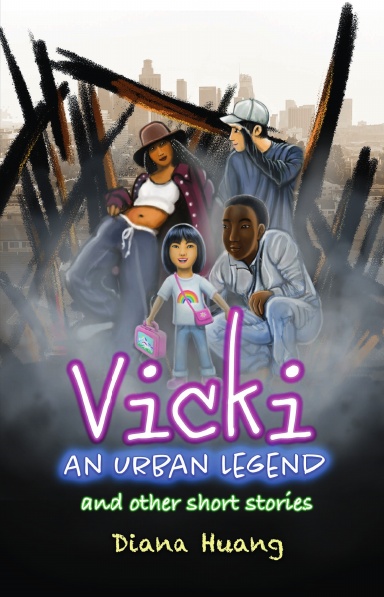
In Vicki: An Urban Legend and other short stories, author Diana Huang offers a selection of intriguing stories. The book's first half centers on Vicki, a girl from Los Angeles's Chinatown. A band of Black teens inadvertently kidnap Vicki in the process of nabbing her mother's Toyota to flee from a robbery. Good-natured and charming, they drive her to their home in South Central where Grandma treats her to some delicious and unfamiliar foods and everyone makes her comfortable before they return her to her Chinatown the next day. In this "urban legend," Vicki befriends the robbers, meets various of their family members, helps them out, escapes a riot, and learns a bit about racial and economic inequality. It's April 1992, during the trial of a group of police officers for the beating of Rodney King. Huang weaves humor into this lively L.A. tall tale of race, culture, and adventure. She is a gifted artist, and you can read more about her work here
The organizers of MCBD invite you to join the celebration, online and in real life. Year-round, MCBD offers free resources, teaching tools, booklists, downloads, and an initiative to distribute diverse, multicultural books -- over 10,000 to date. Details on this year's virtual celebrations are below. And check out these supporters:

MCBD 2023 is honored to be Supported by these Medallion Sponsors!

FOUNDER’S CIRCLE: Mia Wenjen (Pragmaticmom) and Valarie Budayr’s (Audreypress.com)

🏅 Super Platinum Sponsor: Author Deedee Cummings and Make A Way Media

🏅 Platinum Sponsors: Language Lizard Bilingual Books in 50+ Languages 

🏅 Gold Sponsors: Interlink Books, Publisher Spotlight 

🏅 Silver Sponsors: Cardinal Rule Press,  Lee & Low, Barefoot Books, Kimberly Gordon Biddle

🏅 Bronze Sponsors: Vivian Kirkfield, Patrice McLaurin , Quarto Group, Carole P. Roman, Star Bright Books, Redfin.com, Redfin Canada, Bay Equity Home Loans, Rent.com, Title Forward

MCBD 2023 is honored to be Supported by these Author Sponsors!

Authors: Sivan Hong, Amanda Hsiung-Blodgett, Josh Funk , Stephanie M. Wildman, Gwen Jackson, Diana Huang, Afsaneh Moradian, Kathleen Burkinshaw, Eugenia Chu, Jacqueline Jules, Alejandra Domenzain, Gaia Cornwall, Ruth Spiro, Evelyn Sanchez-Toledo, Tonya Duncan Ellis, Kiyanda and Benjamin Young/Twin Powers Books, Kimberly Lee , Tameka Fryer Brown, Talia Aikens-Nuñez, Marcia Argueta Mickelson, Kerry O’Malley Cerra, Jennie Liu, Heather Murphy Capps, Diane Wilson, Sun Yung Shin, Shannon Gibney, John Coy, Irene Latham and Charles Waters, Maritza M Mejia, Lois Petren, J.C. Kato and J.C.², CultureGroove, Lindsey Rowe Parker, Red Comet Press, Shifa Saltagi Safadi, Nancy Tupper Ling, Deborah Acio, Asha Hagood, Priya Kumari, Chris Singleton, Padma Venkatraman, Teresa Robeson, Valerie Williams-Sanchez and Valorena Publishing, Martha Seif Simpson, Rochelle Melander, Alva Sachs, Moni Ritchie Hadley, Gea Meijering, Frances Díaz Evans, Michael Genhart, Angela H. Dale, Courtney Kelly, Queenbe Monyei, Jamia Wilson, Charnaie Gordon, Debbie Ridpath Ohi, Debbie Zapata, Jacquetta Nammar Feldman, Natasha Yim, Tracy T. Agnelli, Kitty Feld, Anna Maria DiDio, Ko Kim, Shachi Kaushik 

MCBD 2023 is Honored to be Supported by our CoHosts and Global CoHosts!

MCBD 2023 is Honored to be Supported by these Media Partners!

Check out MCBD's Multicultural Books for Kids Pinterest Board!

📌 FREE RESOURCES from Multicultural Children’s Book Day

📌 Register HERE for the MCBD Read Your World Virtual Party.  Thursday, January 26, 2023, at 9 pm EST for the 10th annual Multicultural Children's Book Day Read Your World Virtual Party! This year it's on Zoom (not Twitter). An epically fun and fast-paced hour will feature multicultural book discussions, addressing timely issues, diverse book recommendations, & reading ideas. MCBD will be giving away an 8-Book Bundle every 5 minutes plus Bonus Prizes as well!

*** US and Global participants welcome. ***

Follow the hashtag #ReadYourWorld to join the online conversation, and connect with like-minded parts, authors, publishers, educators, organizations, and librarians.