Showing posts with label Tara Lazar. Show all posts

Wednesday, February 7, 2018

The Life of a Writer--Keeping Track of Your Ideas ~By Suzy Leopold

Another outstanding writing event took place during the month of January. I’m quite certain many of you participated in Storystorm with Tara Lazar. As always, there were excellent posts for writers to learn and grow from.
Storystorm 2018
Now, what are your plans for the ideas you generated and wrote down?

Ideas are what keep a writer moving forward. Whether you have too many ideas or not enough, keeping track of ideas in an organized fashion will support you and your writing goals. Putting them altogether in one place becomes a depository of ideas.

Perhaps you jotted down tidbits on scraps of paper, scribbled on a receipt, note cards, or even a paper napkin. Better yet, you may have typed your thoughts into a document on your computer. Did you write your inspiring *light bulb* ideas in a journal?  You’re ahead of the game if you kept your ideas in one place. Whatever tool you used, be affirmed in knowing you are moving in the right direction.

If you need some organization for your ideas, it’s time. It is time to gather all of your incredible ideas and keep them in one place. 

The human brain can’t possibly remember them all. Perhaps you are like me . . . I can’t remember most ideas since they seem to disappear into thin air as fast as they appear.

Created by Suzy
Any type or size of journal will work. Composition notebooks work best for me. Gather all of the odds and ends and pieces of paper you used to jot down your thoughts: Post-it® notes, index cards, your scribble scrabbles, receipts, and envelopes, etc. There is no need to rewrite your many ideas. Use a glue stick to adhere your collection of bits and pieces of paper inside a notebook.
Journals
Recording and tracking your ideas, are excellent organizational tools for a writer. Your ideas are ready and handy for when you need them. Over time you can refer to each one and expand on the idea as you develop it further. Are some of the shiny ideas standing out more than others? Perhaps some ideas are demanding, "Write me!"

As you weed through what you scribed during the Storystorm challenge, consider each idea thoughtfully. Carefully examine each idea and whittle down the list. Evaluate and determine which ideas have a strong picture book potential.

What makes a good idea? That's a challenging question. While no idea is ever wasted, a writer needs to consider the shiny ideas first. You need to weed through each one. Which ideas do you want to consider developing further? 

Here's my list of suggestions:

1. Choose an idea and write a pitch or a tweet.
2. Set a timer for 30 minutes and write a sloppy copy.
3. Brainstorm a few ideas with a critique partner.
4. Draft an outline to see where the idea takes you.
5. Select an idea and create a character map.
6. Ask yourself questions. Does the idea lend itself to a clear theme?
7. Do you feel you can expand on the catchy title idea? 
8. Search on Amazon. Do you see another writer who wrote about your idea? Don't be discouraged. Set out to write a story with a new spin, told in a way that only you can do. 
9. Write a draft, followed by several rewrites. From there take time to reconfigure and reconsider before sharing your manuscript with a critique partner or group. 
10. Finally, ask yourself, "Am I passionate about this idea?" Then you must write it.

After you have organized your Storystorm ideas in your Notebook of Ideas and prioritized which ideas have a strong potential to become manuscripts, keep on going. 

The journal can be used for future ideas throughout the year— an ongoing list to inspire you. 

Hang onto your inspiration. Create a depository of writing ideas.

Share in the comments below your suggestions for keeping track of your writing ideas.

Thursday, September 29, 2016

Henry Herz Fractures a Fairy Tale ~ by Patricia Toht

Fracture. Sounds painful, doesn't it?
Illustration from
Squibs of California, Or Every-day Life Illustrated

But a fracture is anything but painful in the hands of Henry Herz, because Henry has been fracturing fairy tales! 

LITTLE RED CUTTLEFISH,
Pelican Publishing
His newest picture book, LITTLE RED CUTTLEFISH, is a clever take on the old childhood tale Little Red Riding Hood. The story is set in an ocean reef, where Little Red innocently heads off to deliver crab cakes to her grandmother. But a big, bad tiger shark is on the hunt for a tasty seafood snack! Little Red must use her cuttlefish defenses to save the day. Readers will cheer her on while learning a bit about sea life in the reef, too.

I recently tossed a line to Henry, asking for tips on fracturing fairy tales, and he was generous with advice.

Henry: "Before we discuss fractured fairy tales, let's first unpack the term 'fairy tale.' Fairy tales are commonly defined as children's short stories featuring fantasy creatures and magical enchantments. 
THE GOLDEN BOOK OF FAIRY TALES

"Thomas Keightley indicated that the word 'fairy' derived from the old French faerie, denoting enchantment. 
Ida Rentoul Outhwaite's illustration from
ELVES AND FAIRIES, 1916
Fairies have been flitting around literature for centuries, from Morgan le Fay (King Arthur), to Tinkerbell (J.M. Barrie's PETER PAN), to Holly Short (Eoin Colfer's ARTEMIS FOWL). You can find them in modern picture books, too, like Doreen Cronin's BLOOM, and [Henry's other new release!] MABEL AND THE QUEEN OF DREAMS, inspired by Queen Mab in Romeo and Juliet.
Henry's other 2016 release,
MABEL AND THE QUEEN OF DREAMS,
Schiffer Publishing

"But today the term 'fractured fairy tale' seems to have broadened to mean the recasting of a story, whether technically a fairy tale or not. WHEN YOU GIVE AN IMP A PENNY from IF YOU GIVE A MOUSE A COOKIE or WEST SIDE STORY from ROMEO AND JULIET are two examples of recasting stories that were not originally fairy tales. By 'recasting' we mean a new version in which the author changes the setting, the character(s), the story arc, and/or the theme.

"When I consider writing a fractured fairy tale, I start with the choice of source material. For me, it must be both a story I love and a story sufficiently well-known so that readers will recognize the provenance, or origin, of the fractured version. The latter is critical, both for market appeal, and because much of the charm of a fractured fairy tale derives from when the reader notices and appreciates the differences between the two stories. A musical analogy would be a 'cover,' like this pair of Slovakian cellists shredding AC/DC's 'Thunderstruck':


"I find the most critical writing decision is which aspects should be changed versus which aspects should be kept the same. I generally try to keep the theme intact, although it's okay to add a layer. For example, in LITTLE RED CUTTLEFISH, the setting is changed from forest to underwater, and the characters are swapped for aquatic creatures. I also changed the story arc so that the heroine resolves her own challenge. This makes her more empathetic and adds a layer of ingenuity to the original theme of beware of strangers. 

"In INTERSTELLAR CINDERELLA, Deborah Underwood not only put the story in space and makes Cinderella a skilled mechanic, she also transformed the story into rhyme!"

I would like to thank Henry Herz for his insights, and I encourage you to check out his new books. If you would like to try your hand at fracturing a fairy tale, readers, begin by studying some mentor texts - Henry provides a list here.
Tara Lazar also offers some advice here. 

Go forth and fracture! Just don't get hurt in the process...


Friday, April 8, 2016

What Good Writers Do ~By Suzy Leopold

Showing up where you are with what you have is what good writers do.

Are you showing up where you are with what you have? 

In January, many writers set goals and resolutions when the 2016 calendar began. Perhaps it is time to revisit your set of writer’s goals.

Think about and check your list of short-term goals and your long-term SMART goals. Has your plan provided you with the results that you set out to achieve?

First Step: Set Goals
Second Step: Get to Work
Third Step: Stick to It
Fourth Step: Make a Plan
Fifth Step: Achieve
If your established plan is working, celebrate your accomplishments both big and small. Perhaps there are some areas where you can improve. Adjust as need be. For more information see a previous post Ready or Not. It's Time to Show Up.

As I look back on the first three months of 2016, I note there are some days when I stumble with the Third Step: Stick to It. Sometimes just sticking to my plan and sitting down to begin writing is all it takes. 

It’s easier to make unacceptable excuses for not writing today:

It must be writer’s block.
I’m waiting for inspiration to strike.
I don’t want to stare at this blank page.

No excuses allowed. Stop the stagnation. Dismiss negative thoughts that zap your productivity. Surround yourself with positive thoughts and find determination. Sure, there will be some days when you skip and stumble a step or two when  writing does not happen. It's okay. Take small steps and move forward without being critical of yourself. Think about what works best for you and your writing career.

There are many days when I feel I can justify my unacceptable excuses for not sticking to it. Yet, I know I need to believe in my voice and learn to ward off the urge to procrastinate. 

Making time to write is both a matter of desire as it is discipline. It takes determination. 

Writing can be compared to exercise. You feel better once you’ve done it.  
Created by my
Cousin Sheri McCulley Seibold
If inspiration is eluding you consider crafting a new story. Select an idea you wrote down during Tara Lazar's PiBoIdMo Writing Challenge. Feel accomplished after revising a manuscript. Refer to a stack of books as mentor texts from the research that you did during ReFoReMo, with Carrie Charley Brown. Participate in Angie Karcher's RhyPiBoMo that she hosts this month. Writers will grow and learn from the many resources, lessons and writing prompts. 

Write a blog post about a recently read book about the craft of writing that you found inspiring. Set a timer and chase after your daily word count. Consider establishing some agreed upon rules, expectations and most importantly accountability with a critique partner or group. By checking in with a writerly friend, I feel I can do a better job of holding myself accountable to my promises and aspirations than just checking in with myself. Perhaps heading to your local indie book store or the public library you will find some ideas and inspiration, along with time to read and write.
Time to revise & edit.
A stack of mentor texts.
One more thought. Take your writing serious. Make sure you go to work because this is your job. Your boss does not accept excuses for lack of inspiration, for feeling tired, for not showing up nor other lame excuses that you can think of. And don't forget the importance of having a set of business cards. This is your career.
Business cards
So grab your writer’s tools: a computer, a journal, a pen or a pencil, a highlighter, a dictionary, a thesaurus, a stack of mentor texts, a cup of hot tea and turn on some music to find your muse. You can do it! Yes, you can!
Would you like some sugar or
a slice of lemon with your tea?
One thousand crumby words on paper are better than one hundred thousand fabulous words that are in your head.

Make writing a habit and you’ll see improvement in you writing.

A writer writes. Write, always.

Monday, March 14, 2016

Blasted Rejections! ~ by Patricia Toht

In the past few weeks I've seen multiple posts about manuscript rejections. 
Thanks to Charles M. Schulz,
we know how Snoopy deals with rejection!
Why, I wonder? Has there been a burst of replies? Perhaps agents have hit a response window for submissions sent as the New Year began. Perhaps editors are clearing their desks in preparation for spring sales meetings or the Bologna Book Fair. Or perhaps writers have assumed a rejection after sending manuscripts into the Black Hole of Publishing -- "You won't hear from us unless we're interested" -- and enough time has passed to consider them dead in the publishing pool.


Whatever the reason, some terrific advice is being offered in the blogosphere: 

On the Institute of Children's Literature site, Jan Fields welcomes you to her "Pity Party." Among the many fine points she discusses, Jan reminds us is that "rejections are about specific manuscripts in specific situations." 


I learned this lesson at the 2014 SCBWI LA Conference. An editor admitted that she had passed on Pat Zietlow Miller's picture book, SOPHIE'S SQUASH. She just didn't connect with the manuscript. Well, the author was at the same conference, accepting her Golden Kite Award for SOPHIE'S SQUASH, which had been published by Schwartz and Wade and received four starred reviews!


Tara Lazar offers an extensive list of "Common Rejections and What They Mean."  My latest rejection, just last week, was a form rejection. That's my second least-favorite type of rejection, with nothing constructive to offer. (For my least favorite, refer to the Black Hole, above ^^^.) But in the past year, I've also heard "It's too quiet," "It's not right for us at this time," and "I didn't quite connect with this in the way I'd hoped." Tara de-mystifies these phrases in her post. Check it out.

So, how do you feel about rejections? I usually feel like this:
Photo by Lawrence Whittemore.

Often, a wise quote is enough to lift my spirits.

"Fall seven times, stand up eight." ~ Japanese proverb

"So you're taking a few blows. That's the price for being in the arena and not on the sidelines." ~ The War of Art, by Steven Pressfield

"Many of life's failures are people who did not realize how close they were to success when they gave up." ~ Thomas Edison


But sometimes my funk is deep. When that happens, I often pull out an old buddy of a book to get me through. BIRD BY BIRD: SOME INSTRUCTIONS ON WRITING AND LIFE by Anne Lamott always makes me laugh and reminds me that even a successful writer has a multitude of demons. And yet she also has a path out, step by step, bird by bird.


Recently, I also looked over my copy of
 THE WRITER'S BOOK OF HOPE: GETTING FROM FRUSTRATION TO PUBLICATION, by Ralph Keyes. The author devotes an entire chapter on "Keeping Hope Alive." I love some of his suggestions:


1) Build a Consolation File -- a collection of information about famous writers who were repeatedly rejected, like JK Rowling, Dr Seuss, and Madeline L'Engle. Author websites can also offer insight and reassurance, such as Dan Gutman's rejection letters for HONUS & ME.

2) Study the acknowledgements in novels. Ralph Keyes says that these often confirm that the author was discouraged while writing their book, they received support from encouraging people in their lives, and that support helped them complete the book and get it published. 

3) Attend conferences and courses. Because writers are often so isolated, this will help you see that you are not alone in your feelings and frustrations, nor in your odd work habits. (How many of you write in your jammies? C'mon...be honest...) You can join SCBWI, or meet with a critique group. Be part of a Facebook community. Connect through blogs. Find your peeps. ('Tis the season for Peeps!)

4) Indulge in dubious motives for writing. Do you ever write to satisfy your ego? Do you write to express anger? I admit that I'd love to send a published book of mine to the college professor who told me I was a lousy writer and should give it up. That usually riles me up enough to start working again!

Ralph Keyes offers several other ways to keep despair at bay and hope alive. (Chapter 9 in my edition.)

Rejection stinks. Someone doesn't like your baby. You have every right to feel crabby and blue. Just don't let it derail you. If all else fails, make a game of it. Heather Ayris Burnell has invited the Sub It Club to play Rejection Bingo with Kirsten Larson. Now that's a great way to deal with rejection!

How do you deal with rejection?

Monday, January 11, 2016

Fracturing a Fairy Tale ~ by Patricia Toht

Back in July, I wrote a post about creating a picture book text by giving an old theme a new twist. Today I'm going to focus on one popular way of doing this --  


Let's fracture some fairy tales, folks!

Fractured fairy tales are nothing new. From way back in the 1960's comes historic proof:

Obviously there's staying power in fractured fairy tales. So, how exactly do you make a fairy tale dance to a different tune? Here are just three of the moves you can do to change a fairy tale or childhood story/rhyme.

The Two-Step (or Three-Step, Four-Step, Five-Step, ...)

Take a short, simple childhood rhyme or story and add to it, expand it. The crucial factor is to assure that the expansion has a story arc to it that will propel the reader forward. Jim Aylesworth has written picture books in this vein.


THE COMPLETED HICKORY DICKORY DOCK begins with the well-known verse and then the author extends it by following the mouse through twelve hours of the day. The book is written in verse, each stanza opens with a fun-to-say nonsense word. The reader can count up the hours as the mouse moves through the day.


MY SON JOHN ends with the familiar verse. Readers follow an arc from sun-up to sun-down. Each spread depicts another child from the rural area taking part in simple activities. Son John ends the day in bed with his one shoe on.


The Twist


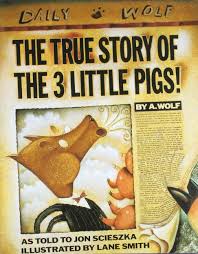
THE TRUE STORY OF THE 3 LITTLE PIGS by Jon Scieszka is a well-known example of a fractured fairy tale. The story is relayed by the wolf, who tells the "true" story of what happened with the pigs from his point of view. According to him, the whole misunderstanding was about a cup of sugar and a case of the sneezes. If you'd like to try writing something similar, take the "bad guy" of a story and examine events from his/her point of view, being sure to add lots of emotion. How does that change the story?


NINJA RED RIDING HOOD by Corey Rosen Schwartz. Corey has written a Ninja trilogy; each one combines a childhood tale with ninja training. The limerick verses in this one are terrifically catchy, and the author manages to work in traditional lines (e.g. "The better to see you with, my dear") with seeming effortlessness. She also dares to even out the match between Wolf and Red -- they've both had ninja lessons! Someone else shows up in a gi to help save the day. To twist like Corey does, select a well-known childhood story and add an element that kids are crazy about. Tara Lazar's "500+ Things that Kids Like" is a great source for brainstorming.


The Mash

What might happen if you mash together a whole bunch of tales or characters? 

Tara Lazar's LITTLE RED GLIDING HOOD is one-part twist and one part mash up. It begins with an amazing title. Obviously "gliding" implies that Red is doing something special -- she's skating. Tara sets a goal for Red that reflects the title. What would a skater want? Why, to win a skating competition, of course. This storyline propels the reader through the story (on a ribbon of ice). But the author adds SO much more! Easily recognized characters are peppered throughout the story, and the feared big bad wolf is not-so-bad after all. Cleverness and puns abound.


The tale in INTERRUPTING CHICKEN by David Ezra Stein combines several childhood stories, but doesn't really scramble them up. As Papa Chicken reads his Chick a bedtime story, Chick keeps interrupting the stories by jumping in them to save characters from harm. 

Penny Parker Klostermann (who won the Best in Rhyme award for THERE WAS AN OLD DRAGON WHO SWALLOWED A KNIGHT) has said that INTERRUPTING CHICKEN was one of the mentor texts for her upcoming mash up, A COOKED UP FAIRY TALE (Summer, 2017). For an interview with Penny about her use of mentor texts, see the interview here.

I hope these examples will give you some ideas for fracturing fairy tales. Start dancing, writers, and see what shakes out!

Friday, March 27, 2015

Wordless Spreads in Picture Books ~ by Patricia Toht

And now, for a few words (well, more than a few) about wordless spreads in picture books...

In my newest PB manuscript, I'm choosing to ignore two strong suggestions for picture book writers:


1) DON'T write in rhyme!
2) DON'T include illustrator notes!

I'm a published poet, so I feel I have some justification for writing a rhymed text. But what about those illustrator notes? As Deborah Underwood once said, "It's not the illustrator's job to tell you what to write -- just as it's not your job to tell her [or him] what to draw." I agree, whole-heartedly! So...why the notes?

Long-time readers of the GROG may recall my fondness for making picture book dummies by laying out my text in spreads that mimic a finished book. When I did so with the new book, I discovered a spot where I could cut lots of text by letting an illustrator go crazy with a wordless spread.

Before hitting the "submit" button, I thought it wise to study up on picture books that contained just one or two wordless spreads, to see if my suggestion made sense. I knew of several books to consider, and a shout out to members of PiBoIdMo bolstered my list.
A few of the books I studied.
I discovered some interesting things:

From my sampling (16 books), a wordless spread was more likely to occur in the second half of a book.

Wordless spreads were as likely to occur in books authored and illustrated by different people as those by author/illustrators. 

In many of the books, the spread served as a pause or slowing of pace, a chance for the reader to reflect. 

The spreads served other functions and conveyed varied messages (sometimes more than one, which is why the percentages below add up to way more than 100%!).

• 50% were humorous (many LOL). A majority of these happened in the second half of the book.
I love the "naked centerfold" in Peter Brown's MR. TIGER GOES WILD!
 • 50% demonstrated change, either within the character or in his/her situation.

• 33% portrayed setting out on a journey or adventure
The zoo animals hop aboard a bus in
A SICK DAY FOR AMOS McGEE
by Philip and Erin Stead
• 33% showed a difference in size or scale. This contrast between two characters, or between a character and the surroundings, elicited a variety of emotions from fear to loneliness to sweetness to wonder.

• 25% portrayed the culmination of a quest/resolution of a problem.

• One book introduced the main conflict through a wordless spread early on (pages 10 & 11).
Watch out, Billy Twitters! A blue whale is coming your way!
BILLY TWITTERS AND HIS BLUE WHALE PROBLEM
by Mac Barnett and Adam Rex
• The spreads were all worth their weight in wordless gold-- with the illustrations doing the work of many, many words.


Tara Lazar mentioned that her upcoming book, I THOUGHT THIS WAS A BEAR BOOK, contains a wordless spread. I asked her about it.

Me: Where does it occur?
Tara: The wordless spread is in the second-to-last spread in the book, right before you make the final page turn.

Me: What's its purpose?
Tara: It restores a sense of calm to the reader and conveys that everything has been settled. (Or has it????) It gives the bears some time to return home.

Me: Did you request the wordless spread?
Tara: This wordless spread was not in the original manuscript. It was suggested by my editor and illustrator after we made changes to the resolution. It helps with the pacing and sets up the final guffaw.


In the end, I feel a bit bold to suggest the wordless spread, but I feel it's the best vehicle to show lots of activity and a passage of time. Reassuringly, my sleuthing uncovered QUEEN VICTORIA'S BATHING MACHINE by Gloria Whelan and Nancy Carpenter. 


Like my manuscript, this story
1) is written in rhyme
2) is rooted in history
3) contains a wordless spread at the same spot that I am considering 
4) shows the resolution to a problem


And so I am emboldened to go where manuscripts are suggested not to go -- to submission, WITH illustrator notes! Wish me luck!

Thank you to Tara Lazar! (Visit Tara here.) Thanks also to PiBoIdMo members for your suggestions!


Monday, March 9, 2015

Let's Get Ready to Rhyme! ~ by Patricia Toht

Grab a notebook and a pen,
April’s time to rhyme again.
Learn about a challenge here –
RhyPiBoMo’s second year!

RhyPiBoMo stands for Rhyming Picture Book Month, and is pronounced "rye-pie-bow-mow". It is the brainchild of Angie Karcher.


Tell our readers a little about yourself, Angie.

I’m a Hoosier, married to my supportive husband Stan for nearly 24 years and mother of four teens and two doggy assistants. I’m a former kindergarten teacher and developmental therapist. I’ve been writing for over 20 years, and am represented by agent Kendra Marcus of BookStop Literary. I enjoy writing poetry, rhyming picture books, historical fiction and non-fiction.


Angie's first book, Where the River Grins, M.T. Publishing, 2012.
A regional history resource book used in local schools. Buy it here.

Angie's second book, The Legendary R.A. "Cowboy" Jones, M.T. Publishing, 2014.
A biography of a 71-year-old jockey who still races horses in Kentucky. Buy it here.


Angie's special message:

I want to thank everyone for kind words of encouragement after my accident at the L.A. SCBWI Conference last summer. For those who don’t know, I fell and had emergency surgery to repair a severed nerve in my right hand. I am doing great and appreciate all the loyal RhyPiBoMoers who stuck around while I recovered. I wasn’t sure I’d be able to host the event this year, but your kindness and encouragement was quite motivating!


Angie, how did you come up with the idea for RhyPiBoMo?

In 2013 I participated in Tara Lazar’s PiBoIdMo and loved the experience of community and focusing on a specific part of writing. There were no writing challenges in April (poetry month) that focused on poetry and rhyming picture books, so I began planning. Tara was so supportive and helped me get organized, and writer friends helped me find fabulous guest bloggers. Once Jane Yolen and Lee Bennett Hopkins joined, everyone else jumped aboard.

I’ve found there’s a stigma attached to being a writer of rhyme -- being a rhymer is alarmingly frowned upon. So, I started RhyPiBoMo to give rhymers a place for support and to encourage writers of rhyme to do it in a professional manner, following the rules of picture book writing and using rhyme as one piece of the puzzle, not as the focus of the story.


As authors, we’re told to polish our elevator pitch. Doors closing…GO!

RhyPiBoMo (Rhyming Picture Book Month) is an annual writing challenge in April for children’s writers who enjoy writing in rhyme. It features 25 fabulous writing professionals who share their knowledge about the Dos and Don’ts of using rhyme in picture books. There are daily prizes, rhyming parties, a poetry contest and more! Find it on my blog, Angiekarcher.wordpress.com.

Whew…how was that?

Well done! Any changes this year?

We do have a few changes this year. First of all the blog posts will be shared only on week days. This will allow us the weekends to spend with family and get caught up on other important things.
Last year, I taught daily lessons along with the guest blog posts. This year I asked the guest bloggers to choose a topic from a suggested list and to use their blog post as a lesson itself.

Each year, your banner honors a wonderful poet. Last year, it was William Shakespeare, designed by Gayle Wing O’Donnell. Who are this year’s honored poet and illustrator?

I’m thrilled that we are celebrating a personal favorite, Maya Angelou, on our banner. Her passing saddened me, and she was the clear choice for this year’s honored poet.

I love the banner and badges, designed by author/illustrator Tanja Bauerle! 
We met in an online writing class several years ago. Since then, we’ve hugged in person, ridden in an ambulance together, and shared laughs on this bumpy road in children’s literature land. Visit Tanja here to see her amazing work! 

When collaborating with Tanja, we decided to share one of Maya’s quotes on the banner. A few days of research later, we discovered that we both had selected the same quote --


This quote speaks to us as writers. We don’t write to put words on the page, we write to share the joy and our passion for the subjects with children. The poetic rhythm and song of rhyming picture books are magic and should be read aloud to children to experience the full gift.


Tell us about your guest bloggers. I heard you are hosting ALL NEW poets this year!

Yes, this year we have 25 all new guest bloggers! I’m very excited that Kwame Alexander will be in the house! He’s been floating around the country since receiving his esteemed Newbery Award and graciously accepted the final spot on my calendar in the midst of his confetti and fireworks. Buckets of gratitude to all of the busy, talented folks who will celebrate writing poetry and rhyming picture books with us!
You are such a fun-loving poet, Angie. What’s planned for the launch of RhyPiBoMo?

I suppose I have been known to have a good time at whatever I do! I like to laugh and share this passion I have of writing with others. That being said…there may be something coming up in April that will be BIG! It will be memorable and I believe it will remain in the hearts and minds of all…

Oh wait. I’m saying too much. I guess you will need to participate in RhyPiBoMo to find out more! Did I mention that I like to tease too?

Rest assured. We have something BIG up our sleeves for the kick-off. It’s a Rhyming Surprise!


So, mum’s the word? Well, a little blue bird did tell me that RhyPiBoMo will have a flurry of celebration on April 4th

April 4th is Maya Angelou’s birthday, so we’ll celebrate with a webinar hosted by author Jackie Wellington and myself. We will read Maya’s work, discuss her impact on children’s books, and more.

In addition, I’ve been asked by my local Barnes and Noble to give a talk on April 11th about Maya Angelou. I’m thrilled that we’re setting up a book fair to donate proceeds from purchases on the 11th to WE NEED DIVERSE BOOKS, bringing diversity and poetry together to support an important effort. More details to come!

In 2014, members of RhyPiBoMo formed critique groups. Will this happen again in 2015?

Absolutely! Another dear friend, Dawn Young, is the Admin for RhyPiBoMo and Critique Coordinator who will set up rhyming critique groups through our Facebook page. Our Facebook group has grown to over 300 members! This is where we chat and have rhyming parties and lots of silly fun while learning from each other. Request to join the RhyPiBoMo Facebook group and I will admit you.

Dawn, an amazing writer and friend, is instrumental in helping to make RhyPiBoMo a success. She also rode in an ambulance with some very handsome actor/EMTs and me -- it’s amazing how you bond over things like that! You can find more about Dawn here.


What’s a Rhyming Party?

A Rhyming Party is an impromptu or planned party on our Facebook page. I pose questions pertaining to the previous week’s blog posts, and all who participate must answer in rhyming phrases.

For example:
Me: “Who is the lovely poet on our banner?”
Answer: “A lady named Maya who writes about the sky-a.”

It’s fast-paced silliness and a fun way for us to share our love of rhyme and get to know each other. Prizes vary and all who participate leave with a smile.

Will The Golden Quill Poetry Contest return this year?

Yes, we will again host the Golden Quill Poetry Contest. Poems will be judged on clever theme, rhyme scheme, poetic techniques, rhythm, and overall read-it-out-loud-ability. There are wonderful prizes, too! Last year, we had over 40 entries! More information will be on the blog soon. To participate, you must be a registered participant of RhyPiBoMo by April 8th.

That little blue bird was chirping again, telling me about RhyPiBoMo Awards for 2015. Tell me more!

That little bird has been busy! Yes, we’ve formed a new committee of RhyPiBoMo folks who will be reading lots of rhyming picture books soon, and will name a favorite rhyming picture book of 2015 and several honor books this November.  I’m very excited to bring well-deserved attention to brilliantly written and illustrated rhyming picture books.

So, how do we register for RhyPiBoMo?

Registration opens on March 18th and runs through April 8th. Go to Angiekarcher.wordpress.com to register. You must be registered to win prizes and compete in the poetry contest.


Thanks, Angie!

Thank you so much, Patty, for helping me spread the word about RhyPiBoMo. I hope many more writers will join us in this celebration of poetry and rhyming picture books. This is a labor of love for me and many who write and illustrate picture books.


Angie also offers a class, Writing in Rhyme to WOW, as well as critique services. You can find more information here and here.