Showing posts with label Haiku. Show all posts

Wednesday, April 23, 2025

Happy Poetry Month! Haiku Musings from Kathy Halsey


Haiku helps me see

  through this world into others

  unknown until now

Why Haiku? Why not? Haiku rescued me when I was told by an editor that I didn't tell stories, I wrote stage directions.

 FULL. STOP. I stopped writing for a few months. I sat on the back porch that I'm on right now, looking at clematis and told myself, "You can write haiku." After all, it's just three lines, 17 syllables, and a small contained easy package. However, as I delve into the craft of haiku and started to understand the Japanese version, read more, and participate in podcasts like Poetry Pea, I know what looks simple is much more complex. Haiku is what is said, but even more what is not said. The writer and reader engage in making new meaning through the space haiku opens in us.

That was three years ago. I'm sitting on my porch now instead of cleaning, washing clothes or getting ready for company. Why? Because poetry makes me stop  ordinary life and just be. And when I'm using my senses to just see what's around me, I relax and I open  myself up to new possibilities.

Haiku makes me anticipate the spark nature brings every week. Knowing I'll  write haiku every Saturday, I hunt for moments during the week that bring me solace, peace, and take me to other worlds. With my haiku practice, I meet new people and have been published in poetry journals.  In fact, my first book, Be A Rainbow by KiwiCo Press came from a poem that was an extended metaphor. Haiku taught me that.

All poetry makes us pause, linger, see life magnified in all its beauty and complexities. It allows us to wonder and wander, compose images and create art through words. Poetry allows us to play with words, create new words, compose word songs that can be sung with rhyme, rhythm, beat, and a healthy mix of risk-taking and pleasing oneself first. 

Read and write some haiku or poetry every day or join us at #HaikuSautrday w/host Susan Morhar Andrews, @AndrewsSusanM on X and Bluesky. It's our little sunshine spot on X that sheds light and resistance through our ability to connect and create better worlds.


Here's an image that I took in Lansing, Michigan when Bob and I hiked on a dreary day and found this beautiful park tucked away. Be with this image. Create your own poetry. Please share your haiku or any other poetry in the comments. Happy Haiku and Poetry month to you!


Wednesday, August 18, 2021

Summer! Some Are Writing Haiku by Kathy Halsey

Happy Haiku for You 

Sometimes in summer, we need to lighten or change our routines. I needed to lighten my mood early this summer after receiving a professional critique that made me feel like I was couldn't write my way out of a paper bag. I actually stopped writing, but haiku came to my rescue!

I sat on the back deck pouting with my journal, observing nature - clematis, sunflowers, and kids frolicking with their dad. I doodled with words. The simple, 3 line, 5-7-5 haiku format seemed safe. I couldn't mess that up, right?  RIGHT.  

My journaling flowed, haiku made me happy. BAM! I was writing. I even used haiku to attack a shelved story, now ready to submit. Switching gears and formats made the difference! 

Join Me in Some Haiku

I'm sharing my haiku and some photos as possible prompts. Join in the fun and share your haiku in the comments. Traditional haiku is more contemplative but some of mine are active. (and may fudge a syllable or 2.) Just play and do it your way.


Tall purple iris.
Show off your fascinator.
Queen of the garden.


Garden sunshine blooms.
Follows the sun. Petal power.
Stretch to azure sky.


A smooth oblong stone.
A carefree rock skimmer with
perfect form. Skip . . . splash!


Clematis climbs, winds
its crisscross highway of vines
intersect. Find sun.


Here's one just for fun! Can't wait to see what haiku comes from you!


Wednesday, May 9, 2018

A SPECIAL MOTHER'S DAY STORY with Amy Losak -- H IS FOR HAIKU

Amy talks about her late mother, haiku and the gift of sharing her mom's poetry with young readers . . .


By Eileen Meyer


Mother’s Day is just around the corner -- that special day where we celebrate and honor mothers, grandmothers, aunts, mentors and other special women who have meant so much to us.

I have a special story to share with you:

One about a daughter honoring her mother’s life and her beautiful poetry.

It’s a LOVE story.
A mother-daughter story.
A children’s publishing story.

(Photo: Sydell Rosenberg
 with daughter, Amy)

Welcome to one of my TAKE FIVE interviews. I hope that you’ll take five minutes to get to know Amy Losak and learn about the new children’s picture book, H IS FOR HAIKU, by her late mother, Sydell (“Syd”) Rosenberg.


Syd was a public school teacher in New York City and also a charter member of the Haiku Society of America when it was formed fifty years ago. The story of this book and Amy’s efforts to share it with readers is a powerful story of love and family -- and so appropriate as we prepare to honor the women in our lives on this special holiday.

Eileen:  Since Mother’s Day is this weekend, May 13th, I wanted to interview you for our blog readers. You have a beautiful story about your role in bringing your mother’s work to publishers for the newly released picture book, H IS FOR HAIKU. Will you share that with our readers?


Amy: Thanks, Eileen. It’s such a pleasure to be here! As you kindly noted, my mother Sydell Rosenberg was a teacher in New York City schools. She also taught adult ESL. Mom also was a writer her entire life: poetry, short stories, literary and word puzzles, and more. The “more” includes, among other things, a racy novel she published as a young woman – I think almost straight out of Brooklyn College in the early 1950s. She worked as a copy editor for a small publishing company. This potboiler was published under a male pseudonym, Gale Sydney (a reversal of her maiden name initials, Sydell Gasnick.) It was titled “Strange Circle.” Interestingly, copies are still available online!

Syd was a product of New York but she had a love for nature and an intense curiosity about big and small things around her. At some point in the 1960s, Syd became captivated by the poetic form, haiku. She spent years learning about haiku and related forms. She even studied Japanese, I vaguely remember, perhaps to try and read the original masters. She was a charter member of the Haiku Society of America (HSA) in 1968 and attended the founding meeting. She also served as HSA secretary in 1975 and on their Merit Book Awards committees. Some of her poetry won awards and honorable mentions.

Decades ago, Syd wanted to publish a children’s poetry book –a haiku alphabet book. She submitted her manuscript to publishers back in the 1970s and 1980s. (Going through her papers, I unearthed some of the rejection letters she had saved.)

Mom was successful in publishing an assortment of poetry and other works over the course of her decades-long writing career. But when she died suddenly in1996 from an undiagnosed heart condition, she had not fulfilled her dream of publishing a book for children. Her family members resolved to fulfill that dream of hers!

However, it took many years before I was ready to take on this task. The project itself was daunting -- and the more I procrastinated, the more insurmountable this project became for me. But the need to share her poems with young readers was a great incentive. Around 2011, I began slowly to sort through, collect and curate a good selection of her work, especially her haiku and senryu. Among her papers, I found at least one of her old manuscripts.

I endeavored to share some of her short poems with arts, nature and literacy groups that serve children. I contacted a lot of organizations! I’m proud of a rewarding partnership that has been underway for several years with NY’s Arts For All (arts-for-all.org). AFA is an excellent nonprofit arts education organization that provides programming to city schools. I fund the teaching artists’ residencies. In several grades and classes, AFA’s teaching artists have used mom’s visually appealing poems to convey the basics of painting, drawing and collage; music; and theater.


Finally, in April, 2011, I began to submit H IS FOR HAIKU directly to publishers that welcomed non-agented submissions. I received either rejections or silence – not surprising. 


Time passed and I thought about self-publishing this book. Then in 2016, thanks to a poet and teacher, Aubrie Cox Warner, I connected with Penny Candy Books. To my great joy, they LOVED mom’s poetry and acquired the manuscript! It has been a wonderful experience to collaborate with Penny Candy. Finally – many years later, mom’s dream has come true. I have many people to thank in the KidLit and poetry communities (not to mention family, friends, coworkers …) – they kept me going when I felt like giving up.

Eileen:  Your mother’s poetry was inspired by her life in New York City. The haiku selections encourage readers “to slow down, linger, and pay attention to the moments we often overlook.” Can you share a favorite experience about city life and your mom/family?

Amy:  Mom and dad (Sam Rosenberg) did so much. We went to the theater, concerts, museums, botanical gardens, beaches, zoos, city parks – and more. Mom had this hunger to immerse herself in various enriching events and experiences both in New York and beyond, and she tried to impart her sense of adventure to my brother Nathan and me.

During our family jaunts, or as a result of them, she crafted a good number of poetry and stories. Some no doubt stayed in her head; others made it to the page. All these years later, I now appreciate her keen “eye.” Syd had a penchant for engaging with so-called “small moments” and making them matter. I think – hope -- mom would be pleased, but it’s even more important that readers be happy with this selection of her wonderful poems.

Eileen: Which poem in the collection is your favorite and why?

Amy: One of my favorites is “So pale”


This one was published a few times in journals, including a 1968 issue of Haiku West (where it won a “best-of-issue” award.) I love its simplicity and sense of stillness and peace. “It” can be anything readers wish to imagine. In H IS FOR HAIKU, Sawsan Chalabi’s illustration of an affable moon perfectly captures the understated enchantment of this poem.

Eileen:  Speaking of the great illustrations -- Sawsan Chalabi’s work is lovely and playful. What can you share with us?

Amy:  Sawsan’s wonderful artistic style is such a vivid complement to the poems! I asked Sawsan to tell us more about her process. . .

Sawsan Chalabi is a designer and illustrator with an MFA in Illustration from Savannah College of Art and Design. Her work is mostly digital and conceptual in nature. With H IS FOR HAIKU, she let each poem speak to her as she interpreted each random thought into a visual. Because the individual poems were not connected to one another (other than via the overall alphabet “framework”), this allowed her ample room and freedom for playfulness with the imagery and hand-lettering. To maintain a smooth transition from one page to the next, Sawsan used the same color palette throughout the book. She made sure each spread worked as one harmonious piece, with the visuals of one poem flowing freely into the next, thus allowing the reader to glide through the poet's thoughts with ease.

Eileen: Where can readers and fans find more information about you and your mother’s book on social media?

Amy: H IS FOR HAIKU and Penny Candy’s other titles can be found here:


The book is available on Amazon and via other retailers, including independent bookstores.

Sawsan’s vibrant artistry is showcased here:


Thank you, Eileen, for this lovely opportunity to chat and to share the story of H IS FOR HAIKU

Happy Mother’s Day to you and all of the GROG BLOG readers!

Monday, August 31, 2015

You,Too, Can Haiku--A Guest Post by Robyn Hood Black

     Greetings, writers! Many thanks to Sherri for inviting me to bring some haiku to the proverbial coffee table this morning. There's much to learn about this deceptively simple genre. I am very much still a student.


     Why haiku? First, its intrinsic value--I think reading and writing haiku make a person of any age more alive. Second, immersing yourself in these short form poems can sharpen your writing skills across other genres.

     What about the 5-7 5 format? Let's get this question out of the way first.  Strong haiku can be written in this format, but it's not an accurate reflection of Japanese haiku because Japanese words contain more syllable sounds than English words do. So, 17 syllables in English are usually too many for one haiku, and make a clunky, forced-sounded poem.

     So, what does constitute haiku? It's more than words that are counted on your fingers and written in a three line format. There is just so much packed into those small poems.


    Dr. David G. Lanoue, current Haiku Society of America president, and Issa scholar, has said a haiku is "a one-breath poem that discovers connection," Connection between juxtaposed images or ideas is often lacking in what passes for "haiku" in popular culture. 

     In a recent book, Lanoue describes a haiku as "an elliptical, succinct, imagistic poem that invites the reader to complete what is only suggested or hinted at on the page."

     How would you describe a good haiku poem?  A strong haiku is concise and offers two precise images, suggesting a connection between them. A successful haiku presents the reader or listener with a moment, an experience, but doesn't override the reader's response by naming the emotions involved. The unfolding of the second image seals the connection and opens the emotional potential of the poem.

     Can you give us an example?  Consider this poem by David G. Lanoue, which he kindly shared on my blog: 

a "lost Dog" sign
nailed deep
into the oak.

Copyright David G. Lanoue. All rights reserved. 
Frogpond, 27.2 (2004)


     First, note the word choices. Are any of them sentimental or sappy? Nope. Too highfalutin to understand? No. Are precise image/sensory details presented? Yes. If you have a dog, or have ever lost one, this haiku likely strikes a chord. Each reader will bring his or her own experiences and sensibilities to the reading.

     When I read this poem, that nail might as well be pounded into my heart, because that's where I would feel the loss of one of my beloved dogs. Also, notice how much stronger it is with the specific word "oak." It has a heavy, hearty sound, and when you say it, it slows you down. It's much better than the generic word "tree."


     What if the poem were constructed like this:

a "Lost dog sign
taped up
to the sign post.

     Hmm. Not much happening there.    

     Or, what if it said:

a "Lost Dog" sign
I sorely miss
my golden retriever.

Um, that one misses the haiku mark. As David has written it, though, I'm grabbed by the visual image of the "lost" sign--Oh, No! That's terrible!, I think to myself...and then pounded with the second image--a nail, or nails, driven with force into the hard oak tree. I hear a hammer, feel the rough bark, even sense the impact of that nail. 

     How about we want to write our own haiku? Great! First I'd suggest reading. A lot. When I first fell under the spell of haiku, I read hundreds and hundreds of poems to get a sense of what they are really about. Let them seep into your bones. The good news is there are many sources out there for you to dive into. You can start with the Haiku Society of America: http://www.hsa-haiku.org and their journal Frogpond. Another resource  is The Haiku Foundation http://www.thehaikufoundation.org.

     What haiku books are on your bookshelf:


    And, finally, some hints for getting haiku subjects, please. 

     Next time you go for a walk, take a notebook. Or, sit on your front stoop or in your back yard with paper and pen handy. Gather your senses. What catches your eye? What are you feeling? What smells surround you? Note the time of day, the season.

     For a traditional English-language haiku, you'll be gathering two parts--one will be two lines, and the other will be a single line. (It doesn't matter which comes first.) One of your two elements can be a seasonal reference--it might be as straightforward as "autumn afternoon" or more subtle, like "burning leaves."

     What does that smell evoke for you? Loss? Change? The trick is to employ another image which suggests that emotion. Perhaps you notice geese overhead. Maybe they are changing flight positions and that reminds you of a shift in a family situation. You might end up with a haiku like this:

burning leaves
a V of geese
regroups.   

     Do you have an assignment for us?  Take a deep breath and a walk, and see if you are inspired to write a haiku or two! You can post them in the comments section. 

     Robyn Hood Black writes poetry, fiction and nonfiction under Spanish moss in the South Carolina Low country. She's active in SCWBI Southern Breeze and in the Southeast Region of the Haiku Society of America. Her haiku have appeared in many contemporary journals including Frogpond, Modern Haiku, The Heron's Nest, Acorn, Chrysanthemum and One Hundred Gourds.
robynhoodblack.com.


Friday, August 7, 2015

Writing Poetry for Kids - Where to Begin? ~ by Patricia Toht

Recently, several of the GROGgers had a discussion about poetry for kids. "How do you get started?" some wondered. "What's the best type of poetry for a beginner to try?" 

I am one of the poets in the GROG group. I've always enjoyed rhyme. My favorite childhood books were rhyming ones.
One of my favorites is missing --
MISS TWIGGLEY'S TREE
by Dorothea Warren Fox 

As an adult, my love of rhyme continues and my collection builds. 
Only a small part of my poetry collection.

And so my first suggestion to hopeful poets is, before you start your poetry-writing engines, prime the pump. Check out a stack of children's poetry collections. Read, read, read! How do the words feel in your mouth? Smooth? Jumpy? What phrases jump out? Revel in the author's word choices.

You can also find books about writing poetry. For all beginners (child and adult alike), I recommend those that are written for children. They boil poetry down to its basic elements and give wonderful examples. I've chosen poetry forms from three of these books to get you started.


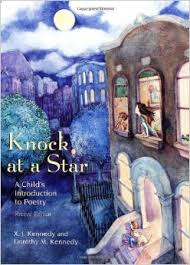
From KNOCK AT A STAR: A CHILD'S INTRODUCTION TO POETRY by X.J. Kennedy

A Takeoff Poem (or Parody)

Choose a rhyme that you already know and make some changes to it. Kennedy gives the example of the common childhood verse, "Twinkle, Twinkle, Little Star." Author Lewis Carroll changed "star" to "bat" and rewrote the rhyme:


Twinkle, twinkle, little bat!
How I wonder where you're at!
Up above the world you fly.
Like a tea tray in the sky.


Because your brain is already familiar verse, it makes it easier to conform to the rhythm. Try Humpty Dumpty, I'm a Little Teapot, Little Miss Muffet, or another childhood favorite.


From HOW TO WRITE POETRY by Paul B. Janeczko

A List Poem

Try a free verse list poem. A free verse has no set rhythm or rhyme.  Pick an interesting topic -- Janeczko includes "The Perfect Friend," "What Cats Do," or "How to Make a Rainbow." Write a list of anything and everything that comes to mind about your topic. Then read over your list. Can you narrow its focus? Maybe "What Cats Do" becomes "What Cats Do at Night." Which words or phrases seem to fit your topic best? Cross off those that are vague or unclear. Focus on word choice - use your thesaurus for more exact words. Try switching around the order of your list. How does the rhythm sound? Is there sense in how the reader moves from one thing on the list to another?

A wonderful example of a list poem is the picture book, THE QUIET BOOK by Deborah Underwood. The author lists all the different types of "quiet," such as "Coloring in the lines quiet," "Hide and seek quiet," and "Bedtime kiss quiet." 


From POEM-MAKING: WAYS TO BEGIN WRITING POETRY by Myra Cohn Livingston

A Haiku

A haiku is a Japanese form with three lines and seventeen syllables. The first and third lines have five syllables and the second line has seven. Traditional haiku celebrate something in nature. Write in present tense, like it is happening right now. Keep the focus narrow. Livingston says to "present a picture of something you want your reader to think about further." She gives this example by Joso:


That duck, bobbing up
from the green deeps of a pond,
has seen something strange...


Choose your words well, with strong verbs and specific adjectives. Writing a powerful haiku takes time and lots of tweaking!


So, fellow GROGgers and other readers, are you ready to try your hand at some poetry? You can do it! Good luck!


Friday, October 3, 2014

National Poetry Day ~By Suzy Leopold

Many readers and writers are familiar with Poetry Month that is celebrated during the month of April. During this springtime month, many Language Arts Teachers incorporate the study of poetry in the classroom. Students learn about the rhythm and rhyme of poetry, that just seems to sing, as one reads a poem.

My many students, throughout the years, from preschool through 8th grade, including college level students, and I enjoyed reading and writing poetry together in the classroom. Acrostic poems, Bio poems, Diamante poems, and Haiku were the top choices that my students learned about, wrote about and kept in their pockets.
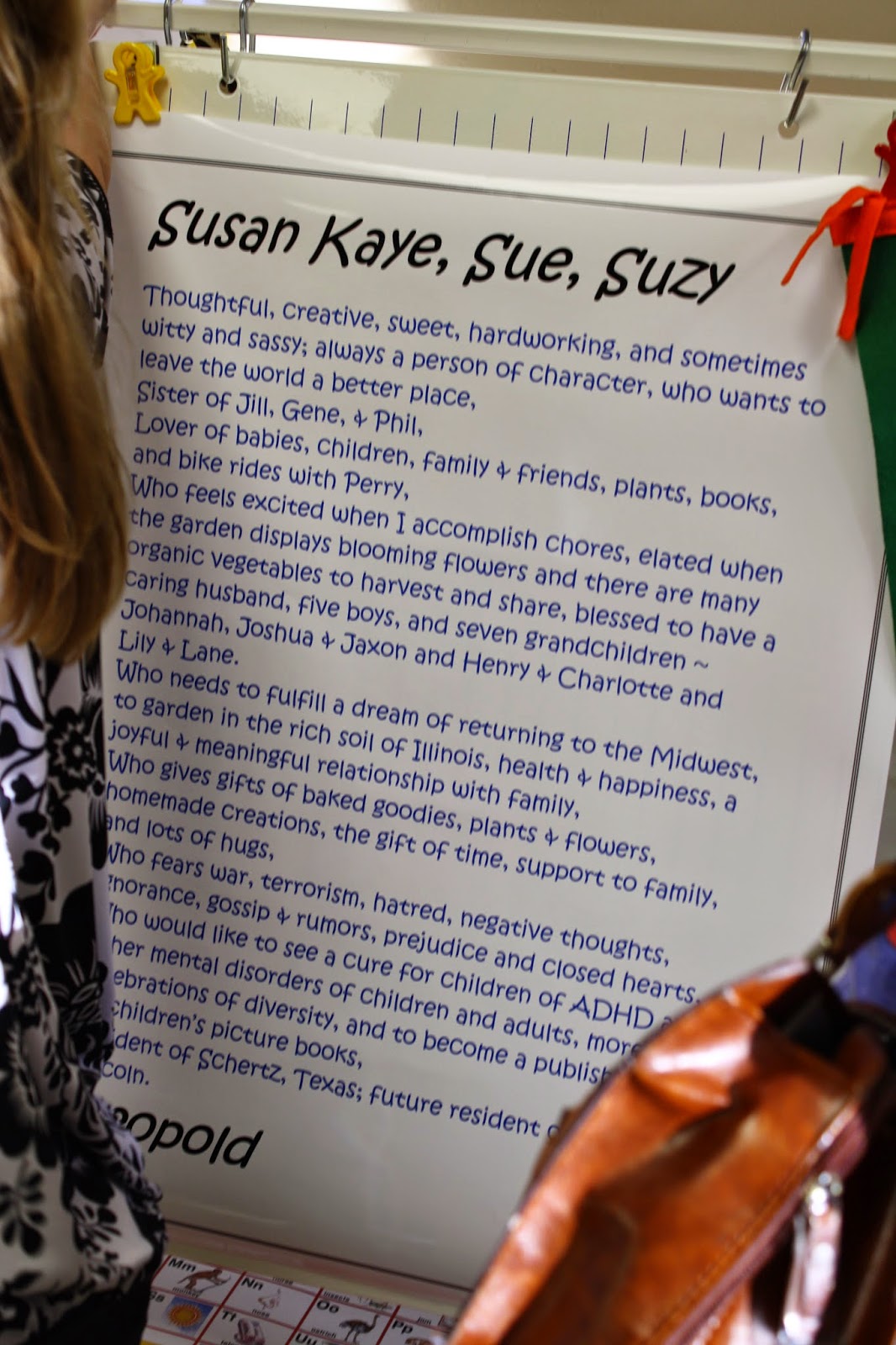
Mrs. Leopold's Bio Poem
Do you know about National Poetry Day? Hopefully, your answer is a resounding, yes! 
Like a flower for it's hour. ~Walter de la Mare
Before I share information with you about National Poetry Day, you need to know about The Forward Arts Foundation

In 1991, William Sieghart, a poetry lover, noted a need for a published anthology containing the best poetry of the year. Sieghart published one himself. 

The Forward Arts Foundation 
The mission statement is: "A charity committed to widening poetry's audience, honouring achievement and supporting talent."

The purpose is: 
  • to identify and encourage talent
  • to inspire a love of poetry in people of all ages and circumstances
  • to support poets at all stages of their careers
  • to encourage collaboration with performers, musicians, artists, film-makers and social innovators
  • to build a sense of community through developing membership

Three years later, in 1994, Sieghart founded National Poetry Day. The annual event was yesterday.

National Poetry Day 
Thursday, October 2, 2014 
Theme: Remember
Think of a Poem
Making poetry heard is important. The Forward Arts Foundation has excellent lessons for celebrating poetry in the classroom. Just check out this link for many lesson plans and much more.

I have a memory of being introduced to poetry, when I was in 5th grade. 

My favorite poem, Me, is by Walter de La Mare, 1873~1956.

My favorite poem from 5th grade.
Do you believe I still have it?
Me 
by Walter de la Mare

As long as I live
I shall always be
My Self-and no other,
Just me.

Like a tree.
Violets that grow in my 
Prairie Flower Garden.

Like a willow or elder,
An aspen, a thorn,
Or a cypress forlorn.

Like a flower,
For its hour
A primrose, a pink,

Or a violet - 

Sunned by the sun,

And with dewdrops wet.

Always just me.


Research shows that beginning readers benefit from listening to stories and poems that rhyme. Emergent readers and writers become stronger and better readers.

Do you have a favorite poet? Can you recite a poem by memory?

It's not too late to celebrate the beauty of poetry. Why wait until the month of April or the one day in October? Celebrate the love of poetry all year long with Kristine O'Connell George.

What poem are you thinking of? Do you have a special poem that you remember as a kid? Which poem do you carry in your pocket? Do you have a poem that you hold deeply in your heart? Poetry must be heard! Poetry must be shared!
Think of a Poem with Suzy Q

Thursday, April 17, 2014

Poetry Month: Let's Write Some Haiku by Todd Burleson

Dear Colleagues,

April is poetry month.  Last week Jon Muth camme to visit my students.  In addition to sharing his magnificent new book "Hi, Koo" he spoke with us about his process and captivated the students with his large brush painting.  He created a priceless painting for us and absolutley delighted everyone with how warm and kind he was.  If you would like to see a short video that highlights his recent visit, you can view it below. 


Jon Muth Visit from Todd Burleson on Vimeo.

 Writing poetry is like rhubarb; people often love it or hate it.  I would like to help those of you who don't love it to see some pretty simple, but rewarding ways to bring poetry to your students.  We touch on these in our Resource Center times, but you might want to revisit them with your students.  You could use them as a 'center' for kids to go to when they are done, or as a 'choice' time activity too.

Because Haiku has been on our radar since Jon Muth's Hi, Koo visit, take a look at a resource that we've shared with all of the students this past week.  It's from Read, Write, Think.  It is available as an app for iPad and as a 'site' on desktops and laptops.  The app is pretty simple.  It reviews Haiku and then helps the kids brainstorm words.  After creating their own Haiku, the kids can tweak the background, font, etc.  The end result is a beautiful creation.  Imagine collecting all of these from your students as PDF's and turning it into an iBook that could be viewed by students.  That would be awesome! 

The app opens with a brief review of what a Haiku poem is.

It walks the students through brainstorming words to use in their poem.

A neat feature is after brainstorming the words, they appear on the screen as you start to write your poem.

The poem appears on a beautiful cherry blossom background, however, the kids can change both the font and backgrounds as they wish.

The final product can be emailed, saved for work later, or downloaded to the desktop to be used as desired.

Give this app a try.  I think you'll be pleased.  It's a fun way to explore Japanese Haiku poetry.