Showing posts with label writing inspiration. Show all posts

Wednesday, April 22, 2026

The Sixth Annual GROG Arthropod Roundtable

hosted by Sue Heavenrich

Welcome to the Sixth Annual Arthropod Roundtable! Grab your cuppa, pull up a chair, and please help me welcome our guests. 

Laura Gehl is a former science teacher and scientist who is now a full-time children’s book author. So it almost makes sense that most of her books center around science and nature themes. Her newest board book is Odd Bugs , the third in a series that includes Odd Beasts and Odd Birds

“When I was doing research for Odd Beasts, I came across a lot of fascinating bugs and couldn’t wait to give them their own book,” says Laura.

Melissa Stewart is a science writer, children’s book author, and avid nature lover. Her new picture book is Monarch and Mourning Cloak: A Butterfly Journal. While visiting schools to take about her earlier butterfly book, A Place for Butterflies (published in 2006) she noticed that many students raise monarchs. She also noticed that they thought all butterfly species have similar lives and habitats. 

“Butterflies are an incredibly diverse group of insects,” Melissa points out. “So, in 2008 I began writing a book called Two Butterflies, Two Lives to help kids understand the variety of foods butterflies eat, the different habitats they call home, and the many ways they survive winter weather.” Over the years, that book evolved into Monarch and Mourning Cloak!

Karen Jameson is a retired elementary school teacher and author of lyrical, rhyming picture books. Insects have found their way into several of her books (including the beetles and dragonflies in It's Time to Shine). There’s even more bugs in her newest book, Who Nests Here?

“Insects have such unique ways of nesting,” says Karen. “I spotlight gall wasps, mole crabs, scorpions, and devil crayfish in my new book. And who wouldn’t thrill to see a termitarium – a giant termite nest?!

Katherine Hocker is a science illustrator, naturalist, and educator with an inordinate fondness for aquatic insects. Her new book, When You See Us, takes us on a field trip into the mysterious and fascinating world of aquatic insects. 

"They are some of the most watchable wildlife I know,” says Katherine. “They live pretty much everywhere on Earth, and are easy to find and observe. When you consider that they live double lives as some of our most familiar winged insects, such as dragonflies and mosquitoes, everyone should know about them!”

Jenni Walsh writes novels for kids and adults. She confesses that she didn’t know how cool bugs were until she was researching their defense mechanisms for her middle-grade tale of mystery and thievery, The Bug Bandits. 

“My book is inspired by a real heist that occurred at the Philadelphia Insectarium," says Jenni. "Over $40,000 worth of rare insects were stolen – and I found this utterly fascinating. In the book, we call it a buglery.”

I’m joining in this year because 13 Ways to Eat a Fly is celebrating its fifth birthday! Before writing books for kids, I taught science and also worked as a newspaper reporter. One afternoon I was covering the opening of a nature preserve. People were standing because there were “small bees” perching on the sun-warmed metal chairs. Those “bees” were actually flower flies – awesome little pollinators! That’s when I realized that too many folks have no idea about the diversity of flies buzzing around them. 

Initially I wrote 13 Ways to Eat a Fly as a backyard field guide. Bo-oring! It took a few years (and many revisions) before I came to the idea of making it a backwards counting book. You know: starting with a bunch of flies that disappear one by one as each hungry critter (or plant) grabs a snack. I added a brain-eating fungus, because who can resist zombies! I got to wondering... 

... why did other folks chose the format they did?

Melissa Stewart
Melissa: Because butterflies are so beautiful and graceful, I thought free-verse poetry would be the best way to share information. Initially, I wrote a series of poems in two voices, but the first-person point of view wasn’t working. Over the years, I continued to revise, writing draft after draft and receiving rejection after rejection. The book’s design pays homage to this process by showing each poem atop a stack of papers. Finally, in 2023, I decided that perhaps the book needed an additional conceptual layer that tied into the art and design. So I sent the manuscript to my friend, illustrator, and past collaborator Sarah S. Brannen. I let her know what I was thinking and invited her to go on a hike to brainstorm. A few hours later, we had a vision for what the book could be—a nature journal bursting with art, poems, and informational notes.

Jenni: I wrote The Bug Bandits for my 10-year-old so middle grade was the perfect age group for him. He’s a reluctant reader but I’m pleased to say he couldn’t resist a heist book that is Night at the Museum meets Home Alone.

Laura Gehl
Laura: I love writing board books because they can serve as a child’s first introduction to a topic—in this case, really weird and amazing bugs!

Karen: Lyrical, rhyming picture books are my jam. It feels natural to write this way in the main text - a style which is brief and accessible to younger readers. Science concepts in the back matter are written in prose for those who wish to explore the topic in more depth.

Katherine: I wanted the story to be told in the voices of the insects themselves—a kind of song they sing to reveal their secrets. That called for a more lyrical approach.

Me: As a kid, I was fascinated by ants. They lived in sidewalk cracks and in our garden, often working together to carry bits of dead beetles to their homes. Plus they have queens! Being a fairy tale-reading second-grader, how could I resist? I wondered ...

... what was the gateway arthropod for other authors?

Katherine Hocker
Katherine: Caddisflies! I remember discovering them as a child—these tiny crawling underwater beasties that built themselves homes out of grains of sand or tiny twigs. We used to call them “stick bugs.” It was many years before I learned that they have a winged adult form.

Laura: I read about a poop-shooting caterpillar when I was in grad school, and one of my first-ever published pieces of writing was about that caterpillar. I’ve been hooked on bugs ever since!

Karen: I am obsessed with dragonflies! Not only are they beautiful, but they’re symbolic of joy, good omens, and transformation.

Melissa: I’ve been a lover of all creatures big and small since childhood. I was fortunate that my parents owned 10 acres of woods, and we had a national forest across the street from our house. My brother and I spent most of our time outdoors—immersed in the natural world. Some of my long-time favorite insects include walking sticks, lightning bugs, and of course, butterflies.

Jenni Walsh
Jenni: I’ve always loved butterflies. When we visited the insectarium the book is based on, my family and I loved walking through the butterfly pavilion. We also hatched them at home and had a release party. It inspired my main character, Liberty, to have a butterfly releasing business in The Bug Bandits!

Me: Today is Earth Day. What can we – and the kids we write for – do to help make our backyards and neighborhoods better places for bugs?

Jenni: There are certain native plants that encourage bug-life, such as butterflies. I encourage everyone to find out what plants/flowers are bug friendly for your area!

Karen Jameson
Karen: I include a Nesting Site Conservation section in the back matter of Who Nests Here? Here’s a few tips: 1) Pick up trash and keep waterways clean. 2) Leave rocks, shells, pine cones and other natural elements where they are, as they may be someone’s home. 3) Don’t poke sticks into nests or move them to another site.

Laura: This is pretty easy for me, because my husband and I don’t have the time or energy to keep our back yard neat or tidy! Having a messy yard with leaf litter, brush/wood piles, clover and dandelions, and sections of longer grass is great for bugs!

Katherine: Aquatic insects need water to survive. Many, such as caddisflies, stoneflies, and mayflies, need water that’s very clean and cold. We can help them thrive by protecting our ponds, lakes, streams, and rivers.

Melissa: Grow native plants is the most obvious answer. But Earth, our precious planet, is one big interconnected system. Anything we can do to lessen pollution and climate change, and to preserve natural areas is going to help every living thing—including us.

your host, Sue Heavenrich
looking for spiders
Me: To these great suggestions I’ll add that using natural mulches, such as dried leaves, grass, and straw creates the perfect habitat for spiders. Also, my lazy gardening provides other benefits. All those dried, hollow flower stems that I never remove turn out to be great homes for native bees. 

We could talk bugs all day long… but I’m out of coffee. Check out our author websites, drop by our blogs, and remember to head outside and watch some bugs!

Katherine Hocker at  https://katherinehocker.art/
Melissa Stewart at   https://melissa-stewart.com/

Wednesday, June 18, 2025

Gone Fishin' ~ a bucket of fishy tales

 by Sue Heavenrich

A couple months ago, Kathy Halsey interviewed Pam Courtney about her new book, A Season For Fishin’: A Fish Fry Tradition. And that got me thinking of all the fish stories my uncles and cousins used to tell – about the ones they caught, the ones that were “this big” (imagine arms spread as wide as they can go), and mostly about the ones that got away. And THAT got me wondering … 

how many ways could we tell a fish story?

We could stick with the facts, like Debra Kempf Shumaker does in her book, Freaky, Funky Fish: Odd Facts about Fascinating Fish. To be a fish, she writes, you have to have certain characteristics: scales, gills, maybe fins. But not all fish are alike. Debra shows, in rhyming text, the different ways fish are adapted to survive in their world. Some fish zap, some sing, some produce copious amounts of slime – and one even has a see-through head! What I love about this book is how she rates each fish on a funkiness scale of 1-5. 


We could profile a specific fish, like Elaine M. Alexander does in Anglerfish: The Seadevil of the Deep. The anglerfish looks like a very scary monster, what with that big mouth and sharp teeth. But she wasn’t always so big, or so toothy. In this book, we follow the anglerfish from fry to fierce predator to releasing eggs for the next generation. What I particularly like about this book is how the dark, mysterious illustrations bring us right into anglerfish’s deep, dark world.. I also like the comparison of the different species of angler fish. I didn’t know there were so many!


We could tell stories about the people who study fish. Like the students in Emmy’s class that Mary Boone follows in School of Fish. They watch salmon eggs from the day they’re dropped into the fish tank to the day they release the fry into a river. Along the way, the students learn about more than fish; they learn about ecosystem connections. And they learn how to work together for the good of the fish.


Or like fish scientists, such as Cristina Zenato, profiled in Sharks Unhooked, The Adventures of Cristina Zenato, Underwater Ranger, by Patricia Newman and Else Bostelmann, the underwater artist profiled in Else B. in the sea : the woman who painted the wonders of the deep, by Jeanne Walker Harvey. Not only are these fish stories, but they are about amazing women in science!


We could write about the important work fish do, like the cleaner fish in Susan Stockdale’s book, Don't Eat the Cleaners! Tiny Fish with a Big Job. When fish get dirty (like … how does that even happen? They live in water!) they head to a cleaning station. Cleaner wrasse and cleaner shrimp hang out there, ready to nibble dead skin and parasites of their fishy customers. These cleaner fish also slip between sharp teeth, pulling out bits of food, and nibble algae from sea turtle shells.

Or how tiny fish no longer than your finger are helping to save an important biome, in Sy Montgomery’s Amazon adventure : how tiny fish are saving the world's largest rainforest. They save not only the rainforest but the culture and economy that depend on them.


And of course, we could tell stories in the tradition of  an authentic “fish story” – absurd tall tales that get taller with each telling. Here are two that had me chuckling:

Don’t Trust Fish, by Neil Sharpson which begins with some matter of fact explanations of how to tell a mammal from a bird but quickly goes off the rails when it comes to fish. Why? Because you can’t trust fish! They spend all their time in the water, some are as big as a bus, and what are they teaching in those “schools” anyways?

I Need Pants! by Susan Sweet in which Fish desperately wants a pair of pants. Octopus points out that Fish can’t wear pants because fish don’t have legs. But once Fish finds a pair of pants and struts around the ocean in style, Octopus decides to try a few pairs on for size … 

So grab your tackle box – or your pencil and notebook, paints and sketchpad – and head to the river. What sort of Fish Story will you come back with?

Wednesday, November 17, 2021

Take a Look Around - What Inspires You?

Most writers and illustrators spend an incredible amount of solitary time in one key  location—whether it's their office, studio space, or a favorite out-of-the-way nook. While lost in thought when we're digging deep—and inevitably searching for a bit of inspiration—what do we look at? What does our gaze settle on?

A piece of beautiful art or a memorable photo? 

A knickknack with an important back-story? 

A meaningful quote?  

What fills us up and nudges us on? Friends in my creative community shared their thoughts with me.


Carmela Martino glances at an opaque blue-gray egg that was a gift during the time she worked on her M.F.A. at Vermont College. At the end of a semester and a period of working closely together, her mentor presented her with the glass egg. She noted it was a symbol of Carmela's yet unborn stories still waiting to be shared. Simply holding or rubbing the smooth, cool glass egg in her hands helps Carmela seek out inspiration.


Looking at a beautiful piece of art and remembering the story associated with the piece plays a central role for many of us. Julie Phend's husband bought her a piece of woodcut art from Costa Rica entitled "El Escribidor," which means The Writer. She noted "it reminds me that I am indeed a writer, and I have a responsibility to develop my skills."  And what a lovely show of support from her husband.

Michelle Schaub studies a postcard she picked up when she signed up for her first Highlights poetry workshop.

At the program, she worked on polishing a manuscript that would later become her first book sale. She didn't know at the time how attending the workshop would boost that project. "I went for the experience, and I met so many amazing people who have become mentors and supporters," she noted. "It reminds me to say 'yes' to opportunities because you don't know where they will lead. And to enjoy the journey as much as the destination."

Dana Easley hangs watercolors in her office so she is surrounded by creativity while she works on her writing projects. (Cool fact—she actually created this art, too, which I think is pretty amazing!) Who wouldn't be energized and inspired looking at beautiful florals as you ponder a first draft or tackle a challenging revision. It's a reminder that our own creativity knows no bounds.


Dana also has a large quote displayed on one of her office walls that says "Books turn Muggles into Wizards." It reminds her of the joy and value of books. (Created from a vinyl adhesive decal  ordered online—you simply rub it on the wall surface.) I love Dana's example of a big quote on the wall of your office. How cool is that?  I'm going  to have to think about how I can use this awesome idea.

Patty Toht has a few favorite quotes that help her move forward. There are two that she keeps taped to her computer . . . "Almost all good writing begins with terrible first efforts. You need to start somewhere."—Anne Lamont, Bird by Bird. (I need to remember that as I start my awful first drafts . . .) And then there's this one, "Many of life's failures are people who did not realize how close they were to success when they gave up."
—Thomas Edison. I love both of these!

When Christy Mihaly was out for a nature walk, she spotted this hand-painted stone. Who painted it? And who took the time to leave it as a sweet surprise for someone to find and brighten their day? An unsolved mystery. It reminds Christy to take notice, be present—and yes, to take joy! (Plus it makes her smile—and a happy writer is usually a productive writer.)


Suzy Leopold finds inspiration from a beautiful hand-quilted creation made by her mom. Displayed right next to her writing desk, gazing at the lovely quilt reminds Suzy of her mother's love as well as her supportive and encouraging words: read, write and create every day. (Bonus—on a cold winter's day Suzy can also use the quilt for an extra layer of warmth to chase away the chill!)


Sherri Rivers surveys the Word Bird art perched on her bookcase and reflects on the amazing experience she had at a Highlights Nonfiction Workshop. During the conference, attendees bid on items as a small fundraiser and this cute piece caught her eye. After winning the bid, her workshop leader would not let her pay for it and bought it for her! Whenever she looks at this little treasure, she remembers the joy of attending the conference, the kindness and generosity of her workshop leader—and the kidlit community in general. Sherri knows that words count and can change lives!


I have one favorite object that speaks to me.  I keep a heavy, round paperweight in a prominent spot on my desk. It's right next to my computer monitor, so I see it whenever I sit down to work. It reads: "The difference between ordinary and extraordinary is that little extra." When I'm done with my umpteenth draft of a picture book project and think it just might be across the finish line . . . this paperweight serves as a nice braking mechanism. It encourages me to have patience and set high standards for this work-in-progress. It reminds me to use my critique groups for input. It sends a message to gather and listen to the feedback from industry professionals at conferences. And most importantly,  it signals to give my project more effort before sharing it with a key decision-maker. (Besides, it looks a lot nicer than a big red STOP sign!)


Take a look around. What inspires YOU in your favorite workspace? 


Wednesday, September 15, 2021

Submission Strategy: Aim for 100 Rejections (or more)

a Roundtable Discussion led by Kathy Halsey
 
Back in 2019 I was commiserating with writing friend, Beth Gallagher about "rejection." As it turned out, she had been having a similar conversation with another author, a friend who happened to be a best-seller. Beth remembers complaining that she “might not be meant to write.” Her friend said that his first book had been rejected 47 times before it was published, and was now being made into a movie. He encouraged her to wallow only after the 100th rejection. 

As we talked, the kernel of an idea began to form. Why not create a group to support each other as we aim to reach 100 rejections? So that’s what we did in January 2019. I announced it on the GROG and invited folks to join.


Now we have 64 members who support and motivate each other. We invited a few of them over to the GROG blog share thoughts about aiming high for rejections. Hanging out at the blog with me today are Beth, Dedra Davis, Patti Richards, and fellow GROGger, Sue Heavenrich.

Kathy: Welcome and thanks for joining us today. My reaction to 100 rejections was, why not? Beth and I wanted accountability and I like doing things in a BIG way. What was your reaction to the idea of 100 rejections being a good thing?

Beth: One of the things I realized was how subjective this business is, and that it truly is a numbers game. And that I needed to get my nose back to the grindstone.

Dedra: I have two words that keep me going—Fail Forward. Sending out 100 queries and, most likely, receiving 100 rejections fall into my theme of failing forward. I’ve sent 90 this year; and I’ve been collecting rejections for over two years now.

Patti Richards 
Patti:
Having been in the submission trenches for many years, the idea of a group dedicated solely to encouraging each other to keep submitting makes me so happy! Having a place to share successes and "declinations," submission opportunities, and lots of "You can do this!” means  everything!

Sue: I thought the idea was brilliant. I could not wait to flip my perspective on the submissions game, and going for rejections would definitely do that. Even though it sounds crazy, I get it: the more you submit, the more chance there is of someone saying YES.

Kathy: By making an outrageous goal, somehow subbing felt less serious to me and gave me freedom not to take the process so solemnly. How did having a goal of 100 rejections change the way you submit?

Beth Gallagher


Beth: Having 100 rejections first made me imagine get enough of them to decoupage an entire wall of my studio. Like Kathy, that goal gave me the freedom to keep on trying without feeling like I’m failing.

Dedra: It’s a challenge I give myself; it keeps me researching and sending queries out throughout the year. I like a challenge. I feel like the ball is in my court when I query and hit send. Then, of course, it’s up to the agent.

Patti: In this business, rejections, no matter where you are on your journey can sting. Seasoned writers develop a thick skin over time, or at least they should. Changing the way you think about rejection really helps with this! Having this "reverse" goal means you've come to a point where you realize that without rejection, there can be no success. 

Sue: Having this challenge spurred me to become more organized. I drew a 10-by-10 grid at the back of my desk calendar and numbered each square. Each time I submitted, I checked off a box. What a feeling of accomplishment! Each check represented a potential rejection! By the end of 2019, I’d gathered more than 90 rejections and four “Yesses” – assignments for articles.

Kathy: The real test is whether aiming for those rejections helped us succeed. For me, I did succeed by accepting every opportunity for a “yes” in 2019. My successes include a #PBChat 2109 mentorship, an opportunity to work for Storyteller Academy, and doing author studies for ReFoReMo. (No “yes” yet, but I feel it’s coming.) What about everyone else?

Beth: Since it IS a numbers game, the aim of getting 100 rejections ensures my odds of achieving either that number or publication! As for success, it’s achieving the goals I set for myself. If we don’t have confidence in our own work, how can we expect others to? I’m thrilled that so many writers both published and nonpublished have joined our merry band FB group! It’s so nice to have a place to vent, chat, share opportunities, and meet new friends.

Dedra: To me, success is having an agent and a book deal – and a career of ongoing book deals. I haven’t succeeded yet. YET! But I will, and the 100 rejections keep the challenge and me moving forward and failing forward. What I really want is kids holding my book. saying, “Read it again!" To that end, I’m participating in Julie Hedlund’s 12 X 12 Picture Book Challenge. So far, I have twenty manuscripts from this year: I’m constantly revising and writing new stories. One day, when the time is right, I’ll have plenty of manuscripts to offer an agent. 

Patti: Absolutely! I've actually lost track of how many rejections I've had since joining this group, even though I have an Excel spreadsheet filled with them. I'm pretty sure I've hit the 100 mark or am close to it! Having this goal has kept me moving forward in the face of some pretty disappointing rejections since we formed the group. "Moving forward" is now how I define success, and it's all due to having something to shoot for besides those coveted contracts! Since this group began, I've sold 3 picture books! MRS. NOAH (Little Lamb Books) releases on October 5th! And I’m still submitting – let those “declinations” roll in!

Sue Heavenrich
Sue: Aiming for rejection put less pressure on me to get a “yes” – and without that pressure the fear of “failure” disappeared. Sending out 5 subs a week gave me a rhythm for submitting. It gave me tons of practice writing query letters. It gave me a tremendous feeling of accomplishment that I’d gotten 90-ish subs out the door. To me, success is all about showing up. Being willing to do the work. And having faith in my stories. One of those potential rejections, a nonfiction book proposal, now has a title and is slated for release in 2022. 

Kathy: I gain momentum and inspiration from being in this group of strong, talented, resilient writers. You can join us at 100 Rejections Are a Good Thing. Start racking up the trail of “nos” that lead to “yes.” You can do it!

Wednesday, February 6, 2019

Cabin Fever Writing Month


By the time February comes 'round, writers in my neck of the woods get cranky. Stir crazy. Apt to toss computers out the window and into the snow.

It's Cabin Fever time. But this year a bunch of us have a remedy: Cabin Fever Writing Month. At the back table in the library. Bring your own coffee; chocolate will be provided. Along with heat, books, and a feeling of neighborliness without the demands of making conversation.

You see, we plan to write. Because every one of us took a look at the calendar when NaNoWriMo came along and rolled our eyes.

"A guy must have come up with November," we agreed. After all, there were turkeys to catch, pies to bake, community harvest dinners, family dinners, getting a head start on overseas holiday cards...

"Let's do it next year," we said. Nothing ever happens in February. Sure, there are holidays - Groundhog Day, Lunar New Year, President's Day, Valentine's Day - but nothing requiring pies. Or turkeys. So this month we're pulling out those outlines for novels, our scribbled thoughts for a short story, and picture book manuscripts that got shoved aside during the holidays. We're tucking folders and laptops and thermoses full of hot cocoa or coffee into our book bags and heading to the library. On Wednesdays. To write. With our friends.

Who knows? Maybe we'll actually finish that draft, or turn a few StoryStorm ideas into completed stories.

Because this time next month the sky will be brighter, the days longer, and the world will smell like spring. So this is it, my friends. Sharpen your pencils and get those words onto the page before the ice melts and the sap starts runnin'.

Monday, May 15, 2017

Let's Play! ~ Christy Mihaly

By Jlbirman1 (Own work)
[CC BY-SA 3.0 (http://creativecommons.org/licenses/by-sa/3.0)]
Writing is my jobit's how I make a living. I love it, but sometimes it's a tough slog: a deadline looms, a beloved manuscript isn’t selling, and words bog down and refuse to sing. Ugh.

As the weather warms, it's a good time to remember an important part of the work of writing that we don't always honor: PLAY. 

Earlier this month I had the great pleasure of hanging out with a bunch of artists for a week. Watching the visual artists at work was a powerful reminder that play is central to the creative process.

The lucky participants in Vermont Artists Week,
Vermont Studio Center, May 2017
View from my studio window:
the VSC's Red Mill, on the Gihon River,
Johnson, Vermont
The event was a week-long residency at the Vermont Studio Center, on the Gihon River in Johnson, Vermont. VSC offers full-month residencies to artists and writers from around the world . . . but each spring they reserve one week for Vermont artists and writers. What a gift!


I'd submitted my work in January and then held my breath for a month. I was thrilled to hear in February that I was accepted for Vermont Artists Week. Finally, at the beginning of May, from the far corners of this small state, we assembled: eighteen writers (poets, novelists, memoirists, nonfiction writers) and 30+ visual artists (painters, sculptors, printers, photographers). Among these were several who writer and/or illustrate kids' books! The very air was abuzz with creativity.

Butmy point about the playing: 
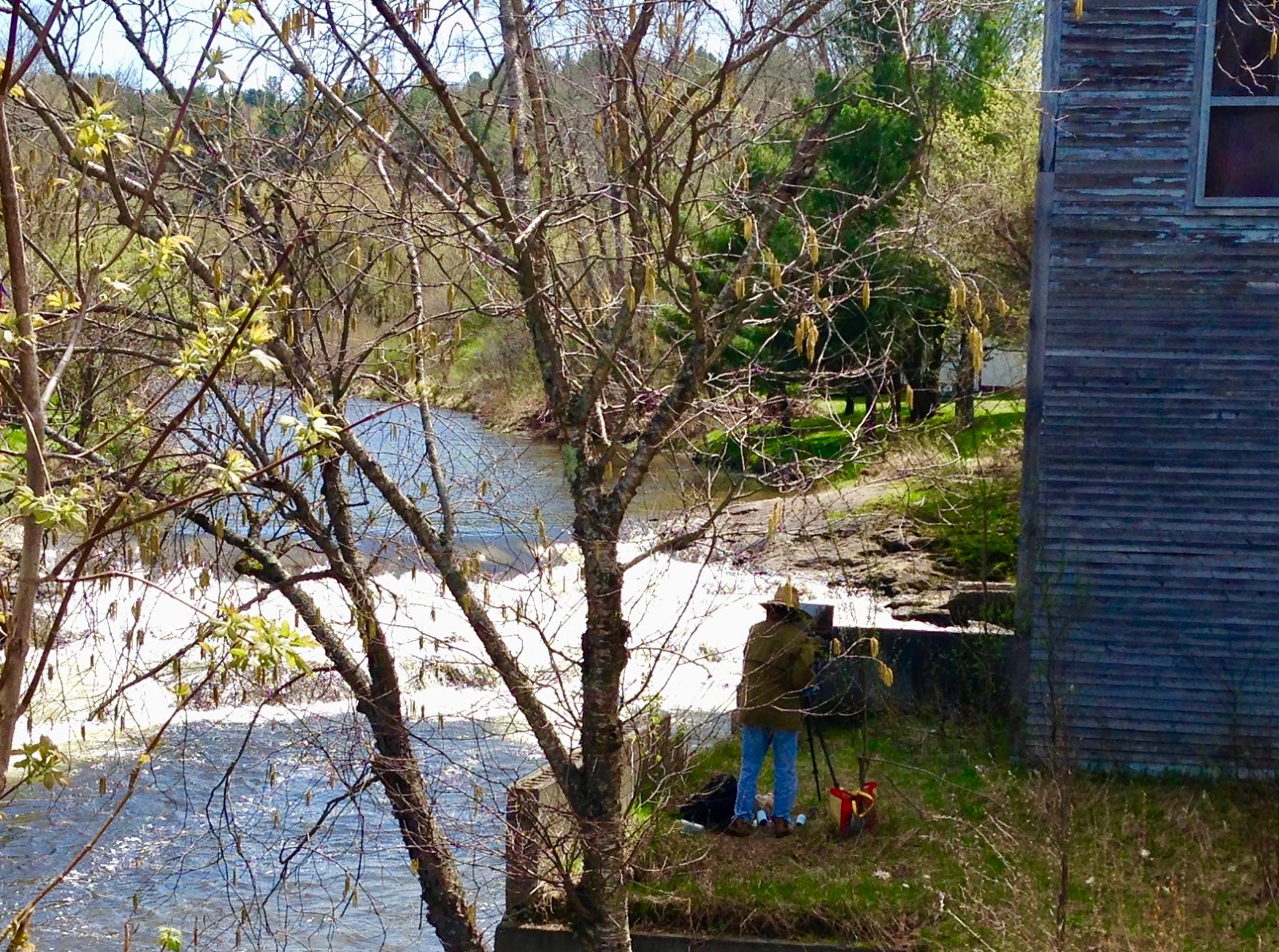
Artist at easel, by the river -- plein air painting

As I visited the artists' studios and admired the art that these folks had created, I was struck to hear them all describe what they'd done at VSC as “playing.” A woman who usually works with metal had used the week to play with cloth. A sculptor who works in wood or stone was playing with clay. Someone else was experimenting with a new way to compose her collages. Another was trying out new materials and playing with new combinations of colors.

They all were having tons of fun. 


My writing studio for the week.
(Yes, it has a view of the river)
Over in the writers' studios, we writers were soaking up the atmosphere, taking advantage of all that VSC offers . . . and working hard. Among the writers, I sensed higher levels of angst than I'd seen in the art studios. Like many of the writers, I'd  arrived with a long “To Do” list, and didn't want to waste a moment of precious writing time. 

Halfway through a week of intense work, though, my brain seized up. I was stuck on a balky manuscript. Of course, stops and starts can all be part of the writing process, but . . . I could see that those playful artists were on to something good. I started thinking about ways I could bring more play into my writing life. 

Here are a few ideas I collected:

Write a poem. It could be a little ditty about anything, just for fun. A silly rhyme! A haiku! Or, you could try a poem focused on a work in progress, perhaps free verse from your main character's point of view. 

The writers' version of playing:
a manual typewriter in the common area was
an invitation to type out random thoughts and notes

Write in a new genre. If you're a nonfiction writer, experiment with a short story. If you're a novel writer, try a first-person magazine article. Play around with it!

Play with point of view. 
Consider writing a page or a chapter of your story from a different POV. 

Sculpture of branches and feathers,
by Sabine Likhite 
Appreciate art. Just breathing the air of the art studios was enough to get some creative juices flowing. Try closing your eyes, and picture what you're writing about. How would you re-create your subject with paints or clay or wax or fabric? Does that give you new inspiration to paint with your words?


Eve at Journey's End


Of course sometimes, the working writer needs to get up out of the chair and find some fun elsewhere! How about these options?

Walk! Walking is an important part of the writing process for me. In Johnson, I enjoyed a woodsy walk to Journey's End falls with artist friend Eve Jacobs-Carnahan. 
Fairy House
We admired the waterfall, and then, thanks to Eve and her artist's eye, we also appreciated some unexpected creations left by prior hikers: fairy houses and gnome homes hidden in the underbrush. Some artistic souls had engaged in play that elves could be thankful for.

Ebenezer Book is awesome
(and not just because they carry my books!)

Visit your local bookstore, and read something fun! I visited (several times) the town of Johnson's outstanding local shop, Ebenezer Books. Along with a reference work for a nonfiction work-in-progress, I bought volumes of poetry and funny picture books -- that's some great play for a kids' writer!

Buy an artist (or a writer) a drink, and share some stories. Writers don't often get opportunities to compare notes with one another, and with artists, so if the chance presents itself, say yes! One of the joys of Vermont Artists’ Week was meeting so many neighbors (of both the writerly and artistic persuasions) and sharing stories of our work and our lives (and all the people we knew in common), and expanding our circles of creative colleagues. If that's not fun, what is?

So, if the grind gets you down, remember to play with your work! Try new things, notice the unexpected, and enjoy the journey.  Happy writing!
Covered bridge in the rain, Johnson.
Because, Vermont.

Monday, January 2, 2017

Start New Year with a Storm of Story Ideas


~by Sue Heavenrich 

I love the beginning of a new year. It gives me a great excuse to buy pens and notebooks and sticky notes... and inspires me to list my writing goals for the upcoming twelve months. And then... I eat chocolate and split wood and procrastinate.

But not this year because Tara Lazar - the very Tara of PiBiIdMo fame- has a brainstorming challenge to get us going for the year. It's called Storystorm and it happens this month! 

If you participated in PiBoIdMo - aka, Picture Book Idea Month - you'll remember it was during November. The idea was awesome: jot down an idea or two for picture books every day during the month - kind of like NaNoWriMo but with way fewer words.

The timing was not so great. "Over the years I kept hearing the same questions," Tara said. "Why November? It's always such a busy time, what with Thanksgiving." She paused, musing that she never meant it to be a burden. "So I got to thinking, what month could I do it?"

The answer: January. It's a new year and what better way to start a new year than with a month of new ideas!

"People probably have some writing resolutions to begin their new year. So I figured I'd make a challenge that would fit in with that. It would be like going to the [writing] gym," Tara said.

 But wait! There's more! Tara wanted to open the idea-generating challenge to any kind of writer or artist, whether picture book or novelist, illustrator or fine artist. "Putting aside time everyday to think about projects is a good habit," she says. "I see the Storystorm challenge as an opportunity for people to unplug and take time to think about their art." 

Storystorm is a month of brainstorming, Tara says. At the end of the month participants should have their brains filled up with ideas and be ready to go. Tara has a month's worth of guest bloggers lined up: novelists, picture book writers, nonfiction writers, artists, and experts in creativity. Registration is open through Saturday, January 7  here, where you'll also find a link to the Facebook discussion group. Check Tara's blog daily for Storystorm posts.

"It takes 30 days to make a habit," says Tara. She hopes people will continue this daily habit of catching ideas for the following eleven months.

When Tara isn't rounding up story ideas, she's busy writing and raising her children. She's a member on the Rutgers University Council on Children's Literature conference committee and also a mentor for We Need Diverse Books. She's written a bunch of picture books (The Monstore, I Thought This Was A Bear Book,    Little Red Gliding Hood, Normal Norman,Way Past  Bedtime, 7 Ate 9: The Untold Story) and she’s busy on her newest project: The Whiz-Bang Word Book - an illustrated dictionary. You can find out more about her at her website, taralazar.com