Showing posts with label writer's block. Show all posts

Wednesday, November 8, 2023

GOT WRITER'S BLOCK? by Mona Pease


I personally don’t believe there’s such a thing as writer’s block. When I sit and stare at the blank page, I like to think of it as brain rest! There’s no point sitting there trying to have words magically appear. Instead, it may be best to get up and walk away, just for a bit anyway. Do something else for awhile until enough’s enough and naptime is over!


“But I’m still drawing a blank.” 


So let’s shake things up and get back to creating those wonderful stories that we know are resting in there somewhere.  Here are some ideas and resources that help me find light again. Maybe a few things that could help start your sparks flickering again too. 

I thrive on deadlines, prompts, and contests. Not that I have editor or agent deadlines. I make my own. The ones that I set for myself to keep me accountable to me and my critique partners. 


WRITING PROMPTS

Start here, right where you are. Look outside your window. What do you see? Leaves fluttering to the ground but only one whirls away. Where is it going?  An unusual bird at your feeder, not like the others? Mmmm…where did that one come from? How about the kids across the street trying to find their dog who has broken its leash. Is your mind turning this into an exciting adventure? What are you cooking? A family recipe that you could write about, its origin and tradition. 

Here’s another way to activate your writing muse again. Members of our critique group post random photos or videos as prompts then we quickly spill out 50 words or less. Just ramble on the page without thinking much about it. Totally different thoughts and words burst from this exercise. Each writer has a different story to tell. Some are lyrical, or family oriented, maybe nonfiction or mysterious. A few might make it to your storyboard!

Still not there?

Here's a site that offers 100 ideas of things to write about.

 https://kindlepreneur.com/childrens-book-ideas/

And this one could be my favorite for grabbing random prompts. Maybe because it’s like a wheel of fortune or a mysterious grab bag.

https://wordwall.net/resource/418403/writing-prompts

Round and round and round it spun and this is the prompt it found for me—

                     You are walking through a forest when one of the trees

starts talking to you. What does it have to say? What

do you do?

My mind takes the nonfiction path with researching trees, forests, production, photosynthesis, maple syrup, deciduous, evergreen…..


Or, you may take another path that leads to a mysterious new world where all the trees talk and you are the alien! That’s kind of an interesting twist, isn’t it? And I certainly wouldn’t have thought of it without the random wheel spin.


CONTESTS AND BLOGS

They’re all about deadlines and themes and prompts and wise advice from professionals. And, often PRIZES!

We’re heading into a new year and that means new story ideas, especially if you start off in January by joining Tara Lazar and her StoryStorm. Presenters will take you on their publication journeys, offer helpful hints, or glimpses of book pages. Your mission is to jot at least one story idea for thirty days. And, who knows, a few of them might explode into new manuscripts!  You must be registered, comment on the posts, and then sign a pledge saying you’ve come up with at least thirty story ideas to make you eligible for randomly drawn prizes. That’s it! 

Then in February, if you love nonfiction and biographies as much as I do, you may want to join the NFNinjas over at www.nffest.com The blog is full of information and inspiration. The Ninjas describe the NFfest as a “month long crash course in nonfiction.”
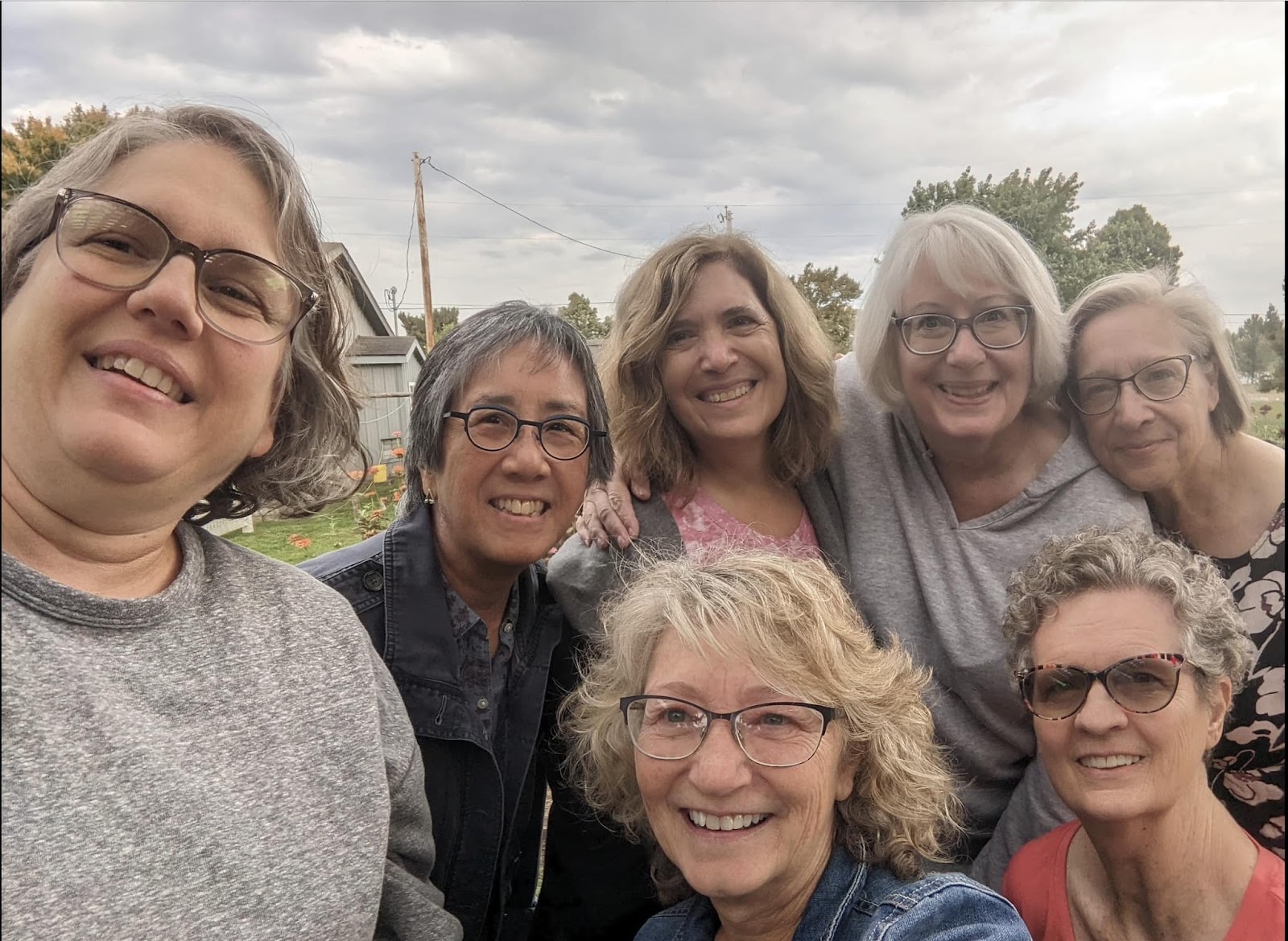

Here they are going off on a planning retreat because after the Fest, they hang around for the year offering nonfiction writing tips and advice. N
ow, I bet you’re full of inspiration and ready to write! Not quite?

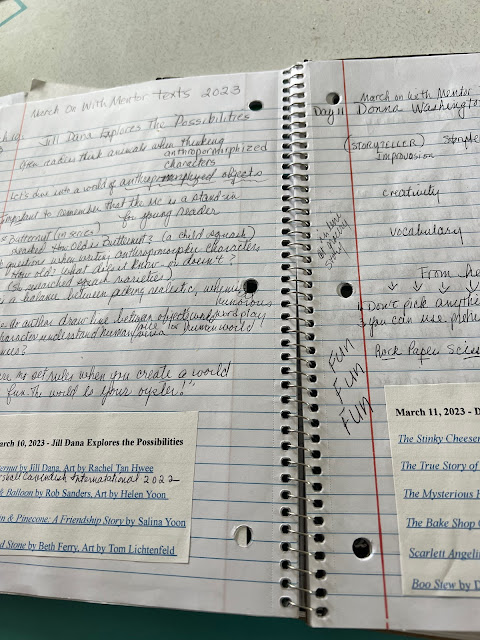
Well then, how about going over to spend March with Lynne Marie at www.rateyourstory.org/march-on. It surprises me at how much I can learn by reading other authors’ children’s books. I have a special notebook for this one. I literally “copy, cut, and paste”!  


AND MORE!

The wonderful, yes, wonderful person/author, Vivian Kirkfield, offers us the 50 Precious Words contest in March. Fifty words don’t seem like many, but try and write a children’s story with a beginning, middle, and end, with a plot in just fifty words!

Then there’s Susanna Leonard Hill, who gives you opportunity to sharpen your pencil and writing skills with Valentiney, Halloweensie, and Holiday contests.  

Kaitlyn Leean Sanchez, literary agent, gives you a chance to “create connections and grow as writers” with her Fall Writing Frenzy. Isn’t that what we’re looking for, to grow as writers?

There are so many more sites and authors who can help us get out of that writer's block we thought we were in. Look around, visit their sites, and I'll bet you'll find lots of help to get your muse motoring again! Which ones have I missed? Where are your favorite story igniters?

Be inspired! 

Get excited!

Write!


Wednesday, May 4, 2022

6 Views on Why We Need Nature

by Sue Heavenrich

Whenever I get stuck in my writing, I head outside. I tuck my camera in my pocket and tell myself that I’m just going out for a breath of fresh air. I might walk down my road, noticing how low the sun is in the sky, or the way snowflakes rest on dried rosehips.

I might wander around the yard, discovering brilliant green moss gardens. Or I’ll pull on my garden boots and head to the garden – which sometimes turns into a three-hour minivacation as I discover bees and flies, watch birds, notice buds opening. I’ve been known to turn a quick one-mile walk into an hour exploration.
photo by Sue Heavenrich

My excuse: being outside, in nature, is Good For Me. And there’s research to back it up. Time spent in nature – whether it’s a hiking trail or a patch of green in your backyard – can perk up your brain, decrease stress, make you happier, and increase your creativity. 

Add in some exercise, and you’ve got a winning recipe for breaking through tiny creative blocks. Not only is walking good for your health, it stimulates creativity and improves one’s mood. According to a study at Stanford, people’s creative output increased 60 percent while walking.

I know that when I come back inside, I feel more creative. So I asked a few friends whether they took nature breaks.

They are essential, says snail scientist and writer, Marla Coppolino. “If I've been struggling to figure out how to write or draw something, the "a-ha" moments come when I step outside and meander through my field and connect with the grasses, insects, and whatever else I meet. It re-awakens the parts of my mind that solve problems. Maybe part of this just comes from relaxing, but I think it's more of the connection I feel.”

Illustrator, Annie Zygarowicz spends time watching clouds with her husband. “When we’re driving, we’ll pull over to observe and photograph the cloud formations, their color, density and texture.” Cloud photos and memories inspire their painting and poetry.  

When author Kathy Halsey feels stuck, she heads out to a garden. “Being surrounded by growing things, the sounds of birds and the wind  make feel hopeful and refreshed. My head clears. I feel relaxed, less stressed, and able to sit and work again.” Spending quiet time outdoors has renewed her interest in writing haiku, and she shares her Saturday haiku on twitter using the hashtag #HaikuSaturday. In turn, writing haiku has made her more observant of nature. 

photo by Leslie Colin Tribble

Christy Mihaly sometimes takes her manuscript for a walk. “Usually I walk with my dog through the woods. Sometimes I focus on a particular story problem. Other times, I'm just taking a break and letting my mind wander. Either way, every time, it gets my brain out of whatever rut it’s in, and gives me a fresh start when I return to work. Often the universe sends me new lines for a poem as I walk.”

One such walk resulted in a picture book. Strolling by a hayfield and watching the balers operate, Chris mused, “Storing summer in a bale…” Those thoughts grew into HEY, HEY, HAY! (A Tale of Bales and the Machines That Make them)

Photographer and nature writer Leslie Colin Tribble finds that being outside is the best therapy for feeding the creative part of her life. “The act of movement while being outdoors sparks my mind into focus and clarity. Putting one foot in front of the other clears my thoughts and gives me greater vision about a project - allowing my mind to wander into the story I’m writing. Nature photography sharpens my perception, and I love stumbling across the perfect vignette of rock, lichen, wildflowers and soil that I can capture with my lens. Focusing on the small things in the immense landscape where I live reminds me that the tiniest detail is important in creative efforts.”

Later, when she looks back on her photos, she feels the sense of place all over again – bringing back physical and emotional details she can incorporate in a story.

So this week, head outside and see what you can discover. And if you are looking for some weekly nature breaks, check out my Wednesday posts at Archimedes Notebook.

Thursday, April 27, 2017

Filling the Creative Well

by Sue Heavenrich

Earlier this month Christy shared a passel of great ideas for what to do to “blast through writer’s block”. Reading her post reminded me of the “artist dates” that Julia Cameron advocates in her book, The Artist’s Way. 

Cameron encourages writers (and other artists) to take time for themselves in doing activities that “fill the well” of creativity. She calls these once-a-week encounters “artist dates”. The thing is, Cameron explains, that they are things you do to explore something that interests you, fires up your imagination, sparks whimsy, encourages play. They are activities that “feed our creative work by replenishing our inner well of images and inspiration,” she says.

There are no rules about how to do artist dates other than to ask yourself: what sound fun? And then allow yourself to try it – even if it is something you have never done before. In that spirit, I share a year’s worth of artist dates I have done or intend to try, plus those gleaned from fellow writers and illustrators. Try one; try them all – and add your own ideas to the list. 


Around the home and yard:

  • Listen to classical music (or the Hamilton sound track)
  • Read a book – even cartoon paperbacks
  • Put on some dance music and move
  • Find streets/ buildings/ places in your town you have never been to before
  • Bake or cook something
  • Watch a movie
  • Grow a mini-garden in your kitchen
  • Make a blanket fort, snuggle in with books and hot cocoa
  • Find some postcards; then write notes on them and mail them to friends

Take a field trip:
  • Visit an art museum or gallery
  • Meander through a used book store or library book sale
  • Turn a map upside down and see where it takes you
  • Attend a local festival
  • Hang out in an ethnic shop
  • Visit a zoo or botanical garden
  • Visit a museum
  • Visit a historical building
  • Look at doors or stairs on houses you walk by
  • Visit a farmer’s market
  • Explore an antique store
  • Ride on a bus

Outside/ nature:
  • Walk in the woods or a park
  • Meditate on a beach or river bank
  • Go on a walk to look at flowers growing in yards
  • Lay on your back and watch clouds
  • Watch leaves spin and fall
  • Follow a butterfly or bumble bee
  

 Make Something:
  • Make a collage from old magazines
  • Make a sculpture from junk
  • Paint on something that is not paper
  • Make a greeting card for someone
  • Make or cut out paper dolls
  • Make a journal or notebook
  • Take your camera for a walk
  • Write haiku or other poetry
  • Make something that could hang from a window or Christmas tree
  • Let a cookie fortune inspire you
  • Create sidewalk art with colored chalk
  • Make a map of a story that’s tickling your mind
  • Paint with berry juice
  • Capture a sunset with watercolors

 Play:
  • Build with legos or blocks
  • Start a collection of stones, marbles
  • Play in the snow
  • Make some play-dough and play with it
  • Finger paint
  • Play with a kid’s toy you enjoyed
  • Learn some words in a new language
  • Do a jigsaw puzzle
  • Try origami
  • Go fly a kite
  • Invent new words with scrabble tiles

Monday, April 10, 2017

Blasting Through Writer's Block ~ by Christy Mihaly

When faced with the dreaded Writer’s Block . . . what should a working writer do?


Pyre-Vulpimorph: http://fav.me/d5xoc7s

(a) sit and stew
(b) scream and shout
(c) swear: "I'll never write again!"

OR 
(d): Read this post, and get yourself out of that funk. 

GROG readers, take heart! Yes, sometimes it seems as if the Muse has flown, never to be seen again. We've all been there. But if you're looking for a way out of the mire, select option (d), and consider these tried-and-true secrets for blasting through that block.


1. Move! Get up from your dreary desk, and try one (or more) of these potentially productive options for movement:

Christian Gonzalez, flickr:
  https://www.flickr.com/
photos/full-aperture/8265272536
    
a. Take a walk. Some writers call this “walking the story.” It’s smart to carry a notebook and pencil, or some other way to record your thoughts, because inspiration often shows up on long walks.

b. Move to a different writing space. Maybe it’s just to a comfy chair in the den. Maybe you can sit with your laptop under the spreading oak. You’ll benefit from  looking at the world from a new perspective.

c.  Run some errands. If it’s stuff you have to do anyway, don’t think of it as wasting time . . . just be sure to keep your mind open to creative thinking while driving or walking or riding. And if you have to pull over and write something down – do it.

d. Take a shower. Sometimes, ahem, we at-home writers might “forget.” Look down. Are you still wearing your pajamas at 2:00 p.m.? Perhaps a nice shower and a change of clothes would get the blood flowing to the brain.

2.     Find Fresh Inspiration. There are many ways to recharge your writing batteries and collect new writing ideas.

a.  Read.  Read mentor texts. Read poetry. Read anything. Notice what works and doesn’t work, yes. But read, read, read, for the pleasure of it.

b.  Watch kids. Don't be creepy, but if you’re a writer for children, you must understand how kids operate to write authentically about and for them. Sit by a playground or park, if you can, or spend time observing your own children or grandchildren.

c.  Fill the well. If your creativity is running dry, consider visiting an art show or a museum, or drawing or painting or playing some music or singing or doing whatever it is that feeds your artist’s spirit.
Leonid Pasternak, “The Passion of Creation”  [wikimedia]

d.  Call a writing buddy. Commiserate with someone who understands. Ask your friend to hold you accountable for your writing. Talk over some ideas that might work.

e.  Work on your craft. Are you thinking about signing up for a course or a workshop? Perhaps it’s a good time to buy a book about the craft of writing, and start working through it.

f.   Stretch your writing muscles. Switch it up with some writing exercises. If your picture book isn’t working, try making a picture book dummy. Compose a poem in your main character’s voice. Or change your story from the past tense to the present. Find the fun!

 https://www.flickr.com/photos/theilr/5360570788    

3. 
Productive procrastination. You must, of course, avoid regular procrastination -- the time-wasting kind. But in a pinch, a bit of writing-related procrastination may prove profitable. So if creative energy eludes you, try some tasks that use other parts of your writing brain.

a. Pursue the business of writing. Update (or write) your lists, your spreadsheet of manuscripts, your chart of submissions. Send a reminder to someone who has been holding your manuscript or query for six months; submit a piece if it’s ready.

b. Organize your files. Be on the lookout for a prior draft or an old manuscript that calls to you. Is it time for a fresh revision? Is this just what an editor wants now? Can you breathe new life into this piece?
 Sharon Drummond, https://www.flickr.com/photos/dolmansaxlil/4487159833    

c.  Check your deadlines. Maybe you have another project that’s due soon, or the contest you've meaning to enter is about to close. Deadlines can be highly motivating.

d.  Research. Maybe you need to do library or field research or photo research, for fiction or nonfiction work. Maybe you can work investigate possible publishers, agents, markets, or theme lists, doing research can inspire new writing ideas. Completing a bibliography can feel very productive, too, and remind you just how much you know about your topic.


e.   Plan a presentation. Have you been meaning to schedule a school visit or bookstore presentation? Think about working on this.

f.  Consider your writing plan. Identify your writing priorities. Do you want to sign up for a writing course? Read a book on craft? Do you want to try a different genre? Join a writing group? Volunteer for SCBWI? All these actions can move your writing forward . . . and get you out of the block.

And, finally, one of my personal favorites. . . write a blog post! 

If you have your own writer's block remedies to share, let us know in the comments.  And happy writing!