Showing posts with label Advice on Writing. Show all posts

Wednesday, September 25, 2019

Welcome to our newest blogger, Carol Coven Grannick! ~ by Patricia Toht

The GROG has added a new blogger to its roster:

Carol Coven Grannick!

PT: Welcome, Carol! How did you get started as a writer?

Carol: As a child, it seemed natural for me to write, to put thoughts and emotions to paper. From childhood on, poetry and wonderful stories delighted and moved me, and the most natural thing in the world seemed to be for me to create the same. I suppose without putting it into words at the time, it felt like this - this thing, this experience is 'me.'

As far as I've meandered from full-time writing, being a writer has always figured into my multi-faceted identity. But there did come a time, once I was writing for children in a committed way, when I said to myself that whether or not I ever became book-published, I was a writer, and would keep writing. For several years, I put submitting on the back burner, and that freed me to write exactly what I needed and wanted to write. I still do. The deepest joy is in creating and re-creating.


PT: What inspires you?

Carol: Everywhere I go, everything I do, every moment of my life, can inspire a poem or idea for a picture book. It could be something a child does or says, something I observe or experience during the day, but it's always something visceral and something that my brain sees in language. An idea comes from this kind of response to anything - always something that catches me, sparks a sensation of wonder, even awe. Something tiny, but breathtaking, whether beautiful, joyful, painful, sorrowful, will catch my attention, and I'll hear an opening line of a poem, a title or opening lines for a picture book.


Advice Image source and CC link
PT: You've written quite a bit for newsletters and blogs. What are your favorite bits of advice for writers?

Carol: It's true that I've written lots of articles on the writer's inner life for newsletters and blogs. In fact, before I had a professional interest in the writer's inner journey and the strengths needed for persisting on the journey, I wrote columns for my high school paper, and later longer papers and articles that always leaned "internal." 

I never offer advice that I don't take myself, and so the small pieces of advice I'd offer - as a writer and clinical social worker - are these overarching things:

  1. trust or learn to trust your emotions and refrain from judging them; 
  2. if a pessimistic framework seems to inhibit your work, choices, and life, learn - with help and practice - to reframe language into a heartfelt, optimistic framework; and
  3. when preoccupied with the self-absorbing issues of working at being creative, make certain that your life has "other-balance" - focusing on what you can do for others or the greater good.

PT: Which books and authors are among your favorites?

Carol: Many authors have impacted my writing life, from the ALL OF A KIND FAMILY books I received as a child and classic picture books like BLUEBERRIES FOR SAL, MAKE WAY FOR DUCKLINGS, and THE STORY OF FERDINAND, to the extraordinary books I discovered at Skokie Solomon Schechter Day School, where Irene Sufrin had created and shared a magnificent K-5 library that took my breath away and turned my writing journey toward children. I read and re-read Jerry Spinelli, Linda Sue Park, Katherine Applegate, Kerry Madden, Karen Hesse, Lois Lowry, Claudia Mills, Deborah Wiles, Frances O'Roarke Dowell, Richard Peck, and so many more I don't have room to mention.

PT: Tell us a little about your upcoming book. What was your path to publication?
Esther Hershenhorn

Carol: My middle grade novel in verse, REENI'S TURN (Fitzroy Books, 2020), is a story of becoming, as one of my mentors, Esther Hershenhorn, so aptly said - really, a story of a shy, self-conscious preteen girl becoming the girl she'd like to be, without giving up the person she already is. It is a body-positive story that challenges the cultural notion that who we are, what we achieve in our lives, and what we even allow ourselves to want, is dependent on the size and shape of our bodies. 
The seed story for the novel appeared in Cricket Magazine in 2001, and inspired the award-winning experimental film, La Folia (Filmelodic, 2018). For now, I'll say that REENI has been through many years and more drafts and versions than I could have imagined, with me facing plenty of obstacles not unique to our business, but important to learn from, and to share. The degree of help and support I received from so many people in so many different arenas was a true gift. I took a turn toward independent, traditional publishers in early 2019, and found my good (and best) match with Fitzroy Books and publisher/editor Jaynie Royal.
Carol spent time this summer on a creative retreat, led by
Esther Hershenhorn in Landgrove, Vermont.

PT: Do you prefer the initial writing or the revision process?

Carol: I prefer revision, hands down! I love revising and have learned to revise with the eyes of a stranger. The benefit of putting away a manuscript for some period of time cannot be overstated. Our brains need the distance in order to see clearly.

PT: What's next for you?

Carol: I believe I've circled back to where I began my writing life - with poetry, whether verse or poetic prose, it feels like where I belong.


Heidi Bee Roemer
Poetry for the very young is my primary focus right now. When I began writing full-time, for the first time in my life, in July 2018, I took an intensive class with Heidi Bee Roemer. I felt like my brain exploded into a garden. I couldn't stop writing poetry for the very young, and I didn't want to! My inspirations were, and still are, the beloved children at the cutting-edge early childhood center where I'd worked for six years, and continue to serve as a volunteer story-reader. Heidi is a wonderful teacher, and a loving and supportive mentor. My classmates and I continue to exchange valuable critiques online.

I'm also working slowly and carefully on a poetry chapbook for adults that deals with an experience in a major hospital that jeopardized my husband's life, and had a major impact on me that I'm still processing.

PT: Wow, Carol! What an interesting journey you've had. Your path and persistence are an inspiration to me. We're so looking forward to having you join us on the GROG!


Hello, Carol!


************ WINNER ALERT!!! ************

Congratulations to Andrea Page,
the winner of Michelle Schaub's
new picture book/poetry collection,
FINDING TREASURE!

Andrea, please contact Michelle via her website
HERE.


Wednesday, February 7, 2018

The Life of a Writer--Keeping Track of Your Ideas ~By Suzy Leopold

Another outstanding writing event took place during the month of January. I’m quite certain many of you participated in Storystorm with Tara Lazar. As always, there were excellent posts for writers to learn and grow from.
Storystorm 2018
Now, what are your plans for the ideas you generated and wrote down?

Ideas are what keep a writer moving forward. Whether you have too many ideas or not enough, keeping track of ideas in an organized fashion will support you and your writing goals. Putting them altogether in one place becomes a depository of ideas.

Perhaps you jotted down tidbits on scraps of paper, scribbled on a receipt, note cards, or even a paper napkin. Better yet, you may have typed your thoughts into a document on your computer. Did you write your inspiring *light bulb* ideas in a journal?  You’re ahead of the game if you kept your ideas in one place. Whatever tool you used, be affirmed in knowing you are moving in the right direction.

If you need some organization for your ideas, it’s time. It is time to gather all of your incredible ideas and keep them in one place. 

The human brain can’t possibly remember them all. Perhaps you are like me . . . I can’t remember most ideas since they seem to disappear into thin air as fast as they appear.

Created by Suzy
Any type or size of journal will work. Composition notebooks work best for me. Gather all of the odds and ends and pieces of paper you used to jot down your thoughts: Post-it® notes, index cards, your scribble scrabbles, receipts, and envelopes, etc. There is no need to rewrite your many ideas. Use a glue stick to adhere your collection of bits and pieces of paper inside a notebook.
Journals
Recording and tracking your ideas, are excellent organizational tools for a writer. Your ideas are ready and handy for when you need them. Over time you can refer to each one and expand on the idea as you develop it further. Are some of the shiny ideas standing out more than others? Perhaps some ideas are demanding, "Write me!"

As you weed through what you scribed during the Storystorm challenge, consider each idea thoughtfully. Carefully examine each idea and whittle down the list. Evaluate and determine which ideas have a strong picture book potential.

What makes a good idea? That's a challenging question. While no idea is ever wasted, a writer needs to consider the shiny ideas first. You need to weed through each one. Which ideas do you want to consider developing further? 

Here's my list of suggestions:

1. Choose an idea and write a pitch or a tweet.
2. Set a timer for 30 minutes and write a sloppy copy.
3. Brainstorm a few ideas with a critique partner.
4. Draft an outline to see where the idea takes you.
5. Select an idea and create a character map.
6. Ask yourself questions. Does the idea lend itself to a clear theme?
7. Do you feel you can expand on the catchy title idea? 
8. Search on Amazon. Do you see another writer who wrote about your idea? Don't be discouraged. Set out to write a story with a new spin, told in a way that only you can do. 
9. Write a draft, followed by several rewrites. From there take time to reconfigure and reconsider before sharing your manuscript with a critique partner or group. 
10. Finally, ask yourself, "Am I passionate about this idea?" Then you must write it.

After you have organized your Storystorm ideas in your Notebook of Ideas and prioritized which ideas have a strong potential to become manuscripts, keep on going. 

The journal can be used for future ideas throughout the year— an ongoing list to inspire you. 

Hang onto your inspiration. Create a depository of writing ideas.

Share in the comments below your suggestions for keeping track of your writing ideas.

Thursday, November 9, 2017

Make Writing Challenges, Contests, and NaNoWriMo Work for YOU - by Kathy Halsey

NaNoWriMo, Storystorm, ReFoReMo, PBPitch, Susanna Leonard Hill's contests and Would You Read It Wednesdays... I know you can recite the writing alphabet with me if you are serious about this industry. So many opportunities and such a finite amount of time — so what's a savvy writer to do? My answer is to customize these events so they work for you! 


In the Beginning

We'll begin by using my track record as a newbie. As a beginner, I joined every challenge possible. That was a huge mistake as my time was so fractured, I had no time to spend on my own work. I followed all directions given by the moderator/group leader. I worried if I was doing it "correctly," if I had to use a certain form, or if I had really met the requirements for the challenge.
I still see comments that illuminate my first attempts in forums now, and I know the anxiety these writers feel. If you are asking questions such as "How do I prove I wrote 30  ideas in 30 days?" or "What's the best way to organize ReFoReMo research?" you need to relax and think about YOUR goals and what you need this challenge to do for you.


How to Thrive

  • Your time is precious so pick your challenges wisely. If you are on deadline or juggle writing with another career, an event like StoryStorm (a new idea each day) or Halloweensie (a story of 100 words or less) is more doable than NaNoWriMo (a complete novel in one month.)
  • Survey your strengths and weaknesses as a writer and choose accordingly. Since I had less knowledge on writing chapter books than picture books, joining ChaBooChaLite proved to be just what I needed. If you need help crafting a pitch, help others craft theirs or submit your pitch to Susanna Hill's "Would You Read It Wednesdays." It's great practice.
  • If you are intent in connecting with other writers, finding critique group, or submitting, 12x12 will satisfy your needs. 
  • When beginning a new conest/challenge, look for files with resources contest rules and forms. Review past years' challenges and see how they worked. Don't be afraid to ask questions of moderators and long-time members. These tips will save you time.
How to Customize


These anecdotes from my past will explain how I made events work for me after I'd spent a year or two following all instructions to a "t."

  • NaNoWriMo: This is year two for me, and I'm considered a "rebel." ( I love that NaNo has a nomenclature for what I do.) I am writing 10,000 words, not the recommended 50,000. I am using a picture book plot as my outline and am transforming it into a chapter book. I still get the motivation and camaraderie NaNo provides but on my terms.
  • Contests such as the Halloweensie, the Valentiny Contest, and 50 Precious Words: Word count is crucial in these contests, the lower, the better. I find WIPs that may not be working and  shave them down to the required words. I have saved time and haven't sacrificed a new story. An added bonus for me is these contests have taught me how to write in rhyme, a form I tend not to use.
  • ReFoReMo: Reading and learning from the copious mentor text lists is always a fun challenge. Now I peruse the lists, and select the texts that fit my current work – be it humor, science, circular stories. I also try to read a stack of books from specific  publishers/imprints if I am querying them in the future.
As writers, we all the same amount of time given to us each day to hone our craft. Find ways to make contests and special writing month authors create for us work to our advantage. Make the process a win-win.  Please share in the comments ways you've modified challenges to fit your needs. 


Monday, May 15, 2017

Let's Play! ~ Christy Mihaly

By Jlbirman1 (Own work)
[CC BY-SA 3.0 (http://creativecommons.org/licenses/by-sa/3.0)]
Writing is my job—it's how I make a living. I love it, but sometimes it's a tough slog: a deadline looms, a beloved manuscript isn’t selling, and words bog down and refuse to sing. Ugh.

As the weather warms, it's a good time to remember an important part of the work of writing that we don't always honor: PLAY. 

Earlier this month I had the great pleasure of hanging out with a bunch of artists for a week. Watching the visual artists at work was a powerful reminder that play is central to the creative process.

The lucky participants in Vermont Artists Week,
Vermont Studio Center, May 2017
View from my studio window:
the VSC's Red Mill, on the Gihon River,
Johnson, Vermont
The event was a week-long residency at the Vermont Studio Center, on the Gihon River in Johnson, Vermont. VSC offers full-month residencies to artists and writers from around the world . . . but each spring they reserve one week for Vermont artists and writers. What a gift!


I'd submitted my work in January and then held my breath for a month. I was thrilled to hear in February that I was accepted for Vermont Artists Week. Finally, at the beginning of May, from the far corners of this small state, we assembled: eighteen writers (poets, novelists, memoirists, nonfiction writers) and 30+ visual artists (painters, sculptors, printers, photographers). Among these were several who writer and/or illustrate kids' books! The very air was abuzz with creativity.

But—my point about the playing: 
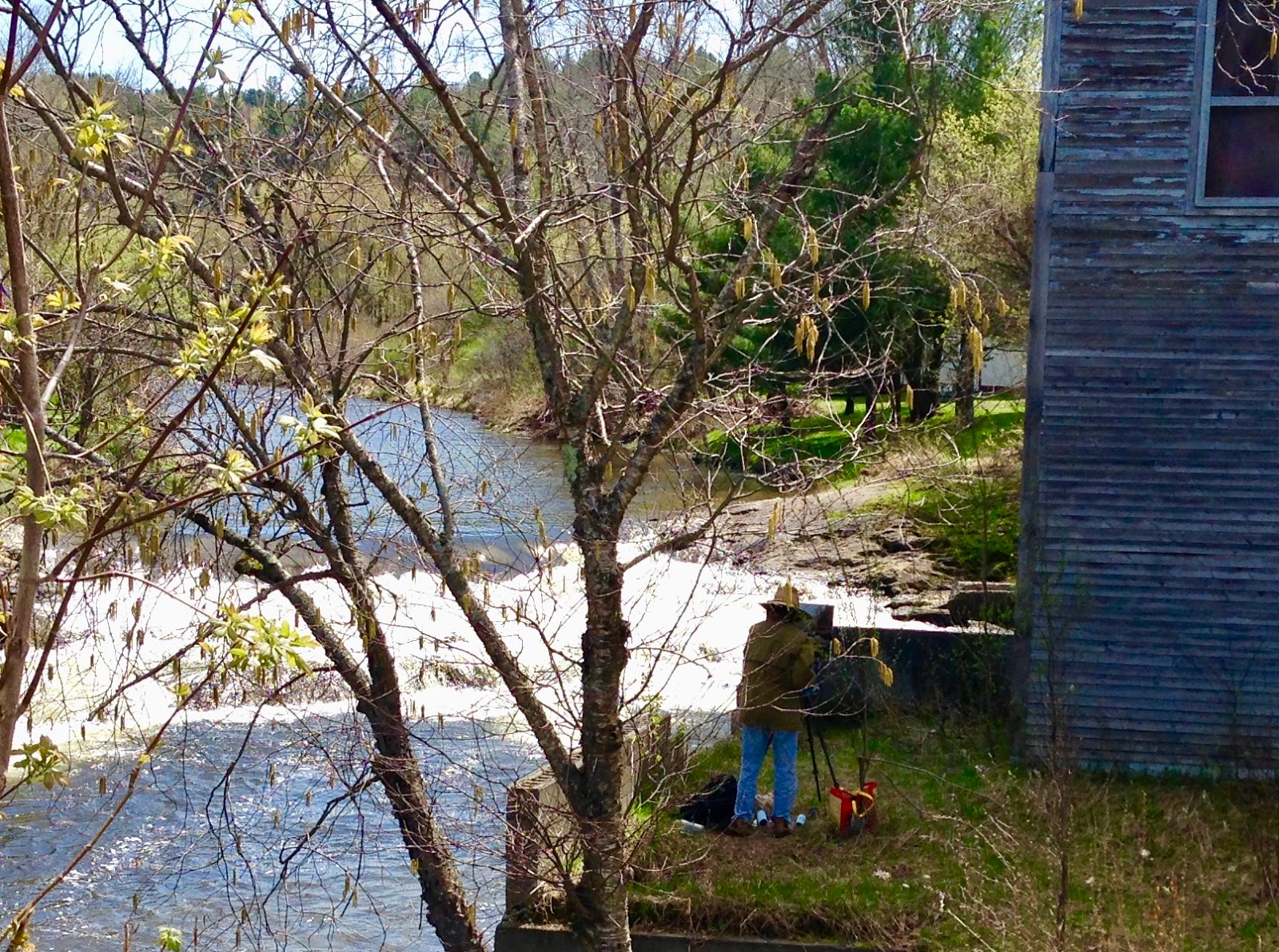
Artist at easel, by the river -- plein air painting

As I visited the artists' studios and admired the art that these folks had created, I was struck to hear them all describe what they'd done at VSC as “playing.” A woman who usually works with metal had used the week to play with cloth. A sculptor who works in wood or stone was playing with clay. Someone else was experimenting with a new way to compose her collages. Another was trying out new materials and playing with new combinations of colors.

They all were having tons of fun. 


My writing studio for the week.
(Yes, it has a view of the river)
Over in the writers' studios, we writers were soaking up the atmosphere, taking advantage of all that VSC offers . . . and working hard. Among the writers, I sensed higher levels of angst than I'd seen in the art studios. Like many of the writers, I'd  arrived with a long “To Do” list, and didn't want to waste a moment of precious writing time. 

Halfway through a week of intense work, though, my brain seized up. I was stuck on a balky manuscript. Of course, stops and starts can all be part of the writing process, but . . . I could see that those playful artists were on to something good. I started thinking about ways I could bring more play into my writing life. 

Here are a few ideas I collected:

Write a poem. It could be a little ditty about anything, just for fun. A silly rhyme! A haiku! Or, you could try a poem focused on a work in progress, perhaps free verse from your main character's point of view. 

The writers' version of playing:
a manual typewriter in the common area was
an invitation to type out random thoughts and notes

Write in a new genre. If you're a nonfiction writer, experiment with a short story. If you're a novel writer, try a first-person magazine article. Play around with it!

Play with point of view. 
Consider writing a page or a chapter of your story from a different POV. 

Sculpture of branches and feathers,
by Sabine Likhite 
Appreciate art. Just breathing the air of the art studios was enough to get some creative juices flowing. Try closing your eyes, and picture what you're writing about. How would you re-create your subject with paints or clay or wax or fabric? Does that give you new inspiration to paint with your words?


Eve at Journey's End


Of course sometimes, the working writer needs to get up out of the chair and find some fun elsewhere! How about these options?

Walk! Walking is an important part of the writing process for me. In Johnson, I enjoyed a woodsy walk to Journey's End falls with artist friend Eve Jacobs-Carnahan. 
Fairy House
We admired the waterfall, and then, thanks to Eve and her artist's eye, we also appreciated some unexpected creations left by prior hikers: fairy houses and gnome homes hidden in the underbrush. Some artistic souls had engaged in play that elves could be thankful for.

Ebenezer Book is awesome
(and not just because they carry my books!)

Visit your local bookstore, and read something fun! I visited (several times) the town of Johnson's outstanding local shop, Ebenezer Books. Along with a reference work for a nonfiction work-in-progress, I bought volumes of poetry and funny picture books -- that's some great play for a kids' writer!

Buy an artist (or a writer) a drink, and share some stories. Writers don't often get opportunities to compare notes with one another, and with artists, so if the chance presents itself, say yes! One of the joys of Vermont Artists’ Week was meeting so many neighbors (of both the writerly and artistic persuasions) and sharing stories of our work and our lives (and all the people we knew in common), and expanding our circles of creative colleagues. If that's not fun, what is?

So, if the grind gets you down, remember to play with your work! Try new things, notice the unexpected, and enjoy the journey.  Happy writing!
Covered bridge in the rain, Johnson.
Because, Vermont.