Showing posts with label Owl Moon. Show all posts

Wednesday, February 28, 2018

The First Fifty Words--Make Them Count

     You've probably heard from different sources how important the first fifty words are, especially of a picture book. In a recent webinar, THE Jane Yolen mentioned that openings are critical. She mentioned having been a Golden Kite judge, and how much she enjoyed doing that. Jane gave special notice to the stories' beginnings. A successful opening, she says, comes within the first fifty words of the book. She enjoys playing around with her own openings until she feels she's got it just right. She suggests we do the same---type up the first fifty words of a number of picture books. Then, type up the first fifty of your own manuscripts. How do yours stack up? What's lacking that you could add to spice things up? How are you hooking the reader with your opening words?
     I decided to type up the first fifty words of four different books. What did it tell me? Did I want to read on? How did it hook me? So, here are my four, starting with Owl Moon by Jane Yolen:


     "It was late one winter night,
       long past my bedtime,
       when Pa and I went owling.
       There was no wind.
       The trees stood still
       as giant statues.
       And the moon was so bright
       the sky seemed to shine.
       Somewhere behind us
       a train whistle blows,
       long and low,
       like a sad, sad song." (53 words)

     The scene draws us in...late at night, wintertime, with a child and her father on a special adventure. Children will love the out-of-the-ordinary nighttime experience, feeling secure with a loved parent. The language is lovely and lyrical, drawing you in to the story. "Stood still as giant statues" brings the poetic use of alliteration as well as "long and low," which evokes melancholy. The use of alliteration of the words "somewhere," "sad," and "song" is lyrical language at its finest. The long vowel sounds throughout slow us down as we read. We are hooked by the sights and sounds as we join these two on their fascinating journey to see what they will find on this cold winter's night.


     The second manuscript is Banjo Granny by Sarah Martin Busse:


     "When Owen's Granny heard he was a baby who went wiggly, jiggly, all-around giggly, and tip over tumble for bluegrass music, she packed her banjo in its trusty old case with the taped-up handle. She put on her thousand-mile shoes. And she started out to cross one river, one mountain, and a desert." (52)

     This story has a totally different feel to it from Owl Moon. You can tell it's going to be a fun romp. Will she make it safely to baby Owen's? What obstacles might she face as she crosses one river, one mountain, and a desert? The language is fun, and who doesn't like a Granny with moxie and determination? Her thousand-mile shoes tell you she's been around a while and is rich in experience, which helps her navigate the three obstacles. The refrain of "wiggly, jiggly, and all-around giggly and tip over tumble for bluegrass music" is used successfully to help move the story along. Not to mention it's so much fun to say!


     The third story beginning is from Take a Picture of Me, James Van Der Zee! by Andrea J. Loney:


     "Deep in the heart of Lenox, Massachusetts, in a white frame house nestled between his aunts' home and his grandparents' house, lived a boy named James VanDerZee. James was the oldest boy of three sons and two daughters. At the Van Der Zee's, the children learned about music and art, and kindness, too." (51)

    What do we learn from the first words of this biography? We learn that family is important, kindness is emphasized, and that the Van Der Zee  children were introduced to a variety of artistic pursuits. How will those facts feed into the story? Of the five "W's", we learn the WHO--James VanDerZee. We learn the WHAT-what he wants is to capture each person's uniqueness through art,(even though his art turns out to be photography). The WHEN is hinted at in that cameras were cutting edge at that time. The WHERE is Lenox, Massachusetts. Kindness is fleshed out in the story as he takes extra pains to portray each person at his or her best when he photographs them. Even when the photography business dries up, there is a bright spot for James when his many photos taken over the years are used for a Metropolitan Museum of Art Harlem exhibit. He has succeeded in his quest.

     The last manuscript is Fearless, by Barb Rosenstock:


     "In those days it was pretty tough to be a girl. You had to follow the rules. You couldn't speak your mind. You had to ask permission. There were games you couldn't play. You weren't allowed at the best schools. You were supposed to stay clean, quiet, and obedient." (49)

     This takes place in a time when a woman was not expected to act like anything other than a refined lady. From this, we get the idea that someone is not going to fit the description of "clean, quiet, and obedient." Who is it, and how does she push the boundaries? In the next sentence we learn her name---Louise.  First, she was not CLEAN when the car she borrowed hit a chicken coop, wood splinters covered the seats, and chicken feathers filled the air. She was not QUIET when she crunched into a troublesome driver, scraped a car into the wall, and va-roomed past all to the finish line. She was not OBEDIENT when she tells her husband (who has told her to never race again) she is going on a vacation, but goes instead to Daytona to race. Louise spent her life fast, faster, flying, free, and FEARLESS!

     I hope you will find this exercise helpful in your own writing. Those first fifty words---make them fabulous and make them count!


Wednesday, April 6, 2016

Absorbing Writing Wisdom at Picture Book Boot Camp -- by Christy Mihaly

Heidi and Jane, savoring a job well done
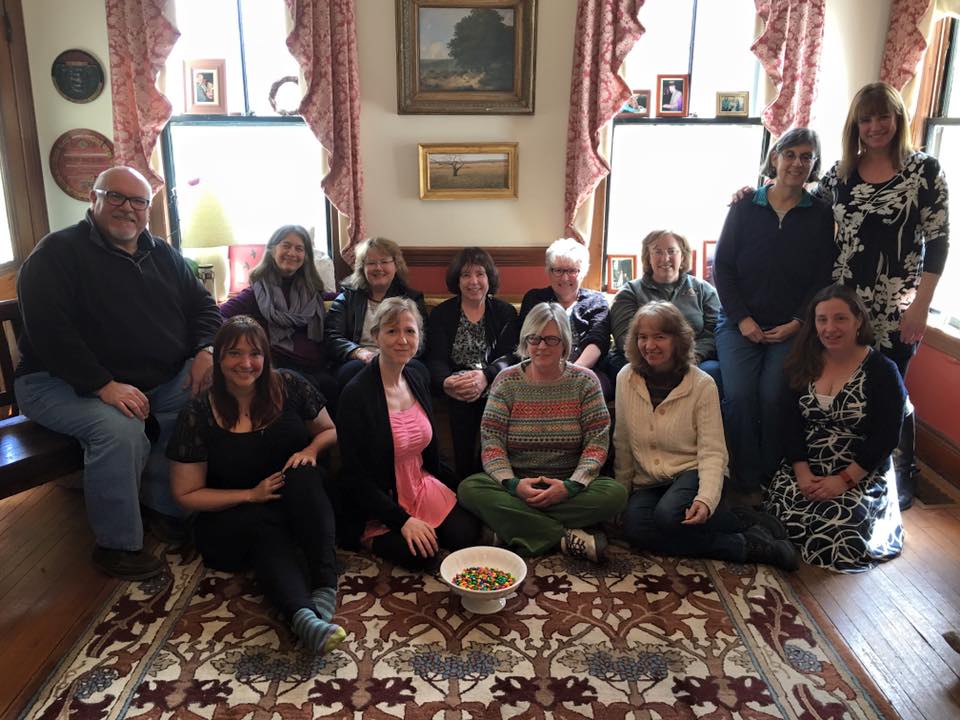
In a classic farmhouse in a small New England town, a dozen writers convened last weekend. No, this isn't the opening of a mystery story . . . or a tale of horror.

Aren't we looking inspired? (Note the candy bowl.)
This was Picture Book Boot Camp. And it was a transformative experience. From Thursday through Sunday, we were hosted by the inimitable Jane Yolen, who shared her bountiful wisdom (and her beautiful home) with us, and the multitalented Heidi Stemple, who had plenty of her own wisdom to share, and who also organized the weekend, cooked mouth-watering meals, and kept us all on track. 
This was the fourth time this mother-daughter team has presented PBBC at Phoenix Farm. Receiving the acceptance letter to PBBC4 felt like getting admitted to Hogwarts.  

Once there, I soaked up enough inspiration, practical pointers, and writerly fellowship to carry me through quite a few rounds of future manuscript revisions. I thought I'd share some highlights and nuggets of wisdom . . . plus a little back matter.

Critiques
A month before PBBC, participants submitted two picture book manuscripts for critique by both Jane and Heidi. Both of them offered perceptive comments, some in an in-person meeting, and some in writing. For many participants, these suggestions resolved longstanding problems or breathed new life into floundering manuscripts. 


Jane is a careful listener
We also had group critiques, with three or four writers reading a manuscript each evening. Those group things can make me crazy: Do I trust these strangers enough to share the creation of my heart? How can I be both honest and helpful? Will they notice if I sneak out of here? 

I needn't have worried. Very soon, we weren't strangers. Everyone brought works-in-progress they thought weren't quite working, and all were generous and supportive in their critiques. And astute! One writer who hadn't planned to read for the group changed her mind when she saw how constructive the suggestions were. She was glad she did -- she received excellent, exciting comments.

I too waited till our last evening to read . . . stayed up late the prior night revising my manuscript based on what I'd learned so far from critiques, lectures, and chats . . . 
and received incredibly helpful advice on my manuscript. Back home on Sunday night, I jumped into my revision with new hope.

Shared Stories
I arrived at Phoenix Farm hoping to improve my craft. I did learn a great deal about the peculiar art of writing picture books. But just as valuable -- perhaps even more so -- were the many tales from the trenches that everyone shared. 
Dinner: delicious food and titillating tales


Jane has published more than 350 books, so it's tempting to imagine publishers racing to accept her latest work. Yet she reminded us repeatedly that she gets rejections, many rejections. There are editors who have failed to respond, ever, to Jane's submissions. (Hey, that happened to me, too!) Publishers have left manuscripts to molder for years. Editors have made changes that have led writers to pull back their manuscripts. It's all part of this crazy business. But if we love writing -- and we do -- we keep at it. 

The boot campers had written all kinds of children's books. Among the group were award-winners and big sellers, writing teachers, ghost writers, and more. I learned from everyone, and everyone had stories to share. We recounted our worst rejections and subsequent triumphs. Some of these made us laugh. Some might have made us spill our wine. We talked about books we love, and books we love to hate. Jane and Heidi were generous in recommending publishing houses and editors they thought could be right -- or wrong -- for particular manuscripts. 

Bedtime Stories
Picture book writers know we should be reading aloud -- both our own manuscripts and great picture books. But how often do we have the pleasure of listening to great books read by Jane Yolen or Heidi Stemple? At PBBC, Jane often read aloud to us from excellent picture books. 


Heidi reads YOU NEST HERE WITH ME
But the best read-aloud was at the end of each long day. After we'd worked together from 7:00 a.m. to 10:00 or so at night, Jane or Heidi read us bedtime stories. We heard author readings of Owl Moon, What to do with a Box, and You Nest Here With Me. Picture book writer heaven!

Three PBBC Nuggets for Picture Book Writers
I absorbed many excellent bits of writing advice at Phoenix Farm. Here are three points that stood out for me:
  • Use good words: Picture book writers shouldn't "dumb down" their writing -- expose children to delicious words.
  • Learn to see: You must observe (faces, nature, settings) before you can show in your writing.
  • Try new things: Re-invent yourself and your writing regularly to stay fresh. Just say, "Yes I can!" 

Back Matter: Nuts and Bolts and Extras
Jane and Heidi have perfected the pacing of PBBC. Although we were exhausted by Sunday, the program never dragged and we had an interesting variety of activities as the weekend built to a satisfying conclusion. 

The first night, we went owling! Heidi led us into the chilly night and called to the owls. You may know that Jane's book, Owl Moon, is a family story, and Heidi is the little girl in that book. Well, Heidi still goes looking for owls. She told us that since it was nesting time, she didn't want to lure the owls away from their trees that night. But when she called, we heard the answering cry of a screech owl in a tree. Sometimes there are owls.


We heard from two guest lecturers: an outstanding editor and an industry expert (a/k/a Big Mouth) who seemed to know everything about every kids' book ever printed. I appreciated these additional perspectives, and the advice these industry insiders were willing to share.

On a field trip to the Eric Carle Museum of Picture Book Art, we were treated to a behind-the-scenes tour. That included entry into the vault, where we viewed original art including a Sylvester picture by William Steig. 
PBBC4 at the CARLE MUSEUM
And those willing and able to get up at 6:00 a.m. could join Jane for her morning walk through town.
Jane and Libby walk the walk


What I Brought Home from PBBC


Coffee, tea, and a view of fresh snow in the morning
My manuscripts are now heading in a great new direction. I learned a ton about writing and selling. But the best part of PBBC was feeling supported by others who are on the same journey. Writers are often hungry for fellowship, and at PBBC we were all well fed, in so many ways.

If you're curious about the other boot campers, you'll find links to their websites listed at the end of this post.
Heidi thought of everything: including this "cheat sheet" so we could remember names
If you're a writer with a traditionally published children's book (or a signed contract), my advice is don't delay, apply to PBBC. Jane and Heidi say they always save a space or two for published children's writers who are new to picture books. I hear they're starting to organize the next PBBC soon. You'll find more information about Jane, Heidi, and PBBC on the links provided in the beginning of this post. 

Appreciations: Thank you to Jane and to Heidi (who also took many of these photos) for inviting us into your home and your writing world. Thanks to all my fellow boot campers for their generosity of spirit. And particular thanks to Laurel Neme, who convinced me to apply to PBBC! Great call, Laurel.
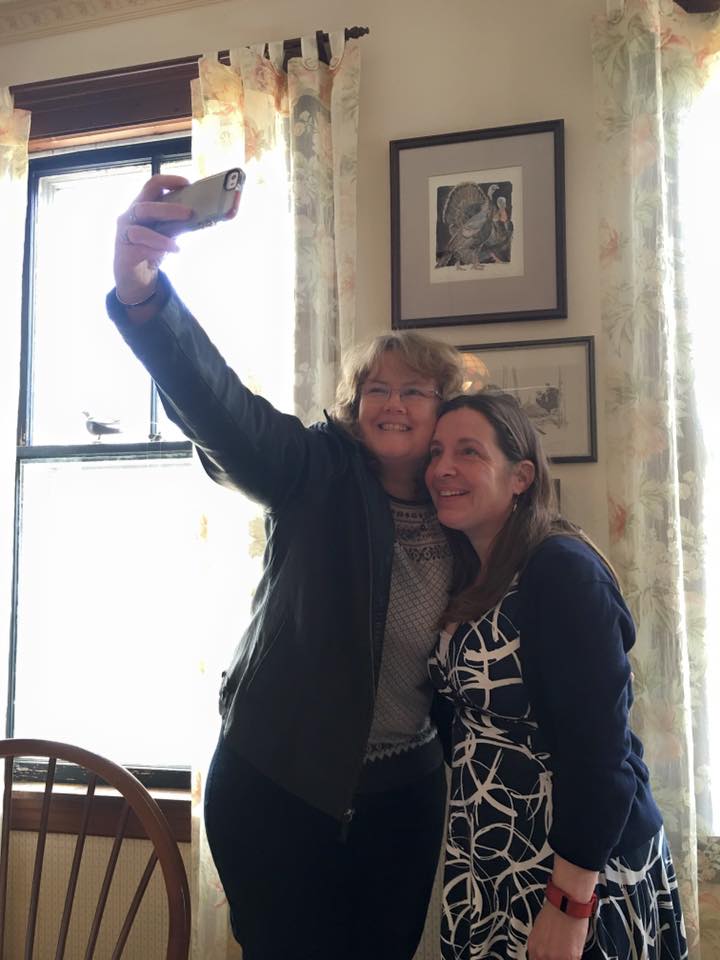
Jane, me, Laurel, Heidi


PBBC 4 participants:
Laurie Wallmark
Marcia Strykowski
Rob Sanders
Aimee Reid
Laurel Neme
Libby Koponen
Alethea Kontis
Lynda Mullaly Hunt

Wednesday, February 4, 2015

Meet GROGer Todd Burleson! ~ by Patricia Toht

Todd Burleson is the GROG's fearless leader, tech trouble-shooter, and all-around great guy. Just look at that smiling face!

To know Todd is to love him, so I'm delighted to introduce him to you. 


What drew you to writing for children, Todd?

Five years ago when I started working as a library media specialist, my relationship with words changed forever. Now, I read hundreds of picture books aloud to students each year. I feel and hear the rhythm of words and see the interplay that they have with illustrations. In short, I started ‘seeing’ the world through books.  Pretty quickly I realized, as Orson Scott Card said: “Everybody walks past a thousand story ideas every day. The good writers are the ones who see five or six of them. Most people don’t see any.” I’m doing pretty well if I get one new idea a day, but that doesn’t stop me from looking! 

Todd hosts Jon Muth at Hubbard Woods Elementary School
Another visitor, Arun Ghandi

How do you come up with ideas to write about?

Curiosity inspires me to write; I’m never bored. I am always exploring new media, books and ideas. I have a long commute, but I look at that commuting time as idea gathering time. I find that NPR and Podcasts spark tiny ideas that frequently lead to some of my best writing projects. I keep a pad of paper in my car at all times and post it notes are omnipresent! I also love to experience new things and travel. There are amazing stories everywhere.
Todd is quite the adventurous man!
How long have you been writing?

I was an early reader, but writing didn’t come easily for me as a kid. In fact, I don’t remember a single writing project I did in school. What I do remember, felt formulaic and forced. ‘Writing’ then for me, took the form of lists and outlines. Eventually, those lists evolved and spilled into journal entries, which gave me a way to ‘think.’ Soon, poetry and song lyrics crept into my journals.  Next came sketches, photographs and ticket stubs. Mix in lots of new experiences and places and you have pretty fertile ground for ideas!

What authors have mentored you?

Whether they realize it or not, I’ve learned from the best!  I make studying my favorite authors a big part of my writing ‘workout.’  I’m constantly typing out the text of my favorite authors to feel and see their rhythm and phrasing.  I’m one of 16 authors here on the
Ann Bausum's latest book,
Stubby the War Dog
GROG and have learned so, so much from reading and working alongside them.
  I am thrilled to have been selected by SCBWI WI to be mentored by award winning author Ann Bausum.  I’ll be working with her this year on a non-fiction picture book project and soaking up every ounce of knowledge I can!

(Not only are you working with mentor Ann Bausum this year, Todd, you've also recently been awarded a Highlights scholarship for nonfiction and you're working with agent, Jodell Sadler. I think 2015 is going to be a very good year for you!)

What is your current WIP?

Right now, I’ve got two that have bubbled to the top. One is a story about the first magician in America, and the other is about the last ice merchant on Mount Chimborazo in Ecuador.  Both of these topics intrigued me enough to research them and when I did I found that there were stories there that I thought needed to be told.
Todd busy at research.
If you could invite any author or illustrator to dinner, who would it be?

This was a tough question. Lately I’ve been enamored with Snowflake Bentley written by Jacqueline Briggs Martin and illustrated by Mary Azarian. It won the Caldeott in 1999. I like that Jacqueline is such a diverse writer; I have to imagine she’s a fascinating person. I would love to have both of them over for dinner. 

Do you have a favorite picture book?

That should be hard, but I actually really do have one:  Owl Moon by Jane Yolen. Of course this Caldecott winner’s images are phenomenal, but it’s the way the words and images work together that make it my favorite. Just the first line shouts to me that it is going to be amazing: “It was late one winter night, long past my bedtime, when Pa and I went owling.” I have never been owling, but I sure feel like I would know what to do after reading this book. 

What are your hobbies?

Making stuff. I like to explore with different media: photography, painting, sketching, wood, etc. Someday I hope to have a barn that is my ‘creation space.’ I want to be able to sling paint on giant canvases, weld huge chunks of steel and turn all sorts of things on a lathe! Basically I want to have a place where I can make a HUGE mess! I recently restored a 1947 Tourette Teardrop Trailer and took it on an epic road trip with my son. I love fly-fishing and visiting national parks around the country.


Todd and his daughter Grace after completing a high ropes course!


What’s one thing about yourself that very few people know?

I’m color blind in one eye; but I can’t remember which eye it is!

Where can readers find about more about you?

Visit my personal blog, ToddBurlesonWrites.
Read about my work as children's librarian, A Zen Librarian, here.
Follow my restoration and travels in my 1947 Teardrop Trailer.
And, of course, follow along on the GROG!

Thanks for giving a peek into your life, Todd, and best wishes for your writing this year!