Showing posts with label book launch. Show all posts

Wednesday, October 29, 2025

So Rude: Animals Behaving Badly! Book Chat and Review with Jessica Fries-Gaither by Kathy Halsey

It’s always a treat when an author friend has a new book drop and wants to share it with the GROG. This week’s treat from Jessica Fries-Gaither, a nonfiction picture book, is a trick as well as a treat. Beware… some of the 20 animals featured in So Rude: Animals Behaving Badly, may even keep you up at night! Imagine rude, crude creatures like the Eastern Hognose snake, or Turkey vultures, or a Tongue-eating louse. If I have your attention, just imagine how kinder-middle schoolers will react to this book that shares unique animal behaviors even your Mom would look at in askance! 


Book Review


So Rude: Animals Behaving Badly is engaging “browseable” nonfiction that enables readers to dip in and out of content to focus on what interests them most. This feature is especially helpful for younger readers who may not be ready to tackle longer pieces of text and for school librarians interested in sparking curiosity for research projects.  As author, nonfiction expert Melissa Stewart says browseable nonfiction features “eye-catching design, lavishly illustrated along with short blocks of straightforward text.” Fries-Gaither’s newest from Millbrook Press combines unusual facts (Hippos throw their waste around!), compelling photographs, and great book design.


As a practicing science teacher for over 20 years, Jessica Fries-Gaither knows how to entice students and teach about animal behaviors simultaneously. She combines humor and employs the “ick” factor that elementary students love. Back matter with a glossary, further explanation of animal behavior, and list of books for further reading make this a winning book for kids and educators alike.


Craft Chat 

Jessica and I met up at the Ohioana Book Festival.


Kathy:  So Rude features so many animals behaving badly. How did you whittle down the list to the 20 most rude for the book? Which animal, in your opinion, has the highest "ick/cringe" factor? (For me, my husband and I agreed it’s the tongue-eating louse! Yikes!)

Jessica: I started my research process by brainstorming a list of rude behaviors (lying, cheating, stealing, etc.) and then looked for animals that exhibited them. That gave me a great place to start, and many of the 20 came from that process. I also tend to bookmark articles I find interesting and think I might be able to use someday in either my writing or teaching, and several animals came from that massive collection.

As for the highest “ick” factor, there’s no competition in my mind. The tongue-eating louse wins that gold medal. Everyone–from my critique group to the team at Millbrook–has commented something along the lines of “EWWWW!”

YIKES! It's the tongue-eating louse!

Kathy:I love the visual appeal of this book. For new nonfiction writers or those considering writing nonfiction, can you explain the structure idea adding speech bubbles, text boxes, and photographs to shape this book? Did you have input in the design, or did Millbrook Press/Lerner take the lead on this?

Jessica: I think the book is so visually appealing, and that’s all due to the Millbrook Press/Lerner team. The book is part of their photo-illustrated STEM series (the same series that my previous title, Nature’s Rule Breakers: Creatures That Don’t Fit In belongs to), so it was always going to include the captivating photographs. But the speech bubbles and text boxes were all thanks to the talented design team!

Kathy: Tell us about your research process for So Rude: Animals Behaving Badly. I know you'll have some great tips, since you spent last year as an Einstein Fellow at the Library of Congress! What are your favorite go-to science resources?

Jessica: I get a lot of ideas from popular science articles that land in my inbox or come across my social media feed: National Geographic, Science Daily, Live Science, etc. After reading those, I always try to track down the original scientific paper that the article was based on. I have a degree in biology, so making sure I understand the original findings and as many nuances as I can understand is important to me. Just check out my bibliography for the book! But I’m also not above Google searches for terms like “rude animals” when I get stuck! I cast a wide net and then make sure I read well on the specific examples I choose. 

Kathy: Review sources state that this book is aimed at preschoolers or readers ages 4-9. Since you're a practicing science educator and I'm a former middle grade teacher and K-12 school librarian, I'm interested in where you see this book fitting in both the curriculum and grade bands. I feel intermediate and middle school students would love this book.

Jessica: If I’m being completely honest, I was really surprised to see that preschool designation in the reviews. Millbrook/Lerner’s series is aimed at grades K-2, to the best of my knowledge, and I knew I was landing on the higher end of that range with some of the vocabulary and technical information I chose to include. In my experience, kids really enjoy the stretch in concepts and vocabulary that a read-aloud can provide, and you can always simplify a read-aloud for younger children.

From a curricular perspective, I think this fits well in both primary and upper elementary grades. The Next Generation Science Standards include Disciplinary Core Ideas around animal behavior in both 1st and 4th grades that align with the examples and message of the book. And while I find that picture books can be a tough sell to middle school students, I think they would definitely enjoy the content!

No one is behaving badly at Cover to Cover Books for Young Readers!

Kathy: So Rude just came out at the beginning of October. How are you celebrating and promoting this book? Tell us about school visits, bookstore events, and activities that educators and parents can access. Do you have an educator guide?

Jessica: I had a fun launch event at my favorite local independent children’s bookstore, Cover to Cover Books for Kids. In the month of November, I’ll be at the Buckeye Book Fair in Wooster, OH on Saturday, November 1 and at Books By the Banks in Cincinnati on Saturday, November 15. Technically, I’m promoting another book at these events (Wild Wonderings: Scientists and Their Questions), but I’ll have a display copy of So Rude! and ordering information for those who are interested. 

Ironically, even though I’m a teacher, I haven’t created educator guides for my books. Perhaps I need to consider that as a future project.


About Jessica Frie-Gaither

Jessica is an experienced science educator and an award-winning author of books for students and teachers. Her titles include So Rude: Animals Behaving Badly, Nature's Rule Breakers: Creatures That Don't Fit In, Notable Notebooks: Scientists and Their Writings, Exemplary Evidence: Scientists and Their Data, Wild Wonderings: Scientists and Their Questions, and Science Notebooks in Student-Centered Classrooms. She is currently a 2024-2025 Albert Einstein Distinguished Educator Fellow at the Library of Congress.


Jessica's Social Media Contacts

 www.jessicafriesgaither.com

https://www.facebook.com/jfriesgaither

Instagram @JessicaFGWrites

BlueSky: @jessicafgwrites.bsky.social

 https://www.linkedin.com/in/jessica-fries-gaither-14407233/


Wednesday, October 23, 2024

Sarah Kurpiel and A LITTLE LIKE MAGIC: Review and Craft chat by Kathy Halsey


A LITTLE LIKE MAGIC BOOK REVIEW


Author-illustrator Sarah Kurpiel weaves spare text with a limited color palette to share a heartfelt story of a young girl overcoming her fears to find the everyday magic our world holds, if we give it a chance. 


We’ve all been in our young main character’s shoes: a bit grumpy, a bit whiny, and we just don’t want to go where we are supposed to go. But, after she dons her scratchy coat, and pockets her trusty plastic horse, she and Mom join a group of people to witness ice carving until it gets too cold, even with hot chocolate. 


On the way home, our main character wonders about all the fuss over ice. But when she discovers her toy horse is gone, she and Mom go back to the exhibit. It’s colder, more crowded, but NOW she’s OK. This time there’s “only light and ice and stars” as she sees the glowing magic of ice animals and ventures out to find an ice foal, and at its feet, her tiny horse. Yes, the ice melts, the seasons change, but the memory of that special night stays with her.


Writers will appreciate the weight and care that simple words and perfect pacing deliver to create a poignant story. Educators and librarians can dive into the SEL themes of perseverance and seeing things with a different point of view with their students.They could even go on a wonder walk to look at ordinary things and see the extraordinary. While the main character is in a wheel-chair, it is noteworthy that being differently-abled is not the story's focus. We can all walk in wonder with this picture book.  


Craft Chat with Sarah Kurpiel

Kathy: Tell me more about how your real-life experience as a child watching ice sculpting competitions and how inspired this book. Did you have a toy horse? 


Sarah: Hi there! Thanks so much for welcoming me onto the GROG! A Little Like Magic is about a young girl who visits an ice festival with her mother. It’s a story about art, memory, and the way venturing outside our comfort zone can sometimes lead to special experiences. The book is loosely based on an experience I had as a kid. When I was a few years older than the main character, my hometown hosted a professional ice sculpting competition. It was the only time I ever saw ice carving in-person, and it’s always stuck with me. 


One of the most memorable moments (which I didn’t include in the book) is when an unfinished sculpture collapsed. At competitions, sculptors often take risks with the ice, and then there’s the weather to contend with. For us onlookers, it was surprising and sad to see so much work come crashing down. I also remember the sculptures melting, which is something that worries the young girl in A Little Like Magic. She tends to worry and feel nervous, which is why she carries a familiar toy horse with her when she goes out. I didn’t have a favorite toy horse as a child, but I did have a favorite stuffed animal–a little bison that I got as a souvenir on a family vacation–which I certainly thought about as I wrote the story.


Kathy: As an author-illustrator what comes first for you - images or story? What informed your choices for the color palette? The color feels cold, until it feels cozy blue, and then “lit” up with white light as you illuminate the sculptures.


Sarah: Great question! Usually, I start with a loose concept and then thumbnail the story before working out the final words. Then, revise, revise, revise. In this case, however, the words and pictures emerged at the same time. It felt like the story was fully formed from the start. (I sure hope that happens to me again one day!) 


As for the color palette, at first I wanted to make the whole book monochromatic in blue, which seemed fitting for a wintery book about the power of memories. I love books that use a minimal limited palette, and I thought it might work well with this story. But, in the end, the story called for more colors, especially to show seasonal change and the difference between inside and outside. So, I changed course. But as you’ve noticed, the book still has a lot of blue. Even as her outfits change, the main character is always wearing blue, and the base of her wheelchair is a shade of blue as well. 


Kathy: I love the simplicity and pacing of the story. For writers only, like me, how can we play with pacing? I admire how two sentences can fill a whole spread! Example:  

“It's not there when I wake up

or while I'm playing and with my friends.

 It's not sitting on my knee 

or getting ready to go out.”


Sarah: Thank you. I think thumbnailing is one of the best ways to feel the pacing–even if you’re not the illustrator. It helps me find the natural page turns–like a setting change or a small cliffhanger–and helps me see where I want readers to speed up or slow down. There’s a particular moment in A Little Like Magic where I wanted readers to really slow down and linger for a while. On that page, I still kept the sentences short to retain a childlike voice, but I wrote them in a way that allowed me to insert several commas to create extra pauses. 


It’s a tiny, sentence-level thing, but I think all those tiny things, once added up, can make a difference. This was my first time writing a story in first-person using a childlike lyrical voice. I tried as much as possible to stay true to that voice throughout. If, during revision, a sentence became too long or too poetic, I’d ask myself, “Would a kid ever really say anything like this?” If the answer was, “Definitely not,” I looked for another way.


Kathy: How long have you been drawing? What are your favorite mediums? how would you suggest interested readers begin teaching themselves art?


Sarah: I’ve been drawing as a hobby for as a long as I can remember, but I didn’t start drawing digitally until 2016. I often sketch in pencil or pen, but I create my final illustrations digitally using a Wacom tablet connected to my computer. I tend to use digital dry media brushes because I like the rough textures they offer. Lately, though, I’ve been playing with some new techniques and digital brushes, which I’m enjoying quite a bit. 


Doodling for fun is one of my favorite things to do. Sometimes it leads me to new characters and potential story ideas. I try to carve out time for doodling regularly because it both relaxes and re-energizes me, especially when I’m feeling discouraged. I know I’m not a highly skilled artist, but I love creating and learning new things, and that’s what I try to focus on–the enjoyment of it all. 


For readers interested in teaching themselves art, I suggest asking yourself what kind of art you enjoy looking at most and what specifically you like about it. Then, dive right in! Don’t wait for permission to start. Just start. Get a sketchbook or notebook (if you’re like me, the cheaper the better so you don’t get too worried about “wasting” pages) and keep it handy. 


If you’re not sure what to draw or paint or collage, try a fun art prompt list–October has some of the best, like Artober, Calmtober, and Peachtober. Pour over your favorite picture book illustrations, explore portfolios of your favorite illustrators, watch free art tutorials online, check out art handbooks from the library–whatever helps and inspires you most. But mostly, play around. Experiment. 


Make the art you want to see. And if, like me, you have a disability or limitation that makes it difficult to use a certain medium, tool, or technique, try a different one. Find what works for you. Sometimes it’s our limitations that help us find our unique style.


Kathy: Did you consciously think of the SEL aspect of the main character's personality, or am I reading that into the story?  I'm noticing phrases like “heavy coats, itchy hats, cold winds, the sounds of whirrings and  brr-ings.” (Great language by the way!) 


Sarah: While I didn’t consciously think about SEL as I wrote A Little Like Magic, I did think about the main character’s emotional arc. She starts off nervous and worried. Everything feels uncomfortable–possibly because she’s nervous or possibly because she’s sensitive to certain clothing, temperatures, and sounds. Either way, going to new places isn’t an easy thing for her. To help, she brings along her favorite toy horse, a little piece of home in her pocket. Without giving away too much of the story, suffice it to say, by the end, she’s different–not miraculously different, but different enough to see the value of pushing through those challenging feelings.


Kathy: From your website, I see that you are a librarian and a self-taught artist. Tell us how being a librarian helps you write for children. 

Sarah: My background is in academic libraries, so I don’t (usually) get to work with children’s books. However, my first library job involved cataloging children’s books used by college students studying to become teachers. That’s how I came to read A Sick Day for Amos McGee, which is the book that set me on a path toward making books myself. 


Later, I worked as a librarian at a small college that had a fairly large picture book collection–which I made ample use of as I was learning to write and illustrate books. Finally, and perhaps most importantly, since I work in the library field, I’m engaged in conversations on topics like information literacy, intellectual property, universal design, accessible design, and the freedom to read, all very relevant in the world of children’s publishing.


Kathy: What are you working on now and do you have any events where we can find you in person or online?


Sarah: Thanks for asking! I’m working on final art for my next picture book, which is about a kid struggling to say goodbye to a beloved old oak tree. It’s currently scheduled to come out next year from Rocky Pond Books. I’m also always working on personal art, which I share on Instagram and Bluesky. If you’re interested in learning more, consider subscribing to my monthly email newsletter.


More about Sarah

 Sarah Kurpiel is a self-taught picture book author and illustrator. Her debut book, Lone Wolf, received a starred review from the School Library Journal, while her books Original Cat, Copy Cat and Snake's Big Mistake were Junior Library Guild Gold Standard Selections. Her latest book, A Little Like Magic, was published in Fall 2024.


A librarian by day, Sarah lives in the Midwest. Her stories are inspired by animals, nature, and moments of wonder in everyday life. She hopes her work brings a bit of happiness into the world—and a bit of disability representation too. Sarah uses a power wheelchair and considers her disability an important part of her identity.


Learn more at sarahkurpiel.com


Wednesday, April 26, 2023

I’m An American by Darshana Khiani Launches May 2, 2023! by Kathy Halsey

Book Review by Kathy Halsey

I’m excited to share author Darshana Khiana’s new book, I’M AN AMERICAN, debuting May 2 with amazing illustrations by Coretta Scott King Illustrator Honoree Laura Freeman. Together words and pictures make a compelling statement about how we all are Americans through the eyes of children and the contributions all of us make together.


This book is thoughtfully and cohesively woven together from the introduction on making sure that readers know that only a small group of ethnicities are included in this picture book but there are a myriad of groups who make up this diverse country. The message is clear there is so much more than one narrative!


I love the direct yet lyrical language used throughout the text that explores and explains that “one must read widely, since no group can be defined by a single story.” The picture book begins with a question to draw readers into the conversation of what makes a person “American.” 


History, cultural pride, families' past experiences taken from classroom children draw out the sometimes difficult encounters facing each group of immigrants who came to America and make it what it is today. Having children speak their truth lends an immediacy and poignancy to each story.  


Strong back matter includes maps that indicate countries of origin and Darshana’s own immigrant story are not to be missed. A bibliography and further reading sections make this a great pick for teachers and librarians. Although the recommended grade range is pre-school to third grade, older elementary students will enjoy this book, too. By using layered text to structure the book, Darshana has created a book for many readers at different reading and interest levels. This is a book for our times. 


I met Darshana at a nonfiction writing retreat in Georgia when we were both new writers with dreams to reach children with our work. It is a joy to see the books Darshana has given young readers!

Craft Chat with Darshana Khiani


Kathy:  I love the emphasis on the multitude of narratives that make up the immigrant story. Was that always a theme for I’m An American? What other throughlines did you want to emphasize in this book?


Darshana: When I started envisioning the story as a concept book, I knew that it would be a diverse classroom with each child telling their family’s unique story. One of the main throughlines is immigration history and what were the reasons that brought immigrants to America. I hope readers see that while we have these American values in common, we can’t take them for granted and must rise to the challenge to uphold them.


Kathy: I’m An American has such strong back matter. Did you add back matter as you wrote? Did you, the illustrator, or your editor suggest the maps that indicate country of origin? Do you see adults or readers as the audience for this section?


Darshana: I wish I had written the backmatter while writing the story. Since I didn’t have any experience with an informational book and there was an eagerness to get the story out, we sent it on submission without backmatter. Plus I had heard that backmatter is subject to the editor’s discretion because it increases the book length. Once the book sold (nearly two years later), I started investigating different types of backmatter I could include and then ran it by my editor. Having to re-hash the research years later was painful. I highly recommend writing the backmatter along with the story. My critique partner, who is a school teacher, suggested having a map. The book is for ages 8 and up. The backmatter is probably for older kids and adults. 


Kathy: Take us through the creation of this book. Where did you get the idea? How many versions/revisions?


Darshana: My initial inspiration came in the Summer of 2017, I watched a YouTube video of a White man conversing with an Asian man about being American. Even though the Asian man answered every question with an answer that was similar if not the same as the White man’s answers, it didn’t matter. The White man would not “see” the 4th generation U.S. born ethnically Chinese man as an American. I was flabbergasted. When is one considered an American? Initially I wrote a narrative story about a biracial child questioning his identity. Unfortunately, the draft didn’t feel like a picture book and had veered from the heart which was “If America is your home and you believe in the ideals/values of this country then you are American, regardless of color, ethnicity, or even citizenship."  From a conference critique, I received a suggestion to create a concept book with layered text, set in a diverse classroom. The American values would be prominently featured in the main text with the student’s family backstory in the secondary text.


Once I was on the right path, there were 9 revisions before it went on submission. Another small revision while it was on submission (between rounds). After it sold, another 6 revisions with my editor. 


Kathy: Did you set up the refrain early in the writing process?  Did it change over time?


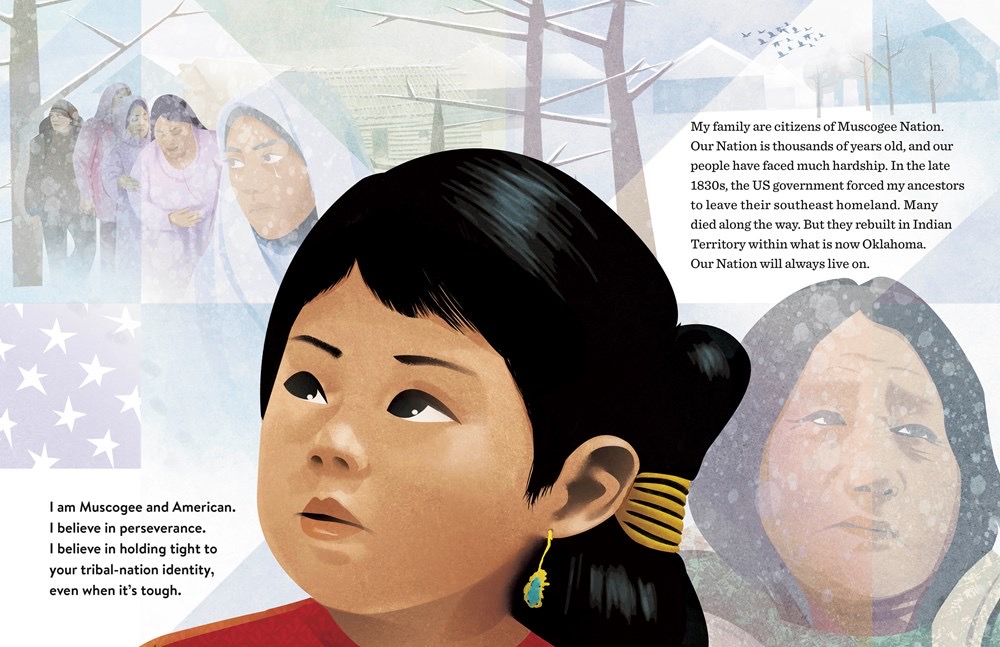
Darshana: The setup of the main text with the refrain was there from the beginning. The one refrain that changed after a sensitivity read was the Muscogee one. It was changed so that the girl identified with her tribal nation first and then the United States. I think this change is quite powerful and exemplifies that tribal nations are nations too. It also has the effect of pausing the reader to stop and think.


 Kathy: How is this book different/like your other books?


Darshana: I write broadly. Three books with different story voices and target markets. They have one thing in common, a theme of persistence.


HOW TO WEAR A SARI book has a 2nd POV direct approach, light and funny and is more for the commercial market. I’ve heard it makes a good “gift book”. In this book, a young girl persists through the challenges and drapes a sari on herself, which is quite an achievement. 


I’M AN AMERICAN is an informational book with layered text. It’s all about teaching more serious topics, best suited for discussions at home or in the classroom. This one is for upper elementary through adults. In this story, the reader learns about the diverse groups that call the United States home and how they have persisted in making a better life for themselves.


BUILDING A DREAM uses lyrical language and is based on a true story. It’s a feel-good, inspiring type of book. The boys in this book tackle environmental and societal challenges and build themselves a floating soccer field that enables them to become one of the best youth soccer teams in southern Thailand.


Kathy: What are you working on now?


Darshana: My next book BUILDING A DREAM: How the Boys of Koh Panyee Became Champions releases in September 2023. Beyond that, I’m revising an older picture book manuscript that is near and dear to my heart, searching for new picture book ideas, and doing exploratory work for a novel that I hope to write someday.


Biography and more!


Darshana Khiani is an author, engineer, and advocate for South Asian children’s literature. She is infinitely curious about the world and enjoys sharing her findings with young readers. If she can make a child laugh even better. Her debut picture book, How to Wear a Sari (Versify), was an Amazon Editors’ Pick. Learn more about her at www.darshanakhiani.com or follow her on Twitter or Instagram @darshanakhiani.