Showing posts with label Pamela Courtney. Show all posts

Wednesday, September 3, 2025

"Back to Cool (School)" Picture Books & Ideas to Create a Positive Classroom Climate - by Kathy Halsey


Back to school? How about back to cool? Let’s make the re-entry to school fun and memorable with new books and interactive activities. These ideas promote thoughtful ways to create a positive, inclusive, and engaging environment for all. I hope you find some intersectionality between your books and their usefulness in back to school units, or you get ideas for new projects that fit the back to school theme!

 Books for Everybody to Pair & Share

As a former teacher and librarian, I remember scrolling over student lists, making diacritical marks in order to pronounce everyone's name correctly and noting who had nicknames or wanted to be called something different. Students of all ages  know the feeling  of people stumbling over their names.

Book:  The Power of Your Name

Author, Jyoti Gopal knows this feeling herself, and has a wonderful lyrical picture book hot off the presses August 26, that helps start a great conversation about names and how aspirational they can be. (Illustrator Olivia Sua's cut paper illustrations create vibrant worlds.)

 Classroom Activities/Ideas

Share Jyoti’s words from her interview with John Schu  Have you ever wondered where your name came from? Maybe you asked your grown-ups or maybe you took your name for granted and didn’t even think about it. In The Power of Your Name, we learn that names have stories, that each name is a feast of sounds, a gift, filled with promise, that it holds your family's heritage, hopes and dreams. Through the ABCs, this book celebrates the beauty of names and the fact that every name—including yours—is special. Whether your name is long, short, easy to pronounce, or often misheard like mine frequently is, this book will make you think about the story your name tells.

  • Students can create a poster with markers or in Canva sharing what their name means along with the correct pronunciation. Students can then swap their posters with someone else . 

  • Together each pair introduces the other to the rest of the class. Finally, add the posters to the classroom bulletin board where all can see them and practice pronunciation.

Book: A Season for Fishin’: A Fish Fry Tradition


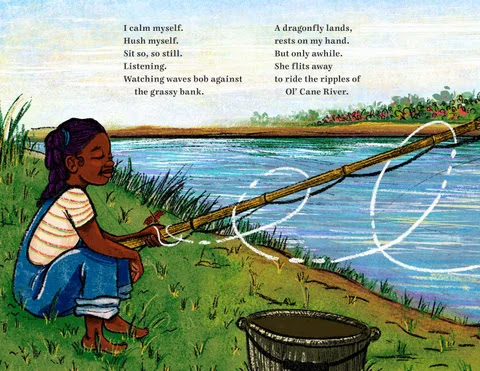
Author Pamela Courtney has cooked up a book that centers family, learning a new skill, and contributing to the family tradition - cane fishing - as she catches her first bream. The prize? Her feeling of pride being part of her community and her own red fish fry apron. I’ve shared her debut book on the GROG before, but in this context the back matter with pronunciations from varied parishes in Louisiana fits the topic of identity and the importance of pronunciation. As Pam’s tante Lula says, “Folks been crisscrossin’, speakin’, and livin’ like the otherin’ for forever”. The spice of the vernacular of Louisiana is fascinating and fun to say aloud. (Illustrator Toni D. Chambers serves up delicious views of Ol Cane River country.)

Classroom Activities/Ideas

 After reading this engaging, lyrical book about the culture of Natchitoches, Louisiana, give students the option to choose one of the following options:

  • Share a family tradition orally, in writing or as a “how-to” demonstration (if it’s a recipe or game).    

  • Create a short slide show that shares unique family background and traditions,  or share a travelogue of family members who live in or outside the US including pronunciation for terms specific to the region. 

PreK -Second Grade


Books pairs are fun to share and these two winners have great activities built into them. For K-2 students, matching and grouping are core skills for classification, a key scientific process. These action-packed picture books highlight skills in observation and comparing and contrasting characteristics, core skills for both math and science. Both books include themes of classroom climate, SEL, and diversity. 

Book: We Match

Author: Chris Barton knows intuitively that kids notice when things match. Think about school spirit days when kids delight in matching outfits. Take that idea to the dog park where Button, a gray terrier, announces the commentary as dogs play ball and chase squirrels. Button observes that some like wet food, others prefer kibble; some wear sweaters; others destroy them. Button discovers more subtle ways the dogs match that also encourages readers to find for connections with their classmates. (Illustrator Sharon Glick creates the most "fetching" dogs.)

Book: Batter Up for the First Day of School

Author Bethany Hegudus, a bonafide baseball fan, creates a tried-and-true back to school picture book that hooks readers with baseball lingo, punny fun, and shares the schedule of a typical school day for young students The Twins, Hank and Erin, begin the day with some nerves, but excitement builds, and at the end of the day, the twins announce that, “Today was a home run!”(Illustrator Nomar Perez creates ballpark joy with his images.)

Classroom Activities/Ideas

Lucky for us, Bethany and Chris have hit a home run with their ready-made activities  students will enjoy.


Look at these adorable “We Match” playing cards from illustrator Nomar Perez! Students can create their own cards and compare their connections with other students.

Here’s an example of Chris and Sharon’s match session.

Bethany has a baseball card activity as a way the new classroom team can announce and share this year’s roster. Celebrate your MVPs here. 


Check out Bethany's MVP and his vital stats as an example to model! 

Readers, what books, book matches and activities do you recommend for a great back-to-cool? Let us know in the comments!


Wednesday, April 30, 2025

Catch of the Day: A SEASON FOR FISHIN': A FISH FRY TRADITION with Pam Courtney by Kathy Halsey

Imagine Pam Courtney and I having a sit down on our virtual porch in Louisiana looking at the Cane River as we chat about her debut book, family, and fishin’. I've known Pam for about 15 years as a friend and  critique partner, and I’ve manifested this day since her debut book was a small fry! It is a thrill to be able to share Pam’s story with you all after all these years. Settle in for awhile and share your family tradtions with us in the comments!

Book Review: A SEASON FOR FISHIN': A FISH FRY TRADITION

I have on my librarian-teacher hat to share my thoughts on this picture book that I’ve known through many iterations as one of Pam’s critique partners.I might be a bit biased, but  A SEASON FOR FISHIN’ is a delight, from illustrator Toni D. Chambers’ engaging illustrations to the thoughtful backmatter author Pam has provided a dictionary of terms of endearment from Louisiana parishes. 

The fresh, active illustrations married to Pam’s poetic, unique Louisiana-influenced words make this the perfect book for a new season, summer and fish fry Fridays.

Main character Cher is excited to become part of her family tradition as she joins her Papere on the Ol’ Cane River along with uncles and a desire to bring in a mess of bream for her Mamere to fry up. 

Young readers will identify with that desire to “measure up” to a family ritual . . . are they ready, can they do it?  All readers will feel immersed in the loving family fun inspired by Pam’s Louisiana upbringing. Educators and librarians will appreciate this joyful read aloud with oodles of onomatopoeia and fresh phrases. As Cher would say, “Howwwwweee, get you a copy of this book and some crispy bream now!

Craft Chat with Pam Courtney

Kathy: Pam, I'm interested in the origin story for this wonderful debut picture book. Please share where this story came from, how it's changed, and what you've learned from “catching this big fish” of a book!

Pam: Actually, this story started as a poem in Renee LaTulippe’s Lyrical Language Lab class in 2014, or maybe 2015. Anyway, it was initially called Fish Fry Friday. Then Fish Fry Friday, A Cane River Upbringing. Then Fish Fry Friday, A Cane River Tale until it had to be changed.

It was initially being groomed for a NIV. It was Renee who nudged me and said, “Why not think about a young protagonist, cut some words, and make this a picture book?” I didn’t want to but I got feedback from other kidlit professionals that were certain this would make a better picture book. 

But as you know, it is a page out of my own childhood. I didn’t go fishing often. Actually, I can count on one hand the number of times I actually fished. I just like going, being with family and friends; eating the snacks that were packed. Like my Uncle Teddy Boy’s home-roasted peanuts. There were a few versions of Fish Fry.

Kathy: Lucky us! Pam’s sharing a few stanzas of an early version!  

Fish Fry on Fridays? 

Let Grand-mere tell it, down on the Cane River,

everybody fries fish on Fridays.

Matter of fact, just travel down any

dirt road in any rural town in

Louisiana on any Friday and

everybody who’s anybody worth

their weight in mudbug is cleaning,

frying, and eating fish. Buffalo fish.

Alligator Garfish. On special

Fridays, Redhorse. 

Fish Fry onFridays?

That’s bayou upbringing

not catholic upbringing.

Down on this river, people been

criss-crossin, speakin and livin like

ta’ otherin forever." says Grand-mere. 

Down on Cane River is the

safe place, the birthplace of my

Grand-mere, my Pa-ran, my Na-nan, 

and my Tante'. 

Yessir. Lot of mystery 

in the history down the road, 

down on Cane River.

Kathy: Oh, I love the roll and rhythm of this language. I can feel your setting and picture the characters! Thanks, Pam!


How did your hometown, Natchitoches, LA, inspire your story? I know you share poignant childhood memories in your author's note. (Readers make sure to check out the Author's Note when you get this book.) What makes Natchitoches unique?

Pam: The story takes place on Ol’ Cane River. Cane River is actually a man-made lake and it runs smack through the middle of our town. Nearly all of our outdoor events happen on that riverfront. Cane River is also a place within Natchitoches, where the most interesting and complicated history resides. I went fishing down on Cane River. Everyone did. You’d find people casting lines off of the bridge or wrangling for their prized spot on the riverfront. 

But the Friday fish fries is where the magic of my childhood lives. Folks would leave out early morning, return late afternoon with their catch. By early Friday evening everyone was out front in their yard scaling, cleaning fish, and frying fish. Our entire street was perfumed with the aroma!! Oh and the music that accompanied this scene! While I grew up with Prince and Funkadelic, the adults in control of the music had Marvin Gaye, Smokey Robinson, and, of course, gospel music rang out. Howweeee, what memories I have of that time.


Kathy: So what's the best way to cook up a mess of fish and why bream? 

Pam: Well, bream is my mom’s favorite fish. I can’t tell you the number of times our doorbell rings and someone has dropped off freshly caught bream. What’s even sweeter, they’ll also clean and filet them for my mom. But that’s just our way down here in the boot. As for the best way to fry bream. I cheat. I use Zatarain’s fish fry season to coat our fish. It’s the spice in that breading for me. I pan fry. So only quality oil will do. I test the temperature of my oil by sticking the handle of a wooden spoon into the oil. If it bubbles immediately, the temperature is just right for frying up a batch of bream.

Kathy: Yum! I’m hungry now. And to think I grew up with fish sticks as a Catholic! What's the best way for you to cook up a story? Can you share a bit of your process?

Pam: A story idea springs from anywhere. The idea for A Season For Fishin’ came from a specific childhood experience. Anything can inspire an idea. Once I have an idea for my story, it lives in my head (longer than it should) as I think about the “promise of the premise.”  

It takes me an awfully long time to get the idea on paper. I sit at my mom’s dining room table, aka my office, and stare out the glass patio doors smiling at the wildlife that entertain themselves in the backyard. I consider why I’m choosing to share this particular story or experience with readers. 

When inspiration hits me to pull out the laptop I ask myself, what will be the intimate moments that moves my story forward? For that matter, what moves my character to respond as they do? I’m all about creating intimacy in a scene. For me, it’s important to create specific emotional incidents that set up the reader’s relationship with my main character and the people who’ll share the character’s stage. 

In each scene, I consider the purpose of pacing because I want to, on purpose, use language, rhythm, and sentence length to hold a reader in a moment. I’m still in the process of accurate pacing. In a lesson I learned from an amazing teacher on pacing, if it’s done well, it informs tempo, encouraging that effective page turn. 

And yes, I do all of this in my first draft. THIS is why it takes me so very, very long to get my first draft down. I’m learning y’all.

Kathy: You talk a lot about being a good critique partner. How does that skill enhance your own writing and ability to create new stories.

Pam: I’ve had the GREAT fortune to be in the company of some amazing writers in my critique groups. The idea for new stories is always front and center each session whether we actively discuss story ideas or not. Someone will say something that sparks an idea, or someone will have an idea they think is perfect for your brand of storytelling. This is just one small part of a great critique group. 

Being able to look at a story and ask its creator what exactly is their intent for their story is something I always ask. I ask more questions rather than give advice. However, I’m the oldest sibling and we think we know everything, so being slow to offer feedback is still a work in progress. 

What I find is the more questions I ask, out of genuine curiosity for the “promise of the premise,” the more everyone is able to hear specifics about the writer’s intentions for their stories. Many times I’ll ask the writer about their story’s promise. I’ll then ask, “Show me where that lives on the pages of your story?” 

It might be that I’ve completely missed it, or the writer might visualize a scene or moment in their head and that is where it lives. These questions inform how I move through the pages of my story. Though it is much harder questioning your writing strategies than others. LOL

Kathy: Pam, that is a juicy piece of advice about how to critique. Folks, I’ve been a recipient of Pam’s skillful critiques for years! Blessed by it. 

Where can we find you online, on podcast, on blogs as you celebrate this season of your debut book? 

Pam: You can find me on the following artist’s blogs: Susanna Leonard Hill, Sara Holly-Ackerman, Black Voices, and KidLit Works.

Find Pam on the River or Here: Social Media Contacts

 Instagram https://www.instagram.com/pam_is_mylmnop/

Bluesky https://bsky.app/profile/pamismylmnop.bsky.social

Threads https://www.threads.com/@pam_is_mylmnop

Tik-Tok https://www.tiktok.com/@pam_is_mylmnop?lang=en

Now join Pam and me on our virtual porch and share YOUR family tradition in the comments! Mine has to do with my Hungarian grandmother, Otelia Wolslagel and her spicy sausage and paprika. My mouth is burning now!


Thursday, November 30, 2017

Guest Blogger, Pamela Courtney and Her We Need Diverse Books Mentorship - introduced by Kathy Halsey

For me, one of the joys of being a children's writer is the great community and camaraderie that develops over time. Today my friend, writing partner, critique buddy, and fab educator, Pamela Courtney is on tap to share a post with us. 

Pam's  professional biography:
Pamela Courtney lives in Atlanta, GA, but the Red River of Louisiana permanently flows through her veins. She is a former Curriculum Consultant, but is now proud to claim herself "Teacher of some of the most intellectually stimulating Kindergarteners and 1st Graders." Pamela is a 2017 recipient of the We Need Diverse Books mentoring program; mentored by Carole Boston Weatherford.

Writing with Mentors: Musings, Mishaps, and Magic

Thank you Kathy. I am honored to have the opportunity to share my amazing journey in the We Need Diverse Books Mentorship program.

I’ve always dreamed of being mentored by an amazing children’s author. Never in my wildest dreams could I have imagined the blessings coming my way.  Blessings that challenged my work ethic, that demanded diligent study of craft, and blessings that I would rely on, and cherish. Carole Boston Weatherford offered guidance in a way I had not expected.

A POSTURE FOR RECEIVING
I dreamed that my time with Carole would make the writing road smoother. I dreamed Carole would walk me through my own work step by step, line by line. I dreamed my mentor would correct every scene I wrote. It will be so easy. But, I had to leave that dream world, a daunting and necessary step for my growth.

In our Q & A time, Carole Boston Weatherford asked one question that stood out and has remained unanswered. “What do you hope to accomplish in our time together?”  [insert outrageous rambling here]. I thought I’d knock out several successful masterpieces (because yeah, I’m that good, and well, she’s CAROLE BOSTON WEATHERFORD). I reasoned that through magic that some sort of literary osmosis was definite. Carole was cool. “Well, let’s see. We’ll walk through this together.” No, no hand holding at all.
Carole Boston Weatherford Credit: Jeffery Weatherford

Was I ready to receive?

Incoming: “Your language is lovely. Powerful. You have a talent for visually creating a scene. That’s what drew me to your work. But … YOU  HAVE NO PLOT” Ahhh, there’s that “something.”  I straightened my back. I opened my arms. I sat waiting for her to tell me exactly what to do. Silence. This wasn’t easy.

Acquiring Experience: A consummate teacher, Carole maintained this consistent routine of guiding my writer’s eye. “Let’s discuss this scene. How powerful is it playing out? Think about how your students would receive this.” I kept waiting for her to, tell me what to do. This was guidance I hadn’t expected.

Nevertheless,  my work habits changed. Researching even the minutest of detail is part of my writing. Hmm … “sun beats down on backs already low to the ground.” Must research actual weather conditions during this period. Examining each line, determining its rightful place – Carol, showed me how to ask that specific question for each scene. Perhaps Carole’s question has been answered.  I realized that wanting to be a writer and positioning myself as a writer are dream worlds apart. Maintaining a posture of readiness is as crucial as developing work ethic muscles. I’m growing into a writer. Yes, I’ll say it, a good writer.


Here’s the magic. The education of crafting is ongoing. Seeing writing through Carole’s eyes broadened my vision of what writing, good writing for children should and can be. By the way, there was hand holding. Lots of hand holding. Step by step. Line by line. Thank you Carole Boston Weatherford. Thank you We Need Diverse Books. Thank you GROGers.