
Playing with words. Isn’t that what all writers really enjoy doing? Figuring out the best way to make your words make someone laugh, cry, play a movie in their mind, or just wow them.
I think WORD PLAY can have a pretty broad definition, but here are some of the things I think are good examples of word play:
- Puns
- Made up words
- The rhythm of the words
- Unusual words that are just fun
Puns
A pun is a humorous twist on a common phrase that changes the meaning. Sometimes the use of homophones comes into play or sound-alike words.
One of the places I’ve seen this frequently is book titles.

Monstore by Tara Lazar
The Plot Chickens by Mary Jane Auch and Herm Auch
Little Red Writing by Joan Holub
Bawk & Roll by Tammi Sauer
Are We Pears Yet? by Miranda Paul (forthcoming, but when I saw the deal announcement last week, I knew it fit in with title word play)

These punny titles pull the reader in immediately with their humor.
Other authors use puns right in their texts. Tammi Sauer uses several puns in her book BAWK & ROLL. When the chickens are trying to perform in front of a bunch of cows, one of them says:
“We’re going to get mooed off the stage.”
Made Up Words
I love it when an author makes up a word that seems perfect. Even more fun, when they use a familiar word and change the part of speech.

Phyllis Root makes use of onomatopoeic words in her book ONE DUCK STUCK. She uses words like “pleep” and “sloosh,” which aren’t actual words, but they work. She uses these onomatopoeic words as verbs.

In THE POUT-POUT FISH IN THE BIG BIG DARK, author Deborah Diesen uses familiar words strung together with hyphens to create a whole new word. This makes the language feel fresh, but familiar enough the that reader will get it. She uses words like “flit-fluttered” and “heap-deep black.”

Sometimes, the made up words can just be laugh-out-loud-funny. Candace Fleming masterfully creates made up words for the bunnies in her book TIPPY-TIPPY-TIPPY, SPLASH! Mr. Mcgreevy calls the bunnies:
“pesky pufftails”
“wily twitchwhiskers”
“infuriating flopears”
The onomatopoeia throughout the book also makes this book full of word play.

Kim Norman changes up the parts of speech on familiar words. She creates some fabulous adjectives in her book PUDDLE PUG including:
“froggy puddles, deeper-than-a-doggy puddles"
[emphasis mine]
She describes the puddles as:
“Too smelly. Too yelly.”
Changing the verb yell to a made-up adjective “yelly” works for the rhyme, but it lets the reader into the joke.

Tammi Sauer strings words together to make interesting verbs in her book MR. DUCK MEANS BUSINESS.
“Mr. Duck sputtered. He muttered. He tail-a-fluttered.”
Later she says:
“Mr. Duck grumbled. He mumbled. He flip-flop-fumbled.”
All of these use familiar words, then a string of words together to make the reader laugh out loud.
Rhythm
Rhythm is a whole other thing, but sometimes the rhythm of the story is all about how the author strung the words together and played with them so that you feel like you’ve taken a romp with those words as you read.
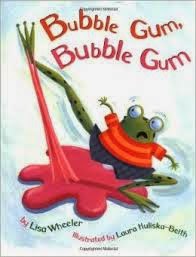
I can think of no other book that does this better than BUBBLEGUM, BUBBLEGUM by Lisa Wheeler.
“Along comes a shrew…
A bad mood shrew,
A bad mood
—HOW RUDE!—
Tough dude shrew.”
Isn’t that fun to read aloud? The whole book is like this and full of great word play.
Unusual Words that Are Just Fun

Take CHICKEN CHEEKS by Michael Ian Black, for example. The whole book is nothing but a list of synonyms for the word “butt.” If synonyms for “butt” weren’t enough to make a kid laugh, he pairs each word up with an animal, increasing the humor. This book is brilliant and full of word play.
“Duck tail”
“Moose caboose”
“Gnu wazoo”
“Chicken cheeks”
Sometimes he uses rhyme, sometimes he uses puns, and sometimes he uses alliteration.
Word Play Works
Word play works in these cases for many reasons.
1) Readaloudability (How’s that for a made-up word?)
These books are all fun to read aloud. The adult reader and the kid reader can both enjoy them. In fact, these books invite the reader to come visit the books again and again because they are fun to read.
2) Humor
Word play amps up the humor in the book. These authors could’ve told a story using different words, but it wouldn’t have been nearly as funny.
3) Standouts
It is easy to see why these books caught an editor’s eye. They stand out. And as a reader, they stand out in my mind as well.
Let’s Play with Words
I’d love to know what books you’ve used as mentor texts for word play. Leave a comment. I want to add them to my to-be-read list.
