Showing posts with label writing prompts. Show all posts

Wednesday, November 8, 2023

GOT WRITER'S BLOCK? by Mona Pease


I personally don’t believe there’s such a thing as writer’s block. When I sit and stare at the blank page, I like to think of it as brain rest! There’s no point sitting there trying to have words magically appear. Instead, it may be best to get up and walk away, just for a bit anyway. Do something else for awhile until enough’s enough and naptime is over!


“But I’m still drawing a blank.” 


So let’s shake things up and get back to creating those wonderful stories that we know are resting in there somewhere.  Here are some ideas and resources that help me find light again. Maybe a few things that could help start your sparks flickering again too. 

I thrive on deadlines, prompts, and contests. Not that I have editor or agent deadlines. I make my own. The ones that I set for myself to keep me accountable to me and my critique partners. 


WRITING PROMPTS

Start here, right where you are. Look outside your window. What do you see? Leaves fluttering to the ground but only one whirls away. Where is it going?  An unusual bird at your feeder, not like the others? Mmmm…where did that one come from? How about the kids across the street trying to find their dog who has broken its leash. Is your mind turning this into an exciting adventure? What are you cooking? A family recipe that you could write about, its origin and tradition. 

Here’s another way to activate your writing muse again. Members of our critique group post random photos or videos as prompts then we quickly spill out 50 words or less. Just ramble on the page without thinking much about it. Totally different thoughts and words burst from this exercise. Each writer has a different story to tell. Some are lyrical, or family oriented, maybe nonfiction or mysterious. A few might make it to your storyboard!

Still not there?

Here's a site that offers 100 ideas of things to write about.

 https://kindlepreneur.com/childrens-book-ideas/

And this one could be my favorite for grabbing random prompts. Maybe because it’s like a wheel of fortune or a mysterious grab bag.

https://wordwall.net/resource/418403/writing-prompts

Round and round and round it spun and this is the prompt it found for me—

                     You are walking through a forest when one of the trees

starts talking to you. What does it have to say? What

do you do?

My mind takes the nonfiction path with researching trees, forests, production, photosynthesis, maple syrup, deciduous, evergreen…..


Or, you may take another path that leads to a mysterious new world where all the trees talk and you are the alien! That’s kind of an interesting twist, isn’t it? And I certainly wouldn’t have thought of it without the random wheel spin.


CONTESTS AND BLOGS

They’re all about deadlines and themes and prompts and wise advice from professionals. And, often PRIZES!

We’re heading into a new year and that means new story ideas, especially if you start off in January by joining Tara Lazar and her StoryStorm. Presenters will take you on their publication journeys, offer helpful hints, or glimpses of book pages. Your mission is to jot at least one story idea for thirty days. And, who knows, a few of them might explode into new manuscripts!  You must be registered, comment on the posts, and then sign a pledge saying you’ve come up with at least thirty story ideas to make you eligible for randomly drawn prizes. That’s it! 

Then in February, if you love nonfiction and biographies as much as I do, you may want to join the NFNinjas over at www.nffest.com The blog is full of information and inspiration. The Ninjas describe the NFfest as a “month long crash course in nonfiction.”
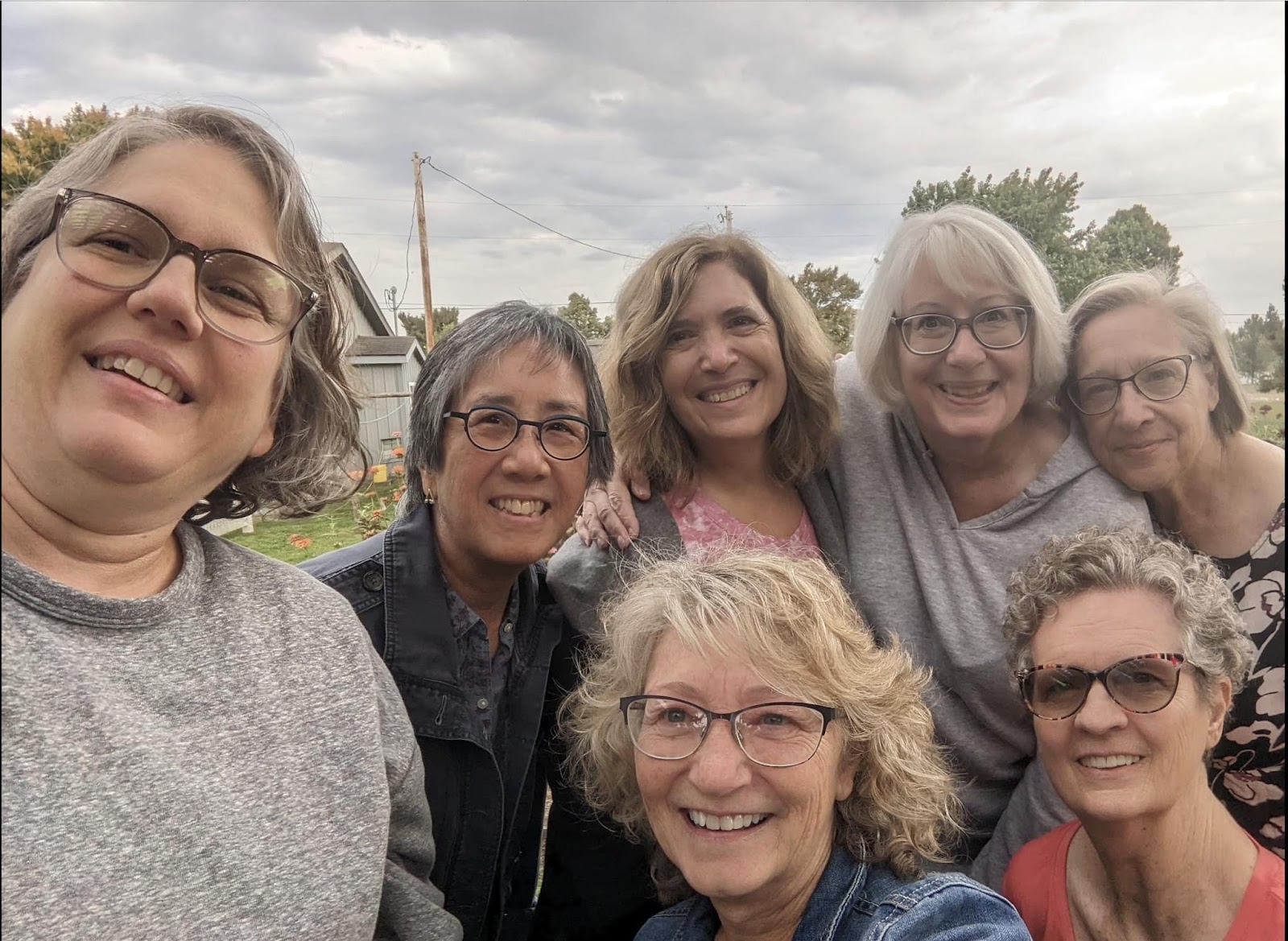

Here they are going off on a planning retreat because after the Fest, they hang around for the year offering nonfiction writing tips and advice. N
ow, I bet you’re full of inspiration and ready to write! Not quite?

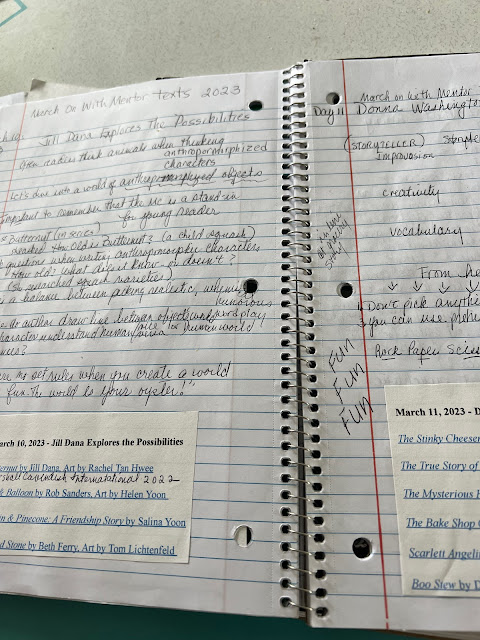
Well then, how about going over to spend March with Lynne Marie at www.rateyourstory.org/march-on. It surprises me at how much I can learn by reading other authors’ children’s books. I have a special notebook for this one. I literally “copy, cut, and paste”!  


AND MORE!

The wonderful, yes, wonderful person/author, Vivian Kirkfield, offers us the 50 Precious Words contest in March. Fifty words don’t seem like many, but try and write a children’s story with a beginning, middle, and end, with a plot in just fifty words!

Then there’s Susanna Leonard Hill, who gives you opportunity to sharpen your pencil and writing skills with Valentiney, Halloweensie, and Holiday contests.  

Kaitlyn Leean Sanchez, literary agent, gives you a chance to “create connections and grow as writers” with her Fall Writing Frenzy. Isn’t that what we’re looking for, to grow as writers?

There are so many more sites and authors who can help us get out of that writer's block we thought we were in. Look around, visit their sites, and I'll bet you'll find lots of help to get your muse motoring again! Which ones have I missed? Where are your favorite story igniters?

Be inspired! 

Get excited!

Write!


Wednesday, May 27, 2020

Premise Palooza! Generating Great Story Ideas


by Julie Phend

What’s a Premise Palooza?

Premise Palooza is a fun idea for creating unique story concepts invented by my critique group: authors Kara Laughlin, Joyana McMahon, Amy Tern, and myself, Julie Phend.  

Last December, we were all completing long-term projects. This can be a discouraging time for a writer—after years of commitment to a novel-in-progress, your heart can sink if you’re not sure what to tackle next. So we decided to skip traditional critiques that month and concentrate on creating memorable story premises. Our quest became Premise Palooza.

How Does Premise Palooza Work?

In fiction, a premise is defined as a one-sentence story concept that includes a protagonist, a goal, and a situation. For our challenge, we agreed to do the following:

  • Spend 15 minutes each day brainstorming premises. 
  • Not censor any ideas.
  • At the end of the month, choose our 10 most promising ideas and write a pitch paragraph for each.

To keep ourselves accountable and bolster morale, we emailed weekly to report our progress. We had some good laughs as we shared a few of our zanier ideas.

Each week, we took turns being in charge of prompts to stimulate creative thinking. We found three techniques to be particularly useful. Here’s how they worked:

Daily Prompts: 

Each night, the prompter sent three random prompts, which could be used together, separately, or not at all.

Examples:
  • A gummy advent calendar, A cross-country train car, Mardi Gras
  •  A secret underwater laboratory, Enemies forced to work together,    National Pun-off
  •  New Year’s Eve, An abandoned mine shaft, A secret

Prompts became especially helpful as the month went on and our personal idea wells began to dry up. We discovered that a prompt generated by someone else often sends you in a direction you would never have gone on your own.

A Page from Julie's Notebook

Borrowed Premises: 

Here, the challenge was to take classic premises from books or movies and retell or update them. This strategy yielded some great story ideas.   

Examples:
  • An update of the Scarlet Letter where a kid is forced to wear a C for cheating
  • A Christmas picture book based on Elf in which the family dog (instead of the baby) climbs into Santa’s sack. 
 

Chain Premises:  

This technique involved taking an existing premise—either our own or someone else’s—and changing one element at a time, resulting in a long list of permutations.

 We all liked this exercise and were often surprised at where we ended up. We felt it really pushed us to be creative—and it was fun because it produced new ideas quickly.

Amy shared a chain sequence that began with a borrowed premise. She said, “My 11-year-old son helped me brainstorm. We wrote down absolutely anything that came to our heads, no matter how silly, as you can see by the examples below.”  
(The premises marked with an asterisk * were generated by Amy’s son.) The original idea comes from “Robbie,” a short story by Isaac Asimov.

1.     Asimov’s premise: Busy parents hire a robot babysitter—but worry when the child gets too attached.
2.     Busy parents hire a robot bodyguard, but worry when the bodyguard turns out to be a coward.
3.     Busy parents hire a robot bodyguard, but worry when the child destroys him during a temper tantrum.*
4.     Busy parents hire a dragon babysitter, but worry when the child gets scared.*
5.     Busy parents hire a dragon babysitter, but worry when the child starts breathing fire.
6.     Busy parents hire an alien babysitter, but worry when the child starts growing a third eye.*
7.     Busy parents hire an alien cook, but worry about the ingredients of the food.
8.     Busy parents hire a dragon cook, but worry when the food is charred.
9.     A kid and his parents are kidnapped by a dragon and forced to babysit a dragonet.*
10.  A kid and his parents are hired by Santa Claus to babysit the elves.*

Testing our Ideas:

At the end of the month, we each wrote pitches for our most promising ideas and gave each other feedback. We also shared them with the children in our lives and asked which stories they’d most like to read. It was fascinating to learn which premises children of different ages liked and why.

Was it Successful?

Amy Tern
I asked the group to comment on their Premise Palooza experience.

Amy: There was something magical about putting all other writing aside and focusing exclusively on generating premises for a solid month. I wrote more than I ever thought possible. 
Kara Laughlin

Kara: It kept me writing during a time of year that typically sees me away from my desk.


Joyana: It was fun to focus on exercising the idea-generating part of my brain without inhibitions. No idea was a bad one during the process.

Joyana Peters McMahon
Julie: I’ve always been a writer who grabbed the first idea that came into my head. This challenge pushed me to stretch my thinking and become more creative.   

Brainstorming premises is clearly a lot of fun. But does it yield valid story ideas?

We all felt that it did. Two of us are currently writing stories based on the challenge, and we’re all excited to have to have a well of story ideas to draw from when we need them.

Julie Phend
Overall, Premise Palooza was great fun, freed our creativity, bonded our group, and generated a ton of ideas—all during the usually less-productive month of December.

Try It!  

So, if you’re looking for a way to spark your creativity, grab a group of friendly writers and organize your own Premise Palooza. Maybe a Pandemic Premise Palooza is in your future.


Monday, June 22, 2015

What Can I Write About? What to Do When the Well Runs Dry by Pat Miller


Recently, one of those registered for my upcoming NF 4 NF Children's Nonfiction Writing Conference asked a surprising question. "It's my writing day today and one of my task list items is to ask you for homework. Sounds strange, I know, but I feel like I'm having writer's block on what to do next."

I find that taking action creates motivation, rather than the other way around. Asking for help is one way to take action when the well runs dry. Perhaps you need a little "homework?" This was the assignment I gave for her nonfiction needs. 

1. Revive a languishing manuscript
If you're like me, you have manuscripts “under the bed” that just didn't catch fire. Distance from your once-loved manuscripts creates a detachment that makes it easier to delete paragraphs, remove incidents, and see where sensory details are needed. Hopefully it’s been long enough that you’ve forgotten the information you subconsciously brought to the page, revealing assumptions and gaps for the reader you were blind to before.

Choose one of your non-starters that still seems to have some juice in it. Use Nancy I. Sanders' checklist to attack your story methodically. Have fun giving this work a thorough makeover. Play with the language. Add details that put us there. Sketch each scene with stick figures to see if you have provided enough detail for the reader’s imagination and the illustrator. Nonfiction needs the same detail so the reader can picture the time, the people, or the science you are writing about. 

2. Do a quick investigation
When you find yourself thinking, “I wonder why…?” or “How does …?” you have a bridge to a writing project. And if those thoughts don't occur to you regularly, here are some books I use to pique curiosity. Sometimes the unpressured action of investigating a mental nudge bypasses the perfectionism that may be keeping you from writing. (I've included a similar website in parenthesis.)

Chase’s Calendar of Events. This book contains 12,500 entries. Many of those could start one writing. The day of the request, for example, was the birthday of Elizabeth Fry. She devoted her life at the turn of the 19th century to improving the conditions of women in prison. Sounds hopeless—why did she care? How did she try? Did she have any success? It was also the beginning of the Mudbug Madness Festival in Shreveport, LA. What is the appeal of mudbugs (crawfish)? What’s their life like? Why is it such a mainstay of the Cajun cookbook? (Important Dates in History)

An Uncommon History of Common Things is a National Geographic book by Bethane Patrick and John Thompson. Chapters include Food & Drink, Toys & Games, Symbols & Customs, and six more. Any of these may make you wonder—and investigate further. This technique works--my upcoming book from Houghton Mifflin Harcourt is about the guy who invented the hole in the doughnut. (Origins of Everyday Things)

Robertson’s Book of Firsts: Who Did What for the First Time by Patrick Robertson. Learn about the first microwave oven, the first railroad accident, even the first elevator music. Perhaps you can challenge yourself to write about the event in 100 words or less—giving yourself practice in getting the best bits into the best words. (Firsts in America)


3. Prime the pump with mentor texts
There are so many engaging and inspiring children’s books that you can use as a mentor or template. For this assignment, you'll need at least three books in your genre—maybe three biographies, or three books about animals.

First, read each one thoughtfully with the goal of choosing your favorite. Second, make a page by page list of the structure of the story. You’re looking at the bones, not the meat.


For example, here is the page by page structure I would write for Those Rebels, John & Tom by Barbara Kerley:

  1. Set the stage, and the hook, with a single summary sentence 
  2. Single sentence that is true about both
  3. John as a kid
  4. Tom as a kid
  5. Two lists of differences between two men
  6. John at home and work
  7. Tom at home and work
  8. They were different, but one big thing they  had in common…

Last, using that structure, build a similar book on the same structure. For this example, choose two people who are similar in a major way, but different in many others, and plug your research into this structure. Maybe Eleanor Roosevelt and Calamity Jane? Ben Franklin and Thomas Edison? Elizabeth Blackwell and Amelia Bloomer?

Or you might choose a book about wolves, and use its structure to write about raccoons. Or a book about the early settlers in Virginia as a model for your book about the early settlers of your home state.

If these suggestions don't get your fingers on the keyboard, here are 11 pages of nonfiction writing prompts from Los Gatos High School, Los Gatos, CA, to keep you busy and inspired. Good luck!