
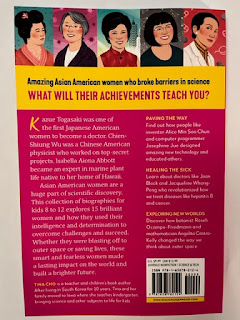
New book alert: My work-for-hire chapter book, Asian American Women in Science: 15 Inspiring People You Should Know, published with Rockridge Press, an imprint of Callisto Media, yesterday, March 1st, right on time for Women’s History Month!

As I begged, politely asked, people to review
it, some asked what work-for-hire means, so I thought I’d explain.
A work-for-hire book is one in which a publisher, most
often an educational publisher, finds writers to write books on a quick time
table, according to an idea usually thought up by the publisher, and in which
the copyright is in the publisher’s name. So that means they will pay the
writer a one-time, agreed upon amount. The writer will not receive any more
funds, no matter how well or poorly the book sells. Also, since the copyright
is in the publisher’s name, they can do whatever they want with the book. The writer
is giving them all rights to his/her work.
Pros of work-for-hire:
· quick
turn-around in getting books published
· sometimes
faster payment for your writing
· a
nice side gig if you want to earn some money (paying for child’s college, hehe)
· a
good way to add to your writing resume
· a
great way to get into the writing business working with an editor
Cons of work-for-hire
· one
payment, no matter how well the book does
· giving
up rights
· fast
turn-around of manuscripts, meaning it can be stressful doing lots of research
and writing in a short amount of time
My experience
I started writing in 2008 for the educational,
work-for-hire market. Most of you know, I’m an elementary teacher and still am.
You can see my work-for-hire projects here. Lately, I
haven’t pursued projects, but rather clients come to me. If I have time, I’ll
accept.
The summer of 2021, an acquisitions editor from
Rockridge Press emailed me. She had seen my bio in SCBWI and of course, my
website. (Another reason to keep those bios current!). She asked if I was
interested in this project—Asian American Women in Science. I was interested in
the topic, but because it was so close to school starting, I wasn’t sure I
could dedicate enough time to research. The editor said if I was interested I’d
need to do a writing sample test on one of the women. So I thought, ok. If it’s
meant to be, then…if not, that’s my answer. Well, it so happened, the editor
chose me, out of the others in the running. So I prayed and told God, if He
wanted me to write this book, He would have to help me. School was starting
soon, and I had a daughter to move in to college.
So from July 26-Sept. 10, I was extremely busy writing 15 biographies, basically every two weeks, five stories were due. I paced on my calendar about how many days to write for each lady. I bought a new notebook (it’s the little fun things that count!) and added tabs for each scientist. I got into a groove of research and writing up my stories. The hardest part was finding enough information on some of the scientists. I wish I could’ve done interviews with those who are still living, but when I tried to contact them, there was no response. Or, I was told not to.

What I learned:
· I
can write a chapter book of 15 biographies in a short amount of time.
· Check
You Tube for interviews of your source.
· Be
activists. I was amazed by the women still living and carrying out their mission.
At the time of the writing, one of the women, Alice Min Soo Chun, was back in
Haiti, carrying out her mission because they had just had another earthquake.
· Women
are unstoppable. We leave legacies for our children. They are watching us, even
if we think they aren’t.
· Never underestimate yourself and what you can do with your writing!
So maybe you’re thinking, I’m interested in doing
work-for-hire. What are the next steps?
· Here is a work-for-hire writing course from my author friend, Annette Whipple. Annette is graciously offering a discount: code KIDLIT25 for 25% off any of our courses
· And
here’s a handout from SCBWI.
· Or
you can jump in yourself. Go to the library and find the children’s nonfiction
shelves. Write down the publishers, check the copyright. Look at the publishers’
websites and how to submit ideas or a sample packet.
For more information, see my posts here.
There are all kinds of work-for-hire writing
assignments. Besides nonfiction, my husband and I translate and proofread
Korean books for Tuttle Publishing. I’ve written guided reading books for
schools, lesson plans, reading passages, devotions, and stories for magazines.
There’s a whole world of writing out there waiting for
you to explore. Have fun!
 Tina Cho is the author of four picture books with 2 more unannounced-- Rice from Heaven: The Secret Mission to Feed North Koreans (Little Bee Books 2018), Korean Celebrations (Tuttle 2019), My Breakfast with Jesus: Worshipping God around the World (Harvest House 2020), and The Ocean Calls: A Haenyeo Mermaid Story (Kokila/Penguin Random House 2020). Her lyrical middle grade graphic novel, The Other Side of Tomorrow, debuts from Harper Alley in 2024. After living in South Korea for ten years, Tina, her husband, and two teenagers reside in Iowa where Tina also teaches kindergarten.


