
 Heads up!
 Many parents and educators struggle with helping our girls maintain a healthy self-esteem through the difficult adolescent years. Studies find that participation in organized sports is one way to encourage girls to find their own strength. But many girls quit sports.
If you've parented, coached, or watched female athletes, you may have noticed that males and females approach athletics differently. But coaches don't always know how to adjust their approaches to account for these differences.
 |
| Mia Wenjen |
Now, Mia Wenjen (who blogs about education and multicultural books at "PragmaticMom.com") and Alison Foley (Boston College Women's Soccer Head Coach) have co-written a book, How to Coach Girls. Published this month by Audrey Press, it's a much-needed practical manual for coaches and parents.
 |
| Alison Foley |
What inspired the authors to write this book? A statistic: Girls quit organized sports at six times the rate of boys. Given the well-established benefits of participating in organized athletics (such as improved health, social skills, motor coordination, and strong friendships), Wenjen and Foley wanted to educate coaches about how to retain girls on their teams.
How to Coach Girls is informed by the personal experiences of both authors as well as Foley's coaching background. The two women are friends, brought together by their own soccer-playing daughters. Their book is based on research including interviews with coaches. My own informal survey of coaching parents confirmed -- coaches need this book. According to Vermont author and girls' coach Mark Freeman, many girls have limited options when seeking to play on athletic teams. If they end up on boys' teams, they--and their parents--are often unhappy with the lack of coaching attention the girls receive.
 |
| Marekpramuka [CC BY-SA 4.0 (https://creativecommons.org/licenses/by-sa/4.0)]Wikimedia Commons |
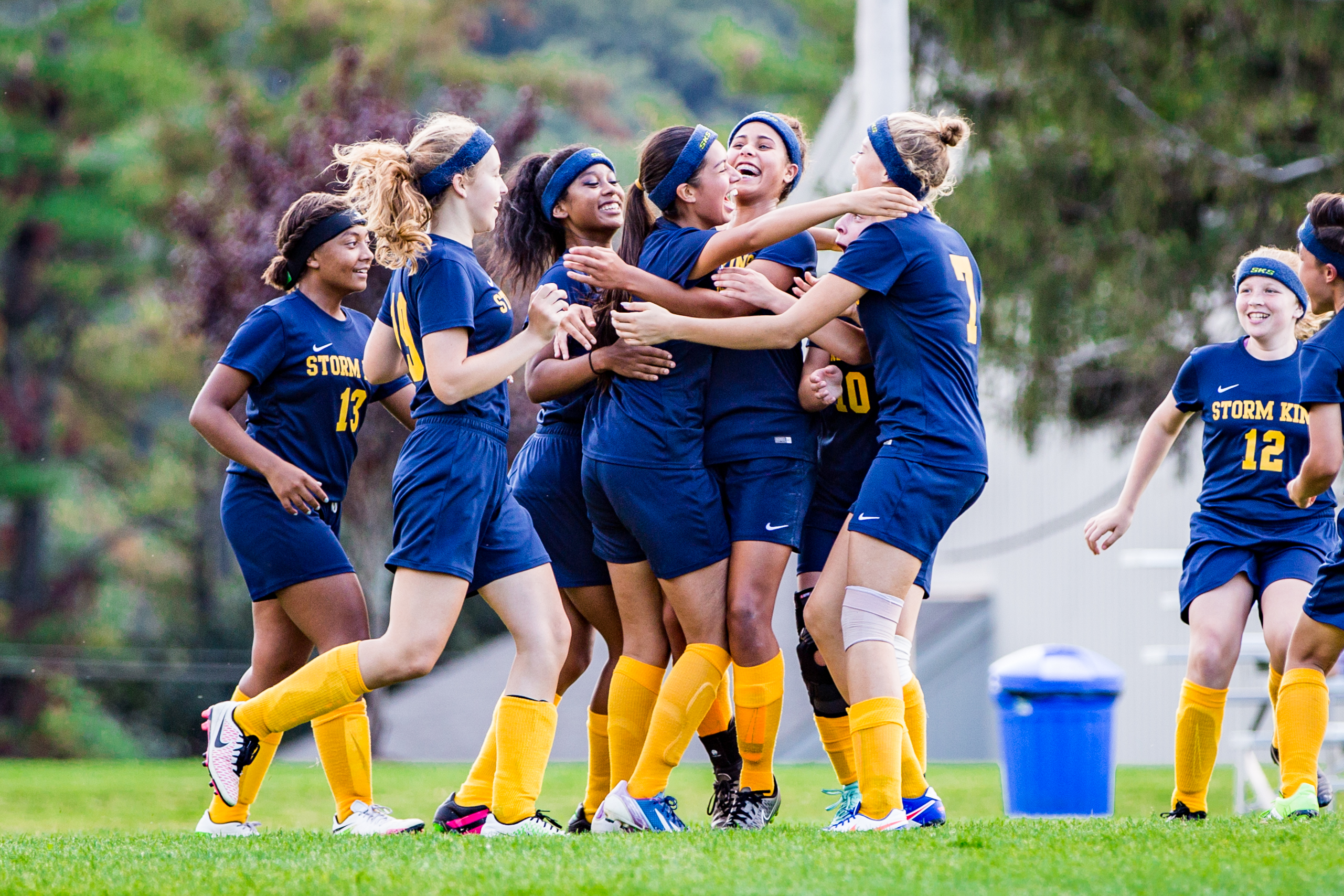
What's the best way to keep girls on teams? Mia Wenjen says, "What we learned is that research shows the number one reason why kids play sports is to have fun. But for girls, 'fun' means being valued and respected." Winning, she explains, is less important than just having fun as part of the team.
The book starts by identifying differences in the ways girls and boys approach sports. For example, the authors report that girls are more likely than boys to doubt their abilities and to seek approval, and that girls have a greater need to know where they stand with the coach. Boys tend to be more confident, and more willing to perform for a coach they don't feel connected to, and they are more likely to inflate their own abilities. Coach Mark Freeman observes that when a coach criticizes the team as a whole, "boys externalize criticism and feedback while girls internalize it." By this he means "if you tell the boys that we as a team are getting beat on defense, the boys take the criticism as other players not doing their job or as a failure as a team, whereas many girls take that criticism on themselves." Based on such insights, How to Coach Girls gives readers a series of practical pointers for working effectively with girls.
 |
| Jarek Tuszyński[CC BY 4.0 (http://creativecommons.org/licenses/by/4.0)], via Wikimedia Commons |
.jpg) |
| Brisbane City Council [CC BY 2.0(http://creativecommons.org/licenses/by/2.0)]Wikimedia Commons |
Here are some of the book's practical examples:
- Make it clear that the main goal is fun.
- Recognize girls for their improvement (not only talent) and praise those who show the courage to try and fail.
- Rotate team captain duties to give all team members a chance.
- Be clear about expectations so girls aren't in the dark.
- Avoid letting teams break into cliques by forming new groups at each practice.
- Keep practice drills engaging by creating lively variations, such as those that mix sports: Soccer Baseball!
- Avoid exacerbating girls' body image issues -- don't refer to players by their physical size.
- Develop a good understanding of each player as an individual, and know what level of feedback and encouragement she needs.
- Participate in team projects that involve service to the community.
- Set clear expectations for positive parent participation -- no Crazy Sports Parents screaming at refs and players -- and enforce that parent code of conduct.
- Let them eat cake!
 |
| Erica's Edibles, https://ericasedibles.wordpress.com/2014/11/01/soccer-cake/ |
How to Coach Girls is a welcome practical guide for adults who wish to help girls succeed in sports -- and in their lives. Some of the recommendations would no doubt go a long way to improving the experiences of many boys in athletics, as well. Thanks go to Wenjen and Foley, two moms who saw the need and wrote the book!
More resources and book information are available at this website.
This review is based on an advance reader copy which I received in exchange for an honest review. ~CM


