
Showing posts with label Writing Retreat. Show all posts
Showing posts with label Writing Retreat. Show all posts
Wednesday, October 4, 2023

Wednesday, August 8, 2018
Consider a “DO-IT-YOURSELF” Writers' Retreat! Eileen Meyer talks about hanging out with your tribe, fueling inspiration and gettin’ things done!
by Eileen R. Meyer
Are you looking for:
· An opportunity to hang out with a small group of fellow writers?
· A chance to sharpen your focus and get work done with minimal distractions?
· A place where kidlit topics populate the agenda?
· A way to keep costs reined in?
 |
| Friend Julie Phend writing outside on the patio. |
Then maybe you should consider participating in a WRITERS’ RETREAT ...
One that you could even put together YOURSELF!
As they say at Nike – “Just do it!”
And so a small group of us did! Here’s our story . . .
Earlier this year, two friends from my writing tribe (who live in different parts of the country) came to visit me in Florida for a DO-IT-YOURSELF WRITERS’ RETREAT!
Backtracking -- a few years ago, my husband and I bought a home in north Florida near the ocean. It’s a beautiful location and provides the perfect getaway for friends and family, BUT you don’t need an ocean hideway. You can host a writing retreat ANYWHERE –at a friend’s cabin in the woods, a relative’s place that they are willing to share, or any location that offers space for a few people, plus a temporary retreat from the outside world. When I offered to host the retreat, long-time pals and fellow kidlit writers, Dana Easley and Julie Phend jumped at the opportunity to leave chilly climates for a springtime getaway. So we put our plans in motion.

Our objectives:
· Each writer would bring an existing project that needed attention.
· Weather-permitting, we hoped to get daily exercise to break up extended periods of sitting (or standing) and writing each day.
· Our schedule would include focused morning and afternoon writing sessions.
· We ate simple breakfast and lunch meals at home to maximize our writing time. Everyone pitched in with kitchen chores.
· We read an inspirational message before each meal and discussed what we thought about it. Mealtime also gave us an opportunity to discuss stumbling blocks and get feedback before our next writing session. Sometimes we provided a speedy critique on a short piece if someone needed immediate feedback before they could write on.
· Most evenings we ventured into town and had a nice casual dinner. It was good to get out of the house and nice to have someone else make our dinner.
· Evenings were reserved for critiques or Q&A time. Each writer had 30-45 min to get input on a topic of their choice.
· And of course, we wanted to enjoy our time together as friends, laugh and have FUN!
By the end of our retreat we hoped that each writer would feel she had accomplished much more than she would have at home. We each planned to make significant progress without the constraints of our typical daily schedule. We also wanted to leave the retreat on a “writing high” – eager to resume our regular lives, yet pumped up with a lot of energy to keep moving forward on our projects.
 As the retreat host, I tried to provide a framework for success:
Each writer had her own room and desk for writing. (There were other spots for work, as well.)

I put together four special messages (excerpts from writing guides or inspirational blog posts) for each day of the retreat.

We started each day with a walk on the beach. One morning we made a point to get out extra early to watch the sun rise above the ocean – that was a fabulous way to begin the day.
It felt good to stretch our legs and get some exercise; we usually spent an hour walking and talking.
 |
| Dana Easley working on her novel in the family room after a morning of writing in her guest room. |
For morning and afternoon writing sessions – we mixed it up. Sometimes, we each moved to a new spot inside or outside. Changing our setting helped us feel refreshed and energized.
 |
| Julie Phend editing her work in a new spot. |
What else did we do?
 |
| Left to right: Dana, Eileen, Julie dining out. |
 |
| Shell and sea glass hunting. |
Hunting for shells and bits of shiny sea glass gave our minds a much needed break – and also provided time to ruminate about a pesky plot or character problem.
Was our DO-IT-YOURSELF WRITERS’ RETREAT a success?
Here is what each of us had to say about this experience:
“I came to the retreat having just re-worked the plot of my novel-in-progress. I hoped to get feedback on the changes and a jump-start on writing the needed revisions. Both goals were accomplished--and more! It was the ideal setting: dedicated time to think and write without distractions, coupled with supportive colleagues who already know my work. One night we even brainstormed ideas for selling and marketing a prior novel, which I have passed on to my agent. We worked hard and had fun doing it! I appreciated this retreat so much and came home filled with new vigor and determination.” -- Julie Phend
“I came to the retreat with two goals in mind: to overcome creative lethargy that had set in over manuscript revisions requested by my agent and to spend some time brainstorming in the company of writing colleagues. The retreat was exactly what I needed. Both the time dedicated to concentrated writing and the camaraderie of fellow writers kickstarted my creative process and got me back on track with my manuscript. The inspirational messages and conversation recharged my writer batteries and gave me the push I needed to complete my revisions the following week and to develop a strategy for prioritizing writing going forward.” – Dana Easley
“I looked forward to spending time with dear friends and working on poems for a collection I hope to complete this year. I continued to make progress, and found it helpful to discuss the project with fellow writers and get instant feedback that shaped the direction of the picture book. The retreat was a big success – by the end of our time together, I felt a greater sense of enthusiasm for the project, my work benefited from instant feedback, and time spent with my friends was a needed break from the typical solitary life of daily writing!” – Eileen Meyer
Hands-down, our writers’ retreat was a GREAT experience!
 I’ll close with a favorite writing and friendship quote . . .
Stay tuned – fellow GROG Blogger Chris Mihaley will post an article about her experience creating a do-it-yourself writing retreat in the coming weeks. It's always nice to have another perspective and additional ideas regarding how to set this up. Hopefully, both of our experiences will inspire you to carve out some special time for your writing soon!
Monday, August 21, 2017
Whispering Woods Recap: Why You'll Want to Go - by Kathy Halsey
 |
| Our Lady of the Prairie (AKA Anne of Green Gables House) |
I flew to Cedar Rapids, Iowa, had a weekend-long "slumber party" with 8 other writers, including author/teachers Jill Esbaum and Linda Skeers. I played charades, stayed in an Anne of Green Gables house, and revised one pesky manuscript and began another that I feel has promise. I had homework - read 30 picture books and did a one sentence synopsis of each book. I amassed 17 handouts and 3 pages of typed notes. Wanna know more? Come along.
Out-of-Sight Insight
- I had never been in such an intimate setting to work on my writing. Going to a serene retreat center helped center me. Being with writers who didn't know me or my work opened up new ways for me to see my stories.
- "Show not Tell" can be unpacked by playing "emotional" charades. Jill gave us cards with one word emotions: confusion, joy, scared, sad, surprised. We acted them out and the rest of us tried to guess the emotion. Body language is useful for show emotion, and will engage our readers, too. As Jill said, "Make the readers do the work." They're smart enough to grasp the author's intent. (Try this w/a face-to-face critique group. It's fun.)

Here writers act out silliness! - Openings are so crucial, but hear this. Editors and agents typically read only the first six words. If you give them a reason to pass on the work, they will. Your first lines are the foundation of the house (story) you build.
- With opening in mind and armed with a Character-driven Picture Book Analysis handout, we scan recent books, noting by which page we identify the main character and her/his internal and external conflicts. Then we look at our own work. If either element isn't there by the third spread, it's time to fortify our story foundation.
- Linda encouraged us to really amp up our main character's defining characteristic. She stresses that one can't go overboard with this. We should be able to pull our character out of the situation and know how he/she would respond in any new set of circumstances. Two mentor texts that show determination as a trait include CINDY MOO by Lori Mortensen and PRUDENCE WANTS A PET by Cathleen Daly.

- When creating characters and story, keep in mind the three Fs found in a child's life: family, friends, and frustration.
- Finally a huge "aha" moment for me came via my manuscript critique...there's still major work to be done. I had a hard time seeing that since I was so invested in it. I've dusted myself off, made a list of how and where I can revise, and this knowledge will make my WIP stronger.
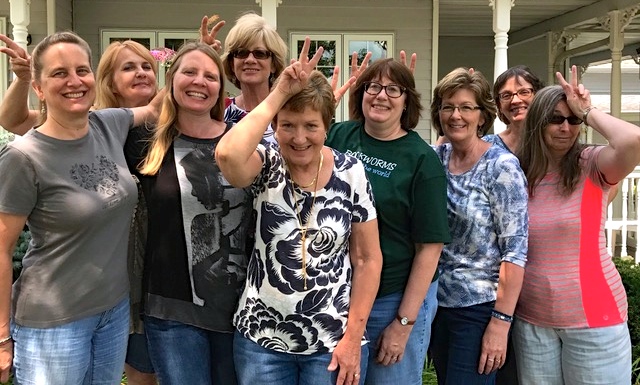
 |
| Linda Skeers & Jill Esbaum |
The Dynamic Duo - Linda & Jill
Using our discretionary income for craft development is important to us writers. I have attended an LA SCBWI annual, NESCBWI twice, as well as workshops in my region for almost four years.. As a former educator with my M. Ed. in Curriculum, I can vouch for the value of Whispering Woods for me. Why?
- Jill and Linda are professional, easy-going, and fun. They've presented this weekend retreat enough that it is a well-orchestrated mix of work, rest, writing, and application of craft.
- The Friday-Sunday summer retreats include home cooked meals - locally grown and organic whenever possible. We were even feted with a festive dinner out on Saturday.

- The grounds include nature paths and wildlife, private rooms w/shared bathrooms, fields of prairie grass, a nature pond, and a labyrinth.
- Our instructors offered very detailed written critiques for each of us as well as oral critiques with our small group. Attendees are friendly and at an intermediate+ level in their craft. I received written critiques from all of them, too.
- Jill and Linda left room on Sunday for an open discussion on anything we wished to discuss. Our conversation included agents, editors, queries, and their recommendations for next steps on our path to publication.
- Slots fill up quickly and this year there were two summer sessions. Contact Linda here. Due to the housing restrictions, the center can only accommodate 10 guests.


- After seasoned writers attend state, regional, and national conferences, I feel a small retreat focused on manuscripts/craft is the next best step. I'm also considering Whispering Pines next spring. See information here.
Please share your professional development favorites for us in the comments, and check out Linda & Jill's newest books, too.


WOMEN WHO DARED by Linda Skeers is a very accessible nonfiction anthology that I'm ready to read NOW. FRANKENBUNNY is a fun mash-up that Jill Esbaum shared with us at the retreat. Ready to hop on it, too.
Monday, May 15, 2017
Let's Play! ~ Christy Mihaly
 |
| By Jlbirman1 (Own work) [CC BY-SA 3.0 (http://creativecommons.org/licenses/by-sa/3.0)] |
As the weather warms, it's a good time to remember an important part of the work of writing that we don't always honor: PLAY.
Earlier this month I had the great pleasure of hanging out with a bunch of artists for a week. Watching the visual artists at work was a powerful reminder that play is central to the creative process.
 |
| The lucky participants in Vermont Artists Week, Vermont Studio Center, May 2017 |
 |
| View from my studio window: the VSC's Red Mill, on the Gihon River, Johnson, Vermont |
But—my point about the playing:
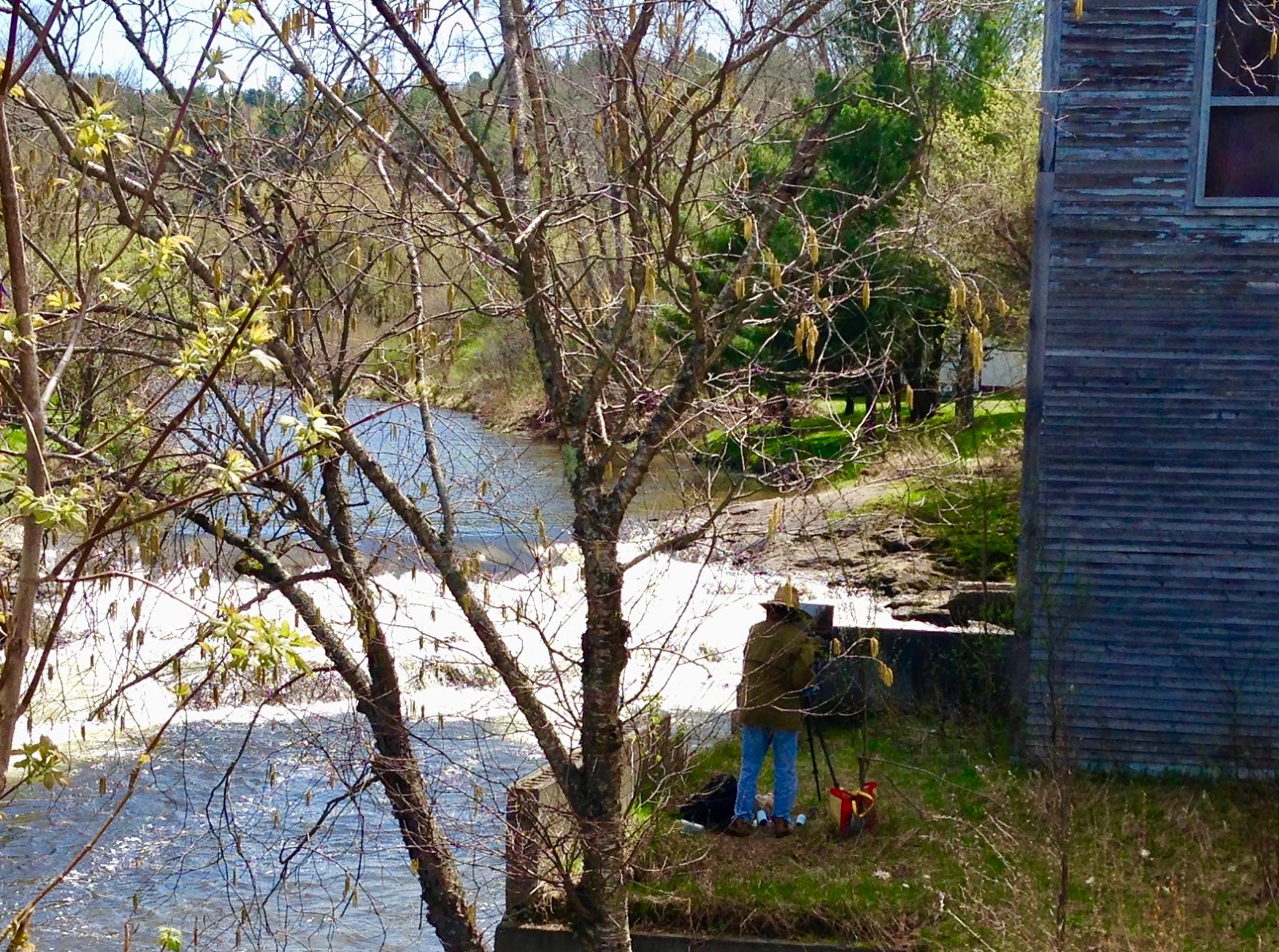 |
| Artist at easel, by the river -- plein air painting |
As I visited the artists' studios and admired the art that these folks had created, I was struck to hear them all describe what they'd done at VSC as “playing.” A woman who usually works with metal had used the week to play with cloth. A sculptor who works in wood or stone was playing with clay. Someone else was experimenting with a new way to compose her collages. Another was trying out new materials and playing with new combinations of colors.
They all were having tons of fun.
 |
| My writing studio for the week. (Yes, it has a view of the river) |
Halfway through a week of intense work, though, my brain seized up. I was stuck on a balky manuscript. Of course, stops and starts can all be part of the writing process, but . . . I could see that those playful artists were on to something good. I started thinking about ways I could bring more play into my writing life.
Here are a few ideas I collected:
Write a poem. It could be a little ditty about anything, just for fun. A silly rhyme! A haiku! Or, you could try a poem focused on a work in progress, perhaps free verse from your main character's point of view.
 |
| The writers' version of playing: a manual typewriter in the common area was an invitation to type out random thoughts and notes |
Write in a new genre. If you're a nonfiction writer, experiment with a short story. If you're a novel writer, try a first-person magazine article. Play around with it!
Play with point of view.
Consider writing a page or a chapter of your story from a different POV.
 |
| Sculpture of branches and feathers, by Sabine Likhite |
 |
| Eve at Journey's End |
Of course sometimes, the working writer needs to get up out of the chair and find some fun elsewhere! How about these options?
Walk! Walking is an important part of the writing process for me. In Johnson, I enjoyed a woodsy walk to Journey's End falls with artist friend Eve Jacobs-Carnahan.
 |
| Fairy House |
 |
| Ebenezer Book is awesome (and not just because they carry my books!) |
Visit your local bookstore, and read something fun! I visited (several times) the town of Johnson's outstanding local shop, Ebenezer Books. Along with a reference work for a nonfiction work-in-progress, I bought volumes of poetry and funny picture books -- that's some great play for a kids' writer!
Buy an artist (or a writer) a drink, and share some stories. Writers don't often get opportunities to compare notes with one another, and with artists, so if the chance presents itself, say yes! One of the joys of Vermont Artists’ Week was meeting so many neighbors (of both the writerly and artistic persuasions) and sharing stories of our work and our lives (and all the people we knew in common), and expanding our circles of creative colleagues. If that's not fun, what is?
So, if the grind gets you down, remember to play with your work! Try new things, notice the unexpected, and enjoy the journey. Happy writing!
 |
| Covered bridge in the rain, Johnson. Because, Vermont. |
Wednesday, July 9, 2014
LIVE FROM THE WOW RETREAT IN BEAUTIFUL ENOTA GA...GROGers GAIN INSPIRATION FROM LISA WHEELER! by Kathy Halsey
Yes, here we are up in the mountains in beautiful Enota, ready to get our "write on," with guru, nonfiction maven, Kristen Fulton. We GROGers have never met our own tribe in person before, so this is a real treat. BUT, we've been so immersed in writing that I can hardly get this post done, so stay tuned for more and pictures to come on Friday.

Today we were treated to an amazingly prolific picture book author, Lisa Wheeler. She condensed her popular Picture Book Boot Camp workshop, and went all "camo" (camouflage) on us. If you get the chance to listen to Lisa Wheeler or take a course, do it! Lisa's sessions today were so inspirational, I began to immediately fiddle with the manuscripts that I brought to the WOW retreat.
Here are some of Lisa's most memorable nuggets for writers that I gathered today. Enjoy and learn from one of the masters:
1. Study script. It's an awesome way to learn to write a picture book.
2. Part of the fun of being a writer is that we (writers) get to be the boss. We get to tell the characters what to do.
3. A picture book should have bookends. (on the importance of the beginning and the ending)
4. ANYTHING that takes your reader out of the book has to be fixed.
5. When a story amused you, show it to others. (How you know you're ready for feedback.)
6. Lisa on talking animals: Yes, you can write about them. An aside on the subject: A picture book writer asks a publisher,"Do you buy talking animals?" Publisher's answer,"It depends on what the animals have to say."
GROGERs kick up their heels.
Today we were treated to an amazingly prolific picture book author, Lisa Wheeler. She condensed her popular Picture Book Boot Camp workshop, and went all "camo" (camouflage) on us. If you get the chance to listen to Lisa Wheeler or take a course, do it! Lisa's sessions today were so inspirational, I began to immediately fiddle with the manuscripts that I brought to the WOW retreat.
Here are some of Lisa's most memorable nuggets for writers that I gathered today. Enjoy and learn from one of the masters:
1. Study script. It's an awesome way to learn to write a picture book.
2. Part of the fun of being a writer is that we (writers) get to be the boss. We get to tell the characters what to do.
3. A picture book should have bookends. (on the importance of the beginning and the ending)
4. ANYTHING that takes your reader out of the book has to be fixed.
5. When a story amused you, show it to others. (How you know you're ready for feedback.)
6. Lisa on talking animals: Yes, you can write about them. An aside on the subject: A picture book writer asks a publisher,"Do you buy talking animals?" Publisher's answer,"It depends on what the animals have to say."
Subscribe to:
Posts (Atom)