Showing posts with label Annette Whipple. Show all posts

Thursday, October 1, 2020

WHOOO KNEW? THE TRUTH ABOUT OWLS

From the desk of Suzy Leopold

Do you know some names of owls indigenous to your state? My state of Illinois is home to eight owls.

  • Barn Owl
  • Bared Eagle Owl
  • Eastern Screech Owl
  • Great-Horned Owl
  • Long-eared Owl
  • Northern Hawk Owl
  • Northern Owl
  • Snow Owl
Most of the species that live in my state are mentioned in today’s featured picture book on the GROG Blog.

WHOOO KNEW? THE TRUTH ABOUT OWLS 

written by Annette Whipple made its debut yesterday!

This informational picture book is published by Reycraft Books, 2020. The thirty-two page book is written for ages 6-10.

Now for another question . . . Do you know how many owl species there are in the world? There are 250 Strigiformes that belong to this order of birds.

The information presented in this book uses the Q & A format.

Check out this amazing two page spread:

Note the question, What’s For Dinner? 

The answer follows to tell the reader what this predator hunts for. A photograph is included to show small mammals on a dinner plate! The outstanding photography is sure to amaze the reader and encourage more curiosity about these majestic birds of prey.

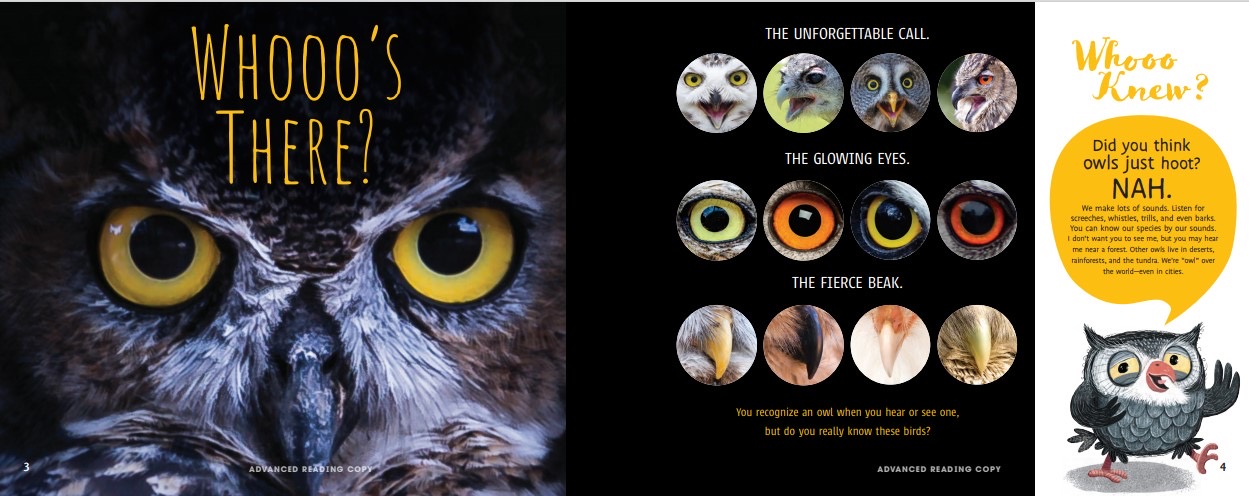
Here is another spread:
Once again an answer follows the question, Whooo’s There?

This time focus on the sparky, open-eyed owl. Several animated owls are included throughout the book. These illustrated owls share answers to questions, too. This feature is included on each spread along with the superb photography.

If you're not familiar with the anatomy of an owl, page 29 includes information about eyes, ears, ear tufts, feathers, talons, and facial disks. 

One section explains how the reader can help owls and states:

"You can help owls and other wildlife by letting nature be wild."

The back matter includes a list of seven words in a glossary and several links to helpful websites.

Thank you, Annette, for sharing your love of owls and for encouraging readers to explore the world around them through your many nonfiction picture books.

This book is not only a hoot to read, the reader will acquire new facts about this interesting bird. 

Now I know! Next time I hear a screech, a whistle, a trill or a bark, I will see if I can identify the owl.

I give this book a total of five stars out of five.
And now Annette shares a craft of writing tip about first lines and how they matter.

From the desk of Annette Whipple

When I was revising Whooo Knew? The Truth About Owls, I knew I loved most of the text. It’s a picture book in question-and-answer format. Every page spread in the informational book has one Q & A as well as a related sidebar. The sidebars bring humor to the text. 


As I revised, I suspected my original first lines just wouldn’t hook a reader. But I felt a bit stuck.


“Owls are easy to recognize. They have big heads, flat faces, and hooked beaks. They’re known for their hunting skills. But do you really know these birds?” 


While at a Highlights conference, the instructor wanted us to focus on first lines. I knew it was an issue with my manuscript, so I was thrilled to do so.


I scribbled and scratched until our instructor asked us to stop. Then, like in many workshops, he asked if anyone wanted to share what they wrote. Without missing a beat, I raised my hand with a grin.


First, I read aloud the original introduction/nonhook.


Then, I shared my new introduction which became…

“The unforgettable call. The glowing eyes. The fierce beak. You recognize an owl when you hear or see one, but do really know these birds?”


See the spread above Whooo’s There? in the ARC [Advanced Reading Copy].


(They actually cheered! I was shocked at that. Writing friends matter.


Oh, the Highlights faculty member who led that session? He works with Reycraft Books, the publisher of Whooo Knew? The Truth About Owls. And next year Reycraft will continue The Truth About series. The next two books are about dogs and spiders! They are all in Q&A format and highly visual with tons of photographs. Each page spread includes an illustrated sidebar.


Now, anytime I know something isn’t working, I sit down with focus. I set the timer and don’t change tasks (or tabs) until the timer goes off. 


First lines matter. Make your manuscript more enticing—and more sellable—by dedicating time to them. That’s the first lesson of this blog post. The second? Attend conferences and workshops like SCBWI and Highlights—even online. You’ll be challenged to try new techniques.


Thanks so much for having me here today. We know first lines are important, but sometimes it takes some extra effort and time to really hook the reader.


For more information about Annette click on these links:


Check out this previous GROG Blog post from August 2020.

Annette Whipple, Children’s Author, Inspiring Curiosity and Wonder

Sign up for Annette’s Monthly Newsletter

A Writing course: Kid Lit Creatives 

Use this code AWBLOG2020 for a 10% discount.

Facebook

Twitter

Instagram


Annette Whipple celebrates curiosity and inspires a sense of wonder in young readers while exciting them about science and history. She’s the author of eight fact-filled children’s books including The Laura Ingalls Wilder Companion: A Chapter-by-Chapter Guide (Chicago Review Press), Whooo Knew? The Truth about Owls (Reycraft Books), and The Story of the Wright Brothers (Rockridge Press). Annette is a fact-loving, chocolate chip cookie-baking children’s nonfiction author from Pennsylvania. Get to know her and learn about her presentations at AnnetteWhipple.com.

Wednesday, August 26, 2020

Hands-on Research Tips with Author, Annette Whipple

By Suzy Leopold

Let's welcome author, Annette Whipple, to the GROG Blog today. I understand Annette thinks facts are fun. I agree. Annette writes informational books for children that include pieces of information as fun facts.

Many writers read books on the craft of writing kid lit to master the art of writing for young readers. Many writers research books and online sites. Annette spends valuable time with hands-on research.

Before Annette gives tips for hands-on research for picture book writers, let's learn more about her as she shares her story and writing journey:

Annette Whipple celebrates curiosity and inspires a sense of wonder in young readers while exciting them about science and history. She's an author of eight fact-filled children's books including:

THE LAURA INGALLS WILDER COMPANION: 

A CHAPTER-BY-CHAPTER GUIDE, 

Chicago Review Press, August 4, 2020


WHOOO KNEW? THE TRUTH ABOUT OWLS, 

Reycraft Books, September 30, 2020


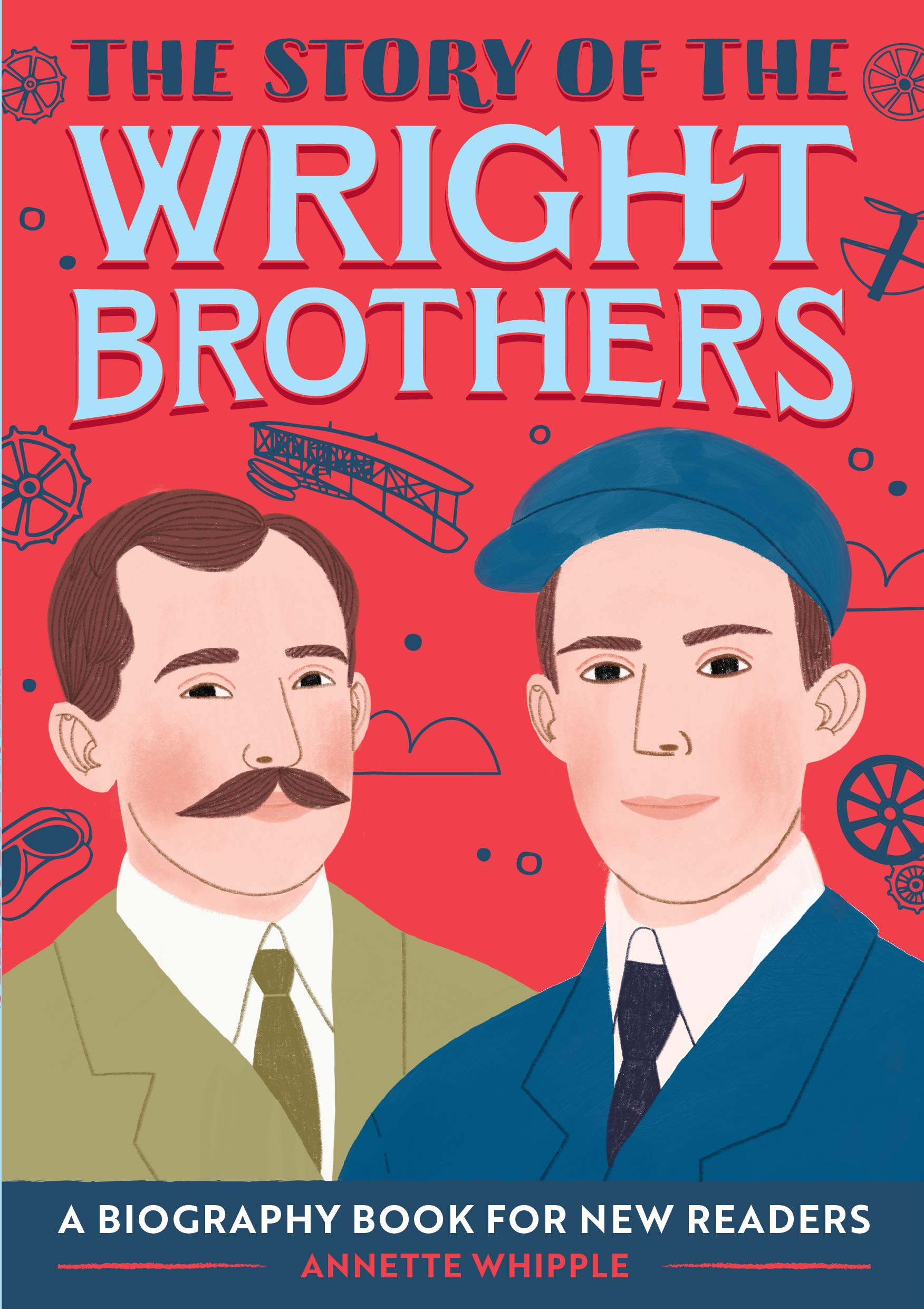
THE STORY OF THE WRIGHT BROTHERS, 

Rockridge Press, 

July 28, 2020
Many writers love chocolate and Annette is no exception. Annette is a fact-loving, chocolate chip cookie-baking children's nonfiction author from Pennsylvania. 

Learn more about children's author, Annette Whipple at her web site.

Tell us more about your writing and reading.

Annette loves to wind down at night and on weekends with a good book. Most of Annette's weekday reading consists of audio books while cooking and exercising. Annette enjoys reading nonfiction books across all age groups--especially kidlit. Additionally, she reads middle grade fiction.

Annette shares why she chooses to read mentor texts and how reading supports her writing in the following quotes:

"Reading great books opens the world [and fictional worlds] for me." 

Books help me connect with and understand people who live very different lives than me.

Even if the characters are fictional, the understanding translates to real people, too.

Of course reading is also huge part of my research process."

Share your writing journal . . . 

My love of writing did not begin as a child. I wrote notes to friends and letters to my penpals. My call to writing began in my thirties.

I began blogging to share my daughter's journey as she overcame a speech disorder apraxia, also known as acquired apraxia of speech [AOS] or childhood apraxia of speech. I quickly learned I loved to encourage others on similar journeys and began sharing my daughter's therapy and progress. I wrote about our home and family life, the books we read, favorite recipes, and fun activities. Overtime, I became serious about writing and took a few classes. Eventually a few magazines published my work.

In August 2014, I had an idea for a book. It was a story I knew I could write. It became my seventh published book. It is:

THE LAURA INGALLS WILDER COMPANION: 
A CHAPTER-BY-CHAPTER GUIDE

For more information click here

I wrote this newest publication because I think the Little House series by Laura Ingalls Wilder is a valuable window into American history. But understanding the historial context makes the stories even richer, especially for children. My book explores the history, people, and the context of each of the books in the Little House series. I address the racism and prejudice found within the books because reading about prejudice is difficult without a conversation. My book can serve as a conversation with others or as an awareness if the book is read independently by a child. I want the reader to understand why people felt the way they did and know it's not right. I included hundreds of pioneer terms and seventy-five activities for readers to "Live Like Laura" [FARMER'S BOY'S activities are referred to as "Live Like Almanzo".]

Children and adults are learning from my book and I've received incredible feedback about THE LAURA INGALLS WILDER COMPANION: CHAPTER-BY-CHAPTER.

I now primarly write for children and I love it. I hope my words inspire, encourage, and teach children about our amazing world.


Tell us about your special place to write and a necessary writing tool . . . 

I don't have a special writing studio or even an office. But I do have a desk made by my great uncle more than twenty years ago. It has my stacks of books and papers all around. It also has a big monitor that I use along with my laptop. Having two screens make writing so much easier. 

My favorite writing tool is probably a good pen. I prefer the Pentel EnerGel pen with a fine tip. I also love my wrist pads and ergonomic wireless mouse.

When you are not reading or writing, what do you like to do?

When I'm not reading or writing, my favorite work-related task is helping authors. I love to critique others' manuscripts and work-for-hire packages. I also love to teach. Though in-person instruction is my favorite, I'm embracing online teaching, too. You can find my on-demand writing video courses at KidLit Creatives.

To relax, you might find me vegging in front of the television or peeking at my bird feeders. Or baking chocolate chip cookies or eating the fruit of my labor. Mmm . . . My favorite!

A literary character that I would like to dine with . . . 

That's a hard phrase to complete. Maybe Ma from the Little House series or the Finch Family from TO KILL A MOCKINGBIRD. Or even Jo from LITTLE WOMEN, LITTLE MEN, and Jo's boys.

I just realized all of those books and series mentioned are more or less based on the lives of authors. Interesting.

Share some hands-on research tips . . .

I write nonfiction and informational fiction for children. So, I want to share a bit of my research process.

I begin my research with books and online searches. I always try to consult with experts. But really, it's getting hands-on with my topics that really makes my writing stronger. 

When I researched and wrote THE LAURA INGALLS WILDER COMPANION, I had a question I could not find the answer to. 

So, I contacted the Wilder Homestead--Almanzo Wilder Farm in Malone, New York. During the conversation, an expert jokingly said I should hop in my car to tour the homestead. That was on a Wednesday afternoon. I planned a road trip and was on my way Saturday morning. I walked around the property with reconstructed barns. I saw Almanzo Wilder's bedroom. I even walked on the floors Almanzo once walked. It was a glorious day at the Almanzo Wilder Homestead. All of it amazed me.

For the book WHOO KNEW: THE TRUTH ABOUT OWLS, I met two owls. Alexandria and Quincy! 

Right away I noted how the Spectacled Owl, Alexandria, had tight, dense feathers. Her feathers keep her dry in the tropical forest of South America. Quincy, the Eurasian Eagle Owl, has fluffy feathers compared to Alexandria. Visting and holding these birds in-person supported my research. I don't believe an on-line photo of the owls could show such detail. 

You can read more about it here.

You can view a book trailer for WHOOO KNEW? THE TRUTH ABOUT OWLS here

Finally, I can't say enough about hands-on research to support your nonfiction writing. 

However, during a global pandemic it's a bit of a challenge. I'm working on another book in The Truth About Animals Series with Reycraft Books. I want to meet some spiders! I should take the time to study spiders I shoo out my back door! However, consulting with an expert and hands-on experience is best to support my research. 

If you want to strengthen your nonfiction writing, try hands-on research to support your manuscript. If you are interested in learning more, consider participating in an on-demand video course through Kidlit Creatives

To receive a 10% off, use this code: WRITER10

Thank you, Annette, for sharing your writing journey, success with publication, amazing book titles, and some outstanding hands-on research for nonfiction writing. 

Facts and information in children's nonfiction literature satisfy a curious young reader to ask for more. Anything with chocolate satisfies a writer to write more.

I baked these dark chocolate chip cookies with dried cranberries for you, Annette.

For more information about Annette:

Author Web Site and Writing Resources

Sign up for a montly Newsletter 

Facebook

Instagram

Twitter

A Giveaway!

To be eligible for a giveaway read and follow these instructions:

In the comments below share a tip about research for nonfiction stories OR a recommendation for a currently published [2020] nonfiction picture book title. 

If you follow the instructions, I’ll put your name in a hat and draw two winners. Each winner will receive a hand crafted 4 X 4 flower cut paper creation painted with acrylics. U. S. Mail only.

The two lucky winners will be announced on the next GROG Blog.

Friday, May 13, 2016

Opportunities in Writing for the Educational Market — by Christy Mihaly


Many of our readers who are writers have asked GROG to post more information about educational writing, or work for hire (WFH).  And no wonder: Getting paid to write? Knowing that your editor wants your manuscript and will get it published it on schedule? Not having to worry about promotion or marketing? What's not to like? 
In today's post, I'm passing along some choice tidbits from the world of Work for Hire: news of two upcoming events, and words of wisdom from a bevy of WFH veterans.

Opportunity Knocks! If you're interested in writing for the educational market, check out two excellent opportunities—a conference and a workshop—happening next month. I attended one of these in 2014, and the other last year, and I highly recommend both. Though they're quite different, both offer high quality instruction and a chance to make great connections. At both, I've met wonderful folks, learned tons about the market, and made contacts that led to book contracts.
In chronological order:


June 10-12: The 21st Century Children's Nonfiction Conference, now in its fourth year, is a three-day event offering a huge selection of workshops and panels on children's nonfiction.  It will be held this year at Iona College in New Rochelle, NY. Topics range from new nonfiction formats and specialized niches to audiobooks and video markets. Workshops cover educational innovations, magazines, science standards, incorporating greater diversity, the publishing process, and how to find work. Co-chairs Sally Isaacs and Lionel Bender have recruited forty-plus faculty members, including established editors and agents, best-selling authors, book packagers, educators, librarians, and marketing gurus. There are opportunities for paid consultations on manuscripts and proposals; there's plenty of time to schmooze with other serious nonfiction writing professionals; and the atmosphere is exhilarating. Fellow GROGger Todd Burleson and I attended in 2014 and blogged about it here. 


June 19-23: The Highlights Foundation workshop, Writing for the Educational Market, is a five-day program taught by two seasoned educational writers, Jan Fields and Paula Morrow. Held at the idyllic facilities of the Highlights Foundation, it covers fiction and poetry as well as nonfiction. In this intimate setting, a select group of writers learns about the practicalities of working for hire (creating and sending out writing samples, juggling multiple assignments, evaluating contracts), the craft of educational writing (with writing exercises and individual critiques), and the details of WFH niches including writing leveled readers and test passages. This year, visits with special guest editors are scheduled. The invaluable personalized attention at this workshop includes an expert review of participants' resumes. And the price of admission includes optional morning yoga! Last summer, I gained a better understanding of the educational market, some great ideas for getting work, and a circle of excellent WFH friends and colleagues.

So if you can find room in your schedule and your budget, consider signing up, and prepare to learn from the masters.

Not convinced yet? Wait, I have more. I asked a group of WFH writers to answer two questions for GROG readers. Here are their generous replies:

 Q: What do you love about Work for Hire? 
The writers I surveyed agreed on several themes:
     
  • Variety: Many writers enjoy switching back and forth between WFH and "passion writing." And there's lots of variety within the WFH work. Observes writer Jen Swanson: "I get to write about really cool technical topics in STEM. I get to work with a bunch of different editors  who have their own formats and structures, which I think makes me a better writer."

  • Money: The money is less than we'd make collecting royalties on a best-seller, yes. But the pay is reliable and can be steady once we're receiving regular assignments. So if you want to make a living as a writer, WFH has great appeal.
  • Clarity: With WFH, the writer knows precisely what the editors want. "What I like is that it's clear-cut," says writer and mentor Laura Purdie Salas. As she describes it, with work for hire, "many of the decisions are already made, and my job is to solve the puzzle of doing the best writing I can do that meets the criteria already set."
  • Publication: With trade books, you write and submit, wait, get rejected, submit, wait, revise, wait (you get the picture). This process may eventually result in publication, but it often seems to take forever. Many of us can't stand the waiting and rejection. With WFH projects, when you submit a manuscript, you know that although you may need to revise, you'll see that book in print before your toddler hits high school.
  • Educating kids: People who write for the educational market love knowing that their work is read by students and appreciated by teachers and librarians.
  • Educating ourselves:  Many WFH writers cited the joy of learning about new subjects, including, as Joanne Gise Mattern says, topics "I would never investigate on my own." Author Lisa Amstutz adds, "I love research, especially when I come across interesting tidbits that I know kids will love."


Q: What are your top tips for writers new to Work for Hire?
I'll just let these experienced writers speak for themselves: 


Study catalogs and get to know other people who work in this niche. 

Laura Purdie Salas 
Put together a great WFH package. Make sure you mention what topics you'd like to write about in your cover letter.  Your writing samples should reflect the age and topics you wish to write about. Most importantly, they need to "sparkle and shine", meaning they should be your best, most energetic, descriptive writing. The writing samples are what will land you the job!Jennifer Swanson 
Identify potential markets and approach them as they request on their website.  Jane Heitman Healy 

 My best advice for breaking in is to carefully study your target market and tailor your writing samples to their style. Your samples should reflect the age level and genre of the writing you want to do (e.g.,nonfiction picture books, middle grade fiction, etc.) 
 My top tips would be to research and investigate new markets and network, network, network with other writers and editors! Word of mouth is an amazing tool to finding new jobs.
—Joanne Gise Mattern 

And on that note, about-to-be published writer Annette Whipple shared this inspirational tale about getting her WFH start at the 21st Century Children’s Nonfiction Conference: 
As an unpublished writer, I was thankful to make a contact through the 21st Century Children's Nonfiction Conference. I sent her my resume and writing samples. A couple months later she asked if I wanted to write a book about insects. I only knew the general topic, word count, due date, and payment. But I said "yes," and the editor explained the specific topic and more detailed requirements for the book. I researched and wrote it in less than two months. Insects as Producers will be out in August. 
Congratulations, Annette!

For Further Reading: 

Writing for the Education Market provides an excellent community forum and job board. 
Evelyn Christensen generously compiles and updates an online list of Educational Markets for Children's Writers. 
At Mentors for Rent, Laura Purdie Salas and Lisa Bullard offer many resources including a how-to book for writers, Writing for the Educational Market.

And here are past GROG pieces introducing the basics of the educational market, and sharing more WFH stories: 
  • Tina Cho's 2014 informative posts about writing for the educational market, parts one and two; plus her review of Nancy I. Sanders' instructional book, here, and her interview with Ev Christensen, here.
  • My 2015 interview with Jen Swanson about her book Brain Games.