Showing posts with label Biographies. Show all posts

Wednesday, March 6, 2024

Celebrating Women's History in Picture Books

by Sue Heavenrich

It’s Women’s History Month and Calkins Creek has a bunch of wonderful women’s biographies for kids. These picture book biographies are aimed at the 7-10-year-old crowd and range from 40 to 48 pages. The women featured in these stories followed their passions and curiosity. They met with challenges and persevered. Some helped create something new; some raised awareness about an issue; all will have you asking: why haven’t we heard their stories before?

The Fabulous Fannie Farmer: Kitchen Scientist and America’s Cook, by Emma Bland Smith; illustrated by Susan Reagan (released January) 

I grew up with The Fanny Farmer Cookbook on a kitchen shelf, so what a pleasant surprise to see this book celebrate her life. When you want to make a stew or bake a cake, the recipes in your cookbooks list how much of each ingredient you need: a cup of flour, a teaspoon of baking soda… But back in the 1800, when Fannie was learning to cook with her mother, recipes were often “cloudier than clam chowder, and the measurements could be downright silly,” writes Emma Bland Smith. A recipe might call for a “suspicion” of nutmeg, a “pinch” of salt, or enough yeast to make the bread “light” – whatever that means.

As Fannie cooked food, something revolutionary was simmering in her mind. You see, she was a scientist, and she noticed (through trial and error) that consistent and precise measurements made a difference in the outcome of cakes and other foods. So she created a cookbook with recipes written so that no matter who cooked them, the result would be the same. 

One of a Kind: The Life of Sydney Taylor, by Richard Michelson; illustrated by Sarah Green (released February)

This book is about books, writing, and an author driven to write her stories because she didn’t see her family and culture mentioned in the books she read as a child. Sydney Taylor didn’t set out to become an author; she simply began writing stories for her daughter. Stories about growing up Jewish, about celebrating the holidays, about family life. She never expected her stories would see publication, but they did – and they appealed to a broad range of readers. More than that, they won awards and inspired others to write their stories. Perhaps you have heard of the Sydney Taylor award, presented for books that authentically portray the Jewish experience. 


Pedal, Balance, Steer: Annie Londonderry, the First Woman to Cycle Around the World, by Vivian Kirkfield; illustrated by Alison Jay (released February)

Annie Londonderry wanted to cycle around the world to win a prize - $10,000! That would really help he pay the bills… but first, she’d have to learn how to ride a bike. So she signs up for lessons from a local bicycle academy and began pedaling. 

“Neighbors scoffed. Strangers sneered. But Annie persevered.” Author, Vivian Kirkfield introduces us to this intrepid adventurer using lyrical language, teasing us with internal rhymes and alliteration. She layers in the details, such as how Annie took off from Boston with only one extra pair of underwear. And she includes important stuff, like how Annie took only a single pair of extra underwear with her – tucked into a pocket. And then there’s the delicious repetition of “pedal, balance, steer.”

Cactus Queen: Minerva Hoyt Establishes Joshua Tree National Park, by Lori Alexander; illustrated by Jenn Ely (released this month)

What if you knew a place that was filled with thorny, spiny beauty and dainty wildflowers, but all other people saw was a wasteland? In the early 1900s that’s how people thought of the Mohave desert. It was a place where you could dig up Joshua trees and yucca plants to put in your garden, and the trees provided wood for furniture. But it was so desolate. There was nothing there.

What if you noticed that, after a few years, the desert plants didn’t grow back? The wild animals, having lost their homes, moved away? If you were Minerva, you’d find a way to help the desert recover – even if it meant going all the way to Philadelphia or Washington to show others how important the desert is. This is a great story about a desire to save an iconic desert area – Joshua Tree National Park.


Bird Girl: Gene Stratton-Porter Shares Her Love of Nature with the World, by Jill Esbaum; illustrated by Rebecca Gibbon (releases next week)

Geneva loved birds. After feeding the chickens, she’d head out to watch the birds around her family’s farm (even the hawk family that occasionally snacked on chickens!). She watched nests and wrote stories about birds and their behavior. And when an editor said they’d publish her stories, Gene was excited – until she learned the illustrator would use stuffed birds as models to draw from. Nope! She wanted photos, and that meant getting a camera and learning to use it. And then lugging the 40-pound beast through brambles and hip-deep swamp water. This book may inspire the young birders in your family!

Skybound: Starring Mary Myers as Carlotta, Daredevil Aeronaut and Scientist, by Sue Ganz-Schmitt; illustrated by Iacopo Bruno (releases in April)

When Mary grew up, young girls were expected to marry, have children, and “stay tethered to their homes.” But not Mary. She dreamed of flying. Even when she did marry, she didn’t settle into the kitchen. Instead, she began researching aeronautics and meteorology. She and her husband developed a fabric for making hot air balloons, and also designed balloons. But Mary had questions: which balloon shape performs best? How do currents and weather affect them? She became an aeronautical science, going up into the air to answer those questions – and more.

What stories do YOU want to share with your children, your friends, your students?  Why not write them down?

Calkins Creek provided copies of these books for review. They are an imprint of Astra Publishing. You can learn more about their books - and check out activity guides - at their website here.

Wednesday, November 3, 2021

Shannon Hitchcock Writes from a Sense of Place

 by Sue Heavenrich

She Sang for the Mountains: The Story of Jean Ritchie Singer Songwriter, Activist 
by Shannon Hitchcock; illustrated by Sophie Page 
‎Reycraft Books, 2021

Jean Ritchie grew up in the Cumberland mountains of Kentucky. There was no radio in her home; instead, her family sang. She eventually went to college and moved to New York to work, but music stayed with her.

I grew up listening to Jean Ritchie and others sing Child ballads and protest songs. So when I heard that Shannon Hitchcock had written a book about Jean Ritchie, I knew I had to read it. And then, because of so many different connections, I knew I had to give Shannon a call. Because...
  • Jean Ritchie’s songs inspired me build a mountain dulcimer.
  • I’d hiked the Appalachian Trail and felt a kinship with the land.
  • And I met Shannon at a writing retreat half-a-dozen years ago.
Fortunately, Shannon picked up the phone…

Me: Your books have such a sense of place. Even without illustrations, the language – hoot owls, rain playing a lullaby on the farmhouse roof – evokes images of rounded, green mountains and a slower pace to life.

Shannon:
A lot of those words, that language, comes naturally. I grew up in rural North Carolina on a 100-acre farm. The people in my family are big storytellers; everyone embellished stories of things that happened. The language is figurative, though a lot more so a generation ago. People now are influenced by TV, radio, travel. My grandparents, not so much. In fact, my grandfather never spent a night away from home. So they amused themselves by telling stories. 

As the kids grew up and started their own families, they got parcels of the original farm. So we all lived close together and gathered for family dinners and holidays. That’s when the storytelling happened.

Though I haven’t been to Kentucky, when I read Jean Ritchie’s autobiography (Singing Family of the Cumberlands) That book resonated with me and I felt a kinship. It reminded me of how my grandfather grew up, how I grew up. I wanted to know more, so I started researching.

Me: In your book about Jean, you show a sense of time and change. She moves away from home and even writes protest songs, yet there remains an anchor to her home in Kentucky. 

Shannon: Although Jean spent most of her married life in Port Washington, New York, she had a deep sense of belonging to Kentucky. She owned a cabin in Kentucky and is buried there in her family’s plot. Her love of her homeland not only shines through her autobiography, but also in the books she and her husband, photographer and filmmaker George Pickow created together. Their books document Jean’s love of her home and mountain music. Here is a wonderful article that showcases some of George's photographs of Jean and features some of her singing.


Jean wrote “Black Waters” to protest coal mining and mountaintop removal that was poisoning the rivers in the 1960s. Rainwater would pick up sulfur and other contaminants and carry them to the river below. The yellow and orange sludge stained the rocks and killed off the life in the river. Probably one of the best sources who wrote about Jean’s activism is Silas House. He shared this remembrance of Jean after she passed. 

Me: Could you share how your books came to be published?

Shannon: I had been writing Appalachian biographies for a while, but no one seemed particularly interested in them. Then I read about Reycraft books in Publishers Weekly. I realized I’d met the editor, Wiley Blevins (he’s from West Virginia) so I sent him an email. Reycraft seeks diverse books, and I wondered whether regional diversity would fall under that umbrella. They were interested in my book Saving Granddaddy’s Stories, about the storyteller, Ray Hicks. I noticed that a lot of their books fall into series, or clusters, so when I submitted She Sang for the Mountains, I brought up the idea of doing a series. Fortunately they liked it, so I’m working on a third book in what I call my Appalachian biography series. It’s about quilting. God willing and the creek don’t rise, it will come out next year.


Shannon also mentioned the importance of finding an editor your story resonates with. It turns out that Wiley Blevins, the editor at Reycraft, is the grandson of a coal miner. He suggested that Sophie Page, who did the wonderful mixed media illustrations, use actual coal. She did, and it adds a distinct flavor to the art. 
 
We then got to talking about Jean Ritchie songs that inspire us. One of Shannon’s favorites is Jean's environmental hymn, “The Cool of the Day.” For me it was the first song I played on my dulcimer: “Shady Grove.” You can find some early recordings of Jean Ritchie in the Alan Lomax collection

Check out Shannon’s website here, where you can find out more about her and her wonderful books. Review copy provided by the author.

Wednesday, October 7, 2020

Picture Books for Civic Engagement and Social Activism ~Christy Mihaly


Greetings! 
A quick announcement up front: I'm excited to be serving as a Round 1 panelist for the Cybils book awards this season, in the Nonfiction category. I'll be very busy reading many fabulous books over the next couple of months! Nominations are open through October 15, and anyone can nominate a worthy book--more info here.
~Christy

Today's Topic: Picture Books and Civic Engagement 
In 2020 we face an election year like no other. Amidst the disruptions to schools, schedules, and psyches, many adults are wondering how they can engage young people in meaningful conversations about our nation's challenges. 
Picture books can help. There's a cornucopia of recent releases to choose from. I asked a passel of creators of recently published picture books to share their inspirations, insights, and pointers for using these books in engaging with kids. 
Don't miss the additional titles they recommend, at the end of the post. And finally, I've included links to book-related additional resources.

Books about Civics
Sometimes we want a book that introduces the conceptual framework of democracy: elections, rights, and the roles of government officials. 

When Catherine Stier couldn't find a book to help her explain to her preschoolers what the President is supposed to do, she wrote it herself.  If I Were President (Albert Whitman, 1999, illustrated by DyAnne DiSalvo-Ryan) offers a kids'-eye view of the presidency. 

Stier's recently released A Vote is a Powerful Thing (Albert Whitman, Sept. 2020, illustrated by Courtney Dawson), provides a kid-friendly take on elections. Stier says she encourages adults sharing this book to talk with kids about issues that are important to them, and encourage them to design campaign posters for causes they care about.

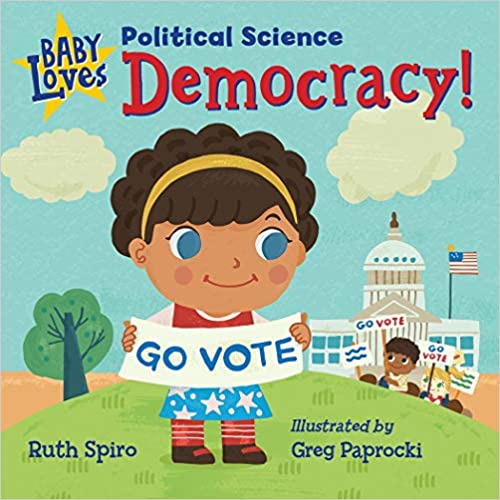
Ruth Spiro's "Baby Loves Political Science" board books explain democracy's basics to even younger kids. (Charlesbridge, 2020-2021, illustrated by Greg Paprocki.) It's never too early to start!
Ruth explains that these new additions to her popular "Baby Loves Science" series use everyday events and observations to teach the fundamentals of government. Democracy introduces elections, while Justice, along with the forthcoming Congress and The Presidency, cover the three branches of government.

In a similar vein, in Free for You and Me: What Our First Amendment Means (Albert Whitman, 2020, illustrated by Manu Montoya) my intention was help kids appreciate the freedoms guaranteed by the First Amendment, and to understand how these freedoms shape our lives. I incorporated poems, historical vignettes, and a contemporary story in which kids exercise their rights to make the world a better place. While some high-profile adults don't always seem to understand the Constitution, I hope this book gives young readers a good start on the road to civic engagement. 

Books to Foster Social Engagement

What better way to capture a young reader's imagination than with a well-told story? That's what these picture books do. Here's a selection of excellent recent and forthcoming PBs that use true stories to bring history to life, promote empathy, and encourage young people to get involved in their communities.

No Voice Too Small: Fourteen Young Americans Making History (Charlesbridge, 2020) profiles 14 contemporary young activists with brief bios and poems by diverse poets. Edited by Lindsay Metcalf, Keila Dawson and Jeanette Bradley, with art by Jeanette Bradley, this book invites kids to read it again and again. It includes back matter explaining the poetic forms, profiles of the poets, and suggestions for activism.

Jeanette Bradley says her daughter inspired her to create this book. After reading other picture book biographies, she told Jeanette, "I wish I lived in the past, so I could change things." This child had concluded, from her reading, that only famous dead people could make a difference in the world! Jeanette hopes that by collecting the stories of modern activist kids, she can correct this misconception and "empower kids to speak out and act when they see a wrong." 

The book's editors also created additional materials to inspire engagement. Keila wrote an activity guide, and Lindsay and Jeanette collected book club materials for teachers on Flip Grid. As Keila says, not only should kids learn about leaders from the past, but they also "can be a part of making history too."
  
Author Elisa Boxer is drawn to unsung heroes. In The Voice That Won the Vote: How One Woman's Words Made History (ill. Vivien Mildenberger, Sleeping Bear Press, 2020), she celebrates a lesser-known figure in the women's suffrage movement. Febb Burn was a mother who helped push through the ratification of the 19th Amendment by writing a letter to her lawmaker son. This story resonated for Elisa, who knew it could "help children realize the power of one voice, and one vote." She hopes her book will "inspire children to give voice to what matters to them." 
Beth Anderson was also moved to tell the story of a lesser-known woman. Lizzie Demands a Seat: Elizabeth Jennings Fights for Streetcar Rights (ill. E.B. Lewis, Calkins Creek, 2020) introduces readers to a young African American schoolteacher in New York City who fought against segregated streetcars in 1854, a century before Rosa Parks took her stand.

In presenting this book to young people, Beth highlights how the "heroic people that come before us inspire us and how we, too, have a responsibility to leave 'footsteps' to inspire others that follow us." Beth leads the kids in an activity in which they trace their feet on colored paper and cut out "footprints." On one footprint, she asks them to write the names of those who have inspired them, and on the other, how they'd like to inspire others.

Author Traci Sorell works to bring greater visibility to members of the Native Nations in literature for young people, and to empower kids to use their voices. Her first Picture Book, We Are Grateful: Otsaliheliga (ill. Frane Lessac, Charlesbridge, 2018), offers readers a look at contemporary Cherokee life. Traci continues to bring Native stories to light in many formats. Look for her forthcoming nonfiction picture books, Classified: The Secret Career of Mary Golda Ross, Cherokee Aerospace Engineer (Millbrook 2021), and We Are Still Here! Native American Truths Everyone Should Know (Charlesbridge 2021).

Do you have other favorite books to share on these topics? Please leave them in the comments! 

More Recommended Recent Picture Books for Young Activists
☑ Sometimes People March, by Tessa Allen (Balzer + Bray, 2020)
☑ Shirley Chisolm is a Verb, by Veronica Chambers, ill. Rachelle Baker (Dial Books, 2020)
☑ Memphis, Martin, and the Mountaintop: The Sanitation Strike of 1968, by Alice Faye Duncan, ill. R. Gregory Christie (Calkins Creek, 2018)
☑ Shaking Things Up: 14 Young Women Who Changed the World, by Susan Hood, ill. Sophie Blackall and 12 more (Harper Collins, 2018) 
☑ We Are Water Protectors, by Carole Lindstrom, ill. Michaela Goade (Roaring Brook, 2020)
☑ Vote for Our Future! by Margaret McNamara, ill. Micah Player (Schwartz & Wade, 2020)
☑ Peaceful Fights for Equal Rightsby Rob Sanders, ill. Jared Andrew Schorr (Simon & Schuster, 2018)
☑ The Teachers March: How Selma's Teachers Changed History, by Sandra Neil Wallace, Rich Wallace, ill. Charly Palmer (Calkins Creek, 2020)

Additional Resources


Monday, May 19, 2014

These Biographies Are NOT "Slight" by Kathy Halsey

Define "Slight," Please
Recently I attended an informative book talk hosted by an educator/books festival impresario. She discussed 60 books in 90 minutes and her knowledge of the genres was impressive. However, she kept referring to the picture book biographies being reviewed as "slight." These "partial" stories did not include birth to grave information.


Now, being a non-fiction aficionado, beginning my first draft of architect Mary Colter's life, I beg to disagree. A partial take on someone's life is not "slight," it's actually a creative way to draw young children into a true story. These slice of life stories are a way to open up a biographee's life via little-known facts, a focus on one event, or on the motivating circumstances that created the drive to be unique or outstanding. I personally find this type of biography fascinating, and I know kids and their teachers would prefer them, too!  

Friday, March 14, 2014

BREATHING LIFE INTO BIOGRAPHIES, From: ANATOMY OF NONFICTION By Margery Facklam and Peggy Thomas. Post by Sherri Jones Rivers

             "The best biographies are the ones that peek into the heart and soul of their subjects." 
                     -------Candace Fleming--------


Are you a snoop? Do you like to know about people's lives? Do you wonder what it would have been like to fly the first airplane, invent the telephone, or be the first African-American Supreme Court Judge? If so, you may have the disease called "Acute Biography Writing Syndrome."


It's been said, "All history is gossip."  Of course, you want to make sure you have your "gossip" properly fact-checked, rechecked, and cited. There are countless biographies on the market, but what makes a strong one? I'm sharing an overview of the ideas put forth by this mother-daughter team that have helped me in crafting my biographies:


                                          STRONG BIOGRAPHIES


** The authors state a good biographer seeks some arrangement or pattern in his subject's life. He will make connections between the events, hold back some of the facts, and foreshadow others. When you focus on a pattern or an outstanding characteristic, you are more apt to leave out information that's not important to the flow of your story. Save some of that for Back Matter, or Author Notes, or Sidebars.


** Sometimes, they say, a biography will tend to focus on a certain aspect of a person's life that people don't know about. That singular aspect gives the person's story a new twist. That's what happened when Peggy Thomas found about George Washington's love of farming, and wrote Farmer George Plants A Nation. Lots of books about George Washington out there, but she found something about him that had "settled in the shadows" and "shone her biographical flashlight on it."


** A strong biography will ground the person in the reality of the times in which he or she lived. An example they cited was Pam Munoz Ryan's When Marian Sang. She felt it was important to show the opera star riding in colored-only train cars and singing to two different audiences, one black and one white. They warn that if you don't ground your subject in the times, it will seem as if he is floating around in space, not connected to anything.


                       FINDING SUBJECTS TO WRITE ABOUT


Magazine theme lists are mentioned as a great place to start. The authors suggest finding out what major historic anniversaries are coming up, and ask teachers what they would like to know more about. When Peggy Thomas asked a school librarian what her elementary students needed more of, the librarian pointed out the biography section and said, "More. We need more books about people kids haven't heard about yet." Does that make you giddy? It should. Find that unknown person and bring him or her to life.


                         MAGAZINES FOR SHORT BIO PIECES


If your subject is not known, but worth reading about, they say writing a magazine profile can serve as a short, focused biography. Cricket and Insight Magazines feature people who have overcome struggles or have made the world a better place. Boys' Life, Yes Mag, and Highlights also print profiles.


                          A FEW HELPFUL BIOGRAPHY WEB-SITES


They list web sites that you can browse for fun, or sites that will give you
information on a certain person.  Here are three to get you started:


** Academy of Achievement: www.achievement.org. Features people in business, the arts, sports, science, and public service.


** Innovative Lives: www.invention.smithsonian.org. Lists inventions and inventors.


** My Hero: http://myhero.com. This one lists achievements of people from all walks of life.


     Okay, who will you be writing about? The library shelves are waiting.....