Showing posts with label elections. Show all posts

Wednesday, September 4, 2024

Books and Poems to Engage Kids in Democracy ~Christy Mihaly

Hello GROG readers. Welcome back to another school year ... and another federal election. 

So here's another post about ways to encourage civic engagement in our young people. How can we support kids in understanding the basics about how our government functions (or is designed to function) and in developing the skills they need to engage in the work of democracy?

I have some ideas. And I'd love to hear your thoughts.

Books!

Let's start with books. My first dive into the pond of writing civics books was a picture book about the First Amendment, published in 2020. Since then I've written one about the Supreme Court and several civics-oriented series for the educational market. 


This month, my picture book about Congress comes out. 

I know, I know: "What? A picture book on Congress, are you kidding?" But when publisher Albert Whitman asked if I'd like to write a book about Congress, I said yes (because that's what writers do). Then I started agonizing about how to approach this tricky topic. 

 I came up with an informational tale about Alice, whose mother is newly elected to Congress. Alice is upset that Mom is moving to DC and disrupting the family -- what's so great about Congress, anyway?

Accompanying Mom to work, she meets the legendary ghost cat of the Capitol (who turns out to be a bit snarky), and embarks on a historical tour of the building with guides both spectral and living. Alice learns about Congress's history and functions, and past crises it has weathered. She comes to understand the central importance of Congress and to appreciate the work her mother is doing. Kirkus calls it timely, and "at least in spots, refreshingly frank." And who am I to argue with Kirkus?? 

This year has seen many new children's books on voting and civics. Here are some recommendations: 


The Day Madear Voted, by Wade Hudson, illus. Don Tate. 

An engaging picture book about a Black family going to the polls for the first time in 1969. 

Leo's First Vote!! by Christina Soontornvat, illus. Isabel Roxas. 


This fun picture book tells the story of a classroom election along with the exercise of the franchise by Leo's dad, a new U.S. citizen. It includes  solid information about voting. 

Ida B. Wells Marches for the Vote, by Dinah Johnson, illus. Jerry Jordan. 

This much-needed picture book biography tells the important story of suffragist Ida B. Wells.


I Voted: Making a Choice Makes a Difference, by Mark Shulman, illus. Serge Bloch. 


This creative picture book focuses on the importance of making choices. It includes nonfiction back matter about voting requirements.


Represent: The Unfinished Fight for the Vote, by Michael Eric Dyson and Marc Favreau. 

This middle grade nonfiction book provides insights into the history of voting rights (and discrimination) in the United States.


Archived GROG posts also include my roundup of older picture books encouraging civic engagement and a review of a middle grade biography of Pauli Murray


Books like these can help kids and adults talk about what the government does, how it sometimes doesn't work the way it should -- and, importantly, what we can do about it.


Getting Engaged

Giving kids books is a great start. Books can facilitate meaningful conversations about important political issues. They can also help inspire kids to engage in civic activism. And we can do more.

This month, for a couple of bookstore events with OUR CONGRESS, I'll not only read from the book, but also talk about who represents us in Congress. We'll provide lists of names and addresses and templates to facilitate the kids writing letters to their members of Congress or state and local representatives. We'll also talk about the elections, and how people are weighing their choices. I'll have "Your Vote, Your Voice" stickers from the Secretary of State's office to hand out. It's a start!

Well-versed in Civics

I also continue to experiment with ways to use poetry to help kids build a democratic community. I wrote about this in my earlier post, Poetry month and civic engagement. I find that introducing young (or older) writers to simple poetic forms helps get the thoughts and words flowing. And that's a good starting point for broader discussions about freedom of expression, and the corresponding responsibility to listen to others. 

In working with fifth-graders in a series of workshops, we started with haiku and moved to Fibonacci poems (one of my favorite forms). We asked students to write from different perspectives. In one session, they paired up to write poems from opposing points of view. Then we wrote poems in two voices, and read them together. Here's the model that the teacher and I read together: 

Writing poems together facilitated self-expression, listening, and empathy. In our final session, we had a lively conversation about an upcoming school board vote on the school budget, with students sharing and listening and considering different sides of the discussion. It was a joy to see the kids modeling the skills we all need for constructive dialog.

As my friend Kathy Halsey put it: 

Creating Poems + Exploring Free Speech = Classroom Engagement.

So in this important election season, let's use our words to engage our youngest community members in civic conversations ... and let's make them proud to participate in their democracy.

Wednesday, October 7, 2020

Picture Books for Civic Engagement and Social Activism ~Christy Mihaly


Greetings! 
A quick announcement up front: I'm excited to be serving as a Round 1 panelist for the Cybils book awards this season, in the Nonfiction category. I'll be very busy reading many fabulous books over the next couple of months! Nominations are open through October 15, and anyone can nominate a worthy book--more info here.
~Christy

Today's Topic: Picture Books and Civic Engagement 
In 2020 we face an election year like no other. Amidst the disruptions to schools, schedules, and psyches, many adults are wondering how they can engage young people in meaningful conversations about our nation's challenges. 
Picture books can help. There's a cornucopia of recent releases to choose from. I asked a passel of creators of recently published picture books to share their inspirations, insights, and pointers for using these books in engaging with kids. 
Don't miss the additional titles they recommend, at the end of the post. And finally, I've included links to book-related additional resources.

Books about Civics
Sometimes we want a book that introduces the conceptual framework of democracy: elections, rights, and the roles of government officials. 

When Catherine Stier couldn't find a book to help her explain to her preschoolers what the President is supposed to do, she wrote it herself.  If I Were President (Albert Whitman, 1999, illustrated by DyAnne DiSalvo-Ryan) offers a kids'-eye view of the presidency. 

Stier's recently released A Vote is a Powerful Thing (Albert Whitman, Sept. 2020, illustrated by Courtney Dawson), provides a kid-friendly take on elections. Stier says she encourages adults sharing this book to talk with kids about issues that are important to them, and encourage them to design campaign posters for causes they care about.

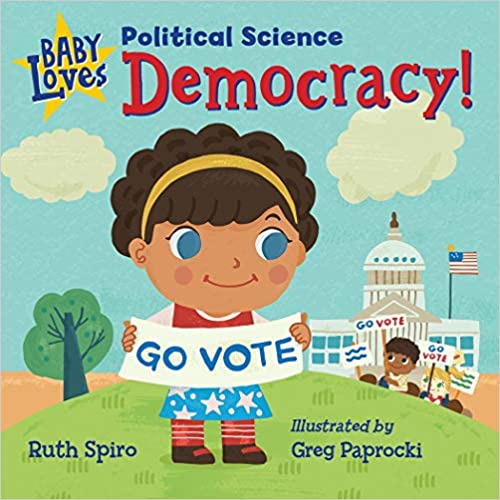
Ruth Spiro's "Baby Loves Political Science" board books explain democracy's basics to even younger kids. (Charlesbridge, 2020-2021, illustrated by Greg Paprocki.) It's never too early to start!
Ruth explains that these new additions to her popular "Baby Loves Science" series use everyday events and observations to teach the fundamentals of government. Democracy introduces elections, while Justice, along with the forthcoming Congress and The Presidency, cover the three branches of government.

In a similar vein, in Free for You and Me: What Our First Amendment Means (Albert Whitman, 2020, illustrated by Manu Montoya) my intention was help kids appreciate the freedoms guaranteed by the First Amendment, and to understand how these freedoms shape our lives. I incorporated poems, historical vignettes, and a contemporary story in which kids exercise their rights to make the world a better place. While some high-profile adults don't always seem to understand the Constitution, I hope this book gives young readers a good start on the road to civic engagement. 

Books to Foster Social Engagement

What better way to capture a young reader's imagination than with a well-told story? That's what these picture books do. Here's a selection of excellent recent and forthcoming PBs that use true stories to bring history to life, promote empathy, and encourage young people to get involved in their communities.

No Voice Too Small: Fourteen Young Americans Making History (Charlesbridge, 2020) profiles 14 contemporary young activists with brief bios and poems by diverse poets. Edited by Lindsay Metcalf, Keila Dawson and Jeanette Bradley, with art by Jeanette Bradley, this book invites kids to read it again and again. It includes back matter explaining the poetic forms, profiles of the poets, and suggestions for activism.

Jeanette Bradley says her daughter inspired her to create this book. After reading other picture book biographies, she told Jeanette, "I wish I lived in the past, so I could change things." This child had concluded, from her reading, that only famous dead people could make a difference in the world! Jeanette hopes that by collecting the stories of modern activist kids, she can correct this misconception and "empower kids to speak out and act when they see a wrong." 

The book's editors also created additional materials to inspire engagement. Keila wrote an activity guide, and Lindsay and Jeanette collected book club materials for teachers on Flip Grid. As Keila says, not only should kids learn about leaders from the past, but they also "can be a part of making history too."
  
Author Elisa Boxer is drawn to unsung heroes. In The Voice That Won the Vote: How One Woman's Words Made History (ill. Vivien Mildenberger, Sleeping Bear Press, 2020), she celebrates a lesser-known figure in the women's suffrage movement. Febb Burn was a mother who helped push through the ratification of the 19th Amendment by writing a letter to her lawmaker son. This story resonated for Elisa, who knew it could "help children realize the power of one voice, and one vote." She hopes her book will "inspire children to give voice to what matters to them." 
Beth Anderson was also moved to tell the story of a lesser-known woman. Lizzie Demands a Seat: Elizabeth Jennings Fights for Streetcar Rights (ill. E.B. Lewis, Calkins Creek, 2020) introduces readers to a young African American schoolteacher in New York City who fought against segregated streetcars in 1854, a century before Rosa Parks took her stand.

In presenting this book to young people, Beth highlights how the "heroic people that come before us inspire us and how we, too, have a responsibility to leave 'footsteps' to inspire others that follow us." Beth leads the kids in an activity in which they trace their feet on colored paper and cut out "footprints." On one footprint, she asks them to write the names of those who have inspired them, and on the other, how they'd like to inspire others.

Author Traci Sorell works to bring greater visibility to members of the Native Nations in literature for young people, and to empower kids to use their voices. Her first Picture Book, We Are Grateful: Otsaliheliga (ill. Frane Lessac, Charlesbridge, 2018), offers readers a look at contemporary Cherokee life. Traci continues to bring Native stories to light in many formats. Look for her forthcoming nonfiction picture books, Classified: The Secret Career of Mary Golda Ross, Cherokee Aerospace Engineer (Millbrook 2021), and We Are Still Here! Native American Truths Everyone Should Know (Charlesbridge 2021).

Do you have other favorite books to share on these topics? Please leave them in the comments! 

More Recommended Recent Picture Books for Young Activists
☑ Sometimes People March, by Tessa Allen (Balzer + Bray, 2020)
☑ Shirley Chisolm is a Verb, by Veronica Chambers, ill. Rachelle Baker (Dial Books, 2020)
☑ Memphis, Martin, and the Mountaintop: The Sanitation Strike of 1968, by Alice Faye Duncan, ill. R. Gregory Christie (Calkins Creek, 2018)
☑ Shaking Things Up: 14 Young Women Who Changed the World, by Susan Hood, ill. Sophie Blackall and 12 more (Harper Collins, 2018) 
☑ We Are Water Protectors, by Carole Lindstrom, ill. Michaela Goade (Roaring Brook, 2020)
☑ Vote for Our Future! by Margaret McNamara, ill. Micah Player (Schwartz & Wade, 2020)
☑ Peaceful Fights for Equal Rightsby Rob Sanders, ill. Jared Andrew Schorr (Simon & Schuster, 2018)
☑ The Teachers March: How Selma's Teachers Changed History, by Sandra Neil Wallace, Rich Wallace, ill. Charly Palmer (Calkins Creek, 2020)

Additional Resources