Monday, May 15, 2017

Let's Play! ~ Christy Mihaly

By Jlbirman1 (Own work)
[CC BY-SA 3.0 (http://creativecommons.org/licenses/by-sa/3.0)]
Writing is my job—it's how I make a living. I love it, but sometimes it's a tough slog: a deadline looms, a beloved manuscript isn’t selling, and words bog down and refuse to sing. Ugh.

As the weather warms, it's a good time to remember an important part of the work of writing that we don't always honor: PLAY. 

Earlier this month I had the great pleasure of hanging out with a bunch of artists for a week. Watching the visual artists at work was a powerful reminder that play is central to the creative process.

The lucky participants in Vermont Artists Week,
Vermont Studio Center, May 2017
View from my studio window:
the VSC's Red Mill, on the Gihon River,
Johnson, Vermont
The event was a week-long residency at the Vermont Studio Center, on the Gihon River in Johnson, Vermont. VSC offers full-month residencies to artists and writers from around the world . . . but each spring they reserve one week for Vermont artists and writers. What a gift!


I'd submitted my work in January and then held my breath for a month. I was thrilled to hear in February that I was accepted for Vermont Artists Week. Finally, at the beginning of May, from the far corners of this small state, we assembled: eighteen writers (poets, novelists, memoirists, nonfiction writers) and 30+ visual artists (painters, sculptors, printers, photographers). Among these were several who writer and/or illustrate kids' books! The very air was abuzz with creativity.

But—my point about the playing: 
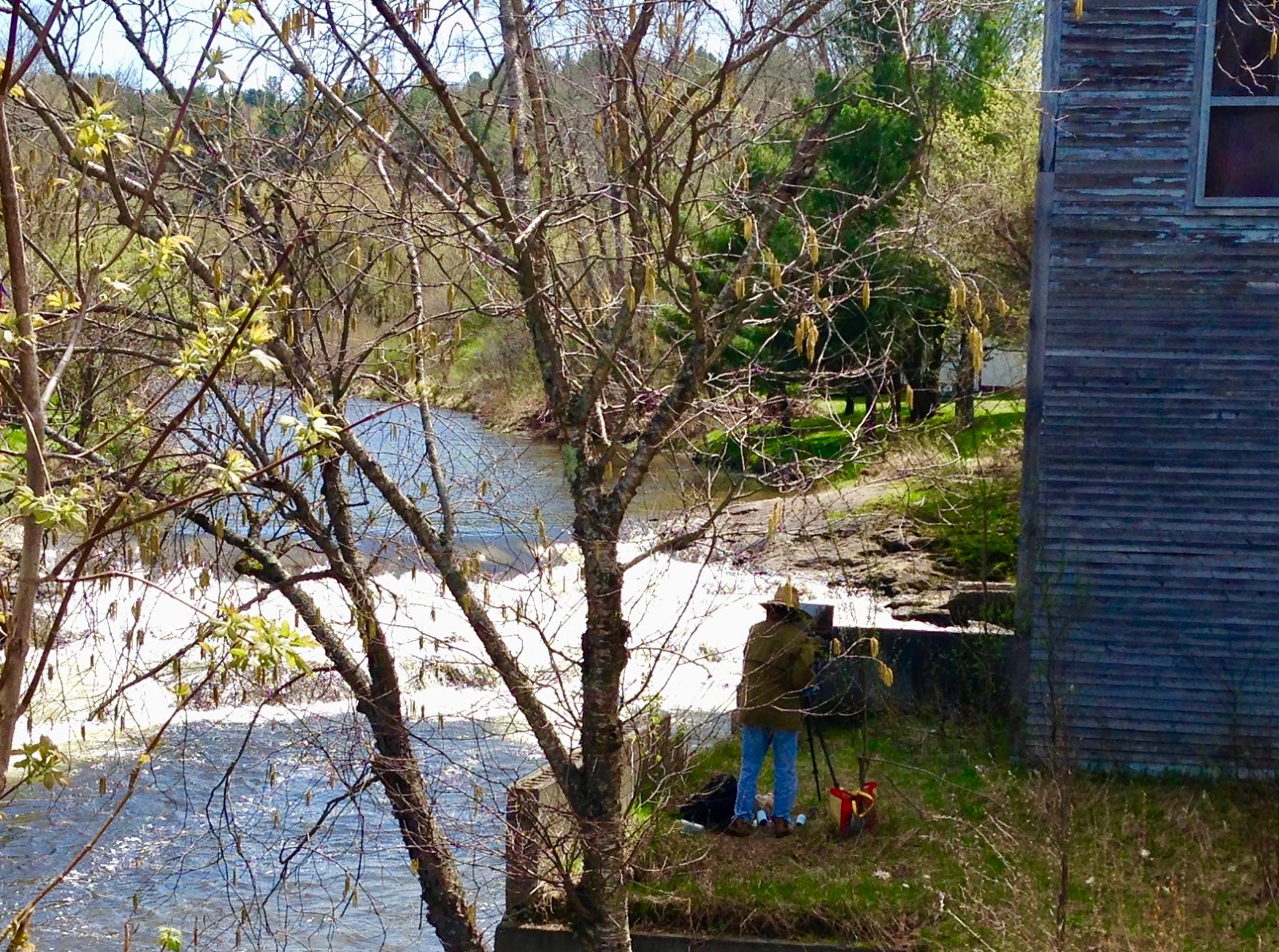
Artist at easel, by the river -- plein air painting

As I visited the artists' studios and admired the art that these folks had created, I was struck to hear them all describe what they'd done at VSC as “playing.” A woman who usually works with metal had used the week to play with cloth. A sculptor who works in wood or stone was playing with clay. Someone else was experimenting with a new way to compose her collages. Another was trying out new materials and playing with new combinations of colors.

They all were having tons of fun. 


My writing studio for the week.
(Yes, it has a view of the river)
Over in the writers' studios, we writers were soaking up the atmosphere, taking advantage of all that VSC offers . . . and working hard. Among the writers, I sensed higher levels of angst than I'd seen in the art studios. Like many of the writers, I'd  arrived with a long “To Do” list, and didn't want to waste a moment of precious writing time. 

Halfway through a week of intense work, though, my brain seized up. I was stuck on a balky manuscript. Of course, stops and starts can all be part of the writing process, but . . . I could see that those playful artists were on to something good. I started thinking about ways I could bring more play into my writing life. 

Here are a few ideas I collected:

Write a poem. It could be a little ditty about anything, just for fun. A silly rhyme! A haiku! Or, you could try a poem focused on a work in progress, perhaps free verse from your main character's point of view. 

The writers' version of playing:
a manual typewriter in the common area was
an invitation to type out random thoughts and notes

Write in a new genre. If you're a nonfiction writer, experiment with a short story. If you're a novel writer, try a first-person magazine article. Play around with it!

Play with point of view. 
Consider writing a page or a chapter of your story from a different POV. 

Sculpture of branches and feathers,
by Sabine Likhite 
Appreciate art. Just breathing the air of the art studios was enough to get some creative juices flowing. Try closing your eyes, and picture what you're writing about. How would you re-create your subject with paints or clay or wax or fabric? Does that give you new inspiration to paint with your words?


Eve at Journey's End


Of course sometimes, the working writer needs to get up out of the chair and find some fun elsewhere! How about these options?

Walk! Walking is an important part of the writing process for me. In Johnson, I enjoyed a woodsy walk to Journey's End falls with artist friend Eve Jacobs-Carnahan. 
Fairy House
We admired the waterfall, and then, thanks to Eve and her artist's eye, we also appreciated some unexpected creations left by prior hikers: fairy houses and gnome homes hidden in the underbrush. Some artistic souls had engaged in play that elves could be thankful for.

Ebenezer Book is awesome
(and not just because they carry my books!)

Visit your local bookstore, and read something fun! I visited (several times) the town of Johnson's outstanding local shop, Ebenezer Books. Along with a reference work for a nonfiction work-in-progress, I bought volumes of poetry and funny picture books -- that's some great play for a kids' writer!

Buy an artist (or a writer) a drink, and share some stories. Writers don't often get opportunities to compare notes with one another, and with artists, so if the chance presents itself, say yes! One of the joys of Vermont Artists’ Week was meeting so many neighbors (of both the writerly and artistic persuasions) and sharing stories of our work and our lives (and all the people we knew in common), and expanding our circles of creative colleagues. If that's not fun, what is?

So, if the grind gets you down, remember to play with your work! Try new things, notice the unexpected, and enjoy the journey.  Happy writing!
Covered bridge in the rain, Johnson.
Because, Vermont.

Thursday, May 11, 2017

A Tale of Two Talks: Public Speaking for Writers by Kathy Halsey


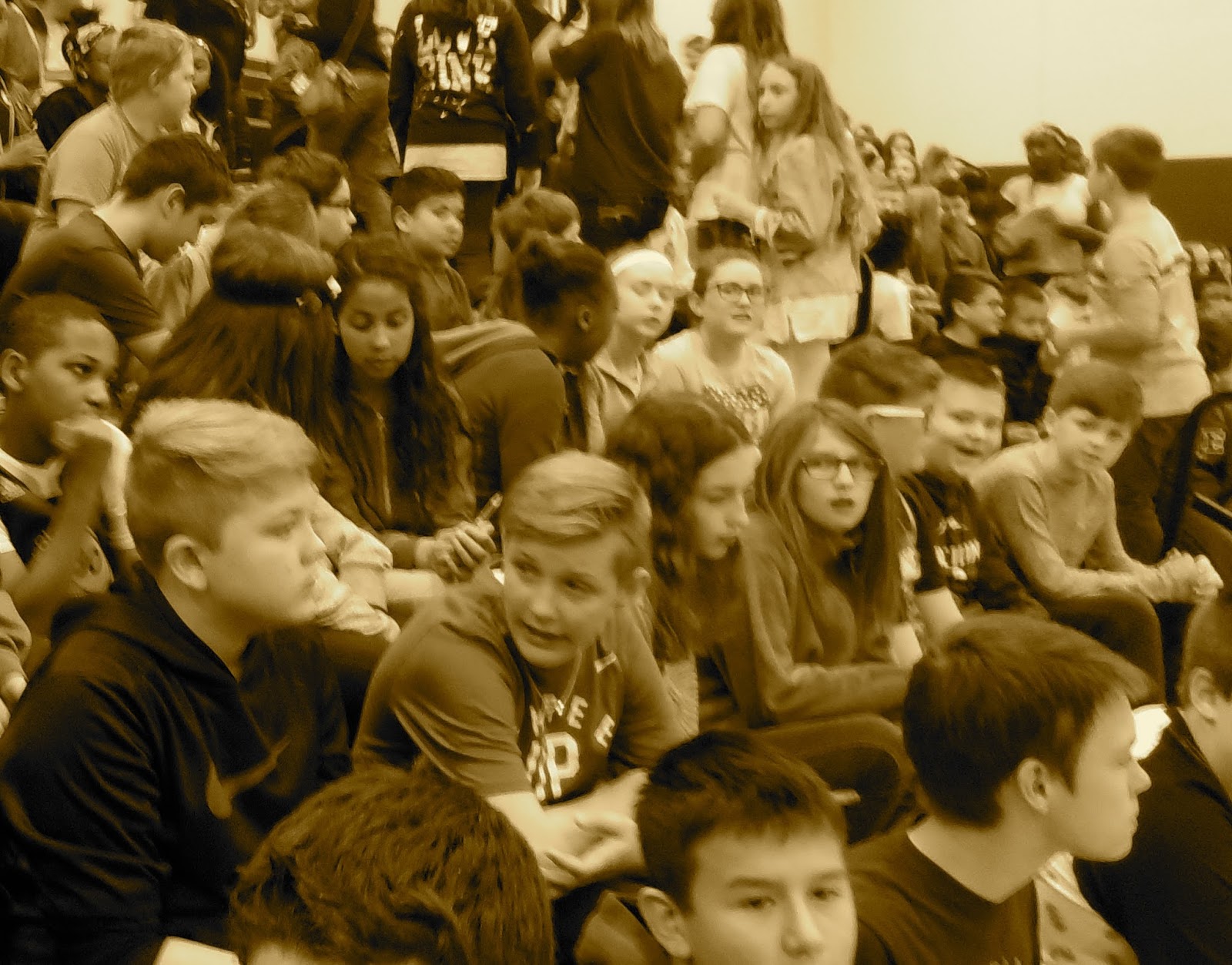
The scene: a middle school gym crowded with 6/7/8th graders at 45 minute intervals on the first sunny Monday in weeks. An author with a microphone, a wooden chair, and a table. No Power point, no bells and whistles, but lots of enthusiasm and nary a peep from the crowd until Q & A time. 

Who? Author Gary Schmidt, who was unflappable and mesmerizing! Let's check out his secret sauce recipe to keeping kids engaged.
Middle grade author Gary Schmidt is used to these scenarios and knows how to work a crowd of antsy kids. (I witnessed Gary and the sixth grade group after gym and lunch. If you've ever corralled a group of kids at this hour, you know what a herculean feat it truly is.)
Gary is a rather low-key, mild-mannered speaker, but he is an accomplished storyteller. As soon as the kids sat down he said, "I'll tell ya a story." In his conversational tone, he began telling a true story about a whale going "berserk-o" as it thrashed and began dying near a barge. It was covered in fish hooks, barbs, and steel cables. Three men attempted to untangle the whale armed only with the crudest of implements. 
  
What I Observed from a Pro 
1. His introduction was very different. Kids leaned in to hear the riveting story. He did not talk about himself or his books until the mid-point of the session.
2. He asked his audience questions about what might happen next. He had them anticipating the plot.
3. Once kids shouted answers, Gary redirected their attention quickly, with a polite, "OK, stay with me, guys." Then he waited for quiet.
4. He traversed the gym floor, paced, and finally came as close as possible to the students at the tale's climax. 
5. When the story ended, he discussed WEDNESDAY WARS, but through the POV of the 6th grade Gary who hated his teacher. Kids nodded their heads in agreement as he tickled off a litany of concerns: boredom, the slow reading group, feeling different. 
5. During the Q & A, Gary repeated questions so his audience could hear, and he innately sensed when his audience grew restless.    
6. Gary Schmidt connected with his audience by relaying and amplifying how it feels to be a tween and by being himself. He spoke of drama and adventure. He did not give a speech, he engaged in storytelling and group conversation. 

Segue: My First Gig as Luncheon Speaker

Scene: A crowded hotel ballroom on a rainy Saturday. Family groups, proud/nervous student honorees for the national PTA Reflections contest, Ohio PTA attendees, and me in uncomfortable heels and a Power Point...
Who? Pre-published writer, former English teacher, judge of Reflections' compositions for middle grade

I am comfortable speaking to library groups, educators, and other writers at conferences, but this was a new kettle of fish. I knew no one and I had never been a luncheon speaker for 250 people. However, as a writer, I knew once I had a published book, I'd be on the circuit of school visits as well as more formal occasions such as this. I took a deep breath and plunged in! 
Newbie Revelations
1. Practice, practice, prepare. I had fifteen minutes to "tell my story" and I know I'm chatty. I shaved my presentation to 10 minutes via practice as I knew students would receive their awards after my speech. My long-suffering critique group timed me, too. Unlike other presentations, I practiced this one orally for 4 days beforehand.
2. Fortunately, I followed Gary Schmidt's lead and focused on my audience. Students grades K-12, wrote, filmed, created art, composed music all on the theme of story. My goal was to inspire them as young creatives, urging them to take that passion to the next level.
3. I asked my social media friends how to structure my talk. The consensus was to keep to 2-3 points, discuss each point, and repeat the theme at the end. (When in doubt, Facebook and Twitter can be a useful "hive mind.")
4. I calmed my nerves by engaging with the families and honorees. I offered to take pictures of proud families, and asked students about their work. My mind was on my audience, not me. I relaxed.
5. After the event, unexpected benefits were mine. Student writers wanted to chat with me and even take my picture. A PTA coordinator shared that I had inspired her to write for pleasure not just for her PhD.

A tale of two talks shows that authenticity, focus on others, and learning from the pros are proven ways to tackle public speaking for writers.  


Monday, May 8, 2017

What's New at the Library

By Leslie Colin Tribble


Ok, I'll admit it. I kind of cheat when I write these posts about new books. I work in the cataloging department of our county library so I get to see all the BRAND NEW kids books when they come in. Best day of the month is when the new shipment of kid lit comes in. I hope you enjoy this little selection - I know I loved all these books!


I Will Love You Anyway by Mick Inkpen, Illustrated by Chloe Inkpen
I've been a Mick Inkpen fan for a long time - I read his book to my children ages ago. What's not to love about this author? First, he has the perfect writer name, second he generally writes about animals. Win-win for me right there,

Inkpen's latest book is a collaboration with his daughter Chloe. It's about a puppy who is a handful, wreaking havoc upon his family, This particular puppy has a tendency to Run Away (an ongoing issue in the book). I loved these lines, "I steal your glove. I steal your shoe. I steal your socks. They smell of you." That is still my life with my now four year old puppy! Plus my dog still runs away (now he comes home though. . .  when he's hungry.) Mick Inkpen completely understands a puppy's character and anyone, adult or child, who has owned a dog will appreciate this quick, rhythmic read.


I Am (Not) Scared by Anna Kang, Illustrated by Christopher Weyant
This book features two bear-like fuzzy creatures who first appeared in Kang's, You Are (Not) Small. The friends talk about the many things that might be scary, ending with snakes and roller coasters. And where do they find themselves? At the amusement park, watching a snake ride a roller coaster. On they hop and soon discover that sometimes scary things can be fun. This is just a fun lap-time read, but could be a great help for children facing a potentially scary situation or event. Sometimes things aren't as bad as we make them out to be.


Rain by Sam Usher
What I first noticed about this book were the raised rain drops on the cover. That give a tactile foreshadowing of all the rain-filled adventures to come. The book opens with a boy and his grandfather waiting out a rain storm. But the rain doesn't stop, which is reflected in the double page spreads of what's happening outside their home. The boy reads books of sea dragons, and ships, and floating cities with boatmen to pass the time. He can't wait to get outside for an adventure! Grandfather is busy writing, but suddenly needs to post a very important letter. Luckily the rain has stopped. The two step out into a magical world, all thanks to the rain. Waiting is sometimes a good thing.


Bunny's Book Club by Annie Silvestro, Illustrated by Tatjana Mai-Wyss
Anyone who loves libraries will love this book. The first hint of the story line is on the cover spread with an illustration of a wonderful old library check out card and pocket. Patrons who have checked out this book include Bunny, Bear, Porcupine and Raccoon. I'm hooked! Our hero is Bunny, who loves books. He spends all summer listening in during story hour in the garden. But fall comes and story time moves inside the library. Bunny is convinced he can't live without books so one night, he searches and searches until he discovers the book drop, and inside the library he falls. Night after night, book after book Bunny raids the library, filling his burrow with his treasures. Soon his friends drop by and catch the reading bug. But what happens when they all visit the library and are discovered by the librarian? Bunny's Book Club is a sweet read filled with the love of books and the all important carrot muffins.


Watersong by Tim McCanna, Illustrated by Richard Smythe
This was my favorite of all these books. The lyrical language and simple but poignant pictures won my heart. It helped that it was raining when I read this book - the lovely words caught the emotion and energy of the rainstorm perfectly. This is a book that begs to be read out loud - "Drip, drop, plip, plop," with every page a perfection of rhyme and rhythm. The main character, a fox, runs through the storm as it builds until he is forced to seek shelter. The danger passes and fox comes out to find a rainbow and the safety of family. Children will love reading along, quietly at first then louder and louder as the storm builds. This book has 53 words, all of them descriptors of water action - spitter, spatter, slosh, babble, bubble, wham, crash. A final page of back matter with a smattering of information about foxes, watersheds, ecosystems and the water cycle round out this wonderful book. Simple, sweet, emotion-laden, and informative - this is the book we all wish we'd written.

Thursday, May 4, 2017

An Interview with Ellen Leventhal about Anniversary Editions and Bluebonnets


by Janie Reinart


Today, we are celebrating the makeover and anniversary edition of DON’T EAT THE BLUEBONNETS by co-authors  Ellen Rothberg and Ellen Leventhal. 

Welcome the lovely Ellen Leventhal for our interview.

Who is your agent? 

No agent as of yet.

   
How did you get the idea for your story?

My co-author, Ellen Rothenberg came up with the idea. We talk a lot at schools about "What if?" 

She saw cows in a patch of bluebonnets and asked, "What if those cows ate those bluebonnets?" The rest is history!


Even thought we loved DON’T EAT THE BLUEBONNETS and it was doing well, the first book went out of print. So we updated the story.  

Our new illustrator, Joel Cook, came at it with a new vision and fresh ideas. Happily, Clear Fork Publishing (Spork) picked it up. 

Order books here.


What is your favorite part of the story?


That's easy. My favorite part is where we came up with a cuter and more kid friendly way to solve the problem in the anniversary text. I giggle when (the cow) Sue Ellen's friends find things in the barn and she finally realizes what has to be done.


How long did it take to write? Get a publisher?

The original took about a year and a half. We entered a contest and won! That's how we got a publisher for the first version. 

This time, after we rewrote the story, I sent it to a publisher, and honestly it didn't take that long for her to accept it. But of course, that is just the beginning.


Ellen's desk.


What is your writing routine?

I wish I could say that I get up early in the morning, work until noon, have a quick lunch, and then go back to writing. But nope, I'm not that disciplined. 

I do write every day, but sometimes it's not for long. There are days when I write for hours, and there are days that I fit writing in between the rest of my life. My goal is to become more disciplined and have a better routine.


What is your favorite writing craft book?
 
Well, that’s not fair. There are so many. I’m one of those people who pick up a book on the craft and think it’s the best. Until I read the next one! 

Of course, I do have Ann Whitford Paul’s Writing Picture Books on my desk, and any craft book by Nancy Sanders in super valuable. I have two of hers on my desk too. My desk if overflowing! (Another goal: Clean up!)
 
What inspires you to write?

Hmm, I’ve always loved to write, so it’s hard to think of a current inspiration except for the fact that I LOVE, LOVE, LOVE, doing school author visits. 

When I taught full time (I still teach part time),I found myself re-writing the curriculum to make it more interesting, writing poems to help kids remember things, and just having fun writing with kids. 

So, the thought of sharing more about literacy or content of a particular book is what pushes me to keep going. So,I guess I would say that kids inspire me.


What are you working on now?


I have a few things going right now. I just finished a new fiction picture book, and I am shopping it around. I sure hope someone loves it. 

I’m also working on a narrative non-fiction which is new for me and a historical fiction picture book. 

Words of advice for writers...

I am certainly no great sage,but if I had to give advice, it would be the same thing I tell myself. 

If you love it do it. 

Rejection is not personal (Eek! That’s a hard one, but so important). 

And don’t be afraid to explore new avenues in both your writing and your submissions. 

Oh, and read, read, read in your genre. I just told a group of kiddos that in order to be a great writer, you must be a great reader. I totally believe that.


Some more good news from Ellen her book LOLA CAN’T LEAP will be out next March from Clear Fork. Congratulations, Ellen!
Thank you for a wonderful interview and best wishes for your new and renewed book launches.
 

Ellen Leventhal is an educator and writer in Houston, TX.  Her grandchildren, chocolate, dogs, and school visits are some of her favorite things.

You can find Ellen on her website,
and on FaceBook, 
 

Monday, May 1, 2017

ALL THINGS ART: AN INTERVIEW WITH CALDECOTT HONOR WINNER R. GREGORY CHRISTIE


     When I got an email from SCBWI Southern Breeze that a fellow Georgian had won a Caldecott Honor for his book, Freedom in Congo Square, 


I knew I wanted to interview him. His list of awards is way too long to mention here, but suffice it to say he is making his mark in children's books. He was gracious enough to take time from his busy schedule to answer some questions for the GROG. 


     On a recent youtube video I watched, you mentioned you had been an artist since you were six. Can you tell us a little bit about your journey, and how it led to picture books?

     I was a very shy child growing up and spent a fair amount of  my playtime copying comic books. As I got older I worked in an art store, then for a framer, then at Star Ledger Newspaper in Newark as an intern doing spot illustrations. Eventually I curbed my shyness by doing live paintings in NY city night clubs. Which lead to meeting DJ's and eventually creating album covers. One cover, in particular, Justice System's "Summer in the City," caught the attention of editors at Lee and Low Books back in 1996 and I was asked to do a series of paintings for a book titled "The Palm of My Heart: Poetry by African American Children." It won the Coretta Scott King Award Honor in 1997, which eventually brought more projects and more awards. I'm extremely thankful for the opportunity that Lee and Low gave me.

     Is there a certain process you go through once you get a manuscript that you are illustrating?

     It really isn't too technical or out of the ordinary. I break down the words to fit a 32 page picture book format and then start the visual research. I need to know hairstyles, clothing, the wild life indigenous to the area, social mores of the time period, plausible scenarios and also to figure out an artistic style that I'm inspired to make the voice of the book. I keep these things in mind and in a folder in my computer. I study these images and eventually as I start to paint my illustrations, I keep them up on the wall with the hope that one work will influence the other work being created. It also serves s a kind of metaphysical visual cheerleader who lets me know that there's only 10 paintings left, then nine, then eight, etc until I take a break and then do the cover. I take a break in order to be fresh in terms of my instincts and sensibilities. I believe the cover is the most important aspect of such projects. It can make or break all the hard work you've just finished, so I want to be at my strongest.


     What elements of a manuscript make it fun or exciting to illustrate?     

     The unpredictability of it all. I've worked with various authors and each one has their own way of relaying information. The various authors have various voices and I love illustrating their ideas.

     
    Is Mousetropolis the only book you have both written and illustrated? How did that come about? I love the mice--they have personalities.


     I saw a photograph of Coney Island Beach by the artist Weegee(Arthur Fellig). It was taken in 1940 and I couldn't believe so many people were ever there at one time. It made me think of Times Square and that perhaps one day it will be a shell of its former glory. Maybe it will not have the same lights or iconic sentiment that it has today. I brought this up to editor Grace Maccarone at Holiday House and a week or so later she suggested that I write a book on Aesop's "The Town Mouse and the Country Mouse." I could do Times Square there as well as any other expansive cityscape. As the project developed I decided to make the city New York influenced rather than specific and chose more universal urban scenes. I had lots of fun creating that book and really pushed my skills, especially on the moving train scene.

     I see that you have illustrated several books by Tonya Bolden and Nikki Grimes. How has that been working with the same author on different manuscripts?

     It's like what I'd imagine a character actor would go through. I take each project as its own entity. I try not to just produce a product or to copy myself from book to book. Even when I did the Dyomande Daniel series based off Nikki Grimes' books, I tried to outdo myself with each book. I try to keep it interesting for me and for the viewer of the art.


     You have traveled to quite a few different countries. How has that impacted your art?


     In the past I've been able to keep a balance of work and play. It's amazing to "work" while right outside your door is a Turkish food market or a sunny Thai beach with crystal clear water. Living in other countries allowed me to live in the present as opposed to the past or even what I consider to be more life numbing, the future. Each day that I got up was a gift and routines were not the norm. So in a way things were simplified and allowed me to keep focused.  I feel that successful art needs craftsmanship, luck, and discipline. I struggle with the latter and in my experience I've known that each artist will generally struggle with one or two of these aspects. Traveling to far away places did wonders for me as I was able to sit down and to create. But I suppose at the end of the day everyone has to discover what is going to be their best personal way of examining their life and creativity.

     Your 2017 illustrating awards include a Coretta Scott King Honor Book and a Caldecott Honor Book Award. Was that a surprise? What do those honors mean for you as an artist?

     Although it's never going to be as good as the first time, that 7 AM phone call is always a surprise. I wasn't expecting it, but a large part of me was hoping for it. I got a call from the Coretta Scott King committee and shortly after, was called by the Caldecott committee. It was an excellent start to my day in the morning and the adventure came for me in getting down to the convention center in spite of the Atlanta morning traffic.


They wanted me there at the center to hear it actually being announced. 
     The awards mean a lot to me. It's amazing to get recognition from librarians, whom I hold in great regard. Each person makes their own parties in life; for me, it's being able to create worlds from words. It's all even sweeter when someone actually gets it and cares about it enough to preserve what I'm doing.


     Can you tell us something about yourself people might now know?

     I have a bookstore and art school inside a mall in Decatur, GA. It's where I am right now in life and it's not something I imagine I'll retire into, but it's making a difference in the community. Anyone can come in to look right over my shoulder as I freelance as an illustrator and hopefully create the next great title for children.


     R. Gregory Christie is a three-time recipient of the Coretta Scott King Award for illustration and a two-time recipient of the New York Times Best Illustrated Children's Books of the Year. He lives in Georgia.