Monday, August 28, 2017

Lisa Amstutz's Recipe for Success (Writing a Picture Book that Sells)


We're excited to have a Guest Blogger for today's GROG post: Lisa Amstutz, author of more than 80 nonfiction books in the school and library market. Lisa's first trade picture book, Applesauce Day, was published this month by Albert Whitman & Co. For this lively story, Lisa drew inspiration from her family's applesauce-making traditions.

And here's Lisa, with her recipe for picture book success!
~ Christy Mihaly

+++++++++++++++++++++++++++++

We’ve probably all had a recipe that flopped at some point. Burnt cookies, salty soup, bread that didn’t rise…. On one memorable occasion, my husband forgot the noodles in a tuna noodle casserole! It happens to even the best cooks. But following a recipe carefully will maximize your chances of an edible result.

The same could be said of writing a picture book. There is no guaranteed recipe for success—after all, even picture book greats like Jane Yolen still get rejections!  However, an editor is more likely to find your picture book "delectable" if you follow these steps.

Fresh, sweet apples
1. Start with a strong concept. You have a concept, but how do you decide whether it's "ripe" for writing? Check first on Amazon and WorldCat to see if someone else has recently written about your topic. If so, make sure your treatment is different enough to stand out. If not, ask yourself why no one has covered this idea before. Is it interesting to kids? Is it age-appropriate? If your story concept passes these tests, move on to #2.

Additive-free!

2. Look for a hook. A sales hook helps make your story “appetizing” to editors. Publishing companies have to make money to stay in business. If an editor falls in love with your story, they have to sell it to their acquisitions committee. Make it easy for them by giving your story a clear sales hook. Maybe it’s similar to a bestseller, or ties in with a major holiday. Perhaps there is an obvious curriculum tie-in. For example, with Applesauce Day, 
many teachers do apple units in the fall. Apple orchards and apple organizations are other potential markets.

Washed and ready for the chopping block
3. Find some mentors. Check out works by "master chefs." Look through recently published picture books to locate luscious mentor texts for your story. These do not need to be about a topic similar to yours, but rather should have the tone, structure, or style that you have in mind for your book. Do you want it to be lyrical? Funny? Rhyming? Straightforward? Circular? Don’t plagiarize, obviously, but use your mentor texts as inspiration.

The family works together in Applesauce Day
4. Add some “heart.” This is the "secret sauce." A successful picture book usually takes the main character, or the reader, on an emotional journey, or evokes a universal theme such as friendship, love, or family. This can be an important selling point for your story. When writing Applesauce Day, I started with a family making applesauce. But my story didn't find its heart until I added the special applesauce-making pot into the story: it symbolizes the handing down of this family's applesauce-making tradition from one generation to the next, and highlights the book's family-togetherness theme.
 
Into the pot
5. Be smart: make a dummy. I resisted this step for years. When I finally started doing it, my stories improved significantly. You don’t have to be an artist to make a dummy; just break your story into page spreads and draw some stick figures. Make sure you have enough content for 12–14 spreads and that there is enough, but not too much, for the illustrator to work with on each spread. Putting together a dummy makes my stories tighter and more visual. It also helps in creating page turns. You won’t submit your story this way unless you’re an author/illustrator. But if you’re serious about selling a picture book, don’t skip this step.

Is it applesauce yet?
6. Revise, revise, revise. Don’t submit your story “half-baked.” I have 40 versions of my current work-in-progress in my computer, and it’s not done yet. Find some good critique partners who will give honest feedback on your work. “Stir” your story well to smooth out any lumps in the storyline. Then sprinkle on some simile/metaphor, rhythm, alliteration, etc. to make your text really delicious.
 
Ta-dah! Delicious, homemade applesauce
There you have it – my not-so-secret recipe for picture book success. Good luck—and bon appétit! 

Lisa Amstutz is the author of more than 80 children’s books. Her newest picture book, 
Applesauce Day     was released Aug. 1 by Albert Whitman & Company. Lisa also serves as a judge at Rate Your Story and Assistant Regional Advisor for Northern Ohio SCBWI. Learn more about her books and critique services at www.LisaAmstutz.com, or follow her on Facebook. 


Thursday, August 24, 2017

Dissecting nonfiction

 by Sue Heavenrich

A few years ago (2011, to be exact) Peggy Thomas and Margery Facklam's wonderful guide to writing nonfiction was born. Since then, it's been my go-to reference for questions about writing true stories for kids.

I think it's because I love the way it's organized - if you remember those biology dissection labs, it makes sense. First, the authors define the species: what is nonfiction? What sets it apart from other kinds of storytelling? They present many examples to give writers a feel for the diversity of this species (magazine writing, works for hire...).

Then they crack open the skull and go straight for the Brainstorming: where do ideas come from? What are kids learning about in school, and when? What's a slant and how will you know if you have one?

They spend two chapters on the skeletal system: the bones of the story. This is a deep dive into research, primary sources and where to find them, and the best way to net information from the Web.  There's useful information on photo research, building a bibliography, interviewing people, and even doing hands-on-research.

"Once in a blue moon, an unexpected event takes you to a whole new world," writes Margery. If that opportunity presents itself, grab on with both hands, she advises. Nothing beats firsthand research.

Once the bones are in place it's time to examine the heart and voice of story. This is where Peggy and Margery examine plotting, dialog, and finding a writing voice that kids will hear. Once those basic building  blocks are in place, it's time to assemble the "Story Skeleton", from an "oh wow" lead to a just as "wow" ending, back matter, and more.

The dynamic duo spend three chapters focusing on specific kinds of nonfiction: biographies, science and nature writing, and how-to pieces. Each chapter is packed with information, tips, examples, and resources. For example, in the science chapter there's a handy list of websites that provide accurate science information (NASA, MIT, US Geological Survey, and more). The best advice: think like a child.

"Take readers into the natural world with all their senses. Show the colors, textures, and smells that create the feeling of the swamp..." or forest or wherever you are taking this story, they write. Make sure it's true, accurate, and kid-friendly.

Concluding chapters focus on strengthening your story and finding markets. There's a great section filled with resources, and an index (for those of us who forget to tag pages with sticky-markers).

Check out Peggy's Anatomy of Nonfiction Writing website here. It's filled with insightful posts and discussions - plus there's a link for how to order your own copy of the book.

Monday, August 21, 2017

Whispering Woods Recap: Why You'll Want to Go - by Kathy Halsey


Summer's over for many of us and kids going back to school may still receive that perennial writing assignment, "What Did You Do This Summer?" Here's my answer.
Our Lady of  the Prairie (AKA Anne of Green Gables House)

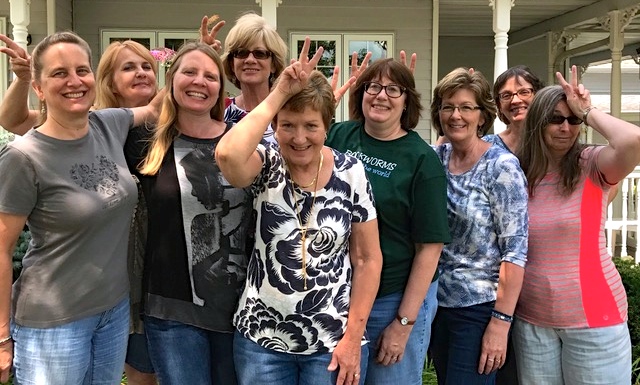
I flew to Cedar Rapids, Iowa, had a weekend-long "slumber party" with 8 other writers, including author/teachers Jill Esbaum and Linda Skeers. I played charades, stayed in an Anne of Green Gables house, and revised one pesky manuscript and began another that I feel has promise. I had homework - read 30 picture books and did a one sentence synopsis of each book. I amassed 17 handouts and 3 pages of typed notes. Wanna know more? Come along.


Out-of-Sight Insight
  • I had never been in such an intimate setting to work on my writing. Going to a serene retreat center helped center me. Being with writers who didn't know me or my work opened up new ways for me to see my stories.
  • "Show not Tell" can be unpacked by playing "emotional" charades. Jill gave us cards with one word emotions: confusion, joy, scared, sad, surprised. We acted them out and the rest of us tried to guess the emotion. Body language is useful for show emotion, and will engage our readers, too. As Jill said, "Make the readers do the work." They're smart enough to grasp the author's intent. (Try this w/a face-to-face critique group. It's fun.) 
    Here writers act out silliness!
  • Openings are so crucial, but hear this. Editors and agents typically read only the first six words. If you give them a reason to pass on the work, they will. Your first lines are the foundation of the house (story) you build. 
  • With opening in mind and  armed with a Character-driven Picture Book Analysis handout,  we scan recent books, noting by which page we identify the main character and her/his internal and external conflicts. Then we look at our own work. If either element isn't there by the third spread, it's time to fortify our story foundation.
  • Linda encouraged us to really amp up our main character's defining characteristic. She stresses that one can't go overboard with this. We should be able to pull our character out of the situation and know how he/she would respond in any new set of circumstances. Two mentor texts that show determination  as a trait include  CINDY MOO by Lori Mortensen and PRUDENCE WANTS A PET by Cathleen Daly.  
  •  When creating characters and story, keep in mind the three Fs found in a child's life: family, friends, and frustration.
  • Finally a huge "aha" moment for me came via my manuscript critique...there's still major work to be done. I had a hard time seeing that since I was so invested in it. I've dusted myself off, made a list of how and where I can revise, and this knowledge will make my WIP stronger.
  •  Linda Skeers & Jill Esbaum
The Dynamic Duo - Linda & Jill
Using our discretionary income for craft development is important to us writers. I have attended an LA SCBWI annual, NESCBWI twice, as well as workshops in my region for almost four years.. As a former educator with my M. Ed. in Curriculum, I can vouch for the value of Whispering Woods for me. Why?
  • Jill and Linda are professional, easy-going, and fun. They've presented this weekend retreat enough that it is a well-orchestrated mix of work, rest, writing, and application of craft. 
  • The Friday-Sunday summer retreats include home cooked meals - locally grown and organic whenever possible. We were even feted with a festive dinner out on Saturday. 
  •  The grounds include nature paths and wildlife, private rooms w/shared bathrooms, fields of prairie grass, a nature pond, and a labyrinth.
  • Our instructors offered very detailed written critiques for each of us as well as oral critiques with our small group. Attendees are friendly and at an intermediate+ level in their craft. I received written critiques from all of them, too.  
  • Jill and Linda left room on Sunday for an open discussion on anything we wished to discuss. Our conversation included agents, editors, queries, and their recommendations for next steps on our path to publication.
  • Slots fill up quickly and this year there were two summer sessions. Contact Linda here. Due to the housing restrictions, the center can only accommodate 10 guests. 
  • After seasoned writers attend state, regional, and national conferences, I feel a small retreat focused on manuscripts/craft is the next best step. I'm also considering Whispering Pines next spring. See information here.

Please share your professional development favorites for us in the comments, and check out Linda & Jill's newest books, too. 


WOMEN WHO DARED by Linda Skeers is a very accessible nonfiction anthology that I'm ready to read NOW. FRANKENBUNNY is a fun mash-up that Jill Esbaum shared with us at the retreat. Ready to hop on it, too. 


Thursday, August 17, 2017

Interview with Every Cowgirl Series Author: Rebecca Janni with Tina Cho

During summer I was able to visit my family in Iowa, and I got to meet a picture book author I had been online friends with--Rebecca Janni (pronounced Yahni). Rebecca is author of the Every Cowgirl Series (Every Cowgirl Needs a Horse, Every Cowgirl Needs Dancing Shoes…), Jammy Dance, and her latest picture book Spin. What’s even neater is that Rebecca’s younger sister and I used to take piano lessons at college together from the same instructor. So when I found out Rebecca wrote these books, I knew I had to personally meet her. Our children are pretty much the same ages, and so we had a wonderful afternoon together.
Tina Cho-left, Rebecca Janni-right
Welcome, Rebecca!

  1. How long have you been writing?
I always loved to write since I was a young child. I kept a journal, played with short stories, and wrote poems.

2. How did you get into writing?
I read lots of picture books to my kids, and I wrote my own story, Jammy Dance, for them. It was one of my first manuscripts. After bathtime, we used to have a “di-dee dance,” and that is how this story was born. I met a local author, plugged into SCBWI and a local writers’ group, and attended some conferences. The writers and illustrators I met have become lifelong friends.

3. How did you create your character, Nellie Sue, the cowgirl?
At age four, my daughter was learning to ride her bike without training wheels. She wore long brown braids, cowboy boots, and a vest. I would say things like:  “How’s my bicycle cowgirl? Get back in the saddle. Hit the trail.” I brainstormed how bikes and horses were alike with my aunt. I was inspired by a Mark Twain piece called “Taming the Bicycle.” My story, Bicycle Cowgirl, eventually became Every Cowgirl Needs a Horse.


4. How did you make the Cowgirl books into a series?
Credit for the series goes entirely to my editor Steve Meltzer and agent Jamie Weiss Chilton. I had endless ideas for Nellie Sue’s adventures, but I never would have presumed they would become a series! I was thrilled when my editor asked for a sequel, and Nellie Sue Gets Back in Line became Every Cowgirl Needs Dancing Boots.


5. How did your latest book, SPIN, come about?
My seven-year-old daughter and I rode one day of RAGBRAI, an annual great bicycle ride across Iowa. As we encountered the highest hill of our 44 mile ride, she said, “It’s not as big as it looks.” I loved her perspective and hoped that she would see the hills of life in the same way. With God, mountains can be moved. So SPIN is about a simple bike ride, a life ride, and even our spiritual journeys.

6. What types of marketing activities have you done?
My release parties have been tied into book fairs so that sales benefited schools. My advice is to live the book at each release party.

For the first book, Every Cowgirl Needs a Horse, my publisher, Penguin, made stickers and activity pages for school visits and bookstore signings. For Every Cowgirl Needs Dancing Boots, we held a square dance at a historic barn in our town. When the fourth book came out, my publisher sent me on a book tour. Every night I boarded a plane to visit schools and bookstores in cities I'd never visited before.


story time

7. What are you working on now?
I’m working on the launch party for SPIN, picture book manuscripts about adoption, a garden party, a new character, and a refugee story.

Thank you so much, Rebecca, for letting me interview you! She is such a sweet person with whom I could talk for hours! She and her family have gone through a lot, both good and bittersweet. She gave her first picture book signed to her father, who was in hospice with brain cancer. When she signed her second contract, she dedicated Every Cowgirl Needs Dancing Boots, to him, with whom she had had the first dance.

Rebecca and her husband also adopted a boy from China, one who fit in with their other three children perfectly. His description was that he, too, had lost a father and liked picture books! Rebecca is fluent in sign language and was the perfect mom for Joshua, who was deaf. Since then, he has had surgery and received hearing devices to help him.


Bio:
Growing up in Iowa, Rebecca Janni learned that biking was the best way to get around the neighborhood and reading was the best way to get around the world.
Author of Spin, Jammy Dance and the Every Cowgirl series, Rebecca divides her time between teaching at Grand View University, visiting schools and libraries, volunteering, and writing for children—all of which take a back seat to motherhood. She loves the joyful chaos of life with her family—her much-loved husband James, their four children, Andrew (17), Anna (15), Jacob (11), Joshua (10), and Mickey Dog. Through it all, she believes God has a plan, and it is good.
Rebecca's office

rebeccajanni.com

Monday, August 14, 2017

nErDcampMI by Marcie Flinchum Atkins

While the Grog was on vacation, I've had a really packed summer. Out of four big trips I took, the first was nErDcampMI.

I don’t know about you, but as a writer, I keep a “bucket list” of conferences I’d like to attend some day. I made the bucket list a few years ago because I realized I wanted to do so many conferences but I couldn’t afford to do them all right away both financially and in time away from work and family.

I put Highlights Foundation on my Vision Board next to my computer. Within a few months, I’d made enough money on freelance work to pay for a workshop. Nerdcamp Michigan (also known as nErDcampMI) was also on the list. I knew it would be packed with book-loving authors, librarians, and teachers just like me who loved readers and books as much as I do.

For those of you who don’t know what nErDcampMI is, it’s an ED camp that has become a conference that draws people from all over the US and Canada to a little town in Michigan where Colby Sharp, teacher and book lover extraordinaire (and one of the Nerdy Book Club blog founders), gives teachers, librarians, and authors a place to mingle and share. And did I mention it’s FREE?

We Need Diverse Books panel moderated by Tracey Baptiste


Day 1 involves panels, NerdTalks (a 7 minute long “Ted Talk”), and dozens and dozens of conference-style sessions to attend. 
Mr. Schu talks to R.J. Palacio before her "NerdTalk."


Sarah Albee and Jess Keating talk about writing nonfiction

Day 2 is ED campstyle. The attendees propose sessions and we take off to different rooms to have conversations about different topics of interest to us. It's more of an impromptu session.

The amazing authors also stay the evening after the conference to do a nErDcamp Jr. which hosts 1,000 kids for FREE! They get to hear authors speak, get free books, and learn to be nerdy just like the rest of us.

I attended sessions on diverse books, how to host an author visit, nonfiction writing tips for kids, a Mr. Schu interview with R.J. Palacio and a mini-book talk and giveaway. On the ED camp day, I attended sessions by Jack Gantos about writing instruction, tough topics in middle grade, and doing your own Sibert Smackdown. I left with a to-do list of things to try for next year.

Jack Gantos talking about his many journals


One of the best parts of nErDcampMI is meeting author, teacher, and librarian friends I’ve known on Twitter in real life.  The internet has made our networking so much easier, but nothing beats the energy you get when you put a bunch of people together in real life who love, love, love books and have the desire to share that love with kids.  

If you are like me, and live far away from Michigan, the cool thing is that nErDcamps are popping up all over the country. 

Do you have a bucket list of conferences? What's on your list?