Showing posts sorted by relevance for query Swanson. Sort by date Show all posts

Wednesday, October 23, 2019

Engineering a Book with Jennifer Swanson

by Kathy Halsey & Sue Heavenrich

illus. by TeMika Grooms; Peachtree Publishing 
When you hop into a car, chances are a chime will remind you to put on your seat belt. But cars didn’t always have seat belts. Or headlights, back-up cameras, or disc brakes. In fact, the first cars didn’t even have bumpers!

“…it took many years, and thousands of crash tests, to create the safe vehicle you ride around in,” writes Jen Swanson. Thousands of safety designers and other engineers – aided by anthropomorphic test devices (aka: the crash-test dummies) – had to define safety problems, imagine solutions, carry out the tests, and collect data so they could design safer cars.

In Save the Crash-Test Dummies, Swanson highlights the engineering that goes into car design, and introduces readers to the family of crash-test dummies, which has grown to now include the dad, mom, three kids sized to represent children aged ten, six, and three. And yes, they have a crash-test dog!

There are plenty of diagrams, a chapter on engineering self-driving cars, and an overview of the diversity of problems different types of engineers solve.

But enough about the book – let’s meet the author!

GROG: So Jen, is it easier now to entice editors with engineering topics? What is your approach in pitching such topics to editors? Has it changed now that you are better known for this genre?

Jen: Editors are more open to STEM topics than ever before. This is so exciting—especially for topics that focus on technology, engineering, and math. The pitch for an engineering-heavy book is really the same as any other: you need a really good HOOK. When I first started working on this book, I wanted to write about the self-driving car. But I needed something to make this topic stand out. It came to me one night while on a walk with my husband. Crash-test dummies! The perfect way to make the history of car safety engineering exciting and intriguing. See, it’s not just about the topic you want to write, it’s more about how it is presented. Go for the high-interest and out-of-the-box thinking every time. It works!

GROG: I've noticed that you use kid-friendly comparisons in your books. How do you come up with size comparisons? Do you just "guesstimate" a size of comparable objects by doing the math or is there a resource you've found for this?

Jen: I use kid-friendly comparisons in all of my books. Why not? The books are for kids. Since a lot of the concepts I talk about in my books are complex, I find that the easiest way to get my point across is to build an image of it for the reader. Sometimes that is an actual illustration. Other times, it’s a picture that I build in their head with my descriptions. I imagine my reader of about 9 or 10 years and I try to come up with ways to get them to understand something immediately. Instead of saying something is about 100 yards long, I say it’s as long as a football field. To get some comparisons, I search the internet. If I’m trying to estimate weight, I might query, “what weighs two tons?” The answer?  You can either say it’s a little bit more than a regular sized car or just under the weight of a fully-grown black rhino. I’ll bet those put those images in your head. Now you know exactly what size I'm talking about.

GROG:  How can we, as writers, encourage more girls to embrace engineering and math? What stories can we tell?

Jen Swanson speaking at the 2019 National Book Festival
Jen: I’d like all students to find STEM more interesting! I realize that there are fewer girls entering the STEM fields, and that needs to be addressed. The best way is to model what you want from your kids or students. I grew up in a family of three brothers. No sisters. I was never told that I couldn’t do the things my brothers did. In fact, I started a science club in my garage when I was seven. I picked up bugs, flowers, leaves, waded through streams, and climbed trees. My mom supported my curiosity and got me a microscope. I realize that I was lucky to have the parents I did and that many girls don't have those same experiences.

I hope that we, as authors, and just as women, can encourage girls and young women to follow their passion for STEM. Join clubs that allow you to be creative, whether that is a robotics club, an art and illustration club, or a club of hikers that go into the woods. Start a science club, or a club at the library where you read STEM/STEAM books and discuss them. Perhaps get together for a cause to help clean up a beach or a landfill or even to plant trees. And I hope that the adults in their lives will encourage and support them in doing this.

Thank You for joining us today, Jen! 
Jennifer Swanson is a prolific author and this year was invited to speak at the World Science Festival and the National Book Festival. She is also the creator and head wrangler of the STEM Tuesday blog. Learn more about Jen and her books at her website.

Explore more of Jen's books with these posts from the GROG. All writers can learn more about the craft of writing and engaging readers with STEM by reading these books! Click on the blog links below.

Geoengineering and Earth's Climate
Brain Games


Friday, October 30, 2015

BRAIN GAMES by Jen Swanson:Review & Mentor Text Study by Kathy Halsey

KAPOW! BRAIN GAMES by Jen Swanson hits a one-two punch for readers, writers, educators, and librarians. Jen's newest nonfiction book published by the esteemed National Geographic Kids really does have something for everyone, and is nominated for a 2015 Cybil for elementary/middle grade nonfiction. 
Jen was challenged to take a dense topic, make it accessible, understandable, and fun. Challenge met. Also,  this project, had a built-in challenge - to take BRAIN GAMES, the very popular NatGeo show, and make it two-dimensional and interactive. Again, challenge met. Kids will be engaged as they use their bodies and minds to solve problems and prove scientific facts. Be prepared for kids to bounce, jump, and mumble to themselves as they connect viscerally to BRAIN GAMES. 
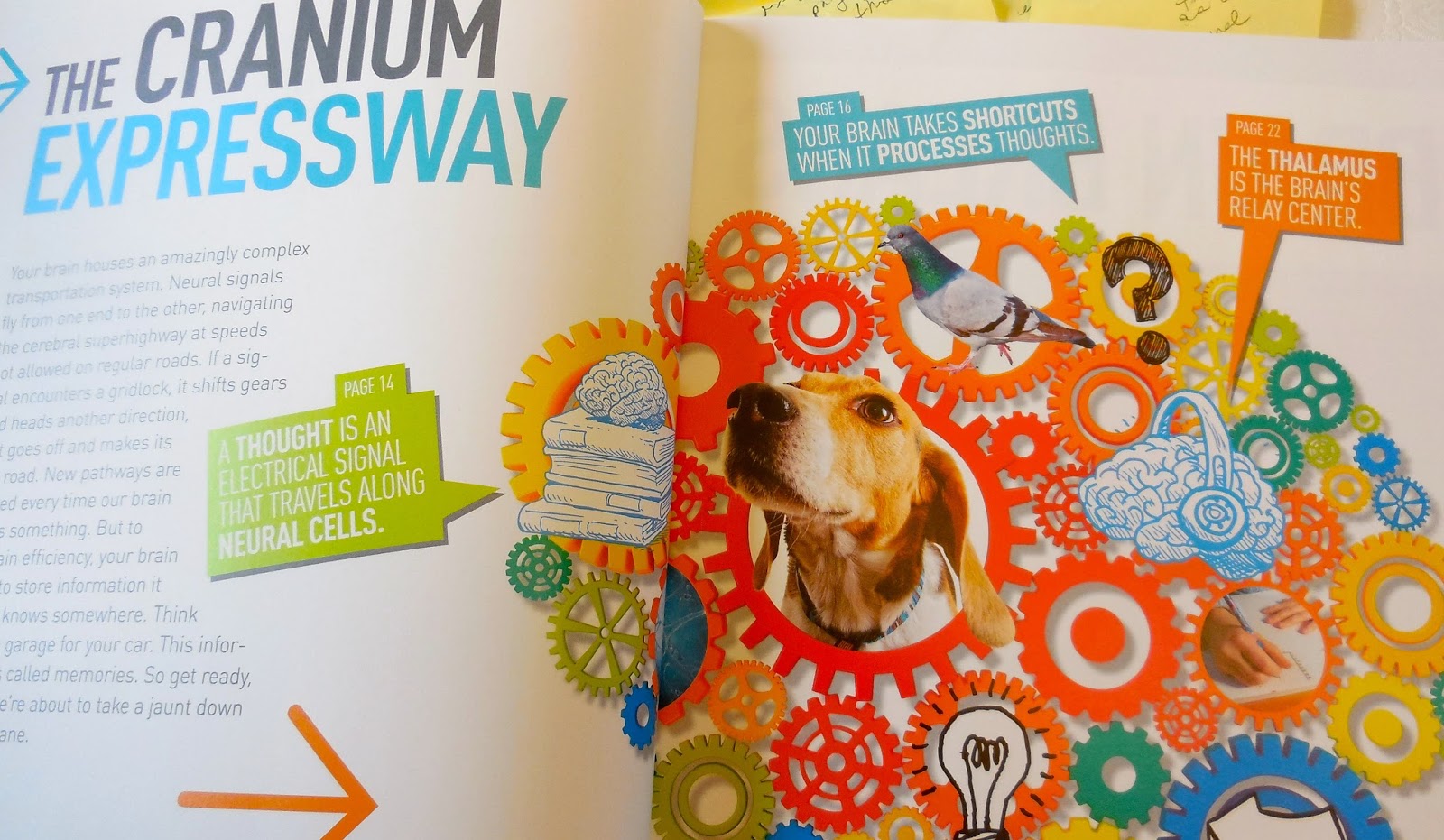
This interior shot from BRAIN GAMES reflected my thoughts about the brain before I read the book. I had to think about thinking - metacognition - ARG! However, Jen Swanson's structure and choice of examples made this an understandable, fascinating read. Nonfiction writers will want to examine this book as a mentor text to learn the techniques Jen has employed.
Mentor Text Goodness
Structure Is King: What entices kids to pick up or discard a book? Design and structure can make the difference. Compare Jen's book with a textbook or a book for the educational market. 
  • Vibrant, color-saturated 2-page spreads introduce each chapter.
  • Every chapter ends with another 2-page spread -side one is a short summary, while side 2 highlights an illustration of the brain with pictures used in the chapter. Three major facts are pulled out in thought bubbles for easy recall. 
  • This predictable, repetitive format helps readers form an anticipatory set. They are aware of text features that aid recall.
  • Using her knowledge of the brain functions, Jen gives the brain a break toward the end of each chapter. We play brain games with pictures and puzzles. 
  • Scientific material is "chunked" into bite-sized pieces for better understanding.
  • A challenge is presented in all chapters to engage kids. On page 21 the challenge asks readers to hold a book at arm's length and  close each eye separately. The scientific explanation follows. "Your eyes see each image separately and send a signal to the visual cortex in the occipital lobe of the brain."
    Chapter 1 Intro


Chapter 1 Summary Spread

Writing style, voice, and tone are intentional:
  • The brain could be a dry topic, but Jen chose a witty, fun, breezy style to lighten the subject.
  • The theme of driving has been chosen to add cohesion. Jen's target reader can't drive, but they are fascinated with cars. 
  • Word play that kids "get" for chapters and headings, such as:  "start your engines, all roads lead to the front." (Think frontal lobe.) 
  • Questions begin most chapters to appeal to the reader. Here are a few examples: "Wish you had access to the largest storage system in the world?" and "Feeling happy? Feeling sad? Get in the mood to learn about how your brain deals with emotion."
  • Jen uses examples/comparisons that her audience likes and understands: brain energy compared to 10-watt light bulb, length of motor neurons compared to a baseball bat; knowledge the brain stores compared to 300 years of TV shows.  
Time for a brain break. Answers at bottom of each page. Every 20 minutes one should take a break. (Knowledge from book.)
Notice how text is chunked into bites for easy reading.

Join me and pick up BRAIN GAMES  by Jen Swanson. Your grey matter will light up whether you are a reader or a writer! Don't forget to read all about Jen, Monday, Nov. 2! Make sure to leave a comment that day and you could win your own copy. 


Thursday, November 2, 2017

Science Rocks: Jen Swanson & GEOENGINEERING EARTH'S CLIMATE:RESETTING THE THERMOSTAT by Kathy Halsey

Nonfiction writers, today is a REAL treat, prolific science writer Jen Swanson shares craft tips and how a fabulous book like GEOENGINNERING came to be. And if you comment on this post, you'll be entered to win a copy of GEOENGINEERING! Plus I'll review Jen's newest noting the exemplary writing techniques she uses. Finally, Jen's up to even more with the launch of a new blog! Over at From the Mixed-Up File of Middle Grade Authors comes STEM Tuesday beginning November 7 with the topic of zoology. Middle grade books will be highlighted along with resources for teachers. Look here to meet the STEM team of writers.

Book Review via a Writer's Lens
It takes a special skill set for an author to make a complicated topic like geoengineering accessible and interesting for tween/teen readers, but that is Jen Swanson's writing sweet spot. Via Jen's clear, concise yet captivating style, I've learned about and reviewed brain science, Brain Games, nanotechnology, Super Gear, and now geoengineering, the science of human interference to counteract climate change. This is a controversial topic and choosing to use the author's note in front rather than back matter was a smart move. Students will know upfront that Jen is discussing a "hot" topic that is at the forefront of our headlines today. (Think hurricanes such as Maria, Harvey, excessive flooding, and the Central Mexican earthquake, among others.) Yet Swanson delineates the pros and cons of every method she discusses so young readers will easily distinguish the facts and opinions stated. Writers new to expository nonfiction would do well to study Jen Swanson's craft throughout this book. Fun titles, the use of onomatopoeia, short chapters, examples kids can understand make this subject come alive. Teachers will appreciate the plethora of back material: source notes, bibliography, glossary, further information, and an index are all provided. I highly recommend this book for intermediate and middle schools as well as writers who wish to write curriculum-related nonfiction. (Jen speaks more about her craft in our Q & A below.)


Jen and Kathy Chat
What drew you to the topic of geoengineering? Did Twenty-First Century Books ask for a proposal? Did they require a set number of resources/websites? What about photos, infographics? Did you have to provide those? 
How this book came about is kind of a funny story. I was at the 21st Century NF conference and went to go get some tea for breakfast. There, I ended up speaking with Domenica DiPiazza, the Editorial Director of Twenty-First Century Books. We got to talking and I told her that I was writing engineering books. She asked if I knew anything about geoengineering. (I said no, because I didn’t). Then she said she was looking for an author to write a book about this very important topic. I quickly googled it and a few weeks later, submitted the proposal. It was a “right time, right place” sort of thing.

Every proposal requires the amount of research it needs. Which seems weird to say, but it’s true. There isn’t a set  of  “I need 10 resources” sort of thing. For me, you research until you know enough about your topic to write an amazing book about it. As for the photos, Twenty-First Century Books provided them for this book. That is not always the case. Every publisher has different requirements for photos.

I know you’ve done great nonfiction work with National Geographic. Is there a point when publishers began contacting you with proposals once you’ve established yourself? 
Once you establish a good working relationship with an editor, you may have chats about book topics they are looking for and/or ideas of your own to discuss with them. Sometimes these develop into actual projects and eventually books.

Your nonfiction is fun and understandable for its intended audience. What writing techniques do you employ to engage readers?
First, I imagine myself as a kid who is really interested in learning about this topic. I ask myself questions, such as: What is really cool about this process/topic/technique? How does it work? Why is it important? Is there something I can do to help? Any connections to the real world that I can make?

I use active words, kid-friendly descriptions and exciting information. For example, if I were going to talk about distance or size, I might say “it’s as big as a football field”  or “as small as a baseball” or maybe “sticky like a piece of tape on a hot summers day”. Something like that puts in immediate picture into the readers’ mind of exactly what you are describing. That allows them to then make their own connection to size and shape.

It’s immensely helpful when explaining difficult concepts, like geoengineering. In my geoengineering book, I made it easy to understand because every process scientists are looking at is something kids know: the rock cycle, the water cycle, the carbon cycle, etc. If you break it down into easy to understand concepts, then your readers will get it right away.

At what point in the research/writing process do you involve experts? How do you find them or does the publisher do that?
I usually look for experts right away. I don’t contact them until I am well-conversed in the subject, though. I approach them through email and sometimes do everything that way. Occasionally, I will ask them for phone interviews, but not always. I find them at universities mostly. The majority of my research is found in reading professional papers written by university professors. I just pick the experts from there. 

What projects are in the publishing pipeline for you now?
I am excited about the three books I have releasing from National Geographic Kids in 2018. Two are series books: Dr. E’s Super Stellar Solar System is about a planetary geologist who studies rocks on other planets (She has even driven the Mars Rover!). It’s some really exciting space stuff  and every chapter opens with a graphic novel spread. The second series book is a relaunch of Nat Geo’s famed Everything series as Absolute Experts: Dolphins which again features a National Geographic Explorer who studies and works with real dolphins. It’s a fantastic peek into the mind of one of the smartest creatures on the planet.

Finally, there is  Astronaut-Aquanaut: How Space Science and Sea Science Interact. I am VERY excited about this book. It’s a compare-contrast of how astronauts and aquanauts live, learn, and train for their environments. I spent many hours tracking down experts from both fields to include their actual experiences in this book. I had a blast writing this book!

What does a typical work day look like for you? How do you keep to such a tight schedule?  
Well, there is no such thing as a “typical” day for me. I’m very much a by-the-seat-of-your-pants type writer. I work best when I’m under deadlines, which is why I probably have so many. Most of my research takes place on the computer since I do a lot of technical books, I have to read A LOT of professional papers. I also head to the library. There are days when my 12-seat dining room table is covered with books stacked 3-4 high.


I love being a children’s author. It is a dream come true. And I am lucky enough to keep getting jobs so that’s what keeps me going, well, that and paying college tuition for two kids.

Remember to comment below to win a copy of this fabulous book! Wiley Corgi will be choosing a winner.

Wednesday, September 5, 2018

Highlights of Nuts & Bolts of Science Writing 2018 by Kathy Halsey

What did I do on my summer vacation? One of the biggest highlights was my first Highlights workshop. In this post I'll share newbie tips along with writerly tidbits from our fab faculty. 


Newbie News
  • Plan when you invest in your writing. I waited five years before I signed up for a Highlights workshop. I wanted to be better at my craft and have some projects that could benefit from being workshopped. I also looked for specific faculty and topics that would stretch me as a writer. I found the perfect fit with Nuts & Bolts Science. I knew Jen Swanson and Miranda Paul were excellent teachers since I've attended conferences where they'd been speakers. 
  • Although I've read and studied nonfiction for children, I'd never written science, so I plunged into writing an informational picture book about gardens using a child's POV. My critique group and writer friends helped me revise and polish my WIP before I sent it to Highlights. My advice? Take a manuscript that you can't make any better on your own to a workshop. ( Be prepared with a second manuscript, too, just in case the opportunity arises for a second critique.)
  • Although it's comforting to attend conferences/workshops with a writer buddy, sometimes going alone will push you to meet new people and network. Now I have a "tribe" of 20 new science writer friends: a snail scientist, an entrepreneur who created a STEM magazine for children, an Ohio writer who is now a contributing editor for Cricket Media, and the amazing author Sarah Aronson. (She gave advice about creativity, the writing doldrums, and shared pieces of her newest book JUST LIKE RUBE GOLDBERG.) Be open to meeting new people who will enrich your life. 
Sarah and Kathy

Fab Faculty TidBits
Take four wonderful professionals (Jen, Miranda, editor Sam Gentry, and Ohio author Tracy Vonder Brink ) together for almost five days, and soon you've had a master class in writing nonfiction, pitching, and a how-to on cracking the magazine market. There was so much insight from these women who generously shared time, knowledge, and books with us. I'll share a chunk of knowledge from all these super stars. (Newbie note - very dark skies in Honesdale PA, so you should plan to star gaze.)

Tracy Vonder Brink  
Jen Swanson, Miranda Paul, Samantha Gentry

  • All lucky attendees received a critique from Samantha, plus we had our choice of two more critiques - one with Jen and one with Miranda, depending on whether we wrote middle grade or picture books. (This is why you bring several solid pieces.)
  • Back matter REALLY matters to Miranda Paul. She had us do a useful exercise that helps writers get an overview of back matter. Take a stack of picture books, fiction and nonfiction, and read them quickly but study the back matter and make a list that includes type of back matter (author note, charts, fun facts, etc), how many pages of back matter, audience for the back matter (educators, parents, children) and if the tone/style fits the front matter.  
  • Jen Swanson swoons for research to make science sing. She begins by going to the library to actually browse the nonfiction section. Serendipity is the name of the game. Jen enjoys hunt, finding both adult and children's books on her topic. For internet research she begins her working bibliography by adding raw links, footnotes at bottom, and then uses Citation Machine or another service. 
  • Many of Jen's National Geographic middle grade books rely on interviewing experts. She has  many tips regarding experts (a person working in the field or a PhD.) You'll find them at universities or by googling your topic. Then email them to see if they have interest in  helping you and indicate what publisher you are pursuing. She recommends an email subject line like this, "children’s author working w/Nat Geo looking for an interview." Add your experts in the acknowledgements and give them a book. Best advice from Jen? Don't skimp on research
Attendees taking notes and absorbing information
  • Samantha Gentry, Assistant Editor at Crown Books for Young Readers, Random House and PRH, engaged attendees by throwing a pitch party. We recreated a twitter pitch party in real life after Sam shared pitch strategies. Sam thinks having a social media presence is helpful for a writer. She suggests picking two options from what she labeled "the trifecta," Twitter, Facebook and Instagram. Follow folks who do SM well, such as Josh Funk, Sarah Albee, and Jess Keating. She stressed creating a community network with local booksellers, libraries, schools, and your local writing community.
  • Finally, Tracy Vonder Brink gave us a solid background in writing for children's magazines. She has a stellar acceptance rate. She's sold eleven stories and is now employed by Cricket Media. Writers can dig through manuscripts that didn't "work" as books or write a story with research that didn’t go into a book. Writers should analyze magazine issues in detail. Look for ratio of simple sentence to compound/complex sentences,  if questions to the reader are common, and if the reader is addressed as "you." Aim to mimic style, voice, tone, content as much as possible with your submission. Tracy feels she's been most successful when she takes a issue's main topic and thinks outside the box for a story. Her boss, Elizabeth Huyck at ASK, looks for magazine pieces that open out to larger questions or fundamentals. 
    Happy scientists and writers on the trail

Discovery!


Friendship


Wednesday, April 18, 2018

Astronaut Aquanaut - A Stellar Science Book and Mentor Text for Nonfiction Writers, Too by Kathy Halsey

I can honesty say that most of what I know about science comes from children's authors like today's featured guest, Jen Swanson. Had science books been as much fun as those she's written for National Geographic Kids, I may have been something more "science-y" than an English teacher. 

Recommended for Teachers, Librarians and Homeschoolers
I highly recommend ASTRONAUT AQUANAUT: HOW SPACE SCIENCE AND SEA SCIENCE INTERACT for school libraries, science classrooms grades 3-8. This book services a multitude of multimodal lessons.

  • Teachers and parents have ready-made experiments/activities that are easy to replicate in almost every chapter. 
  • The comparison/contrast structure of astronauts and aquanauts' training and experiences will get kids wondering and English/Language Arts teachers cheering. (Students at multiple grade levels need to write comparison/contrast compositions, and Jen's book lays out a fine example of the format.) 
  • Science and E/LA teachers could easily expand on the chapter "Space and Deep Sea: More Alike Than You Imagine" for an interdisciplinary project including research.
  • Additionally, web sites, a glossary, and astronaut/aquanaut biographies are added features that librarians and student researches will appreciate.

Recommended Mentor Text for Nonfiction Writers
Nonfiction folks, delve into an author study of Jen Swanson's books to see in-depth how she breaks down complex topics and makes them factual and kid-friendly. (Click here.) I've reviewed several of her books for the GROG.  Here are a few techniques that nonfiction writers will want to emulate. 
  • When tackling dense topics such as space vs. oceans or nanotechnology, write simply and use a cohesive style/structure throughout the text. Predictive text structure help readers relax and concentrate on new material. Every chapter in this book is set up in a similar format with questions, interesting ancillary material in sidebars, an "explorer's notebook," and activities with questions to expand the reader's thoughts after the experiments.
  • Drop definitions into the text deftly and think about alliterative titles, too. Here are some title examples that kids will appreciate: "Darkness Descents," "What Goes Up Must Come Down," and "Expanding Our Horizons." 
  • Look at this example of a quick definition that doesn't stop the reader with an information dump. " 'Micro' is another way of saying 'very small,' so microgravity refers to extremely small gravitational forces."
  • Think about you point of view. Ask questions to entice readers. Jen uses second person POV and as you'll see from our interview (Q & A below), National Geographic prefers this option also.  
  • How you use comparisons matters. Jen creates her own concrete comparisons using ideas kids already know. In describing how pressure feels in the deepest ocean she says, "...the pressure is great than 15,7000 psi. That is a thousand times the amount of pressure you feel when standing on the ground." In a further comparison she states that amount of pressure is like "... one person holding up 50 jumbo airplanes."
Q & A with Jen Swanson

There have been several good blog interviews with Jen on ASTRONAUT AQUANAUT, so I chose to focus on questions nonfiction writers might find instructive. 


K: Do you outline/propose your books now to NatGeo or do you have specific editor w/whom you work?
Jen:  I have been lucky enough to work with one editor at  NGKids on several projects. We have a great, collaborative relationship which makes it really fun to work on books together. Because of this, my submission process is more relaxed. I may not create a full-blown proposal with completely outlined chapters, but more of a “this is what I want to do” sort of thing. It takes awhile to get to that point, and works well for the two of us, since we are also friends. But my agent is involved in the process and still handles all of the contract negotiations.
K: What informed your choice of 2nd person POV? 
J:  That is NGKids style. They love the 2nd person, informal type of language. This allows the reader to feel as if they are going on the journey with the book as they read it. The goal is for them to experience life up in space and down in the ocean, just like the experts did!

K: Do you decide what information is in sidebars?  If not, who does that?

 J:  Everything you see in the book pretty much started with me. Of course, my editor may make suggestions for areas that might need more expansion or ways to improve the book, which I definitely pay attention to, but I wrote all the sidebars. Specifically, it was my idea to approach experts (astronauts and aquanauts) and ask them questions that I thought my readers might want to know. It took a lot of effort and a great deal of persistence to catch up with some of them. But I think it is well worth it.  

K: Where do you find those cool comparisons? On a web site? 

J:  Nope. I just come up with this all on my own. I’m trying to get the reader to understand how big or little something is and the best way is to compare it to something they already know. This is a great tool for writing science books for kids; one I use in all of my books. 

K: What “in-person” research did you do for the book?

J:  Unfortunately, traveling to these amazing environments was not a part of my research. Maybe someday. I did, however, travel to NYC to meet Aquanaut Fabien Cousteau in person. A thrill of a lifetime and the picture of us together with Liz Bentley-Magee, a female aquanaut featured in the book made it into the back page.

K: Your writing tips for tackling science for kids…

J: Think like a kid! Make your writing FUN and EXCITING! Science is best when it’s hands-on because kids can see it happening right in front of them. While you can’t always do that with a book, you can make them feel the excitement of trying it if your words are active and engaging.

K: What are you working on now? 

J: I’m so very excited about this book with Peachtree Publishers coming out next April. It’s called Save The Crash-Test Dummies and it’s a book about ENGINEERING and car safety. I write engineering in all caps, because it is really a big thing for an engineering book to be published by a trade publisher. This book is an out-of-the box and fun look at the history of car safety engineering.  It even has a snarky, talking crash-test dummy as your guide through the ages. I have see the initial layouts and they are stunning. I am REALLY looking forward to this book! Go Engineering!

Finally Jen and Miranda Paul will be teaching their "Nuts and Bolts of science Writing" at Highlights again this summer Attendees will learn the ins and outs of writing fiction and nonfiction science books and will be able to submit to 5 different trade editors. Check out more information here