Showing posts with label Miranda Paul. Show all posts

Wednesday, March 18, 2020

Let's Look at Leads and a Giveaway

by Suzy Leopold

Time to learn about leads and opening lines of well-written stories.

The first lines of a story use the just right words to give a reader a quick peek at the character[s], setting, and story line.

The opening lines must hook a reader. The lead is filled with power to keep the reader turning the page. Coax the reader to continue reading.

A writer must spend time crafting a compelling opening to support all of the hard work of planning, researching, writing, and rewriting a manuscript. These first words help to shape a story.

"The lead must do real work."
--Wiliam Zinsser

How can a writer bring color and cadence to one's story idea through a carefully crafted opening line? 
My students and I begin by examining mentor texts. Recently published books are studied and analyzed. Students are encouraged to read like a writer.
"If I don't like the opening sentences, I put the book back 
[on the shelf]--even if I like another book by that author."
--Peter, 5th grader

As an educator, I need to support students in understanding the lead sentence--the opening sentence, and how it must compel the reader to continue.

Together let's take a look at three nonfiction picture books.
THE PEACE TREE FROM HIROSHIMA
THE LITTLE BONSAI WITH A BIG STORY
Written by
 Sandra Moore
Illustrated by Kazumi Wilds

Author Sandra Moore begins with these two sentences with a POV from a bonsai tree:

"I was born nearly four hundred years ago on the island of Miyajima. As I pushed up through the dirt, I saw my reflection in the mountain lake."


PAPER SON
THE INSPIRING SOTYR OF TYRUS WONG,
IMMIGRANT AND ARTIST
Written by Julie Leung
Illustrated by Chris Sasaki
Does this opening line, written by Julie Leung, capture your interest?

"Before he became an artist named Tyrus Wong, he was a boy named Wong Geng Yeo who traveled with his father across a vast ocean to America, clutching a bundle of papers in his hand."
LITTLE LIBRARIES,
BIG HEROES
Written by Miranda Paul
Illustrated by John Parra

This opening line, by Miranda Paul, includes two sentences and a page turn.

"For thousands of years, people have loved stories about heroes.

Mythical heroes, historical heroes, and
even . . . "

All three of these leads use the element of "show, don't tell". Each book depicts sensory images. Color and cadence are used in the opening lines. Do you note specific nouns and strong verbs? 

Additionally, I note the three authors' voices included many of the Five Ws. The illustrator, too, incorporated images to support the opening lines.

TITLE
WHO?
WHAT?
WHEN?
WHERE?
WHY?
THE PEACE TREE
Through pictures:
an inanimate object
Through words, “As I pushed up through the dirt, . . .” Through pictures: a tiny seedling pushed its way through the soil Through words,
“. . . nearly four hundred years ago . . .”
Through words:
“ . . . on the island of Miyajima.” Through pictures: In a forest
Through pictures: a tiny seedling with a big story

PAPER SON
Through words, “. . . an artist named
Tyrus Wong . . . Through pictures:
Father & son aboard a ship
Through words, “ . . . an artist named Tyrus Wong, . . .” Through pictures:
Immigrant, Tyrus & his father
Through pictures:
People aboard a ship from years ago. 

Through words: . . . “Across a vast ocean to America,
 . . . “
Through pictures:
Immigrants aboard a ship from years ago 
Through pictures & words: An implied theme of immigration to seek better opportunities
LITTLE LIBRARIES
Through pictures: heroes Through words, “. . . people have loved stories about heroes.”
Through pictures: heroes
Through words, 
For thousands of years,. . .”
Through pictures: An implied location of everywhere. Through words: “. . . Throughout the years, people have loved stories about heroes.”
An opening line may:
  • Begin with a question.
  • Start with a fascinating fact.
  • Share an enticing andecdote.
  • State a quote.
  • Dive immediately into action.
  • Start off with a conversation that includes dialogue.
  • Depict a memorable image.
Spend time developing a compelling lead, to make every sentence that follows live up to the lead's power. 

Keep the reader wondering, inquisitive, and wanting more.
###

In the comments below share and write a compelling first line from a nonfiction book to be eligible to win a hand-crafted bookmark painted with watercolors. If you follow the instructions, I'll put your name in a hat and draw two winners. U. S. mail only.

I will announce the lucky winners on the next GROG Blog, March 25th. Good luck. 

1. Write the lead that compelled you to read further. 
2. Include the the title of the book, the author, the illustrator, and the publication date 
[2015-2020].
3. Remember to include your name and email address.
Post script thoughts: During this time, with many schools closed, I note many generous folks sharing read alouds, story time, activities, drawing tips, writing lessons, and more online. Thank you bloggers, authors, illustrators, etc. for encouraging children to avoid "The Spring Slide". 

Want more information? Click on Avoid the Spring Slide to find a list of links. I will continue to update the post with more resources overtime.

May our children continue to learn, grow, stay engaged and be healthy. 

Wednesday, April 24, 2019

April Showers and Baby Shower BOOKS! PLUS Welcoming NEW GROGGER, Julie Phend!


By Eileen R. Meyer

You know the saying . . . “April showers bring May flowers.” This April also brought BABY SHOWERS to mind as a close friend’s daughter and son-in-law await the birth of their first child.  This will be my friend’s first grandchild and she hosted a baby shower to help the parents-to-be prepare for the new arrival.

The shower invitation suggested congratulatory cards could be replaced by the gift of a CHILDREN’s BOOK for the couple, establishing this young family’s starter library in one afternoon. What a genius idea! Each gift giver inscribed the book with a special thought or wish for the family. The parents would see and be reminded of these fond wishes every time they read the books to their growing family.

Many of us give classic children’s books as gifts (more on those fan favorites later), but I would like to suggest a few new titles for your baby shower or birthday gift-giving list. Here are some of my current favorites:


Ruth Spiro’s BABY LOVES SCIENCE series 
Young parents love to encourage curiosity and an interest in the world around them. Spiro’s innovative science board books do just that. Published by Charlesbridge, these are “Little books about big ideas: Take your little scientist on a tour of the world around them! Fly high with the basic concepts of aerodynamics, get down to earth with the forces of gravity, think step-by-step like a coder, and celebrate the thermodynamic power of the sun with this collection of four board books.”  Colorful and beautiful illustrations by Irene Chan make these science books a baby and toddler favorite.


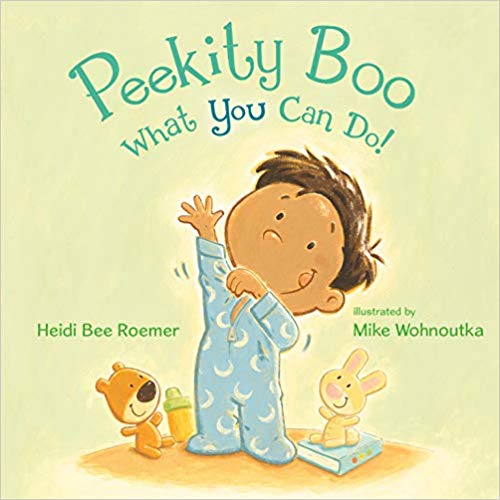
Heidi Bee Roemer’s PEEKITY BOO! What Baby Can Do!
A well-know and award-winning poet, Roemer’s newest title is a nurturing rhyming book. "Writing in soft, rolling rhymes, Roemer walks through a toddler’s nighttime routine as doting parents alternate caretaking roles . . . Wohnoutka’s chalky art creates a sense of homey contentment—like a warm blanket."--Publishers Weekly   Roemer effectively uses playful, silly words and this Christy Ottaviano/Henry Holt book is sure to be a favorite read-aloud for the young set!


Pat Zietlow Miller’s REMARKABLY YOU
Ever since Miller’s picture book, Sophie’s Squash, first came on the scene in 2013, I’ve been a huge fan of her work.  This new title, Remarkably You, celebrates uniqueness and individuality – and what better message to share with a new little one?  From School Library Journal’s review: “Miller’s story and Barton’s illustrated characters are diverse and encourage young readers to not only be themselves, but to also do good deeds. There is an important underlying theme of treating others with respect and dignity. An excellent upbeat addition to any collection.”


Eileen R. Meyer’s SWEET DREAMS, WILD ANIMALS
I can’t forgo listing my own SWEET DREAMS bedtime title as a gift-giving option. I’ll let this review provide the sweet details: “A cozy combination of restful rhymes, natural history notes and close-up pictures of snoozing creatures.... Slumber and science in harmonious combination, equally suitable for bedtime reading or for sharing with wakeful groups.”--Kirkus Reviews

And, if the family expecting a baby has little ones awaiting the new addition, I recommend Miranda Paul's new title, NINE MONTHS: Before a Baby is Born. This is the perfect book to share with a young child awaiting a new sibling. Contrasting the baby's development in the womb with the changes and excitement building for the family, this book details "just enough" information about the new arrival for a  young child to understand and digest. Gorgeous art by Jason Chin. Just out in bookstores this month.


Of course, we can’t forget about classic gift-giving options, either. I polled a circle of friends and here were a few of their favorite gift books to welcome a new baby:

Goodnight Moon by Margaret Wise Brown
Love you Forever by Robert Munsch
Brown Bear, Brown Bear, What do you see? by Bill Martin Jr.
The Very Hungry Caterpillar by Eric Carle
Ten Little Fingers and Ten Little Toes by Mem Fox
Make Way for Ducklings by Robert McCloskey and
any of Alice Schertle’s Little Blue Truck books.

BUT WAIT, there’s more.
Spring is a season of renewal – and it is fitting that we have a NEW GROG BLOGGER, my friend and fellow author, Julie Phend! Allow me to introduce Julie to our readers with a short Q & A.


Eileen:  Welcome, Julie! Tell us a little about your background and your interest in joining the GROG blog.
Julie: I’m a big fan of blogs that connect teachers, writers, and readers. We are a symbiotic community—we need each other to create readers and to create books that provide meaningful experiences for young readers. I’ve admired and learned from the GROG blog, and I’m eager to contribute to its ongoing mission to connect these populations.

Julie at a holiday author event

Eileen Can you give us a sixty-second summary of your experiences in children’s publishing?
Julie: In my career as a middle school teacher, I loved connecting students to great books, as well as encouraging them to explore their own talents as writers. My teaching experience led me to my first publication—D-Day and Beyond was written with WWII veteran Stanley Edwards after he visited my classroom to talk about his experiences in the war. This project wakened a dormant dream of writing for publication. I joined SCBWI and began to research a historical novel based on a true story. That led me to an awesome critique group and a whole community of writers who care about children.


Julie with her dog, Duke
Eileen Would you tell us something that people may not know about you …
Julie: In college, I double-majored in English and Theater and discovered a love of Creative Drama with children. I taught creative drama in school and after-school programs throughout my career and produced dozens of plays with children. In almost every case, the kids and I wrote the scripts ourselves. It’s a dynamic creative process that can’t be beat.

Wow, I’ve known Julie as a friend and fellow-critique group member for over a decade and I didn’t know that she had been a Theater major in college!  I’m delighted to welcome Julie to the GROG Blog Family and I’m already looking forward to her first blog post in the coming weeks.

To all our readers--thanks for stopping by and welcoming Julie Phend to our blogging family!


Wednesday, September 5, 2018

Highlights of Nuts & Bolts of Science Writing 2018 by Kathy Halsey

What did I do on my summer vacation? One of the biggest highlights was my first Highlights workshop. In this post I'll share newbie tips along with writerly tidbits from our fab faculty. 


Newbie News
  • Plan when you invest in your writing. I waited five years before I signed up for a Highlights workshop. I wanted to be better at my craft and have some projects that could benefit from being workshopped. I also looked for specific faculty and topics that would stretch me as a writer. I found the perfect fit with Nuts & Bolts Science. I knew Jen Swanson and Miranda Paul were excellent teachers since I've attended conferences where they'd been speakers. 
  • Although I've read and studied nonfiction for children, I'd never written science, so I plunged into writing an informational picture book about gardens using a child's POV. My critique group and writer friends helped me revise and polish my WIP before I sent it to Highlights. My advice? Take a manuscript that you can't make any better on your own to a workshop. ( Be prepared with a second manuscript, too, just in case the opportunity arises for a second critique.)
  • Although it's comforting to attend conferences/workshops with a writer buddy, sometimes going alone will push you to meet new people and network. Now I have a "tribe" of 20 new science writer friends: a snail scientist, an entrepreneur who created a STEM magazine for children, an Ohio writer who is now a contributing editor for Cricket Media, and the amazing author Sarah Aronson. (She gave advice about creativity, the writing doldrums, and shared pieces of her newest book JUST LIKE RUBE GOLDBERG.) Be open to meeting new people who will enrich your life. 
Sarah and Kathy

Fab Faculty TidBits
Take four wonderful professionals (Jen, Miranda, editor Sam Gentry, and Ohio author Tracy Vonder Brink ) together for almost five days, and soon you've had a master class in writing nonfiction, pitching, and a how-to on cracking the magazine market. There was so much insight from these women who generously shared time, knowledge, and books with us. I'll share a chunk of knowledge from all these super stars. (Newbie note - very dark skies in Honesdale PA, so you should plan to star gaze.)

Tracy Vonder Brink  
Jen Swanson, Miranda Paul, Samantha Gentry

  • All lucky attendees received a critique from Samantha, plus we had our choice of two more critiques - one with Jen and one with Miranda, depending on whether we wrote middle grade or picture books. (This is why you bring several solid pieces.)
  • Back matter REALLY matters to Miranda Paul. She had us do a useful exercise that helps writers get an overview of back matter. Take a stack of picture books, fiction and nonfiction, and read them quickly but study the back matter and make a list that includes type of back matter (author note, charts, fun facts, etc), how many pages of back matter, audience for the back matter (educators, parents, children) and if the tone/style fits the front matter.  
  • Jen Swanson swoons for research to make science sing. She begins by going to the library to actually browse the nonfiction section. Serendipity is the name of the game. Jen enjoys hunt, finding both adult and children's books on her topic. For internet research she begins her working bibliography by adding raw links, footnotes at bottom, and then uses Citation Machine or another service. 
  • Many of Jen's National Geographic middle grade books rely on interviewing experts. She has  many tips regarding experts (a person working in the field or a PhD.) You'll find them at universities or by googling your topic. Then email them to see if they have interest in  helping you and indicate what publisher you are pursuing. She recommends an email subject line like this, "children’s author working w/Nat Geo looking for an interview." Add your experts in the acknowledgements and give them a book. Best advice from Jen? Don't skimp on research
Attendees taking notes and absorbing information
  • Samantha Gentry, Assistant Editor at Crown Books for Young Readers, Random House and PRH, engaged attendees by throwing a pitch party. We recreated a twitter pitch party in real life after Sam shared pitch strategies. Sam thinks having a social media presence is helpful for a writer. She suggests picking two options from what she labeled "the trifecta," Twitter, Facebook and Instagram. Follow folks who do SM well, such as Josh Funk, Sarah Albee, and Jess Keating. She stressed creating a community network with local booksellers, libraries, schools, and your local writing community.
  • Finally, Tracy Vonder Brink gave us a solid background in writing for children's magazines. She has a stellar acceptance rate. She's sold eleven stories and is now employed by Cricket Media. Writers can dig through manuscripts that didn't "work" as books or write a story with research that didn’t go into a book. Writers should analyze magazine issues in detail. Look for ratio of simple sentence to compound/complex sentences,  if questions to the reader are common, and if the reader is addressed as "you." Aim to mimic style, voice, tone, content as much as possible with your submission. Tracy feels she's been most successful when she takes a issue's main topic and thinks outside the box for a story. Her boss, Elizabeth Huyck at ASK, looks for magazine pieces that open out to larger questions or fundamentals. 
    Happy scientists and writers on the trail

Discovery!


Friendship


Wednesday, April 18, 2018

Astronaut Aquanaut - A Stellar Science Book and Mentor Text for Nonfiction Writers, Too by Kathy Halsey

I can honesty say that most of what I know about science comes from children's authors like today's featured guest, Jen Swanson. Had science books been as much fun as those she's written for National Geographic Kids, I may have been something more "science-y" than an English teacher. 

Recommended for Teachers, Librarians and Homeschoolers
I highly recommend ASTRONAUT AQUANAUT: HOW SPACE SCIENCE AND SEA SCIENCE INTERACT for school libraries, science classrooms grades 3-8. This book services a multitude of multimodal lessons.

  • Teachers and parents have ready-made experiments/activities that are easy to replicate in almost every chapter. 
  • The comparison/contrast structure of astronauts and aquanauts' training and experiences will get kids wondering and English/Language Arts teachers cheering. (Students at multiple grade levels need to write comparison/contrast compositions, and Jen's book lays out a fine example of the format.) 
  • Science and E/LA teachers could easily expand on the chapter "Space and Deep Sea: More Alike Than You Imagine" for an interdisciplinary project including research.
  • Additionally, web sites, a glossary, and astronaut/aquanaut biographies are added features that librarians and student researches will appreciate.

Recommended Mentor Text for Nonfiction Writers
Nonfiction folks, delve into an author study of Jen Swanson's books to see in-depth how she breaks down complex topics and makes them factual and kid-friendly. (Click here.) I've reviewed several of her books for the GROG.  Here are a few techniques that nonfiction writers will want to emulate. 
  • When tackling dense topics such as space vs. oceans or nanotechnology, write simply and use a cohesive style/structure throughout the text. Predictive text structure help readers relax and concentrate on new material. Every chapter in this book is set up in a similar format with questions, interesting ancillary material in sidebars, an "explorer's notebook," and activities with questions to expand the reader's thoughts after the experiments.
  • Drop definitions into the text deftly and think about alliterative titles, too. Here are some title examples that kids will appreciate: "Darkness Descents," "What Goes Up Must Come Down," and "Expanding Our Horizons." 
  • Look at this example of a quick definition that doesn't stop the reader with an information dump. " 'Micro' is another way of saying 'very small,' so microgravity refers to extremely small gravitational forces."
  • Think about you point of view. Ask questions to entice readers. Jen uses second person POV and as you'll see from our interview (Q & A below), National Geographic prefers this option also.  
  • How you use comparisons matters. Jen creates her own concrete comparisons using ideas kids already know. In describing how pressure feels in the deepest ocean she says, "...the pressure is great than 15,7000 psi. That is a thousand times the amount of pressure you feel when standing on the ground." In a further comparison she states that amount of pressure is like "... one person holding up 50 jumbo airplanes."
Q & A with Jen Swanson

There have been several good blog interviews with Jen on ASTRONAUT AQUANAUT, so I chose to focus on questions nonfiction writers might find instructive. 


K: Do you outline/propose your books now to NatGeo or do you have specific editor w/whom you work?
Jen:  I have been lucky enough to work with one editor at  NGKids on several projects. We have a great, collaborative relationship which makes it really fun to work on books together. Because of this, my submission process is more relaxed. I may not create a full-blown proposal with completely outlined chapters, but more of a “this is what I want to do” sort of thing. It takes awhile to get to that point, and works well for the two of us, since we are also friends. But my agent is involved in the process and still handles all of the contract negotiations.
K: What informed your choice of 2nd person POV? 
J:  That is NGKids style. They love the 2nd person, informal type of language. This allows the reader to feel as if they are going on the journey with the book as they read it. The goal is for them to experience life up in space and down in the ocean, just like the experts did!

K: Do you decide what information is in sidebars?  If not, who does that?

 J:  Everything you see in the book pretty much started with me. Of course, my editor may make suggestions for areas that might need more expansion or ways to improve the book, which I definitely pay attention to, but I wrote all the sidebars. Specifically, it was my idea to approach experts (astronauts and aquanauts) and ask them questions that I thought my readers might want to know. It took a lot of effort and a great deal of persistence to catch up with some of them. But I think it is well worth it.  

K: Where do you find those cool comparisons? On a web site? 

J:  Nope. I just come up with this all on my own. I’m trying to get the reader to understand how big or little something is and the best way is to compare it to something they already know. This is a great tool for writing science books for kids; one I use in all of my books. 

K: What “in-person” research did you do for the book?

J:  Unfortunately, traveling to these amazing environments was not a part of my research. Maybe someday. I did, however, travel to NYC to meet Aquanaut Fabien Cousteau in person. A thrill of a lifetime and the picture of us together with Liz Bentley-Magee, a female aquanaut featured in the book made it into the back page.

K: Your writing tips for tackling science for kids…

J: Think like a kid! Make your writing FUN and EXCITING! Science is best when it’s hands-on because kids can see it happening right in front of them. While you can’t always do that with a book, you can make them feel the excitement of trying it if your words are active and engaging.

K: What are you working on now? 

J: I’m so very excited about this book with Peachtree Publishers coming out next April. It’s called Save The Crash-Test Dummies and it’s a book about ENGINEERING and car safety. I write engineering in all caps, because it is really a big thing for an engineering book to be published by a trade publisher. This book is an out-of-the box and fun look at the history of car safety engineering.  It even has a snarky, talking crash-test dummy as your guide through the ages. I have see the initial layouts and they are stunning. I am REALLY looking forward to this book! Go Engineering!

Finally Jen and Miranda Paul will be teaching their "Nuts and Bolts of science Writing" at Highlights again this summer Attendees will learn the ins and outs of writing fiction and nonfiction science books and will be able to submit to 5 different trade editors. Check out more information here