Showing posts with label #nonfiction. Show all posts

Wednesday, May 20, 2026

History and Finding Out What is True ~Christy Mihaly

As we approach the 250th anniversary of the nation's founding, I'm excited to say I have a semi-quincentennial book coming out on May 26. It's America's Founding Myths ... And What REALLY Happened!, illustrated by Marta Sevilla and published by Barefoot Books. It's intended as a book that kids will enjoy, even as they learn that they've been lied to. 

The Barefoot Books team, Marta, and I worked to create a lively, kid-friendly book that would engage kids while letting them know that some of the history they've been told was wrong. Marta's art incorporates historic images, photographs, and comic-like art. We have sprinkled cartoons, jokes, and humorous asides throughout.

The image below shows how each of the fifteen main spreads begins by stating a myth:

The spread features a large gatefold flap on the left-hand side. A myth is briefly restated on the front of this flap. The reader then lifts the flap to the left to open the full spread, revealing the true story. Here's an explanatory graphic from the book:

And here's what the full spread looks like with the flap opened. On the reverse of the flap on the left is an explanation of "Where did the myth come from?" then the true story is summarized in the remainder of the double-page spread: 

The book debunks some of the central myths that kids have been told for generations, from Columbus to the First Thanksgiving to Paul Revere's ride and beyond. I also sought to elevate unsung heroes including important female, Black, and Indigenous people. 

Crucially, the book shows readers that to learn about history, we have to ask questions and question assumptions. The introduction starts by asking, "Where does history come from?" -- pointing out that history is messy and that stories change. It proposes other questions for readers to ponder as they read, such as why people tell these myths and what we can learn from them. 

While hoping to make kids laugh, we also model critical thinking and asking questions. Each of the main spreads includes a provocative question related to the myth discussed. For example, on the Boston Tea Party spread, we ask, "Do YOU think it is ever okay for protesters to break the law?" For the myth of Columbus, "How do YOU think celebrating something with a holiday changes the way we think about it?"

In addition, we offer resources on information literacy. A section in the back matter asks, "How do I know what is true?"

This material gives kids tools to use and questions to ask when confronted with new information. It empowers them to evaluate the truth of what they're told. 

Christy Mihaly
I hope America's Founding Myths inspires many conversations among kids and adults about what really happened in our history and what it means for the nation's present and our future. Such conversations are critical to help young people develop the skills they need to be active participants in a vibrant democracy. 

For the educators among you, Barefoot Books has provided a discussion guide for the book, with activities and a Junior Myth Buster certificate for readers who complete the activities. As an aside, the book is "officially" for the 8 to 12 year old age range, but younger kids can use it to learn the true stories early, and high school students as a starting point for further research. 


If you're interested in more new books for young readers centering untold stories of the Revolution, check out author Beth Anderson's blog series, #AmericanRevolution250

Happy reading, and happy semiquincentennial!


Wednesday, May 22, 2024

Creep, Leap, Crunch! A Food Chain Story: Making a Science Topic Accessible for Kids By Jody Jensen Shaffer

Today I welcome author Jody Jensen Shaffer to the Grog Blog. We've been online writing friends for a while, and it's been neat to see Jody's body of published books grow!


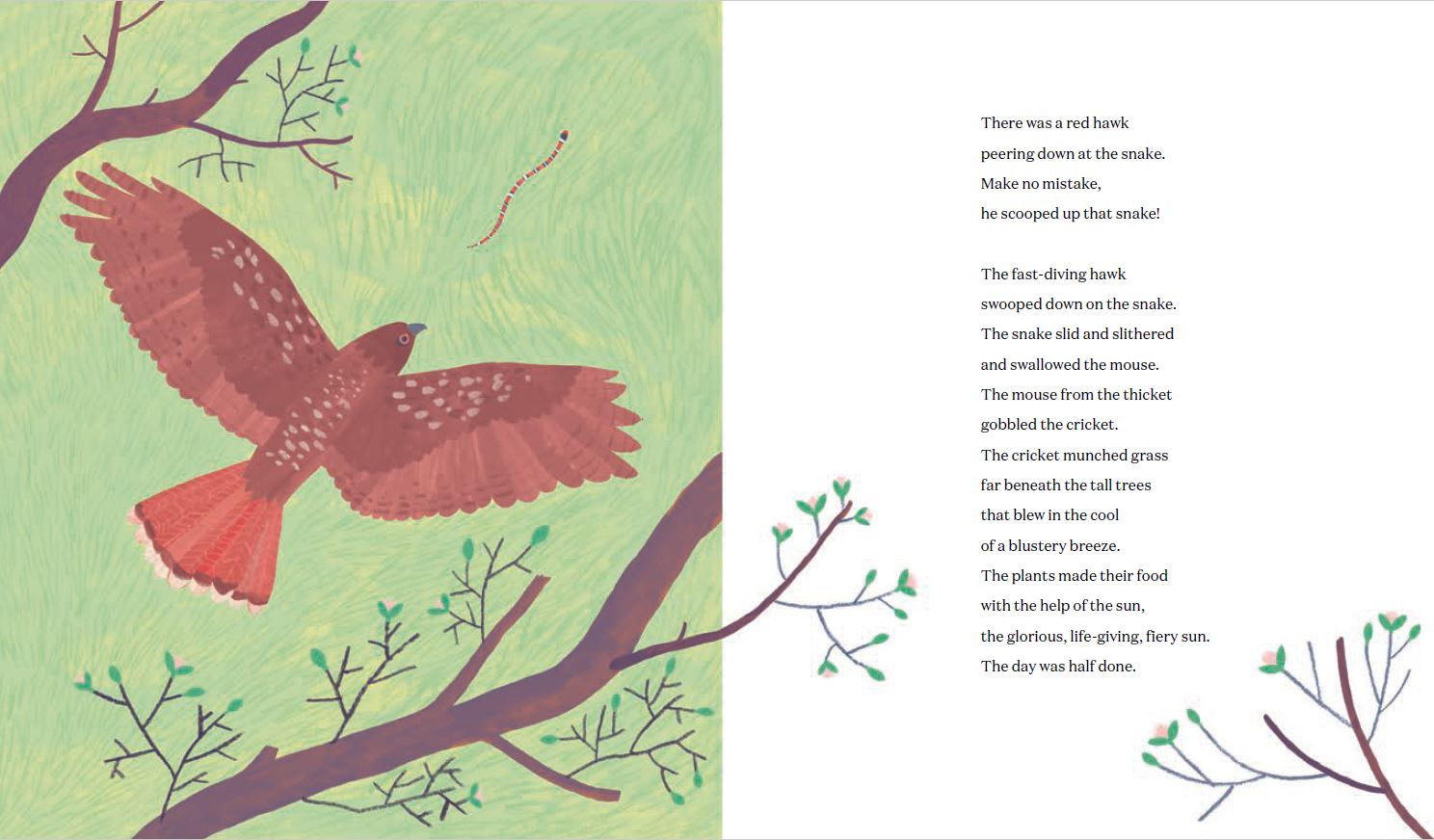
I, Tina Cho, recently read her nonfiction picture book, CREEP, LEAP, CRUNCH! A Food Chain Story to my kindergartners, and they loved guessing the next predator in the food chain, the suspense of the story, and the "scary" snake. 

Today, Jody shares her expertise with us in writing nonfiction. 

Thanks for having me on the Grog Blog, Tina! I’m excited to share my experience making a science topic, like the food chain, accessible (read fun and interesting) for kids.

I’ll give you the short version right up front: I think like a kid, so I write to entertain…myself! If I run across cool facts about how things work in nature, strange creatures with little-known talents, fascinating processes within the human body, or amazing ways of sharing that information, I’m hooked.

My job as a writer then is to share my excitement with (chronological) kids. Here’s how I did that for Creep, Leap, Crunch! A Food Chain Story, gorgeously illustrated by Christopher Silas Neal and published by Knopf Books for Young Readers in December 2023. I hope my process will be helpful for your readers!


Choose a Subject You’re Interested in

If you like what you’re writing about and researching, it’ll show in your manuscript. I knew when my journey began in 2013 with Creep, Leap, Crunch! A Food Chain Story that I wanted to write about the food chain. I researched my state’s science curriculum to see what grades studied food chains, and I read current picture books about the food chain to see what was already out there. Then I began researching kinds of food chains—where they take place, what animals live there, what those animals eat and what eats them.

Structure

I needed my food chain book to be different than what I saw in the market, so I began brainstorming picture book structures—traditional 3-act, cumulative, concept, mirror, parallel, reversal, list, how to, dialogue-driven, lyrical, variety of viewpoints, day in the life, morning to evening, etc. I wanted my structure to be exciting.

Then suddenly—okay, after lots of staring at my computer—“There Was an Old Woman Who Swallowed a Fly” popped into my head. (For those unfamiliar, the old woman swallows a fly, then she swallows a spider to catch the fly, then she swallows a bird to catch the spider. You get the idea.)

Hey, wait! I thought. That’s a food chain! A fictional, rather strange food chain, but a food chain nonetheless! And it was told in a cumulative way—new information was introduced with each page turn, while old information was repeated. I thought using a cumulative structure to discuss the food chain would be really fun! What’s more, I knew kids would be familiar with both the “Old Woman” story and cumulative structure. By building on kids’ past knowledge, I could build interest in my subject.


Voice

So, I had my food chain facts, and I had my story structure. I knew that for kids to recognize my story’s cumulative structure, I would have to be true to the voice of the “Old Woman.” That is, I would have to mimic the rhyme, meter, and cadence of the words of that story. If those lines rhymed, I needed mine to, too, in the exact way and at the exact time. No slant rhymes. No reversed-sentence rhymes. No fudging. This is trickier than one might think! Especially when you’re writing nonfiction, because it all has to be true with actual words! 😊

So I rhymed where I was supposed to, matched my beats to the “Old Woman’s,” followed a cumulative structure, and got all my facts in there. Oh, and I also decided to make it a morning-to-night story (kids are familiar with those) and to write it using lyrical language. Can you tell this project was like putting a puzzle together? I love puzzles, by the way.

Then I went through my text and concentrated on additional literary devices—alliteration, internal rhyme, simile, metaphor, and a fun narrative voice—until it sang.

And guess what? Kids love rhyme that’s well done. They love alliteration. They love repetition. They love a fun narrative voice. All things that make a science topic accessible.


Give it a twist

So, finally, my cumulative, rhyming, nonfiction food chain book began in the morning with the sun and proceeded through a series of ever-larger animals until it ended, rather predictably, at the apex predator, a black bear.

And it felt…incomplete. Even with all the beautiful language and cool structure. Whoop-de-doo, the big guy wins. So what’s new? Yikes for the mouse, I guess.

But I’m an animal-lover and a cheerleader for the underdog (as are kids), so I worried about the cricket and the red-tailed hawk and the fox (even though I’m big enough to know what happens in the real world), and the story sat on my hard drive for three years, unfulfilled and unfulfilling until…

2016!

…when my story twist came to me—“But some days—,” wherein all the critters escape their predators, and the black bear munches flowers and seeds and is perfectly satisfied! Because that happens, too, in the real world! I knew kids (and their adults) would love that alternate ending as much as I did.

From there, it only took me another five years of tinkering—and working on other projects—before I sent it into the world, received two offers, and ultimately accepted Knopf’s.

One more tip: choose a fun, active title. My original, There Was a Blue Sky, was a bit too lyrical.

So, how do you make a science topic accessible for kids? You write it to delight the child inside you.


Thanks for sharing your process, Jody! I, especially, loved how you gave this food chain story a twist! 


 Jody Jensen Shaffer is the author of more than 80 books for children, including Creep, Leap, Crunch! A Food Chain Story (2024 NSTA Outstanding Science Trade Book, Oklahoma's 2025 Donna Norvell masterlist, SLJ starred review), Prudence the Part-Time Cow (Missouri Show Me Award finalist), A Chip Off the Old Block (Iowa Goldfinch Award nominee, Amazon Teachers' Pick), It's Your First Day of School, Busy Bus! (Amazon best seller and Book Box pick), EMERGENCY KITTENS, Sometimes I am Hot Lava, and more! Jody is a frequent school, library, festival, and conference presenter. She lives with her family in Missouri. You can find Jody at jodyjensenshaffer.com and on Twitter at jodywrites4kids.


See all her books at JodyJensenShaffer.com
Twitter @JodyWrites4Kids 


Wednesday, January 3, 2024

Two New Little Golden Book Biographies ~Christy Mihaly


Diana Murray

Happy New Year, friends! We're celebrating GROG's 10th year in 2024! (More to come.)

If you're not receiving email notices of our posts, you're invited to subscribe with the button to the right:  =======➤ 

Christy Mihaly

Today I (Christy Mihaly) am excited to be interviewing the prolific and talented picture book author Diana Murray. Diana and I are friends who met in an online poetry critique group, Poets' Garage. We're both clients of the amazing Erzsi Deak of Hen&ink Literary Studio. And yesterday (1/2/24) we both celebrated book birthdays of books in the Little Golden Book Biography series. Diana wrote about Arnold Schwarzenegger, and I wrote about Mel Brooks, and we thought we'd chat about them a bit today.


You may have noticed LGB has begun a series of bios of a range of artists, celebrities, political figures, and famous folks -- most notably the million-copy-selling Taylor Swift: A Little Golden Book Biography. 

For Diana and me, writing these LGB biographies was a fun change from our usual work.

We each asked one another three questions ... here goes:

Christy: So, Diana, you are known for writing wonderful poetry and rhyming books about knitting pirates, unicorns and witches ... not exactly nonfiction works. Why did you want to write a Little Golden Book biography?

Diana: This was a huge departure for me. Not only is it my first nonfiction book, but it's the first book I've written in prose! I was thrilled to be asked to write it because I love a challenge and I love writing to a prompt. The chance to explore another genre was very exciting and fun for me. Plus, I'm a huge fan of Arnold's movies. "Conan the Barbarian" was one of my favorites during high school -- I must have watched it 50 times. I'm also a first-generation immigrant so I related to him in that way. I understand what it's like to feel grateful for the opportunity to be here. 

CM: You certainly rose to the challenge, Diana. I'd say on your first prose nonfiction work, you nailed it! I also liked learning a new fact about you. What is a favorite fact that you learned about Arnold in the process of writing this book?

DM: I thought it was funny that they dubbed over all his lines in his first movie, "Hercules in New York," because of his accent. And, without his permission, they even changed his name on the movie posters to make it sound less "foreign!" That was in 1970. If only those producers knew what a huge star he would become!

CM: Oh, that is so wonderfully ironic. Talk about overcoming challenges! I know you previously wrote a very adorable fiction/colors LGB, Firehouse Rainbow. I'm sure writing about Arnold was quite different -- were there similarities in writing the two books?

DM: There were two main similarities. One was keeping in mind the audience and making the text appealing for that age group. The other was thinking about page turns and illustrations. You want to create a little tension between page turns. Something that will make readers want to flip the page to learn what happens next. And you need to vary the scenes and locations to create variety -- you can't have the action happening within a single location so it's the same illustration across several spreads.

Now it's my turn! Here are my questions for you, Christy:

DM: You have written several other fabulous nonfiction picture books, such as Hey, Hey, Hay! A Tale of Bales and the Machines That Make Them and Free for You and Me: What Our First Amendment Means. Did that experience make this project easier? How is writing a biography different? 

CM: It's true I think of myself as primarily a nonfiction writer (and I've written many purely nonfiction, educational books), but in picture books I tend to write informational fiction, inventing a story line to convey information in a kid-friendly way. So the challenge in writing the LGB biography was to tell a compelling story for young kids in a few words without making anything up and without leaving out anything important. Honestly, that's always going to be a challenge!

DM: It's such a good question that I have to ask you, too: What's a favorite fact that you learned about Mel Brooks?

CM: I learned a great deal, but found Mel's childhood particularly fascinating. He grew up as Melvin Kaminsky in Brooklyn, without a father and with very little money. He says that he and his three older brothers didn't just share a bedroom -- they all slept in one bed.

DM: I was impressed by how kid-friendly and fun your biography text is.  What are some strategies you use to keep nonfiction from sounding too dry?

CM: Oh, thanks, Diana. One of the first things I did was read a bunch of other LGB biographies to get a feel for how other authors were approaching these short, 24-page biographies. The whole ethos of Little Golden books is to make these stories accessible. 

As I wrote, I paid careful attention both to word choices and to which areas of Mel's life would interest kids. For each spread, I asked: What would a kid want to know? What would a kid think was funny, interesting, intriguing? What would make a young person care about Mel's story? I wrote quite a bit about his childhood, showing how his upbringing affected his life. In describing Mel's later life, I let kids know how important his best friend Carl Reiner was in his life, and also how he overcame many setbacks along the way. And as I chose words and cut excess, I tried to keep the tone light and humorous -- because, Mel Brooks.

Thanks for the great questions, Diana, and your great answers! 

GROG readers, we'd love to see your comments ... Who do you think should be the subject of the next Little Golden Books biography?


Wednesday, January 18, 2023

Back Matter: A Chance to Be More Than a Story, Guest Post by Beth Anderson

Today we have a guest post by author Beth Anderson, who recently had a new picture book biography released, CLOAKED IN COURAGE: UNCOVERING DEBORAH SAMPSON, PATRIOT SOLDIER, illustrated by Anne Lambelet, published by Calkins Creek. I, (Tina Cho), love learning more about the writing craft from Beth. Today she teaches us about back matter. 

For readers, back matter can be scary. Dense paragraphs covering page after page. UGH. Even an author, NF fan, and former educator like me has to admit to sometimes closing the book rather than committing to all that “grown up” text at the end of a gorgeous picture book experience. I know it’s where the author shares lots of great stuff that didn’t fit in the story….but, there’s always the potential of a gigantic info dump. Too much deters. What’s important? What will enhance the story you’ve told? What might answer questions arising from the text? What will invite more thought and exploration?

Creating Back Matter for CLOAKED IN COURAGE

As I wrote CLOAKED IN COURAGE: UNCOVERING DEBORAH SAMPSON, PATRIOT SOLDIER, so much of what I was doing was trying to sort out facts from fiction. Her story had been corrupted early on by one man’s desire to make her into his version of a heroine. And much of that misinformation was carried forward in other sources. One source, Masquerade: The Life and Times of Deborah Sampson, Continental Soldier by Alfred Young, focused on that process of finding the truth, and his historical detective skills were as fascinating as Sampson’s story. So, when it came to back matter, I knew I wanted to share some of that process and my learning with students and educators—some tips along with a few challenges of being a history detective. That choice has resulted in positive comments from reviewers and readers. And I hope it becomes a teaching tool in the classroom.

“The Challenge of Being a History Detective”

It all begins with the Google search, right? In researching colonial times, it helps to know that there was no standard spelling. (See AN INCONVENIENT ALPHABET for that story for kids. 😊 ) Sampson’s name was originally spelled SAMSON. Other names in the story also had multiple spellings. So with that understanding, your access and search widens.

 Then I shared some examples of primary sources. They’re “golden” but can’t be blindly trusted as 100% truth. Critical thinking is essential. I offered some thoughts on the value of secondary sources and went into setting. In the classroom, setting is defined as “time and place,” but I wanted students to think about all that involves for a book like CLOAKED IN COURAGE. I provided specifics such as Continental Army life, using disguises, traditions, and media influence. Also, the importance of trying to understand the meaning of what we learn within the context of the times, not today’s world.

Finally, I provided transparency with some notes about the details in the story that are in question, and that there is so much we can never know. Reading about how the public reacted to her, we know that Deborah Sampson tested the tolerance of her time. She broke barriers, and those courageous actions had a lasting impact. While the book was in the publication process, Congress passed a bill providing protections for female soldiers and veterans—The Deborah Sampson Act. We added that to the back matter because including connections to today helps bring relevance and meaning to stories from the past.

 And there’s more! The back matter in CLOAKED IN COURAGE contains an Author’s Note, which allows kids to see the writer’s personal connection to the story. The Bibliography might be a bit more interesting considering the history detective information. I’m a big fan of quotes and love to include one from or about the main character to give a stronger sense of the person. In this book, I shared a quote about Deborah Sampson from her pension approval signed by John Hancock, someone kids encounter in the basic history of the time. And of course, Acknowledgments—Thank You’s are important in any endeavor, and readers see that it is indeed a collaborative effort.


A Bit on the Benefits of Back Matter

·       For young readers and listeners: extends interest in a book over time, sparks curiosity, enriches story.

·       For teachers: becomes a teaching tool, supports curriculum, adds a higher reading level and different types of text, can support English Language Learners and struggling readers with graphic elements.

·       For publishers: increases range and potential for marketability, can catch reviewers’ eyes.

·       For authors: adds value to your submission, shares more of the story, can be the starting point for a school presentation.


Making Back Matter Inviting

To invite young readers in think about: “density” of text; short sections; graphics, images, and engaging visuals; interactive pieces such as Q&A or search & find.

To support educators consider: What might connect to curriculum or support classroom skills? Further resources are handy. Author’s (and illustrator’s) Notes contribute to understanding objectives like “author’s purpose” and “author’s point of view.” A variety of information formats can expand literacy skills.

 Transparency: Truth matters. Share inconsistencies in research and fictional elements to encourage critical thinking.


More Ideas for Back Matter

Afterword, Words to Know/Glossary, Timeline, Diagrams, Activities, Call to action, Letters, Crafts, Recipes, Experiments, Fun Facts, and Photographs of people, places, processes, realia, etc.  Please feel free to share more ideas in the comments!

 Thank you so much, Beth! And here's my little review of Cloaked in Courage.

Another fantastic picture book biography from Beth Anderson, illustrated by Anne Lambelet, about Deborah Sampson, secret patriot soldier, who used her rebel spirit to push boundaries for women. Never giving up, she accomplished all that she set out to do and more. Beautiful illustrations accompany this riveting text. Impressive back matter explains the usage of primary and secondary sources and how Anderson composed a story using little and conflicting information about her. 


Beth Anderson, a former educator, has always marveled at the power of books. Driven by curiosity and a love for words, she writes untold tales, hoping to inspire kids to laugh, ponder, and question. She’s the award-winning author of CLOAKED IN COURAGE, FRANZ’S PHANTASMAGORICAL MACHINE, REVOLUTIONARY PRUDENCE WRIGHT, TAD LINCOLN’S RESTLESS WRIGGLE, “SMELLY” KELLY AND HIS SUPER SENSES, LIZZIE DEMANDS A SEAT!, and AN INCONVENIENT ALPHABET. Beth has more historical picture books on the way.


https://bethandersonwriter.com  
Twitter • Instagram • FaceBook • Pinterest  


Educator Guide link - https://bethandersonwriter.files.wordpress.com/2022/10/cloaked-in-courage_educatordiscussion-guide.pdf