Showing posts with label #writingforchildren #WeNeedDiverseBooks. Show all posts

Wednesday, January 17, 2024

Have We Done Enough? Diversity in Children's Lit by Tina Cho

Note: I’m writing this from a mom, teacher, and author’s perspective.

            December 19, 2023, my 18-year-old son, a freshman in college, faced racial discrimination by two high schoolers at our local YMCA, where he has been a member over the past few years. He reported it to the person at the front desk, who alerted the owner/boss. Aside from her filing a report with her supervisor and just talking to the boys, I don’t think anything was done.

            My sister said my niece, an 8th grader, who is half Korean, but doesn’t look Asian, receives racial discrimination daily at her school, such as a book being thrown in her face. I asked why she doesn’t report it. “It will make matters worse,” I was told.

            As a mom (and aunt), I’m outraged. How can racial discrimination still be going on, especially among youth? Just turn on the news, and we’ll all see it sadly is.

            Putting on my teacher hat, (I’m a kindergarten teacher at a public school), I’ve seen over the past years, literature slowly changing. More books showing people of color have been published. Yay! Librarians have been challenged to check the number of books on their shelves featuring white characters versus people of color. However, many diverse books seem to focus more on a cultural holiday or how to say someone’s name, rather than just a regular story that happens to have a diverse cast of children. In my classroom, I read lots of books that feature children of color, especially those represented in my class, so kids can not only see themselves, but to make diversity the norm. I saw evidence of this when a couple of my Caucasian students drew their parents with Crayola’s skin-colored crayons, but colored dark skin. Ha!


            The same day my son faced discrimination, in my inbox was the listing of acquired books in Publisher’s Weekly’s Children’s Bookshelf. I read through the picture book section, and noticed that most picture books listed had animal characters. How can we teach diversity if most children’s books feature animal characters? Don’t get me wrong—my kindergartners and I love reading books with animals. But, if we want students to accept each other, they need to see children of color in books, not just animals. (And I know, reporting in PW isn't a total representation of books, and some reportings were acquired long ago.) 

Data: There were 9 picture books listed in the weekly list.

4/9 or 44% featured animals.

2/9 or 22% featured white characters as far as I could tell.

1/9 or 11% featured a black character.

2/9 or 22% featured Asian characters (but like I said, they seem to be holiday or folklore themed, not about current life).

Now, putting on my author hat, I say, we’re not done in this area. Sure, a lot more diverse books books have published over the years. You can see stats for 2022 from the Cooperative Children’s Book Center here. I don’t think the 2023 data is available yet. And Scientific American has a recent article titled, “Are Children’s Books Improving Representation?” My advice to illustrators is—please don’t change an author’s characters to animals. Instead, illustrate with a diverse cast of races. My advice to authors, especially those of color, not only write stories about your culture’s traditions, holidays, and folklore, but also current everyday life stories that feature a family/character of color. Teachers need books showcasing diversity for all different topics, not just when it comes to holidays, etc… A good read is “Teachers Push for Books with More Diversity, Fewer Stereotypes” in Education Week. I appreciate Instagrammer & video creator Maya LĂȘ of Maistorybooklibrary who showcases children’s books with people of color in themed topics as well as other Instagram reviewers who highlight these books. Thank you so much for what you do for educators and parents.

From Martin Luther King Jr.’s “I have a dream speech”:  I have a dream that my four little children will one day live in a nation where they will not be judged by the color of their skin but by the content of their character. 

I'm thankful my forthcoming picture book, God's Little Astronomer, features characters of color in a nonfiction book. More about that later, in another post. 

Thank you, Grog Readers, for sticking with us. Please support people of color creators by checking out their books (or buying them) and sharing them on social media, reading them to your kids and grandkids and students.

And if you haven't yet, please subscribe to our blog in the blue box at the top right side of this site! Thank you!


Tina Cho is first a teacher of 20 years with a master's degree. She is the author of Rice from Heaven: The Secret Mission to Feed North Koreans (Little Bee Books 2018), Korean Celebrations (Tuttle 2019), My Breakfast with Jesus: Worshipping God around the World (Harvest House 2020), The Ocean Calls: A Haenyeo Mermaid Story (Kokila/Penguin Random House 2020), God’s Little Astronomer (Waterbrook 2/20/2024) & God’s Little Oceanographer 2025. Her lyrical middle grade graphic novel, The Other Side of Tomorrow, debuts from Harper Alley (11/12/2024). After living in South Korea for ten years, Tina, her husband, and two kids reside in Iowa where Tina also teaches kindergarten. 

Wednesday, June 10, 2020

Crafting a Story with Two Main Characters--Where Giving Each Equal Weight Is Important, Guest Post by Vivian Kirkfield


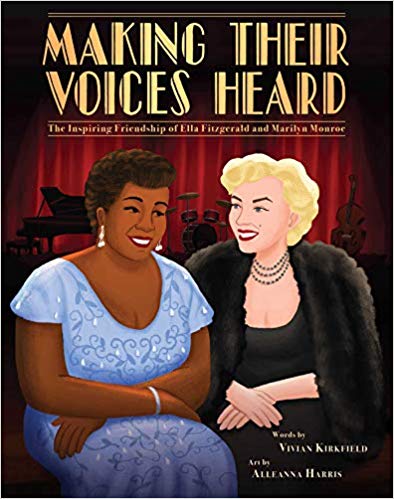
Author Vivian Kirkfield is no stranger to the kidlit world. You can find her just about everywhere in kidlit social media. Her newest picture book, Making Their Voices Heard, debuted the end of January. I, Tina Cho, invited my critique partner to share her writing expertise with our Grog readers. Take it away, Vivian!

Thanks so much for giving me the opportunity to share on the Grog Blog, Tina. I’ve seen a question come up several times on Facebook groups that are devoted to writing, and I thought I would speak to that.


How do you craft a story with two main characters where giving each equal weight is important?


Before I wrote the draft for MAKING THEIR VOICES HEARD: THE INSPIRING FRIENDSHIP OF ELLA FITZGERALD AND MARILYN MONROE, I used several picture books as mentor texts. One of the most helpful was Amelia and Eleanor Go for a Ride by Pam Munoz Ryan, illustrated by Brian Selznick. Another book was Martin and Mahalia: His Words, Her Song by Andrea Davis Pickney, illustrated by Brian Pickney. I studied how the authors introduced their characters and how they relayed information about their lives and how their lives connected.


I’d already done a bunch of research, but none of my sources, mostly books about Ella and Marilyn, spoke about their friendship. I had to become a detective. I contacted the author of one of the Marilyn Monroe books. She didn’t know but she directed me to the website of the president of the Marilyn Remembered fan club. He didn’t know either, but he kindly gave me the phone number of the woman who had been Ella’s promoter for thirty-seven years. It was so hard for me to call her…I’m really timid that way. But I knew I needed the information because I knew I wanted to write an authentic and accurate story for children…and I wanted it to be a story that children could relate to – a story about friendship. Even young kids know about playdates and going to a classmate’s birthday party and how it feels when your friend is mad at you. How to be a good friend is an important lesson for kids. And although it’s true that each of these icons had enormous talent, each was being limited because of discrimination of one kind or another…and it was their friendship and respect for each other which helped break those barriers.

I took a deep breath…or maybe a few…and I called Audrey Franklin. I got her answering machine. And left a message. Miracle of miracles…she called me back the next day - we chatted for hours and she verified that they were, indeed, friends.

So, now I had verified they were friends, but I knew I also had to balance these two superstars. The mechanics of the text set out to do that. I began by introducing both women and pointing out how they are different yet the same.


Ella and Marilyn. On the outside, you couldn’t find two girls who looked more different. But on the inside, they were alike—full of hopes and dreams, and plans of what might be.

Next, I showed how Ella got her start – going from living on the streets to playing with a real band. Then, on the next page, I showed how Marilyn got her start – going from working at an airplane factory to signing a studio contract.

But we need to throw rocks at our heroes, right? And what I love about writing nonfiction is that I don’t have to invent the rocks…these women really faced huge obstacles and barriers. On the next two spreads, I show how Ella, though a jazz phenomenon, battled racial discrimination. And then I show how Marilyn faced an industry run by men who controlled her career.

So far, so good. I was keeping it pretty even and balanced. Now I wanted to show how Ella helped Marilyn…and then how Marilyn helped Ella. The nightclub incident where Marilyn persuades the owner to book Ella by promising to bring the media to his doorstep was easy. There was plenty of online information about that – and Ella even speaks about it in an interview. But how was I going to show how Ella helped Marilyn? That was definitely a challenge.


I found interviews where Marilyn mentioned how much she loved Ella, not only as a singer, but as a person. Ella was actually her idol…Marilyn was a fan girl! And then I read several articles that spoke about how Marilyn studied Ella’s voice to improve her own vocals to get ready for her singing role in Gentlemen Prefer Blondes. Bingo! When critics gave Marilyn rave reviews and her bosses amended her contract and gave her a higher salary and more control over script approval, I knew I had what I needed. Because this was a BIG deal – it’s what she had been fighting for all along. Marilyn also used Ella’s records to help with her insomnia – she’d fall asleep listening to Ella’s voice.

Now when Marilyn spoke, her bosses paid attention. And reporters and photographers followed her everywhere. Determined to thank Ella in person, Marilyn bought tickets to Ella’s next show.

After the show, Ella and Marilyn sit shoulder to shoulder, chatting. When Marilyn discovers that the Mocambo club refused to book Ella, she wanted to help her friend the way her friend had helped her.

Putting their heads together, Marilyn and Ella hatched a plan.
And I love the illustration Alleanna Harris did.


Marilyn put her career on the line to a certain extent because in those days, there was a lot of racial discrimination (not much has changed, unfortunately) and movie studios controlled what their actresses could and couldn’t do. By calling the nightclub owner and insisting that he book Ella, Marilyn stepped up and spoke out. This is what we mean by allyship. You don’t just give money to the cause…you step in and make it happen. The Civil Rights movement was just in its infancy…in fact, the nightclub incident happened in 1954 and it wasn’t until the end of 1955 that Rosa Parks refused to give up her seat on the bus.

I was able to show that both of these strong women admired and respected each other. Ella said, “She was an unusual woman – a little ahead of her time. And she didn’t know it.” And Marilyn said, ““Well, my very favorite person and I love her as a person as well as a singer. I think she’s the greatest and that’s Ella Fitzgerald.”

I also wanted to show how we are all complex individuals. Most of us know Marilyn as a sexy Hollywood star…and kids probably don’t know her at all. Similarly, most kids may never have heard of Ella, but her music was genius…in fact, at the very first Grammys in 1959, Ella Fitzgerald won for best female pop vocalist and best improvised jazz performance. I thought it was time for kids to discover these two special women and how differences in race, color, and creed played absolutely no role in their amazing friendship. And how poignant a time for a book like this. We can, and must, all step up, making our voices heard for what is right, so that our nation can be healed. Covid-19 will, at some point, have a vaccine that will protect us from it. But this sickness of hatred and anger can only be healed with kindness, love, compassion, and with the willingness to listen to the voices of people of color.

Most of you who know me know that I am an extremely optimistic person and I’m always trying to find a positive, even in the darkest of times. My older sister used to call me Pollyanna, after the storybook character who finds something to be glad about in every situation. And I think I have found it. Young people are stepping up and refusing to allow this hatred to go on. A high school junior reached out to me last week. As a school service project, she is building a website where she will showcase videos of teachers reading aloud books from different cultures. She wants to use Sweet Dreams, Sarah and she wrote to ask my permission. Of course, I checked with the publisher who is totally on board. What thrilled me the most were the young girl’s words: “Your book has had a profound impact on my life and has given me the confidence to use my voice.”

And THAT is why I write books for children! Just like Ella and Marilyn, everyone needs to make their voice heard.


Bio: Writer for children—reader forever…that’s Vivian Kirkfield in five words. Her bucket list contains many more than five words – but she’s already checked off skydiving, parasailing, banana-boat riding, and visiting critique buddies all around the world. When she isn’t looking for ways to fall from the sky or sink under the water, she can be found writing picture books in the quaint village of Amherst, NH where the old stone library is her favorite hangout and her young grandson is her favorite board game partner. A retired kindergarten teacher with a masters in Early Childhood Education, Vivian inspires budding writers during classroom visits and shares insights with aspiring authors at conferences and on her blog, Picture Books Help Kids Soar where she hosts the #50PreciousWords International Writing Contest and the #50PreciousWordsforKids Challenge. She is the author of numerous picture books. You can connect with her on her websiteFacebookTwitterPinterestInstagramLinkedin, or just about any place people with picture books are found.

Vivian's books:
PIPPA’S PASSOVER PLATE (Holiday House) illus by Jill Weber
FOUR OTTERS TOBOGGAN: AN ANIMAL COUNTING BOOK (PomegranateKids) illus by Mirka Hokkanen
SWEET DREAMS, SARAH (Creston Books) illus by Chris Ewald
MAKING THEIR VOICES HEARD: THE INSPIRING FRIENDSHIP OF ELLA FITZGERALD AND MARILYN MONROE (Little Bee Books, January 14, 2020) illus by Alleanna Harris
FROM HERE TO THERE: INVENTIONS THAT CHANGED THE WAY THE WORLD MOVES (Houghton Mifflin Harcourt, January 2021, illus by Gilbert Ford