Showing posts with label Children's Poet Laureate. Show all posts

Thursday, October 12, 2017

Margarita Engle on Poetry that Crosses Borders


Margarita Engle is the national Young People’s Poet Laureate, and the first Latino to receive that honor. She is the Cuban-American author of many verse novels, including The Surrender Tree, The Lightning Dreamer, her verse memoir, Enchanted Air, and more recently Forest World. Her newest picture books are All the Way to Havana, and Miguel's Brave Knight: Young Cervantes and His Dream of Don Quixote, a fictionalized first-person biography in verse of Miguel de Cervantes Saavedra. Her upcoming book, The Flying Girl, How Aida de Acosta Learned to Soar will be published this coming spring. You can learn more about Margarita and her writing at her website and follow her on twitter here. And tomorrow, drop by Sally's Bookshelf to read a review on her recently released picture book, All the Way to Havana.

I am so pleased that Margarita could join us today to share her thoughts on poetry and diversity. Thank you, Margarita!
                                               ~     ~     ~    ~

"Poetry that Crosses Borders"
by Margarita Engle

Diverse books from the richly varied cultures of the United States are important, but they're not enough. Americans are notoriously ignorant about geography. When I speak to classrooms, I’m often shocked by how little the younger teachers know about Cuba. That’s because they didn’t learn about this close neighbor of the U.S. when they were in school.

A high school history teacher in California actually asked me if Cuba is a U.S. protectorate like Puerto Rico.  As a result of this widespread geographic confusion, children are more likely to ask, “What is Cuba?” than, “Where is Cuba?”

After Hurricane Irma, television reporters kept referring to the first U.S. landfall as Key West, when actually it was in Puerto Rico, followed by the U.S. Virgin Islands, and then Key West. Americans have a tendency to forget about any portion of U.S. territory that is not part of the primarily English-speaking mainland. I think it’s time for a new era of education in geography.  One of the most powerful ways to teach about our own country as well as other nations is through literature.

When it comes to international books, there is no substitute for “own voices,” or at least books written by someone who has grown to know a country from within, rather than as a casual tourist. Kwame Alexander’s Solo is a wonderful book partly because he has spent so much time working with volunteer projects in Ghana. Notable ‘own voice’ works of border-crossing poetry include verse novels such as Inside Out and Back Again, by Thanhha Lai, and A Time to Dance, by Padma Venkatraman, as well as picture books such as A Different Pond, by Bao Phi, and Somos Como las Nubes/We Are Like the Clouds, by Jorge Tetl Argueta. 

 My own fascination with books about many nations began in childhood. The first book I bought with my own money was Things Fall Apart, by Chinua Achebe.  It was 1961, and I was ten years old. I didn’t relate to the whites-only “classics,” and there simply weren’t any multicultural children’s stories available in the U.S., so I quite naturally drifted toward international books written for adults, including travel diaries, atlases, and books in translation. I did not return to youth literature until I started reading to my own children in the early 1980s. Even then, there wasn’t much in the way of variety.

Today, statistics on diverse books are still pathetic and discouraging, but I love the We Need Diverse Books movement, and lists such as the International Literacy Association’s Notable Books for a Global Society,which honors works that cross borders. I would love to see more poetry on these lists, and I would love to see more books in translation become available in libraries, classrooms, and bookstores. As Americans of diverse ancestry, how can we continue to isolate ourselves when it comes to reading? People of all ages need to open our minds to the whole world, not just our own neighborhoods. In addition to serving as windows, mirrors, and doorways, books can also be bridges, connecting us across oceans and borders.

Tuesday, April 29, 2014

Kenn Nesbitt, Children's Poet Laureate ~ Part 2 ~ by Patricia Toht

Today I'm welcoming back, KENN NESBITT, poet extraordinaire and current Children's Poet Laureate! (If you missed Part 1 of our interview, scroll back to yesterday's post.)


So pull up a chair, GROG readers. In honor of Kenn's taste buds, today we're enjoying a cup of coffee, along with a slice of toast and Marmite. (Okay, maybe Kenn will enjoy the Marmite - I'll be nibbling around the toast edges...)
Yeast extract on toast, anyone?
PT: What is your process for writing a poem, Kenn?

KN: The hardest part is always finding some quiet time, free from distractions, and sitting down to write. Once I get in that place, I have a folder full of ideas and notes that I have jotted down previously. I sift through my notes until I find an idea that seems like a fun one to work on. Sometimes I may only write a few lines or a part of a poem before moving on to another idea. In this way, it may take anywhere from an hour to several months for me to finish any given poem.

PT: Newbie children’s writers are often discouraged from writing in rhyme. What advice do you have for them?


KN: The reason for this is that meter (poetic rhythm) is an integral part of writing in rhyme. Without solid meter, rhyme is not a pleasurable to read. Moreover, beginning writers may be more likely to use "forced" rhymes. My advice is to go ahead and write in rhyme, but just as a learning experience; not for publication. I recommend picking up a book such as Derek Attridge's Poetic Rhythm: An Introduction to learn how to establish rhythm as well as rhyme. And I suggest doing a little reading about what forced rhymes are and how to avoid them. I have an article about this on poetry4kids.com that budding children's writers may find useful.


PT: And finally, did you read poetry when you were young? Can you recall a favorite poet or poem from your childhood?


KN: When I was a kid, my father used to recite poems, often to pass the time while driving on family road trips. He had memorized poems by Rudyard Kipling, Robert Service, Ernest Lawrence Thayer, and many others. Listening to these was my first introduction to poetry. My favorites were the nonsense poems, such as "One Fine Day in the Middle of the Night" and "They Dying Fisherman's Song." I never imagined, though, that I would one day write such poems myself. I feel very lucky to be able to introduce children to kind of poetry that I so enjoyed when I was young.


PT: Thank you, Kenn, for your insights into writing and sharing poetry with children! We wish you the best in your continued role as Children's Poet Laureate.

And thank you for joining us again today, GROG readers. I highly recommend that you explore Kenn's website, Poetry 4 Kids. The "News" section, in particular, has scads of helpful articles for poets.  You'll also find a list of Kenn's books and anthologies and written and recorded interviews with other children's poets. Visit the Poetry Foundation website for information about the honor of Children's Poet Laureate and other poetry resources. 

Monday, April 28, 2014

Kenn Nesbitt, Children's Poet Laureate ~ Part 1 ~ by Patricia Toht

Look at that armful of poetry books!

If you don't know this fellow, you're missing out! He's a funny and prolific poet, promoter of all things poetry, and our current Children's Poet Laureate -- KENN NESBITT! 

(Pause for applause.)

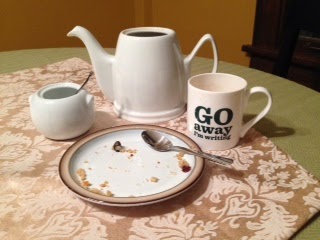
Come, join me for virtual tea and scones, while Kenn tells us about his role as Poet Laureate, offers hints on helping kids enjoy poetry, and talks Common Core. 


PT: You’re now ten months into your position as Children’s Poet Laureate. How’s it going? What has been your favorite part?


KN: In a way, things aren't much different for me now than they were a year ago. That is, I'm still doing everything I can to promote poetry for children. The biggest difference, and probably my favorite part, is that I have created a new website -- www.poetryminute.org -- to share the work of today's most popular children's poets. Every day of the school year, I post a different poem on the home page for teachers to share with their students. I've been pleased with how well Poetry Minute has been received. 

PT: I love Poetry Minute! I signed up through the website to get daily deliveries of poems on my Facebook page. 


PT: How can we help children learn to love poetry?

KN: I think the best way to help children learn to love poetry is to help them discover what kind of poetry they like best. Not everyone loves all kinds of poems. Some kids will enjoy narrative poems, while others may prefer haiku. For some, free verse will be their favorite, while others will be drawn to humor or wordplay. Once a child discovers that there is a particular type of poetry they enjoy, they will be more likely to want to delve deeper and discover more poetry of the kind they like.

PT: You also have many options on your website, Poetry 4 Kids, for children and adults to explore poetry and play with words. It's a treasure chest of goodies! (And thanks to you, Kenn - I'm completely obsessed with the game, Wordjack.)

PT: Do you think the adoption of Core Curriculum Standards will have a positive or negative effect on the use of poetry in schools?

KN: I couldn't say. I'm not a fan of testing kids on their skills at poetic analysis, as I think this makes reading a chore rather than something one does for the joy of it. On the other hand, given today's educational environment where students are often only taught what they are going to be tested on, I think it's a good thing that poetry is part of the Common Core. Without this, they might have little or no exposure to poetry in school.

PT: Thank you, Kenn! Please come back tomorrow and we'll talk about your process for writing poems and your tips for authors who like to write in rhyme.

I hope you enjoyed your tea and scones, GROG readers. Please join us tomorrow for Part 2!