Showing posts with label Guest Posts. Show all posts

Wednesday, November 16, 2022

Picture Book Lessons from the Zoo ~ guest post by Kate Woodle

Kate Woodle is a member of the West/Central New York SCBWI region and also helps facilitate the Syracuse area Shop Talk. She worked as an illustrator at the Rosamond Gifford Zoo in Syracuse, NY for more than 25 years. One day we got chatting about picture books, and I asked her whether her zoo work gave her insights into picture book illustration. Here's what Kate has to say about that:

Working at the zoo was my dream job. It was creative (I was the exhibit designer) and it involved animals. I got to study the animals in our care, learn about their habitats and the food they ate, the environment and conservation issues affecting them, and then present their "story" to the public. 

I created illustrations and designed signs for exhibits. The zoo's educator wrote the signs. As an illustrator, my job was to get people to stop and read the sign. Then I could convey some additional information through the art, such as what food an animal eats, where it lives and what its habitat is like. This frees the zoo educator to address another topic. 

Exhibit illustration is a collaboration much like that between picture book author and illustrator. The biggest difference: in a zoo you have only seconds to catch a visitor's attention. It's harder than it looks. Not only that, you’ve got a limited number of words – hopefully no more than 40 on a sign (pretty close to the recommended number of words per page in a picture book). Sure, this "rule" can be broken, but it does help if you are trying to hold attention. If the sign is meant to be read by an adult who will then interact with the child, you have a little more leeway with your word count.

The illustration for this display helps a child visualize what the words mean. This sign is placed next to a life size baby elephant statue (I made that, too) so that kids can compare their weight, height and how much they eat to that of a baby elephant.

A great example of this in a picture book is "Actual Size," by Steve Jenkins. A gorilla's hand and a pigmy mouse lemur are shown full size on a spread. Not only does the book show the actual size of each animal or part of an animal, it has an interactive element: a child can place their hand on top of the gorilla's to see the difference. A pigmy mouse lemur's whole body can be covered by a child's hand. 

The book also has a fold out page to accommodate a Goliath frog that's 36" long. Jenkins’s amazing illustrations are all done with paper collage.

I also painted murals, both in exhibits and in public spaces. A mural is like a scene in a picture book. It gives all kinds of information that is not conveyed in the text: Does this animal live in a rainforest? What other plants and animals live there? Is it misty and damp with really tall trees, a hot dry African savannah, or the Grand Canyon?  

In Jason Chin's book, he does a great job showing both detail and scale as he takes you from the bottom of the canyon to the top.

Murals and signs can also be interactive. Here's an example of an interactive mural that represents the Amazon Rainforest. 
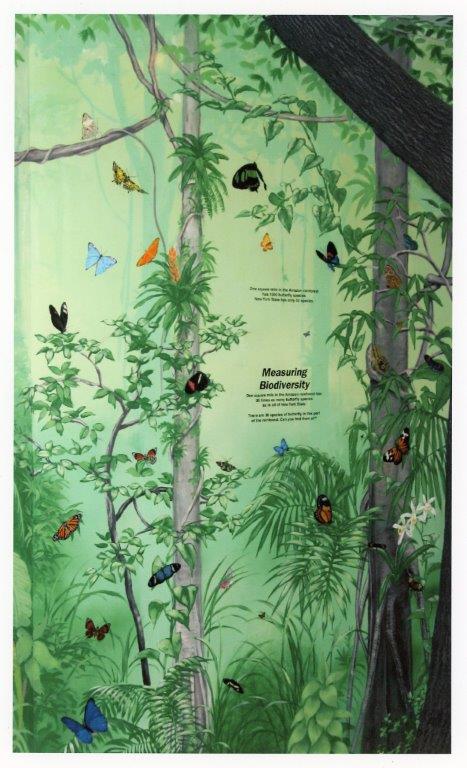
The text on the mural reads: 
Measuring Biodiversity.
One square mile in the Amazon rainforest has 30 times as many butterfly species as in all of New York State. There are 30 species of butterfly in this part of the rainforest. Can you find them all? 

As in the butterfly mural, an illustration can convey a sense of place and add depth to a text. It can evoke a mood. All the World, by Liz Garton Scanlon and illustrated by Marla Frazee is a perfect example of this. Scanlon's marvelous poem includes all kinds of events: playing at the beach, picking vegetables, etc. while Frazee's illustrations add to the action. While a rainstorm is never mentioned in the poem Frazee's storm meshes perfectly with the text. The illustrations are realistic but also evoke, along with the words, a sense of beauty, joy and community. 

I've been interested in illustrating children's books since I was old enough to know that that was a profession, and I'm particularly interested in STEAM books – especially those that feature biology. My job at the zoo encompassed these interests. What I hadn't expected while I was working at the zoo was what a good education it was for illustrating picture books.  


Here's another example of an interactive display: It's a photo opportunity showing all the kinds of primates at our zoo. Children are given the opportunity to include themselves in the group while their parents take a photo. 


This brings to mind the cover for the middle grade book Primates, the Fearless Science of Jane Goodall, Dian Fossey, and Biruté Galdikas.

There are so many similarities to the process. Whether it’s art for a zoo exhibit or for a picture book, research is important. You don't want to be accidentally teaching children something that isn't true. For example, polar bears don't really live with penguins! While fantasy and whimsy are wonderful, I believe it's important to be intentional about the message our artwork communicates to our readers. 

Kate Woodle has been drawing since she was three years old. She received a BFA at Syracuse University’s School of Visual and Performing arts, then taught art and later worked as exhibit designer and graphics artist at the Rosamond Gifford Zoo in Syracuse, NY. As part of her job she wrote and illustrated the children’s newsletter, MyZoo Jr. Her illustrations and photos have also been featured in Scholastic’s Weekly Reader, National Geographic Kids and in the books,  A Friend for Mia, A New Dog, and Newborn Kits (all published by Pioneer Valley Press). She also did several projects for McGraw Hill Education. You can find out more about Kate and see her wonderful artwork at her website, www.katewoodle.com.


Wednesday, February 3, 2021

YES! You DO Actually Use What You Learn in School

 Guest Post by Jennifer Swanson

Today we are turning the blog over to award-winning nonfiction author Jennifer Swanson. Jennifer has written more than 40 nonfiction books, mostly about science and technology. She’s been a STEM girl since age 7, when she started a science club in her garage. She created the STEM Tuesday blog and  has a science podcast for kids, with her cohost Jed Doherty, called Solve It! for Kids 

Think back to the days when you were in elementary school, or even high school or college. How many of you remember sitting in class thinking, “Why do I have to know this? There is no way I’ll ever use this again?” Come on. I know that you have at least one class where you thought this.  I’ll be honest. I did. A lot! Particularly when I was in math, English, or yes, even some science classes. 

Believe it or not, those topics that we are sure we will never use again, we always do. Especially if you’re a writer. Well, that’s what’s happened to me. And I’m sure a bunch of you, too.

The thing is, as a writer you are always told to “write what you know”. That’s a great statement but it can carry more weight than you intend. We’d all like to think that that statement means that we get to write what we are passionate about. Sometimes that’s  the case. And sometimes we write what is offered to us so that we can get a paycheck and keep moving forward

As a new writer starting out, particularly in the nonfiction world the first thing you learn is that you say “YES” to a job that is offered to you. My first few writing jobs were with educational publishers. There you are competing against a bunch of other authors for a work-for-hire job. In order to stay at the top of the acquiring editor’s writer list, you needed to work quickly and diligently to keep getting assignments.

That means that if you get asked to write a book about Electrical Engineering, you say yes! Even if you didn’t do very well in that class in college, as my college roommate reminded me. When I emailed her that I was writing this book. Her exact words were, “Does your editor know you got a ‘D’ in that class?” Uh, no. I sort of left that part out. 

 The COOL thing about using things that you learned years ago is that now you have DISTANCE. Years later when you pick up this topic again, you may find it  much easier. Why? First of all, no tests! And also, you can learn the topic the way you want to, which is not always the way the teacher presents the material.

How did this book turn out? Well, the whole series was a Junior Library Guild Selection and got great reviews. Not bad, huh?

The funny thing is that researching this book actually changed the trajectory of my writing. I learned a lot about electrical engineering, of course, but I also learned that I loved writing about engineering and technology. This book is where I was first introduced to the self-driving car!! (The self-driving car is a big thing for me. If you know me, you know this to be true). 

Is this the only book where I’ve used stuff I learned in school? Nope. When Workman Publishing was looking to expand their Big Fat Notebook series to high schoolers, I got an email from the editor asking me if I wanted to write the chemistry book in that series. Now, this should be a no-brainer, right? I have a B.S. in Chemistry. Uh, yeah, that was 30 years ago. Did I ever think that I’d be writing a chemistry book all these years later. No.

 And yet, I had tons of fun doing it. The trick to using what you never thought you would is that you find out it’s actually kind of fun. Plus, now, you can explain things that you remember were difficult for you.

Take chemical bonds. Some kids have problems with these. But now, I get to take the time to explain it in a way that a kid would understand. (and I do, too, now)


And here’s where that math comes in. Yep! I got to use fractions, units and conversions, all in dimensional analysis. 


So why am I talking about all of this? To let you know that if you’re a writer, you may be asked to write about anything. This is true of both nonfiction and fiction authors.

The point is, don’t say no. You can do it! 

Besides, saying yes to one book, you just might be inspired to write a different one. One that is your own idea. As you can see, my obsession  passion for self-driving cars led me to write this one Without doing the Electrical Engineering book, I may never have written Save the Crash-test Dummies (Peachtree Publishing)

 If you take a look at most of the books I’ve written, you’ll see that I tend to use a lot of what I learned in school. Yes, there is a lot of science, but also history, technology, math, social studies, and don’t forget the after-school sports!

Here is my challenge to you, think about something you thought you’d never use again. Then look around. Have you used it? And if not, then I challenge you to do so. It may open a whole new world of ideas and opportunities for you. 

 Jennifer's books have received starred reviews and other accolades, including Booklist Best Tech books, Green Earth Book Honor award, a Florida Book award, multiple California Reading association awards, and National Science Teaching Best STEM awards. An accomplished and exciting speaker, Jennifer has presented at National NSTA conferences, Highlights Foundation workshops, the World Science Festival in NYC, and the Library of Congress National Book Festival. Visit her website at http://www.JenniferSwansonBooks.com

Wednesday, February 14, 2018

Annette Pimentel on Scaffolding the Past for Young Readers


our guest author, Annette Pimentel
by Sue Heavenrich, with Annette Pimentel

Last fall I reviewed Annette Pimentel's book, Mountain Chef, a wild tale of a cook in the Sierra mountains. I loved the story and the extensive back matter, and was amazed at how Annette did her magic. She graciously accepted our invitation to write a guest post for the GROG. And now I'll turn it over to...

Annette Pimentel

In the picture book biographies I write, I need to accurately recreate yesterday’s world for my young readers. Only when kids understand how things used to be can they see how a true-life hero transformed society. So, in every book I face the challenge of building a scaffold of knowledge about the past to support my reader’s understanding.

First, I need to decide what is important for my reader to understand. I think about assumptions kids make about their world—that girls and boys both play sports, for example. I try to figure out what essential elements of the world I’m writing about kids won’t already be familiar with.
Once I know what gaps I need to fill, it’s time to build that scaffold.
I’ve learned important scaffolding skills from mentor texts. Here are strategies that ensure kids get the background knowledge they need.

Strategy # 1: STOP THE ACTION AND EXPLAIN
If only I could just stop everything and give kids the background they need! Usually that would be death to a story but occasionally it actually works.
Freedom in Congo Square depicts the joyful Sunday music and dance of enslaved people in New Orleans. But with a topic like that, there is the danger that young readers will fail to understand that those were stolen moments within a life of oppression. So before the book even starts, a Foreword tackles the issue of slavery.

Lines, Bars and Circles: How William Playfair Invented Graphs tells the story of a thinker who emerged during the Industrial Revolution. Rather than try to explain the significance of the Industrial Revolution within the story, the information is placed in a sidebar. The reader can drop out of the story for a moment, read, the information, then get back to the story with the knowledge she needs.

Strategy #2: GIVE NECESSARY KNOWLEDGE IN TERMS OF THE MAIN CHARACTER’S LIFE
Handily, you can often build your scaffolding as you describe your main character since the information your reader needs probably relates to that main character’s passions and desires.

Martin’s Dream Day gives kids information about the state of civil rights in the US in 1963 by explaining Martin Luther King’s convictions:
Martin Luther King, Jr. believed in equality. For everyone—not just a few. He wanted all people to have the full rights of citizenship. That meant the right to vote, to go to school, and to get a job. In the 1960s, African Americans did not have these basic rights.

I used the same strategy in Mountain Chef. I needed to explain to kids the ugly realities facing Chinese Americans after the passage of racist laws like the Chinese Exclusion Act in 1882, so I described how my hero ended up in his job as a gourmet trail cook:
Bosses paid Chinese workers less than white workers….Most people with Chinese names ended up cooking in restaurants or washing clothes in laundries. Tie Sing, though, had…dreams as big as the country he loved. Cramped shacks weren’t for him.

Strategy #3: SHOW KIDS SOMETHING THEY RECOGNIZE, AND THEN UNDERLINE THE DIFFERENCES
One great way to scaffold kids’ understanding of the past is to start with something that they will assume they know, and then describe how it was different in the time period you’re writing about.
Karl, Get Out of the Garden is a biography of Karl Linnaeus, who set up the system of animal and plant classifications that we still use today. How do you get kids to imagine a world where there simply aren’t consistent names for plants and animals? Here, it’s done by talking about a plant that every kid knows.
Doctors, gardeners, farmers—everybody!—argued about the names of plants. Dandelions might be called blowball, swine’s snout, or yellow daisy—depending on which town you lived in.
In Girl Running I knew that my soccer-playing girl readers were going to have to imagine a world very different from their own to understand the magnitude of Bobbi Gibb’s accomplishment in breaking the Boston Marathon’s gender barrier. So I start the book in a familiar environment: school.
Bobbi Gibb must wear a skirt to school because she is a girl. She is not allowed to run on the school’s track team. Because those are the rules—and rules are rules.

As young readers dive into more and more nonfiction, their understanding of the world becomes broader, richer, and more nuanced. But that growing understanding depends on the almost-invisible, but carefully-built scaffolds of knowledge constructed within the nonfiction they read.

Thanks you so much, Annette, for filling our writer's tool box with more strategies we can all use. 
Annette Bay Pimentel wrote Girl Running and  Mountain Chef: How One Man Lost His Groceries, Changed His Plans, and Helped Cook up the National Park Service, the 2017 Carter G. Woodson Award winner. Every Wednesday she writes about recently-published nonfiction picture books at http://www.annettebaypimentel.com/ You can also find her on Twitter at @AnnettePimentel She is represented by Andrea Brown Literary.

Thursday, November 30, 2017

Guest Blogger, Pamela Courtney and Her We Need Diverse Books Mentorship - introduced by Kathy Halsey

For me, one of the joys of being a children's writer is the great community and camaraderie that develops over time. Today my friend, writing partner, critique buddy, and fab educator, Pamela Courtney is on tap to share a post with us. 

Pam's  professional biography:
Pamela Courtney lives in Atlanta, GA, but the Red River of Louisiana permanently flows through her veins. She is a former Curriculum Consultant, but is now proud to claim herself "Teacher of some of the most intellectually stimulating Kindergarteners and 1st Graders." Pamela is a 2017 recipient of the We Need Diverse Books mentoring program; mentored by Carole Boston Weatherford.

Writing with Mentors: Musings, Mishaps, and Magic

Thank you Kathy. I am honored to have the opportunity to share my amazing journey in the We Need Diverse Books Mentorship program.

I’ve always dreamed of being mentored by an amazing children’s author. Never in my wildest dreams could I have imagined the blessings coming my way.  Blessings that challenged my work ethic, that demanded diligent study of craft, and blessings that I would rely on, and cherish. Carole Boston Weatherford offered guidance in a way I had not expected.

A POSTURE FOR RECEIVING
I dreamed that my time with Carole would make the writing road smoother. I dreamed Carole would walk me through my own work step by step, line by line. I dreamed my mentor would correct every scene I wrote. It will be so easy. But, I had to leave that dream world, a daunting and necessary step for my growth.

In our Q & A time, Carole Boston Weatherford asked one question that stood out and has remained unanswered. “What do you hope to accomplish in our time together?”  [insert outrageous rambling here]. I thought I’d knock out several successful masterpieces (because yeah, I’m that good, and well, she’s CAROLE BOSTON WEATHERFORD). I reasoned that through magic that some sort of literary osmosis was definite. Carole was cool. “Well, let’s see. We’ll walk through this together.” No, no hand holding at all.
Carole Boston Weatherford Credit: Jeffery Weatherford

Was I ready to receive?

Incoming: “Your language is lovely. Powerful. You have a talent for visually creating a scene. That’s what drew me to your work. But … YOU  HAVE NO PLOT” Ahhh, there’s that “something.”  I straightened my back. I opened my arms. I sat waiting for her to tell me exactly what to do. Silence. This wasn’t easy.

Acquiring Experience: A consummate teacher, Carole maintained this consistent routine of guiding my writer’s eye. “Let’s discuss this scene. How powerful is it playing out? Think about how your students would receive this.” I kept waiting for her to, tell me what to do. This was guidance I hadn’t expected.

Nevertheless,  my work habits changed. Researching even the minutest of detail is part of my writing. Hmm … “sun beats down on backs already low to the ground.” Must research actual weather conditions during this period. Examining each line, determining its rightful place – Carol, showed me how to ask that specific question for each scene. Perhaps Carole’s question has been answered.  I realized that wanting to be a writer and positioning myself as a writer are dream worlds apart. Maintaining a posture of readiness is as crucial as developing work ethic muscles. I’m growing into a writer. Yes, I’ll say it, a good writer.


Here’s the magic. The education of crafting is ongoing. Seeing writing through Carole’s eyes broadened my vision of what writing, good writing for children should and can be. By the way, there was hand holding. Lots of hand holding. Step by step. Line by line. Thank you Carole Boston Weatherford. Thank you We Need Diverse Books. Thank you GROGers.