Showing posts with label Ralph Fletcher. Show all posts

Wednesday, February 2, 2022

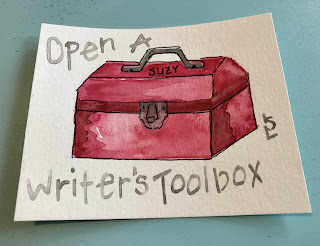
A Tool Box for Creatives

By Suzy Leopold

Today is Groundhog Day! Will Punxsutawney Phil see his shadow?

Since today’s GROG Blog post is about toolboxes—not the legendary groundhog, let's move on . . . 

Many creatives keep toolboxes. 

A toolbox contains various tools. A toolkit also keeps tools—resources and skills to increase knowledge and support—creativity all kept inside a box or container.

Many writers and illustrators create toolboxes. Items are organized in one place and can easily be transported. The toolbox supports creating at home, at the library, a cafe, at a writing conference or workshop.

A writer's toolbox can be used to expand and master the craft of writing.

A toolbox may be a physical container with shiny tools and resources or it can be a metaphorical toolbox to develop deeper knowledge. Both are designed to improve creativity.

It is not the tools that matter but what one does with the tools and the ability to use the tools effectively.

Peer Inside a Toolbox

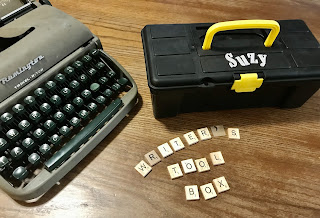
Suzy’s Writing Toolbox

  • Writing tools--pens, pencils, markers
from Leah Cheak; from Julie Cohen (links will redirect you)
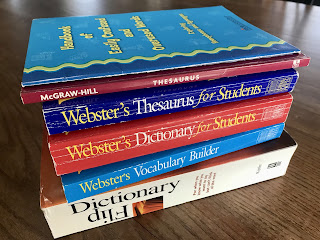
  • Dictionary and thesaurus
  • Mentor texts to mine for the author's craft
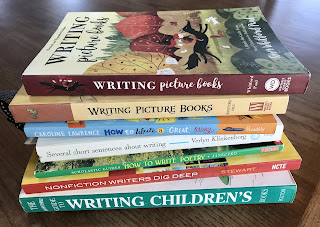
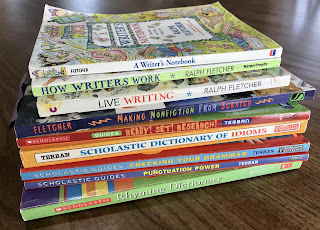
  • Craft of writing books

More Tool Ideas for a Writer's Toolbox
from Ralph Fletcher & Dolly Garland
from Kathyrn Evans
from Joanne Sher
  • Writing tips:        
 1. Make every word count with excellent word choices 
from Debbie Ridpath Ohi & Josh Funk 

 2. Rules of three 

from Pamela Hodges
from Rob Sanders
from Debbie Ridpath Ohi
  • Continue to grow and learn 
from Josh Funk
from Joe Bunting; Suzy
from Marcie Flinchum Atkins
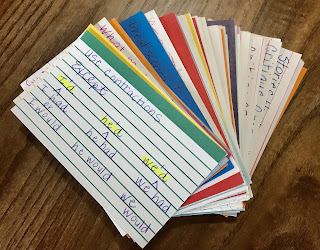
Index cards with tips


What's in your toolbox? In the comments share the tools you keep in your writer's toolbox.

Wednesday, February 13, 2019

Writers Use Mentor Texts ~By Suzy Leopold

Writers know the value of reading mentor texts. 

My students at Lincoln Land Community College, know the value of reading mentor texts. Students in my classroom read for pleasure becoming proficient readers. Through daily reading, freshman learn how to write and make improvements with their writing.

Mentor texts can be used in a variety of ways for all students and writers. Mentor texts become powerful models to inspire students and writers.

There are times when I share direct instruction to guide students and model for them good writing elements and what to look for.


"Let's look at what real writers are doing. Let's see how 
we can learn from these writers." 
Ralph Fletcher, Author

A shorter reading passage can be used as a mentor text to focus students' attention with a mini-lesson.
I picked these flowers for you
from my 2018 garden.
Happy Valentine's Day!
Here's an example of a mini-lesson using direct instruction along with what I might say . . .

Today's lesson includes author's word choice. Let's read, and look for word choices made by the author on these two pages.

Now reread. This time as you read, jot down and write as you answer these questions:

1. Do you note active verbs?
2. What word did the author chose? Think of a synonym that may work.
3. Did you find interesting figurative language, such as a metaphor?

I don't always require students to focus on a particular concept, such as word choice. Some lessons are less structure, allowing students to discover what is working in a piece of writing. As an educator, I must encourage higher order thinking through the six steps of Bloom's Taxonomy [there are several variations of Bloom's Taxonomy--a cognitive development tool]. The highest level of learning takes place is through evaluating. To do so, students are judging the value of the material being read for a given purpose.

Click on the link again and you'll note active verbs used by students for this learning outcome: evaluate, appraise, assess, compare, and so forth.

"Every writer, no matter how skilled you are or how beginning 
you are, encounters and reads something that can 
lift and inform and infuse their own writing."
Ralph Fletcher, Author

Writers and readers use mentor texts to discover why writers are successful. Reading and examining books as model texts encourages readers and writers to become better at the craft of writing.

Mentor texts are powerful tools--books that students and writers can learn from, glean from and eventually affects your writing in positive ways.

There are numerous methods for reading and examining mentor texts to support students and writers.

I'll share a mini-lesson on the Book Head Heart Reading Framework.

The BHH model was developed by Kylene Beers and Robert E. Probst. They are the authors of DISRUPTING THINKING WHY HOW WE READ MATTERS.

"What do we mean by Book, Head, and Heart?
This is a simply a short, telegraphic phrase to suggest 
that we need to pay attention to the text, to our thoughts about it, 
and to what we feel and how we might have changed, 
no matter how slightly, as a result of reading."
Kylene Beers and Robert E. Probst

BHH Reading
The BHH framework is a great tool for students and writers to stop, notice, and note.
DISRUPTING THINKING
WHY HOW WE READ MATTERS
Reading carefully requires a certain amount of stamina, concentration, and patience. There are moments when a reader needs to slow down and ask what is working and what isn't.

Open up a mentor text and read it. Now read the story for a second time--better yet, read it aloud. Consider using the BHH Reading Framework. Find several ideas that can be used as a take-away to make your own writing polished and satisfying.

Next month as you participate in ReFoReMo, with coordinators and contributors, embrace mentor texts in a way that makes room for your meaning to improve your writing.

Check out these Picture books by Ralph Fletcher
This tab shares books for writing teachers and there are excellent tips for all writers on the teacher hangout tab.

Monday, July 14, 2014

Details, Details, Details!


By Janie Reinart

The power of a story is in the details. Annie Lamott, in Bird by Bird: Some Instructions on Writing and Life, says all you have to do is write down as much as you can see through a one-inch picture frame.

 I agree. Focus and give the readers something concrete to hold in their mind and to see with their imagination. Ralph Fletcher, in What a Writer Needs tells us, "Writing becomes beautiful when it becomes specific." 
 
Before my young authors write, I ask them to close their eyes and picture a treasure chest. Next, I direct them to open that treasure chest in their mind and take out three things. I mention the three objects should be something you can hold in your hand that remind you of the person or place you are writing about. The possibilities are endless: a ring, a hat, a piece of candy, the scent from a perfume bottle, a musical instrument, or something in nature.

Before writing her poem, B. told me about the memory of her mom leaving their home. When I asked what do you remember, B. said mom wore a black coat with only one button. That detail helps us connect with the poignancy of her poem. 


Mom  
by B. in 2nd grade

Mom you light up
Like the sun
I remember you
With your black coat
Your black button
You called me sweet girl
You and me
Cooked pizza
I cried and cried
Til you came back
I love you mom
I don’t want to cry
Some more


Anthony wanted to write about listening to music with his Grand Dad after school. I asked for specifics and found out the kind of music Grand Dad loved.  Anthony's poem helps us to know his grandfather.


To My Grand Dad 
By: Anthony in 2nd grade


My Grand Dad
Listens to Jazz
Smooth and neat
As a clarinet
Eats steak
So tasty and juicy
It makes his mouth water
Sits outside
Sun bleached
Feeling cozy
Glad because
He has the day off

Open your treasure chest of details and write something beautiful! We would love to have you post your short poem in the comments to share with us.