Showing posts with label WOW. Show all posts

Monday, June 20, 2016

Introverts Attending Conferences: Words of Advice ~ Christy Mihaly

As the summer conference season gets underway, this post offers some conference tips and techniques for introverts—ways to optimize your experience in what may be a challenging forum.
Charles Dickens, by Herbert Watkins

At first you may think, isn't a writer's conference something of an oxymoron? I mean, isn't writing a solitary activity? 

Yes and no. Most writing requires time alone. But improving your writing, and getting a book published, require interacting with others who love writing: illustrators, editors, agents, and authors willing to share what they've learned. That's what conferences and workshops are for. So what's an introvert to do?

Recommended reading for all
Okay, yes, I realize some writers are extraverts. These folks thrive in crowds, get pleasure from promoting themselves, and are otherwise somewhat incomprehensible to those of us who revel in retreating to our quiet writing corners. 
[Note to Extraverts: This post isn't for you, and you need read no further – unless of course you’re interested in better understanding your introverted friends and colleagues.] 

Being introverted is not the same as being shy, or anti-social; introverts can be just as friendly and fun-loving as anyone else. The difference is that for an introvert, socializing comes at a cost – it’s tiring. 
(For an excellent further explanation of introversion versus extraversion, I recommend Susan Cain’s 2012 book, QUIET: The Power of Introverts in a World That Can't Stop Talking.)  So, here are a few introvert-friendly tips for getting conference-ready, and enjoying yourself to the fullest once the conference gets going.

1. Before committing: Research and select with care. Conferences come in many flavors. Where you go should depend on what you're looking for. You'll focus on different types of conferences if your goal is meeting an agent, working on craft, or meeting more people writing nonfiction, for example.  (There's a list of GROG reviews of various conferences at the end of this post.) But overall, I’d break all these writerly events into three main categories: national conferences; medium-sized or specialized conferences; and smaller writing retreats. 
Large (SCBWI)!   

National conferences: Think large, crowded halls, loud voices filling packed dining rooms, anxious people thronging around the big editors and agents  . . .  you get the picture. The advantages of large gatherings include the opportunity to meet lots of people in the industry and hear top-notch speakers and panels. If you’re an introvert, though, there are obvious disadvantages. This is not your natural scene. Crowds make you tired and sap your energy. It might be well worth it, but you’ll need to psych yourself up for the event, and plan for some recovery time afterwards.

Medium (Falling Leaves)
Regional/specialized conferences: Regional conferences and meetings organized around a particular subject or genre tend to be smaller (though sizes will vary). I've attended conferences focusing on nonfiction and on picture books, for example. Like the big national gatherings, these usually offer keynote speeches, specialized panels and instructional workshops. They often include the opportunity for one-on-one critiques, round tables or open-microphone events or pitch competitions. Remember that SCBWI regional conferences are open to people from outside the region, so don't feel limited to your own geographical niche.
Medium (WOW)
Writing retreats or workshops: Smaller in size, these retreats (sometimes called "master classes") are often held in rustic locations and may offer quiet time for contemplation or writing. In this more casual atmosphere, attendees have the opportunity for relaxed socializing with other writers, editors and agents, walks in the woods, and often writing time too. The one-on-one critiques often run longer: 30 or 45 minutes. And did I mention there's less noise and more time for leisurely conversations? 
Small (Picture Book Boot Camp)
Evaluate your options. Try to talk with others who have attended an event you're considering, or see if you can convince a writing or illustrating friend to attend a conference or workshop with you. But wherever you go, never fear—lots of other conference-goers will be in the Introvert Boat with you.

2.  When registering: Some ideas to consider.
      Sign up for individual critiques. If they're available, they're almost always worth the price. You'll have a designated time period with an expert to discuss your manuscript. This is much more conducive to a productive conversation than one of those on-the-fly interrupted hallway exchanges with your Dream Agent, trying to shout above the crowd.

     Volunteer to help. Many conferences, especially at SCBWI, rely upon volunteers to keep things running smoothly. Volunteering is a great way to meet people, including workshop presenters, and get involved with the organization. 

·      Think about requesting a single room. Some retreats have limited space and will assign roommates. If you really think you’d rather have a single room, ask whether it’s available and how much extra it would cost – and consider springing for the extra. How much is your sleep—and sanity—worth, anyway?

3. Getting ready to go: be prepared.

Print up something to hand to people you meet. Maybe it's your business card. Or you might prepare bookmarks or postcards (especially if you illustrate). When you're momentarily stuck for the next witty thing to say, it's handy to be able to hand over a card with your contact information printed up.

·      Practice your pitch. Don’t be trying to invent a summary of your latest work in progress on the spot. Take the time before the conference to write down a quick synopsis of your manuscript. Turn that into a witty pitch. And use it when people ask you (as they will) what you’re working on.


4. Enjoying the conference: Techniques and Tips.
·      Take photos. This is an old introvert’s trick. Assign yourself the job of taking photos of your group, or of people you meet (famous or not!). Offer to take photos of speakers during the panels, and offer to email photos that you take to the people you’ve photographed. Most folks will appreciate this. And it makes meeting people a snap.

  Review the program, and plan for breaks. With some conferences, you'll sign up for small group sessions ahead of time. With others, you'll choose when you arrive. Either way, you'll want to be flexible. But study the schedule, and determine how you'll get the down time you need. An early-morning walk, a work-out in the gym, or a quick reading break in your room can rejuvenate you for the next big group gathering.

        Get offsite: If there are one or two people you’d like to get to know better, see if they’re interested in going to dinner or lunch or drinks off site. This may not always be possible, but can be a nice option if the group scene is a little overstimulating, especially during a longer conference. 

FOCUS on your GOAL: Set yourself a manageable goal for the conference. (And no, “sign a three-book contract” is not a manageable goal.) Maybe it’s “meet Edith Editor,” or “make two new contacts who might want to start a critique group,” or maybe it’s “figure out how to get that manuscript unstuck.” Focus on your main goal, and don’t worry if you aren’t the loudest, most rowdy writer in the room. 
GROGging at SCBWI

That said, be open to the possibilities that arise. The best part of conferences is meeting new (or old) writing friends. Because, really, no matter how much you may love your solitary writing, nobody can write alone all the time! 

RESOURCES: 

In compiling the list below, I've confirmed that GROG writers really do believe in conferences. Here are a few prior posts providing conference reviews and other conference-related information:
21st Century Children's Nonfiction Conference (T. Burleson & C. Mihaly)
Asian Festival of Children's Content (T. Cho)
Highlights Foundation workshop (J. Annino)
Library Conventions (K. Halsey)
Making a memorable author card (J. Reinart)
NF4NF (Nonfiction for New Folks) (J. Reinart)
Jane Yolen's Picture Book Boot Camp (C. Mihaly)
Rhyming Picture Book Revolution (S. Leopold)
SCBWI Florida (J. Annino)
SCBWI Illinois (P. Toht)
SCBWI National (Los Angeles) (K. Halsey & P. Toht)
SCBWI New England 2016 (K. Halsey)
SCBWI New England 2014 (C. Mihaly & P. Vaughan) 
SCBWI Northern Ohio (K. Halsey) 

Friday, July 31, 2015

Reading, Writing and ... Research?

Some tips to help you discover the hidden treasure of your next project.

by Leslie Colin Tribble

Have you ever had the most perfect idea for a nonfiction picture book hit you like a tsunami? The idea washes over you, engulfing you in its absolute brilliance and you rush to your computer, ready to type as fast as your thoughts are flying. 

But then you stop because you realize this will require research. You realize you have no idea where to begin, where to start. How will you find all the juicy information that will make your book different from the rest? How do you actually DO research for a picture book?


I asked several of the Groggers how they start sleuthing for information. Read on to learn about research techniques from this group as well as some pointers from the recent Week of Writing (WOW) retreat.


Look It Up at Your Local Library
Nearly all of the Groggers said their first step is visitng their local library. Start locally but search statewide to save some time. Utilize your library system's inter library loan to request materials. It's gnerally cheaper to pay the fee for an ILL than purchase all those books. It also helps you decide which books are the best resources and which ones you really won't need.


Delve into the digital goodness of WorldCat.org. This online card catalog resource "connects you to the collections and services of more than 10,000 libraries worldwide." WorldCat displays materials in libraries near you, including other states. This is a great way just to see what's already been written on a topic.


Browse the Bibliographies
After you've read all those books from the library, check out the bibliographies. There's a goldmine of resources hidden in those pages. Some bibliographic resources might be out of print or hiding in a locked case at a library you can't get to. Marcie Flinchum Atkins recommends checking abebooks.com for out of print or unusual books.


Another resource that can be helpful is the bibliography and links at the end of a Wikipedia article. But as Candace Fleming reminded the attendees of the WOW Retreat, Wikipedia is not a source. Use it as a first step if you need help getting started finding materials.


Identify the Experts
Often during your research you'll find a few names of experts which keep popping up. These are the folks you'll want to contact for an interview down the road. Experts are the final go to resource after you’ve done all your other research.


While you're in your discovery phase, you'll want to keep in mind the four paths of research which Candace Fleming talked to WOW participants about.
  • First are the primary sources. These are autobiographies, interviews, eyewitness accounts, journals or anything else that came directly from the subject of your research.
  • The second path are your secondary sources - newspaper and magazine articles, biographies and other books about your subject.
  • Third comes my personal favorite - travel. If you can get to a place that was intimately connected with your subject then you’ll have a deeper understanding of the person and what makes them special. However, travel can be expensive and time consuming. Sometimes we have to fore go this path of research. Sigh.
  • Finally, after you’ve done your homework, talk to the experts. Interviewing experts at the end of your work is a great way to fill in any gaps or unearth that nugget that will make your story glow.

Now you have a road map to start your research project. This discovery process can sometimes be as much fun as the actual writing, especially if you can add in some travel to your book work. Now get out there and get that research done!

Friday, July 24, 2015

Why You Need to go to a Conference

By Leslie Colin Tribble

I'm the queen of cheap, the princess of penny pinchers, the tsarina of thrift. In other words, I don't spend money very often nor very readily. That's one of the reasons why going to a conference isn't easy for me. But I recently attend the WOW  (Week of Writing) Conference and I am SO GLAD I did.

Conferences are good for every writer and here are a few reasons why.

1. Networking
All those Facebook writing friends you have, actually become real flesh and blood folks when you attend a conference. Meeting the other GROGGERS at WOW was so much fun! Networking in person strengthens bonds and make you feel a part of something larger. Writers hole up in their offices, cars or coffee shops and can go days without really connecting with other writers. Conferences pave the way for finding like-minded individuals with whom you can connect once you get back home.


2. Learning
Conferences like regional SCBWI events or Highlights or any of the other myriad events you can attend go out of their way to secure top flight faculty. This is the best way to immerse yourself in the knowledge and experience of people who are successful at what you want to do. All of the teaching sessions at WOW were excellent, but getting to listen to Candace Fleming speak for 6 hours was alone worth the cost of the conference.


3. Finding Your Tribe
I had five days at WOW to talk to people I'd never met and discover they are just like me - not published and not agented. Ok! There's hope for everyone! Sometimes I did chat with someone who is agented and/or published and found out they're normal people as well. Just because you're on the next rung of the writing ladder doesn't mean you stop learning, stop connecting, or stop needing your tribe.


4. Getting Feedback
We had round table sessions at WOW where we read our manuscripts to a small group moderated by an agent, editor or published writer. Those sessions were invaluable for me. I got great, constructive, positive feedback which will help me grow in this profession. I had one agent tell me my story itself wasn't really working, but that I'm a good writer and would get it figured out. Having an agent say that I'm a good writer was again, worth the cost of the conference and then some. That kind of validation is such a soothing balm to a writer's fragile ego.


5. Fun
After the sessions are over, the round tables have finished and the individual critiques are done comes the fun. Sitting out under amazing starry skies and chatting with new friends over a glass of wine is where the true magic of a conference happens. Sharing life is really the best part of any event. That's real networking.


So which conference do you really want to attend? Figure out a way to make it happen. Start saving now. Find out if there are any scholarships or grants you can apply for. Do something extra to earn the money but GET THERE.


Monday, July 20, 2015

Reflections From WOW


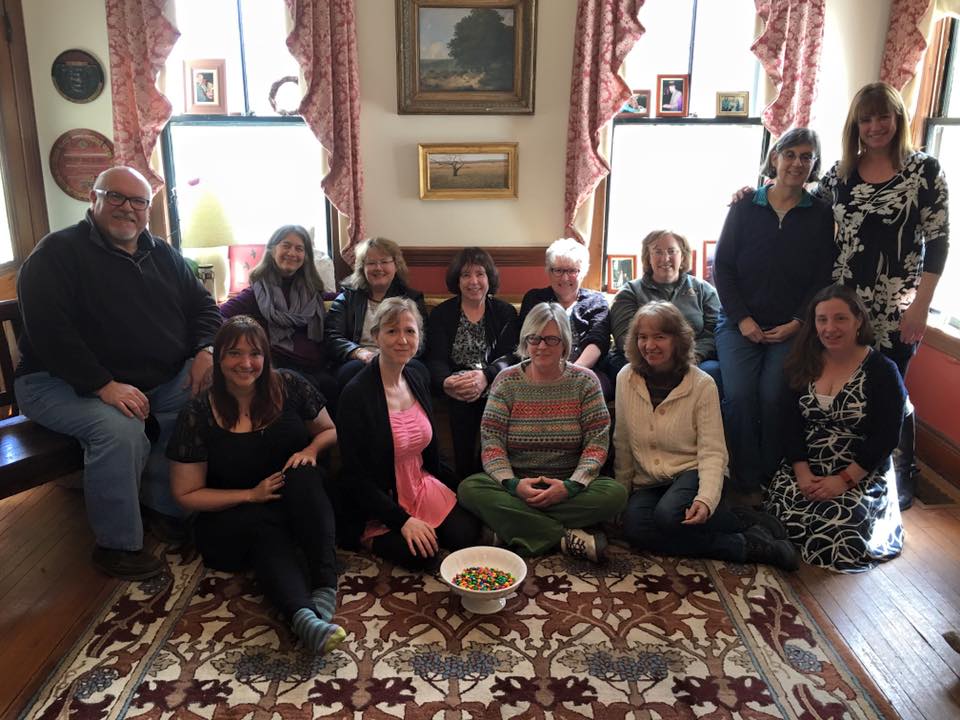
WOW participants and faculty, at the end of a full week
There's nothing like a writer's conference to get those creative juices flowing. Nine of the GROGger gang were lucky enough to participate in the WOW [Week of Writing] conference for children's writers last week in the Georgia mountains. 

Wow! Sessions on the craft of writing, markets, and critiques, individual manuscript critiques, round tables, arts and crafts, games, costumes, and meeting other kid lit peeps. Here are some of the tidbits we picked up.

Kristen and The GROGgers 
WOW 2015
From the Desk of Suzy Leopold:
Are You a Good Critiquer
Presentation by 

Kendra Marcus & Minju Chang 
of BookStop Literary.

Think about the following points and thoughts about 
critique groups . . . 
Spectacular view of the
Southern Appalachian Mountains
  • Are you good at giving AND receiving critiques? 
  • As a writer you are the consumer. 
  • Is your critique group a good match for you and your genre of writing? 
  • Is your critique group digging out and helping you solve your writing challenges? 
  • How often do you meet? 
  • Do you want critiquers to support your writing with a *feel good feeling* or do you want honest, direct critiques with fresh eyes? 
  • Does everyone in attendance receive an equal amount of time and attention for their manuscripts? 
  • Ground rules must be established. 
  • An agenda must be followed.
Denise Fleming
Candace Fleming

Dianna Huttts Aston

Christy Mihaly's Post-Wow Resolutions:
  • Read more! Read everything!
  • Write more poetry. Poetry, and playing with language, help you practice using language creatively. Use picturesque language.
  • Revise, revise, revise my manuscripts, with a focus on three things: developing my voice, making my characters compelling, and cutting words where the pictures can carry the tale.

Kathy Halsey's Revelations of WOW's awesomeness:
  • From Kendra Marcus, a quote that left me gobsmacked. "Our job is to stretch the ears of the audience." Kendra said this while speaking about word choice, but stretching children's minds and hearts is why we write. Thank you, Kendra!
  • From one of my critique partners, Kathleen Birmingham, "Your strength is your voice." True d'at. We all need to find it and own it.
  • Candy Fleming had the best kickoff EVER. Your story is scenes and summaries. Find them, mark them up. And, if you have a chance to see Denise, do it.
  • Denise Fleming: 
  • You have an artist within you. Find it. Create a spread with section of your text. Dummy it; create it w/tissue paper and glue. It is a guide to your true story.
  • Come to WOW. Kristen Fulton has created an awesome cadre of talented writers/agents/editors who support each other.   
Editor/Agent table during Trivia Night

Leslie Colin Tribble WOW Words of Wisdom:
  • Candace Fleming did the Monday intensive, which alone was worth the price of the conference. She talked a lot about scenes to move the story forward and finding your "vital idea" or heart of the story. 
  • Laura Whitaker, editor, told us, "The most important thing is to stay true to your vision, so speak up."
  • Jill Corcoran, agent, "Passion is people who change the world."
  • Editor Emily Feinberg reminded us that we're storytellers first and foremost.

From the desk of: Sherri Jones Rivers
  • Candace Fleming: used a baking analogy. "With fiction, you can bake a cake that's yummy and use any ingredient you want. With nonfiction, you have to bake with ingredients that are already at hand; you have to use what's there."
  • "There are three voices--the author's, the manuscript's, and the character's."
  • "Scenes are made up of 1. Specific time, 2. Specific place, and 3. One change."
  • "In every single paragraph, put one of the five senses; and you can mix them--'the lion roared yellow.'"
  • Ariel Richardson on novelty books - "Study what's out there. Ask yourself if it's possible to do it. Does it stand out?"
  • Denise Fleming - "Any activity that enlarges a book helps sell it."
  • Laura Whitaker:  I learned the term "breaking the fourth wall." That's when narrator speaks to reader.
From the desk (really, it's just a laptop in a lap) of Patricia Toht
Nuggets from the Fleming non-sisters: 
  • "Every book is a learning curve, a discovery process." (Candace) 
  • "Sometimes the material will tell you how to write the story." (Candace) 
  • "Really great picture books have a heart to the story, a vital idea." (Candace) 
  • "Let the illustrator illustrate the adjectives. As a writer, you should focus on the verbs, the emotional feel." 
  • (Denise) "If your PB isn't hopping by page 10 (of your manuscript layout dummy), you're blabbing too much." (Candace) 
  • "Let go of your ego. Your illustrator can think of things you've never thought of." (Denise)
Evening campfire at beautiful Unicoi Lodge

Friday, September 12, 2014

How Do Writers Spend Their Time? -- By Christy Mihaly (and Cheddar)


Join this Writer’s Organization! Try that Challenge! Take another Course! EEK! Writer friends urge me to participate in this course, that workshop, these Facebook groups, those writing challenges. What am I missing? How can I ever find the time? 
Photo by GROGGER Suzy Leopold

Time for a reality check: I turned to my GROG colleagues --  serious writers all, ranging across continents, occupations, levels of experience, and numbers of publications. I asked them: "How do you spend your writing time?" I asked them to estimate how many hours they spent drafting, revising, reading, doing research, conferences, courses, social media, marketing, etc.  

And now, I'm happy to share these thoughts and recommendations, from my informal GROG survey.  

Bottom line: None of us has time to do it all.  We have day jobs, spouses and loved ones, social obligations, volunteer work, children, grandchildren, friends in need. We want to "give back" to the writing world. What’s a writer to do?  

We know the answer: WRITE. The GROGGER responses reminded me that when it comes to all those “writing-related” activities, we have to stick to the ones that are helpful enough to warrant taking time away from actual writing. 

I boiled my colleagues' responses down to these three points: 

1.  Write!  Carve out “writing time” every day.  Make writing your top priority during that designated time. Maybe it’s a half-hour before the rest of the household awakes. Maybe it’s an hour after everyone else is asleep. Whenever it is, make it sacrosanct.  No internet surfing.  No opening mail. “Writing” means drafting and revising. If inspiration isn’t coming, try writing a poem! A journal entry, a cover letter . . . just write! GROGGERs' writing times vary considerably, depending on where they are on a particular project (or other aspects of their busy lives) but range from about an hour a day to 30 hours or more per week.  (And we all spend more time revising than drafting!) 
GRAB THAT PENCIL, CHEDDAR!

2.  Everything else is extra. Select only those “extras” that really help your writing. Want to refine your craft?  Maybe a course or studying a book on craft is your best bet. Are you feeling isolated?  Then join a community, whether it’s an in-person critique group or an online writing group, or volunteer to work with kids. Has your inspiration dried up? Maybe you need to hang out with the grandchildren, or maybe just going for a walk is what you need! You’ll never be able to do it all . . . so choose what inspires you, and nourishes your writing.
Sniffing out new inspiration . . . 
Here's some collective GROGGER wisdom about setting priorities,  from among all those “other” activities:

Research: If you write nonfiction, this is a major element of your process . . . though fiction writers need research too. For our nonfiction GROGGERs, research can take MORE time than writing.  When we're in that "research groove," that's all we want to do. The consensus: Go for it!
                        

Challenges: GROGGERs have tried various online challenges, and concluded it's best to choose one, or at most two, per year. Favorites among GROGGERs are 12x12, WOW, and PiBoIdMo.

Reading: Do it! Study mentor texts, read books on writing craft and the business of writing, adult fiction and nonfiction for pleasure, YA for the heck of it, poetry, The New Yorker – read it all. GROGGER Pam Vaughan suggests that, if you’re stuck in the car a lot (chauffeuring kids, anyone?) try books-on-tape! GROG members agree, reading is a high priority. Most of us try to get some reading done every day.
 Hey, I get great ideas in my dreams!

Conferences/workshops: We can’t afford to attend all the conferences we’d like, but agree that two or three a year is good. SCBWI is the standard. A pointer: Figure out which format – National? Regional? Small? – works best for you, then focus on that type of gathering. For more GROG thoughts on conferences, check out these posts: 21st Century NF; SCBWI LA; SCBWI New England; write conference for you.
Critique groups: Serious writers must share drafts and revisions with trusted writing buddies. Online groups work well for many. Some are lucky enough to find supportive face-to-face groups. Crit groups are well worth the time -- though most GROG members find that one, or two, of these is the most we can responsibly handle.
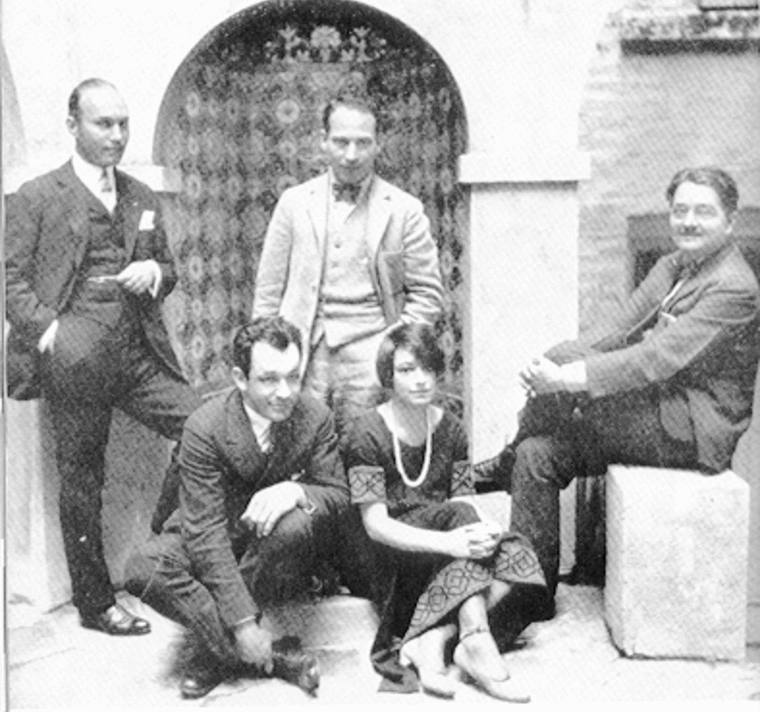
Algonquin Round Table members 
Art Samuels, Charlie MacArthur, Harpo Marx, Dorothy Parker, Alexander Woollcott 
circa 1919, from Wikimedia commons, photographer unknown.

Warning!  Warning!  LIMIT social media!  

Sure, there are some wonderful Facebook groups, and FB can be a great place to share information and support other writers. Twitter provides valuable connections and information too . . . but GROGGERs find social media can consume too much precious writing time. All GROGGERs participate in social media, and we agree a little can be good (a half-hour to an hour a day?).  (See these prior posts:  Facebook groups; more Facebook groups; Twitter tipsmore Twitter tips.)  But it's also true that too much is . . . too much.

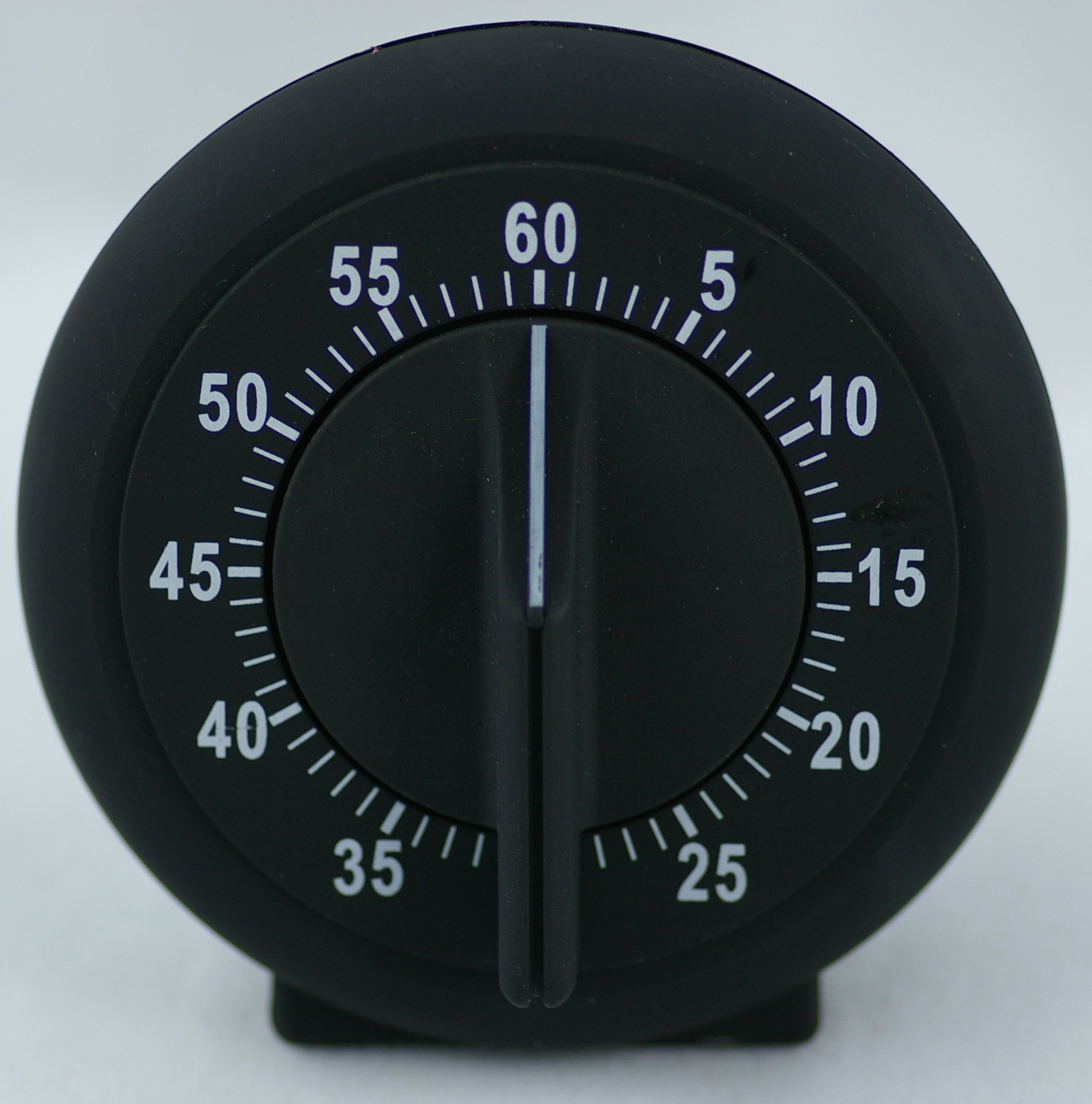
Try setting a timer!


By Hustvedt (Own work) [CC-BY-SA-3.0 (http://creativecommons.org/licenses/by-sa/3.0) or GFDL (http://www.gnu.org/copyleft/fdl.html)], via Wikimedia Commons


3. Keep track of how you spend your time 
(see above). 

Some of my GROG friends could tell me exactly how much time they spent regularly on various activities . . . others, not so much. Try this for a week or a month: record your hours. If you feel you're not getting enough writing done, you’ll see exactly what’s taking up too much time. You'll get a more realistic sense of how long different tasks take. And when you meet a writing target or a goal – celebrate!

Bottom line:  Remember Jane Yolen's essential rule:  "Butt in chair!" And write on. 
That's BUTT in chair, Cheddar!!


Special thanks to Marcie Atkins, Todd Burleson, Tina Cho, Suzy Leopold, Pat Miller, Janie Reinart, Patty Toht, and Pam Vaughan.