
I am one of the poets in the GROG group. I've always enjoyed rhyme. My favorite childhood books were rhyming ones.
 |
| One of my favorites is missing -- MISS TWIGGLEY'S TREE by Dorothea Warren Fox |
As an adult, my love of rhyme continues and my collection builds.
 |
| Only a small part of my poetry collection. |
And so my first suggestion to hopeful poets is, before you start your poetry-writing engines, prime the pump. Check out a stack of children's poetry collections. Read, read, read! How do the words feel in your mouth? Smooth? Jumpy? What phrases jump out? Revel in the author's word choices.
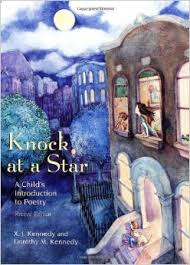
You can also find books about writing poetry. For all beginners (child and adult alike), I recommend those that are written for children. They boil poetry down to its basic elements and give wonderful examples. I've chosen poetry forms from three of these books to get you started.
A Takeoff Poem (or Parody)
Choose a rhyme that you already know and make some changes to it. Kennedy gives the example of the common childhood verse, "Twinkle, Twinkle, Little Star." Author Lewis Carroll changed "star" to "bat" and rewrote the rhyme:
Twinkle, twinkle, little bat!
How I wonder where you're at!
Up above the world you fly.
Like a tea tray in the sky.
Because your brain is already familiar verse, it makes it easier to conform to the rhythm. Try Humpty Dumpty, I'm a Little Teapot, Little Miss Muffet, or another childhood favorite.

A List Poem
Try a free verse list poem. A free verse has no set rhythm or rhyme. Pick an interesting topic -- Janeczko includes "The Perfect Friend," "What Cats Do," or "How to Make a Rainbow." Write a list of anything and everything that comes to mind about your topic. Then read over your list. Can you narrow its focus? Maybe "What Cats Do" becomes "What Cats Do at Night." Which words or phrases seem to fit your topic best? Cross off those that are vague or unclear. Focus on word choice - use your thesaurus for more exact words. Try switching around the order of your list. How does the rhythm sound? Is there sense in how the reader moves from one thing on the list to another?

A wonderful example of a list poem is the picture book, THE QUIET BOOK by Deborah Underwood. The author lists all the different types of "quiet," such as "Coloring in the lines quiet," "Hide and seek quiet," and "Bedtime kiss quiet."

A Haiku
A haiku is a Japanese form with three lines and seventeen syllables. The first and third lines have five syllables and the second line has seven. Traditional haiku celebrate something in nature. Write in present tense, like it is happening right now. Keep the focus narrow. Livingston says to "present a picture of something you want your reader to think about further." She gives this example by Joso:
That duck, bobbing up
from the green deeps of a pond,
has seen something strange...
Choose your words well, with strong verbs and specific adjectives. Writing a powerful haiku takes time and lots of tweaking!
So, fellow GROGgers and other readers, are you ready to try your hand at some poetry? You can do it! Good luck!
