Showing posts with label novel in verse. Show all posts

Wednesday, May 27, 2026

Lindsay H. Metcalf Uses Verse to Write about STEM

by Sue Heavenrich

Today I’m chatting with award-winning author. Lindsay H. Metcalf. I was introduced to her writing through her nonfiction picture books about Beatrix Potter and indoor farming. This spring her newest book, Footeprint: Eunice Newton Foote at the Dawn of Climate Science and Women’s Rights, was released from Charlesbridge. Footeprint is written for teens and, unlike her previous books, is a novel-in-verse! I loved reading it so much that I knew we had to sit down and talk about her book, climate science, and women’s history.

Welcome to the GROG, Lindsay. The first thing I want to know is why you decided to write this book as a novel rather than nonfiction? 

Lindsay: I started writing FOOTEPRINT as nonfiction but ran into roadblocks with few sections I didn’t have answers for. When I began researching Eunice Newton Foote’s life, there were no traditionally published books about her. Here was a woman who had discovered something groundbreaking—that excess carbon dioxide warms the atmosphere—and she had been largely forgotten after her 1856 experiment was published. I became determined to piece together a birth-to-death story of her life, just to get it all on the record. 

The vast majority of the book is factual and documented in the book’s extensive bibliography. In a few places, I hedged to access the emotional core of the moment. Take, for example, the poem where Eunice learns about the upcoming 1848 Women’s Rights Convention in her town of Seneca Falls, NY. The poem says she learned of the convention by reading an article in the Seneca County Courier. It’s true that Eunice attended the convention and got involved, and it’s true that the newspaper ran an announcement. I can’t prove that she read it. There are a few other examples of this kind of “light fiction” throughout the book. Generally, I stuck as closely to the facts as I could. 

Me: That makes sense. Can you tell us how you decided to use verse as the means of telling Eunice's story?

Lindsay: Verse was an extension of my desire to stick closely to the facts while also pulling emotion into the story. With verse, I could use the conventions of poetry (metaphor, simile, white space, etc.) to invite the reader to bring their own emotion to the story, rather than me assigning feelings to Eunice:

Eunice isn’t sure what to expect, 
but she is drawn to this women’s convention
like a magnet, 
or like gravity. 

Another advantage with verse was the nature of the poems themselves. Each one captures a moment, and the breaks between them represent the passage of time. During my research I created a timeline of Eunice’s life, but there were gaps of months or years where I had no idea what Eunice was doing. Instead of making anything up, I could transition with a poem about what was happening around her or a more thematic poem to set tone. These helped place her firmly in the period of industrialization and contextualize why her experiments and women’s rights activism were important.


photo: Lindsay,  standing next to statues of Elizabeth Cady Stanton and Frederick Douglass at the Women’s Rights National Historical Park in Seneca Falls, NY where she presented a program about FOOTEPRINT on April 18.

Me: That’s a brilliant reason to use poetry to tell a story! The combination of poetry and Eunice’s story engaged me more than I expected. The story is from the 1800s, but the battles Eunice faced – to be taken seriously as a woman in science and to be acknowledged for her contributions – continue. In one poem, Eunice wonders: how can any group advance while holding back any other? I get the feeling that this book is informed and inspired by our current time.

Lindsay: I was absolutely inspired by current politics. We are living through a time of extreme contradiction. Scientists have proven that climate change is real, and yet so many world powers are failing to heed their calls to action. And not just failing through negligence, but in the case of the United States, actively erasing documentation of human-caused climate change, first by scrubbing federal websites (1) and documents of climate-change references and data, and last winter, by taking steps to shutter the National Center for Atmospheric Research.(2)
Eunice’s story fascinated me because she and her family’s storyline intertwined with many consequential events of the mid-nineteenth century. She and her husband, Elisha, were inventors, and he went on to be the US patent commissioner in the late 1860s during the height of industrialization. His department approved patents for many of the first machines to use fossil fuels—the cradle of human-caused climate change itself.

Me: Can you talk about word choice? I especially like how you describe Eunice’s birth as being born “kicking the glass ceiling" and, later, describing the women’s convention as “the convention to defy convention”. Do you think verse opens up to this sort of word play more than straight nonfiction?

Lindsay: For me it does! I love to play with language—the way it sounds, feels on the tongue, and looks on the page. This applies when I write picture books, but verse especially opens up the latter, with line breaks emphasizing certain words visually. I wrote most of FOOTEPRINT in free verse, but I often toyed with tabs and white space to echo a poem’s theme, sometimes veering into concrete poetry. All of that brings a distant story more into the visceral present.

photo: Lindsay points to a tiny portrait of a woman who she believes is Eunice Newton Foote. The painting is "Dudley Observatory Dedication, August 28, 1856,” by Tompkins Harrison Matteson, 1857. It’s held at the Albany Institute of History & Art, where Lindsay talked about FOOTEPRINT and her suspected presence in the painting on April 19.

Me: What are some of the challenges you faced writing about climate science, and the experiments Eunice undertook? Did the complexity of the science sway you toward YA?

Lindsay: The science was one of the easiest parts for me to write, because it was fully documented. Eunice’s experiment, “Circumstances affecting the Heat of the Sun’s Rays,” was published, so I could write in detail about how she conducted her experiment by placing test tubes filled with different gases in the sun and measuring their temperatures over time. I could quote Eunice’s words and conclusions. The understandings of the scientific community of the mid-1800s were also well documented, so I could readily understand that she sought to understand why the world was warmer when dinosaurs lived.

I wrote and the story poured out without me giving much thought to where it would appear on the shelf. I had a half-formed belief that the book might be middle-grade, but I wasn’t sure. It didn’t feature a child protagonist because I didn’t know much about Eunice’s childhood. My editor at Charlesbridge wisely read what I had written, considered the language level, and placed it in the YA category. 

Me: Before writing for children, you worked as a journalist. How did that experience inform your approach to writing for kids and the topics you choose?

Lindsay: I started out covering education in a suburban bureau of The Kansas City Star newspaper, so I was always in the space of thinking about what kids learn, and how decisions made by adults affect that learning. My favorite assignments were both investigative and narrative, layered with emotion. Those stories departed from the daily churn I had to produce after attending school board or municipal meetings. 

With writing for children, I get to cherry-pick my favorite parts of journalism—the heavy, archival research and the reveal of the universal human experience through empowering narratives. There was a learning curve to go from writing for a daily newspaper to working on a project alone, on spec, for months or years at a time. But I am still having fun as I attempt to reveal stories that help people think about the world in a new way. 

Me: What do you hope readers take away from your book?

Lindsay: On a personal level, I hope readers see Eunice’s resilience and feel inspired to chase their dreams, no matter what obstacles they face. Eunice lived during a time when women could not vote or own property, intellectual or real. She wanted to practice science and share her inventions with the world. To achieve that, she had to join a movement to fight for her right to do so. 

Zooming out, I hope readers think about the what-ifs of today. When I talk to young people about Eunice, I ask them to consider the butterfly effect. How would our present time have been different if the world had listened to Eunice? What about the future and the paths before us? What if we don’t listen to the scientists of today? 

Thank you, Lindsay! You can find out more about Lindsay at her website, lindsayhmetcalf.com.
Read more about Eunice Foote, the scientist that history forgot at 

Wednesday, February 22, 2023

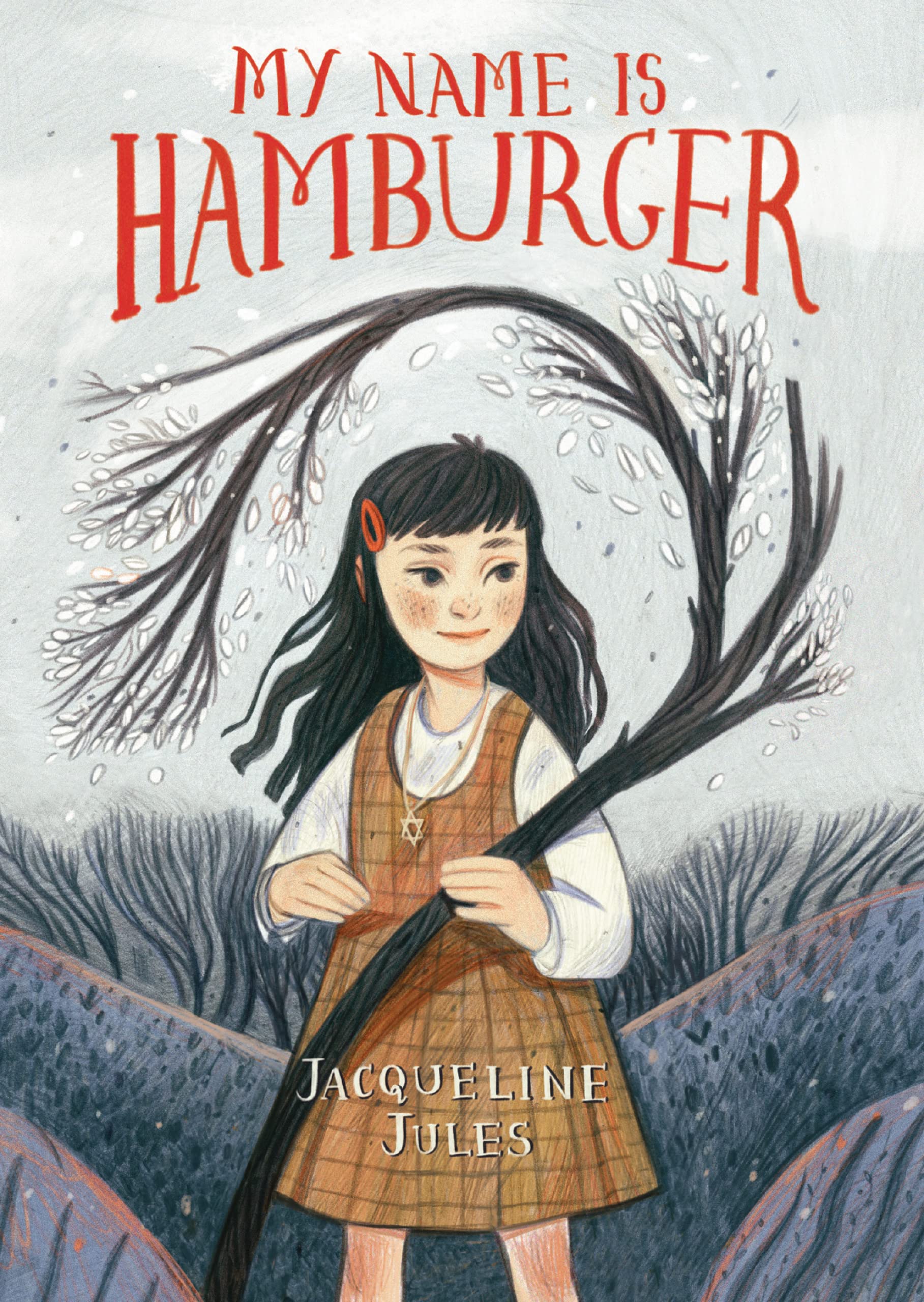
My Name is Hamburger--Interview with Author Jacqueline Jules by Julie Phend


My Name is Hamburger

By Jacqueline Jules


Trudie Hamburger is the only Jewish kid living in the small town of Colburn, Virginia in 1962. Nobody else at her school has a father who speaks with a German accent or a last name that means chopped meat. Trudie doesn't want to be the girl who cries when Daniel Reynolds makes fun of her. Or the girl who hides in the library to avoid singing Christian songs in music class. She doesn't want to be different. But over the course of a few pivotal months, as Trudie confronts her fear and embraces what she loves--including things that make her different--she finally finds a way to say her name with pride.

Julie’s Review

I loved My Name is Hamburger, a middle grade verse novel published in October 2022 by Kar-Ben Publishing. Jacqueline Jules tells Trudie’s story in lyrical, impactful verse that puts us in Trudie's heart as she navigates a confusing year at her new school and emerges stronger for it.

I had the pleasure of interviewing author Jacqueline Jules about the book and her writing career.


Interview with Jacqueline Jules

Julie: You’ve written a lot of books for young people, many of them about Jewish life and culture. What’s new and different about this book?


Jacqueline: All my other books of Jewish interest are picture books written for younger children. I worked as an elementary school librarian in both public and religious settings. Story time was a big part of my job, and for many years I focused on capturing the attention of young listeners with books for adults to read aloud.

My Name is Hamburger is my first middle grade novel. It is a book for reading alone by students old enough to handle mature topics like self-esteem, bullying, and antisemitism. I am excited to share that My Name is Hamburger is a PJ Our Way Selection and was distributed to families through this program. https://www.pjourway.org/story-central/My-Name-Is-Hamburger


Julie: Though this story is set in the 1960s, the topic and issues seem relevant and timely for young people today. Can you comment on that?

Jacqueline: The main character, Trudie Hamburger, is intimidated by a bully and has misunderstandings with friends. Her family is both a source of comfort and embarrassment. She dreams of winning prizes and being admired. Many childhood emotions are universal in every generation.


Julie: You say the book was inspired by your own childhood. What are some of the parallels between your story and Trudie’s?

Jacqueline: My father was a Jewish German-speaking immigrant who came to the United States after World War II. We lived in a small Virginia town. Growing up, I experienced exclusion as a minority. But like Trudie, I also had friends and a strong relationship with my father. And like Trudie, I loved to sing, and I loved to read.


Julie: I love that the book is written in verse. It captures Trudie’s voice so well. I feel her need to prove herself, her hurt when she is teased or rejected, the conflicting feelings she has about how her religion makes her different. At the same time, the poems move the reader through the story with a compelling plotline. Can you comment on your decision to write in verse?


Jacqueline: Thank you for your kind words about Trudie’s voice in the poetry. My Name is Hamburger was originally written in prose. I went through many drafts and none of them quite worked until I began writing the story as a series of poems. At first, it was just an experiment, but as one poem followed another, the main character emerged to tell her story with a stronger, more authentic voice. I love to play with words. When I write, I arrange and rearrange words like the pieces of a jigsaw puzzle. Sometimes I have to turn small, jagged pieces around and around until they fit together. I knew the plot elements of Trudie’s story so I knew what the picture should look like. Finding the words to make that picture clear to the reader was a bigger challenge. Poetry turned out to be the right format because it prompted me to use imagery to express Trudie’s emotions. Each poem focuses on a particular moment and uses metaphor to convey the meaning of that moment.

I never considered writing a novel in verse before My Name is Hamburger. In retrospect, it is surprising because poetry is my first love as a writer. I have well over a hundred poems in literary journals and anthologies. I am the author of three chapbooks and one full-length collection of poems for adults. My poetry collection for children, Tag Your Dreams: Poems of Play and Persistence, was published by Albert Whitman in 2020.       


Julie: Tell us about your publisher, Kar-Ben Publishing. Have you published with this press before?

Jacqueline: I have been a Kar-Ben author since 1998 with the publication of Once Upon a Shabbos. I have twenty books with Kar-Ben. They produce lovely titles and I feel lucky to have found them in the early stages of my career when it was easier to submit without an agent. Once I established a relationship with the editors, I was able to submit new manuscripts, which were luckily accepted.


Julie: Anything else you’d like to share with our readers about writing, publishing, or life?

Jacqueline: Publishing is a hard business. Perseverance is the key to success. There have been many times over the years when I felt discouraged, when I had to force myself to hold on to my dreams of a writing career. The following poem, “Tag Your Dreams” is the title poem of my book, Tag Your Dreams: Poems of Play and Persistence. It was written during a low period in my writing career when I worried that I would not sell another book. The poem was a pep talk to myself. Since I wrote this poem, I have sold twenty-five more books. Believe in yourself. Chase your dreams until you’re breathless.


TAG YOUR DREAMS

by Jacqueline Jules


Play tag

with your dreams.

Chase them

till you’re breathless.

Dreams

have strong legs,

but so do you.

Keep running,

with your arm out,

fingers reaching.

Don’t let them get away.


Thank you, Jacqueline, for sharing your inspiring story. 


Jacqueline Jules is the award-winning author of over fifty books for young readers including the Zapato Power series, the Sofia Martinez series, Duck for Turkey Day, Feathers for Peacock, Never Say a Mean Word Again, and The Porridge-Pot Goblin. Visit her website at www.jacquelinejules.com


Thursday, January 26, 2017

LOVING vs. VIRGINIA: Multi-Cultural Children's Book Day Review ~ Christy Mihaly


Tomorrow is the fourth annual Multi-Cultural Children's Book Day. Hurray! 

If you're a teacher looking for multicultural resources, check out the MCBD Classroom Kindness Kit. MCBD also is making available free books for teachers and diversity book lists and activities for parents and educators.

There's more information about the non-profit MCBD at the end of this post.


As part of MCBD, I have the great pleasure of reviewing Patricia Hruby Powell's excellent forthcoming Loving vs. Virginia.


Described as "a documentary novel of the landmark civil rights case," this book tells the story behind the 1967 United States Supreme Court case holding that states can't ban interracial marriage. It's illustrated by Shadra Strickland and published by Chronicle Books. In addition to Strickland's pictures (in a style she refers to as visual journalism from the 1950s and 1960s), the work features photographs and other primary source materials. Patricia Hruby Powell, author of the award-winning Josephine: The Dazzling Life of Josephine Baker, creates an excellent introduction to an important civil rights issue. At 260 pages, it's advertised for readers 12 and up. 
This spread from Loving v. Virginia illustrates the reality of "separate but equal" segregated schools.
Using verse, the author alternates between the voices of Mildred Jeter Loving (of Native American and African American heritage) and Richard Loving (white). Richard was a friend of Millie's older brothers as they grew up in a racially mixed rural community in Virginia, attending segregated schools. 


The short, poetic chapters provide emotional insights into the family lives, the injustice, the fears and devotion of this young couple. Outside of their small community, white onlookers stare at the couple and hurl insults. They're barred from entering whites-only venues. The injustices anger them, even as their love deepens. They travel to Washington, D.C. to get married. Only weeks later, they're arrested in bed, and terrorized by the local Sheriff because of their "illegal" marriage. They spend time in jail, stand trial and are convicted, and return to Washington, D.C. as exiles. Later, represented by the ACLU, the Lovings initiate their groundbreaking legal case. Nine years later, after numerous setbacks, the Supreme Court unanimously rules in their favor. They return at last to make their home and raise their children in Virginia, where they started. The main narrative spans fifteen years, 1952 to 1967.
First date with brothers and sister at the drive-in

Stopped by the Sheriff again

Arrested in the night, for being married
This hybrid historical fiction novel works well. Its fictional approach allows for lively dialog and lets us see into the hearts of the protagonists, while the factual background and supporting materials provide contextual information about the times in which the Lovings lived. Kudos to the team that created this beautiful book. I recommend it for readers of all ages. Note that some parents may want to be aware that the book describes the birth of the Lovings' first child before their marriage. Mildred left high school to have her first baby. 

Back matter includes a list of interviews conducted by the author and a timeline. Reading this novel may inspire older readers to read more deeply on the covered subject and related issues.
Mildred and Richard Loving, in a photo from the book

Multicultural Children's Book Day was founded by Valarie Budayr from Jump Into A Book and Mia Wenjen from PragmaticMom. Their mission is to raise awareness on the ongoing need to include kid’s books that celebrate diversity in home and school bookshelves while also working diligently to get more of these types of books into the hands of young readers, parents and educators. 

Despite census data that shows 37% of the US population consists of people of color, only 10% of children’s books published have diversity content. Using the Multicultural Children’s Book Day holiday, the MCBD Team are on a mission to change all of that.
Sponsors: Platinum Sponsors include Scholastic, Barefoot Books and Broccoli. Other Medallion Level Sponsors include Author Carole P. Roman, Audrey Press, Candlewick Press, Fathers Incorporated, KidLitTV, Capstone Young Readers, ChildsPlayUsa, Author Gayle Swift, Wisdom Tales Press, Lee& Low Books, The Pack-n-Go Girls, Live Oak Media, Author Charlotte Riggle, Chronicle Books and Pomelo Books.

Author Sponsors include: Karen Leggett Abouraya, Veronica Appleton, Susan Bernardo, Kathleen Burkinshaw, Maria Dismondy, D.G. Driver, Geoff Griffin, Savannah Hendricks, Stephen Hodges, Carmen Bernier-Grand,Vahid Imani, Gwen Jackson, Hena, Kahn, David Kelly, Mariana Llanos, Natasha Moulton-Levy, Teddy O'Malley, Stacy McAnulty, Cerece Murphy, Miranda Paul, Annette Pimentel, Greg Ransom, Sandra Richards, Elsa Takaoka, Graciela Tiscareño-Sato, Sarah Stevenson, Monica Mathis-Stowe SmartChoiceNation, and Andrea Y. Wang.

Monday, June 13, 2016

What Do You Need as a Writer? Three Things Highlights Gave Me by Marcie Flinchum Atkins


In May I attended a Highlights workshop on Novels in Verse with fellow Grogger, Jan Godown Annino. I set my eyes on a Highlights workshop many years ago, and even put it on my vision board so I would keep that goal in the forefront. But it couldn’t just be any workshop. In my mind, it had to be just the right workshop for me. 

I wrote a book in 2010 that needed some work. It was written in prose, but it also had some poetry sprinkled throughout. My critique group, and eventually an interested agent, said they thought it would work as a novel in verse. 

I worked on it several times and after several rejections, I finally put it back in the drawer knowing that I just wasn’t ready to write this book yet. 

But this book wouldn’t leave me alone. It kept begging me to work on it. I worked on other books, but this one was determined not to stay in the drawer. 

When the Highlights Foundation advertised the Novel in Verse workshop led by Kathy Erskine and Alma Fullerton, two writers who have written novels in verse, then I knew, this was the “just right” workshop I’d been looking for. 

Highlights provided 3 things for me:

1) Quiet. 


I work as a librarian in an elementary school with 700+ kids. Then I go home to a 7 and 11 year old. Quiet is something I don’t get much of. It’s part of the reason I get most of my writing done at 5:00am, when no one else is awake. The quiet at Highlights is amazing. There’s no TV, internet in the cabins is slower than usual, and cell phone service is spotty. I’m not complaining about this. I needed to be away from all of that noise anyway. There’s something about a quiet cabin that allows you to focus on the writing at hand. In fact, I’m craving that quiet so badly that I hope to go to an unworkshop very, very soon. 

2) Camaraderie. 


While I loved the quiet time and space to write, I also loved my time with other writers. Our group really connected. The writers attending this conference were passionate about their writing and serious about craft. I learned so much from being with them. I get energy from being around other creative people who are also diligently working to create their best stories. The encouragement from Kathy and Alma and others really helped buoy me through revisions. 

3) Craft. 


While I love going to bigger conferences, I have found that I’ve grown the most as a writer when I attend smaller, craft-focused writing events. I’ve made it a priority to attend more craft-focused events, instead of just publishing related events. Keeping up with publishing is essential, but in order to get my writing ready for that world, I know I need to push myself to get better and better at the craft. Each day we focused on a different aspect of writing the novel in verse. Then I had opportunity to go back to my cabin and apply what I learned. This was HUGE. So many workshops I’ve been to  provide a lot of information in a short amount of time, then I have to sift through the information after returning home. Having the time to sift and sort while still there was just what I needed. 

What About You?


What is that one thing you’ve been wanting to do for awhile? An area of writing you want to pursue, a workshop you want to attend, or a gift you want to give to yourself? 

Write it down, and hang it up. 

It took me several years to make this workshop happen, but because I had my radar out for such a workshop, and I had a specific manuscript that needed extra work, I knew that this opportunity was THE ONE I wanted to pursue when it came across my email. 


Make today the day you acknowledge that goal. If you want to make that goal public, leave a comment and share it with your fellow writers.