Showing posts with label Michelle Schaub. Show all posts

Wednesday, April 6, 2022

Celebrate Poetry Month ~by Christy Mihaly

April has arrived

bringing sunshine and poems.

Welcome! Celebrate!

April took me by surprise this year. (The passage of time seems to have stopped following the rules of order ... but that's another topic.) But here we are ... so welcome to Poetry Month! 

The Academy of American Poets created National Poetry Month in 1996. As they (poetically) put it, the goal is to remind us "that poets have an integral role to play in our culture and that poetry matters." 

I've been thinking about poetry's power. My nonfiction writing often involves sifting through piles of notes, sources, facts, and figures. When I'm stuck, one way out of the "stuckness" is to write a poem. 

A poem is an antidote to writer's block in two ways: First, it can be completed quickly (I mean a draft ... polishing a poem is a different story). Completing a poem helps me restart my writing momentum.

Second, a poem helps me find the heart of my topic. A poem boils down a complex idea into its essence. I've written poems about the First Amendment, for example. A poetic metaphor, an image, a figure of speech, or a silly rhyme might show me a new way to illuminate my topic, a path around writer's block.

For similar reasons, I love sharing poems with kids. A poem is short -- a plus in these days of short attention spans. And a poem gets right to the heart of a topic, often right into a young reader's heart. 

This photo shows me getting some elementary school students excited about a poem from the wonderful anthology, "Hop to It: Poems to Get You Moving." Created by Sylvia Vardell and Janet Wong, it's full of lively verse guaranteed to get readers on their feet.

So, whether for yourself or for some young people in your life, here are a few ideas to celebrate Poetry Month!


CELEBRATING POETRY MONTH: some ideas

Begin each day with a poem.
Read an old favorite from a dog-eared anthology or surf online for a new favorite. Or, join one of the poetry projects that blossom this month. For example, poet Michelle Schaub hosts a delightful blog, Poetry Boost, offering many resources and poems. Every weekday this month she'll post a video of a poet reading a poem they wrote. Check it out -- you may spot several GROG poets this year.

Take your poetry outside: write poems in chalk on your driveway or sidewalk or playground. (Get permission first ...) Poems should be out where they can be seen -- not stuck in dusty books, right?

Memorize a poem
Montpelier's PoemCity celebration
. Recite it for fun, or for a group. This is a nice way to internalize the meter, the feeling of poetry--and to share it.

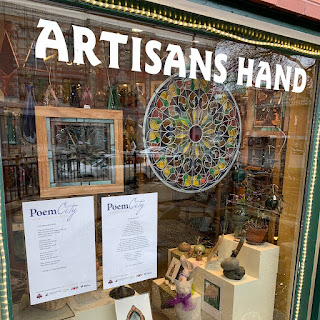
Join public Poetry Month events. Find out what's happening in your area. Montpelier, the capital of Vermont, hosts a PoemCity celebration, posting poems city-wide on walls and windows of local businesses. (I'm excited that one of mine was accepted this year.) Many libraries host April poetry events. Attend a poetry slam! Find a poem-writing workshop! And if you can't find an event ... post your own poems. Or create a poetic celebration with your classroom, friends, or family.

Pair pictures with poems. Choose one or more poems to illustrate. Or use a poem as inspiration for another art project. Your images can show what the poem describes, or respond to the poem by illustrating the feelings it invokes. Or anything else! Or, reverse the process: use a photo or work of art to inspire a new poem. That's an ekphrastic poem!

Put a poem in your pocket. Carry it with you and share it with folks you meet. This year's "Poem in Your Pocket Day" is April 29. You can share a poem in socially distanced ways, too: post it, read it aloud and share the video, or add it to your email footer.

Finally, my personal favorite:

Try writing a poem each day. Capture the magic of Poetry Month by writing a poem a day! Explore different forms. Some formal poems quite brief. You probably know about haiku. Why not experiment with a fibonacci poem? (Following the fibonacci sequence, this 6-line poem has lines of 1, 1, 2, 3, 5, and 8 syllables.) Or a list poem, a diamonte, an acrostic, a limerick.... You can find explanations of many poetry forms online. The Writer's Digest listing is a good starting point.

More online poetry resources: 

Poetry Daily offers a contemporary poem each day.
Poetry 180, a Library of Congress poem-a-day hosted by Billy Collins.
The Poetry Foundation: so much stuff here!
Poetry Out Loud: student-oriented poems and programs.
Poetry4Kids: funny poems and more.
Poem Generator: generates poems in different forms from words you suggest.

Happy Poetry Month! May poetry make your heart glad, this month and always. ❤


Wednesday, November 17, 2021

Take a Look Around - What Inspires You?

Most writers and illustrators spend an incredible amount of solitary time in one key  location—whether it's their office, studio space, or a favorite out-of-the-way nook. While lost in thought when we're digging deep—and inevitably searching for a bit of inspiration—what do we look at? What does our gaze settle on?

A piece of beautiful art or a memorable photo? 

A knickknack with an important back-story? 

A meaningful quote?  

What fills us up and nudges us on? Friends in my creative community shared their thoughts with me.


Carmela Martino glances at an opaque blue-gray egg that was a gift during the time she worked on her M.F.A. at Vermont College. At the end of a semester and a period of working closely together, her mentor presented her with the glass egg. She noted it was a symbol of Carmela's yet unborn stories still waiting to be shared. Simply holding or rubbing the smooth, cool glass egg in her hands helps Carmela seek out inspiration.


Looking at a beautiful piece of art and remembering the story associated with the piece plays a central role for many of us. Julie Phend's husband bought her a piece of woodcut art from Costa Rica entitled "El Escribidor," which means The Writer. She noted "it reminds me that I am indeed a writer, and I have a responsibility to develop my skills."  And what a lovely show of support from her husband.

Michelle Schaub studies a postcard she picked up when she signed up for her first Highlights poetry workshop.

At the program, she worked on polishing a manuscript that would later become her first book sale. She didn't know at the time how attending the workshop would boost that project. "I went for the experience, and I met so many amazing people who have become mentors and supporters," she noted. "It reminds me to say 'yes' to opportunities because you don't know where they will lead. And to enjoy the journey as much as the destination."

Dana Easley hangs watercolors in her office so she is surrounded by creativity while she works on her writing projects. (Cool fact—she actually created this art, too, which I think is pretty amazing!) Who wouldn't be energized and inspired looking at beautiful florals as you ponder a first draft or tackle a challenging revision. It's a reminder that our own creativity knows no bounds.


Dana also has a large quote displayed on one of her office walls that says "Books turn Muggles into Wizards." It reminds her of the joy and value of books. (Created from a vinyl adhesive decal  ordered online—you simply rub it on the wall surface.) I love Dana's example of a big quote on the wall of your office. How cool is that?  I'm going  to have to think about how I can use this awesome idea.

Patty Toht has a few favorite quotes that help her move forward. There are two that she keeps taped to her computer . . . "Almost all good writing begins with terrible first efforts. You need to start somewhere."—Anne Lamont, Bird by Bird. (I need to remember that as I start my awful first drafts . . .) And then there's this one, "Many of life's failures are people who did not realize how close they were to success when they gave up."
—Thomas Edison. I love both of these!

When Christy Mihaly was out for a nature walk, she spotted this hand-painted stone. Who painted it? And who took the time to leave it as a sweet surprise for someone to find and brighten their day? An unsolved mystery. It reminds Christy to take notice, be present—and yes, to take joy! (Plus it makes her smile—and a happy writer is usually a productive writer.)


Suzy Leopold finds inspiration from a beautiful hand-quilted creation made by her mom. Displayed right next to her writing desk, gazing at the lovely quilt reminds Suzy of her mother's love as well as her supportive and encouraging words: read, write and create every day. (Bonus—on a cold winter's day Suzy can also use the quilt for an extra layer of warmth to chase away the chill!)


Sherri Rivers surveys the Word Bird art perched on her bookcase and reflects on the amazing experience she had at a Highlights Nonfiction Workshop. During the conference, attendees bid on items as a small fundraiser and this cute piece caught her eye. After winning the bid, her workshop leader would not let her pay for it and bought it for her! Whenever she looks at this little treasure, she remembers the joy of attending the conference, the kindness and generosity of her workshop leader—and the kidlit community in general. Sherri knows that words count and can change lives!


I have one favorite object that speaks to me.  I keep a heavy, round paperweight in a prominent spot on my desk. It's right next to my computer monitor, so I see it whenever I sit down to work. It reads: "The difference between ordinary and extraordinary is that little extra." When I'm done with my umpteenth draft of a picture book project and think it just might be across the finish line . . . this paperweight serves as a nice braking mechanism. It encourages me to have patience and set high standards for this work-in-progress. It reminds me to use my critique groups for input. It sends a message to gather and listen to the feedback from industry professionals at conferences. And most importantly,  it signals to give my project more effort before sharing it with a key decision-maker. (Besides, it looks a lot nicer than a big red STOP sign!)


Take a look around. What inspires YOU in your favorite workspace? 


Wednesday, March 10, 2021

BUILDING A CONCEPT BOOK "SANDWICH" - LAYER BY LAYER, Guest Post by Michelle Schaub


Grog Blogger Eileen Meyer here -- I’m delighted to invite author and poet Michelle Schaub to join us with a guest post today! Michelle is sharing the story of a manuscript that was near and dear to her heart, but had been rejected numerous times. After she took a break to re-envision her project, and then revise accordingly – IT SOLD!

Here’s the story of KINDNESS IS A KITE STRING, releasing April 1st (and I'm not FOOLing you!) with Cardinal Rule Press.


When I first decided to write a concept book about kindness, this was my recipe:


Mix together a list of kind acts.

Fold in some lyrical language.

Season with rhyme.


Plain and simple. Unfortunately, a little too simple. Here’s some of editorial feedback I received after my first round of submissions:  


I don't think this feels like a real picture book, but more like something you'd see in a kid magazine.”


“I wish there were a clearer protagonist or some tension.”


“I love the message here, but I'm afraid that I don't think that there is enough story for this to work on our list.” 


Editors wanted a triple-decker club sandwich, and I all I had handed them was bread. I needed more layers to create a mouthwatering manuscript.


LAYER 1:  AN ARC


I knew most editors had a taste for character-driven manuscripts with strong story arcs. While I didn’t want to write my text as a narrative, I wondered if I could suggest an arc through the illustrations.


About this time, I saw a commercial that sparked an idea. Set in a city, the commercial starts with one man’s kind deed: he stops a lady from crossing the street in front of a speeding car. In turn, that lady helps a mom carry her stroller off the bus. The mom then helps another person, and the kind acts ripple forward.


I decided to use art notes to suggest a similar chain of kind deeds in my manuscript. As a rule, I try to limit art notes. I like giving illustrators room to breathe their own life into a picture book. But in this case, I felt the needed to provide a visual nudge to editors so they could picture how my simple words might ignite a rich visual narrative.


I added this open-ended art note to the beginning of my manuscript:


[For each spread, I have provided art suggestions for one possible way the chain of kindness might grow through a diverse community; however, I am open to other visual interpretations.] 


Then on each page, I included a short note that suggested a kind act and “actor” for that spread. Ultimately, Claire LaForte put her own delightful spin on my art notes.  She created a beautiful visual story of a diverse individuals coming together to spread kindness. 


LAYER 2: A QUEST


My own kids always enjoyed picture books where they had to search for something in the pictures. (Think Richard Scary’s Lowly Worm.)  This gave me the idea to suggest a “hunt” for a missing pet. So, I added this art note to the first spread:  


[No one notices a pet has slipped out. In subsequent illustrations, family members put up lost pet posters/search for pet]


In the final book, readers can follow the hunt for an adorable missing dog. (Don’t worry, the dog is ultimately reunited with its family.) 


LAYER 3: EDUCATIONAL HOOK


I wanted to make sure educators found my book tasty. As a language arts teacher, I knew curriculum standards across grade levels focused on teaching similes and metaphors. So, I started brainstorming tangible, kid-friendly objects to which I could compare kindness. 


Kindness is like sunshine because it warms you.  

Kindness welcomes others like an open door.  

When you let it out, kindness can lift spirits like a kite string.


To infuse educational flavor, I reshaped my text as a series of comparisons and added an author’s note to further explain the concept of similes and metaphors. 


My newly layered concept book “sandwich” was ready to deliver to


editors. After a few nibbles from different houses, Maria Dismondy at Cardinal Rule Press sunk her teeth in and offered me a contract. 


Now that I can hold KINDNESS IS A KITE STRING in my hands, I really appreciate the value of the added layers. They provide readers with a reason to return to the book again and again and discover different ways to satisfy their appetite… and spread a little kindness!  


Michelle Schaub is a language arts teacher and award-winning children's poet. In addition to her upcoming book, Kindness is a Kite String, The Uplifting Power of Empathy, she is the author of the picture book poetry collections Fresh-Picked Poetry: A Day at the Farmers’ Market, (which won the 2018 Growing Good Kids Award and 2019 Northern Lights Book Award,) and Finding Treasure: A Collection of Collections. She also wrote the bedtime STEM book in verse, Dream Big, Little Scientists. Her poems appear in several anthologies, including A World Full of Poems (DK, 2020) and Hop to It, Poems to Get You Moving (Pomelo Books, 2020) Aloud.  Michelle shares lessons and mentor texts for using poetry to boost literacy at www.poetryboost.com.   Find out more about Michelle at https://www.michelleschaub.com/


Wednesday, September 18, 2019

FINDING TREASURE Author Interview w/ Michelle Schaub + Book Giveaway by Eileen Meyer


Michelle Schaub's latest picture book!

Michelle, thanks for joining us today at the GROG Blog. Where did you get the idea for this book and the poems within?

I first thought about writing a poetry book about things people collect when I was participating in Tara Lazar’s STORY STORM a few years ago. In this challenge, writers come up with a new picture book idea each day for a month. 

One day, when I was short on ideas, I was perusing the items on my bookshelf, and my eyes landed on my grandmother’s seashell collection. I started brainstorming different items that other family and friends collected. My mom collected buttons. (I loved rummaging through her button box when I was little.) My father-in-law collected trains. My husband collected baseball cards as a child. The neighbor around the corner had a birdhouse collection that filled his entire front porch. Each of these topics ended up becoming a poem in the book. But I still needed something to hold the poems together. So, I came up with the idea of adding a protagonist who needs to bring in a collection for a class assignment. This gave the book an arc: a hunt for the perfect collection!

Poem featured in Michelle's new book
Which poem from the collection is your favorite and why?

I had so much fun playing with different forms in this collection, and each presented its own challenges and triumphs. I think my favorite of the lot is “Auntie Kate’s Vanity PL8S” because I thought “outside the box” or more accurately “inside the license plate rectangle” for this poem. Each line of this poem is a vanity plate puzzle that must be decoded.  The challenge with this format was maintaining a rhyme and meter within the constraint of each line being no more than 6 or 7 characters long (including spaces), which is the standard for vanity plates.


Are you a collector yourself, and if so, what do you collect?

My grandmother was a collector. She had an amazing giraffe figurine collection and a butterfly-themed collection.   She also collected teapots and cups. I used to spend hours studying all her different pieces.  As a result, I’ve always loved the idea of collecting. 
Michelle and one of her collectibles: tea cups

Over the years, I’ve started several collections:  a blue teacup collection, a blue Santa collection (I really like the color blue), but then my attention and interests change.  The only collection I’ve managed to sustain is my collection of children’s poetry books. I just had to buy a bigger bookshelf recently to hold all of the wonderful poetry collections written by my fellow children’s poets. I’m also really drawn to the idea of collecting non-tangible things like smiles or words or poems. 


Something folks might not know about you…

I also “collect” visits to farmers’ markets. Farmers’ markets are my happy place.  This statement, written on a tea towel my neighbor gave me, is absolutely true. 
Farmers' Markets & Michelle

The first thing I do when I travel to a new place is find the farmers’ market and see what local fruit and veggies treasures I can spy. I’ve even been known to plan vacations around farmers’ markets that are rumored to be spectacular. Walking down a row of tents at a market, taking in the bright rainbow of fresh produce and listening to chatting neighbors and lively musicians, fills me with joy.  


I channeled that joy into the poems I wrote for my last collection, FRESH-PICKED POETRY: A DAY AT THE FARMERS’ MARKET.

Michelle's debut picture book


Michelle, I know that you have some other exciting news to share ...

I just launched a blog called POETRY BOOST.  I’ll be sharing lesson plans, mentor text, and ideas for using poetry to boost literacy across the curriculum.


GIVEAWAY: For those who leave a comment on the blog post, we'll pick a lucky winner of Michelle's new book on Sept. 23rd! Stay tuned!

Find Michelle here on social media:

Twitter and Instagram: @schaubwrites


Wednesday, June 27, 2018

Poetic Ponderings ~ by Christy Mihaly


POETRY
When I set my writing goals for the year, a big one was to write more poetry. I've dabbled in poems, and published a few. I offered some poetry ponderings in past GROG posts (one is here) but mostly I write nonfiction books. This year I wanted to develop my poetic side. I joined an online poetry critique group, and I've tried to find inspiration for a new poem every day.  I've also started submitting more poems to anthologies and magazines. It takes persistence! Here are some thoughts after a half-year of paying attention to poetry.

What's so great about writing poetry? Consider these points:

 The right words: In a poem, the selection of each word is crucial. Each word affects the rhythm, the meter, the "mouth feel" of the poem. Writing poetry helps strengthen my word choices in other writing.

 Playful words: Poetry encourages the writer to play with words. A poem doesn't need a plot. Its words may simply evoke a feeling, or describe an object or a moment, or entertain. Developing this in-the-moment mindset can enliven your prose writing too.

 A few words: You can easily write a poem in a morning--and it might even be publishable (after a little polishing). Of course you can write a poem just for the pleasure of it. But, if a writer is struggling through year seven of revising a major work in progress, selling a poem--and seeing it in print--can be a big boost. Kids' magazines, in print and online, often seek kid-friendly poems – the Cricket magazines have been particularly interested lately. (Check out their active calls for submissions, here.) 

Plus, a special bonus for aspiring authors: A  series of related poems can become a published collection, like Fresh-Picked Poetry, about farmer's markets by Michelle Schaub, or Rainy Day Poems, by James McDonald -- and so many others that kids love.
And once in a while, a poem grows into an entire picture book. Think of Jane Yolen's How Do Dinosaurs Say Goodnight? It's basically an expanded poem, like many other Jane Yolen books.

The text of Snow Sisters, published this year by Kerri Kokias, is a mirror poem, or palindrome poem, in which the same words are used in the first half and the second half, but in reverse order. Simple? Yes! Hard to write? Yes, to get it right. Brilliant picture book? Absolutely!

My debut picture book, Hey, Hey, HAY! (coming August 14) got its start as a simple rhyming poem about making hay. You never know! 

For more examples of picture books that are poems, check out Marcie Atkins's GROG post, here.

Interested but unsure how to begin? Some writers have a  practice of writing a poem every morning. I can't always make this happen, but when I do, it starts my writing day off with a creative splash. It's a great habit to cultivate. Your morning poem doesn't have to be great literature. It's good practice to just do it. 

If poetry still seems intimidating, try working within the structure of an established poetic form. I've found that experimenting with different forms often helps me get a poem started. Here are a few fun forms to try:

Acrostic

In an acrostic poem, a word or phrase is spelled vertically down the page. This word is the poem's theme or topic. Each line begins with the next letter in your topic word. Rhymes are not required.
(Variations: Each line of poetry ends with the letter of the topic word, or the topic word runs down the middle of the lines.)

Here's a simple example, using "Cat":

Content to snooze
and soak up the sun ...
till Songbird shows up.

© Christy Mihaly

Diamante
A diamante is seven lines long and is printed so that it forms a diamond shape. Again there are variations, but here's the basic idea: The first half describes one subject and the second half describes a different subject, which is often the antonym of the first but may be a synonym. 

The diamante's lines are prescribed as follows:

1: Starting subject
2: Two adjectives about line 1
3: Three gerunds (or -ing verbs) about line 1
4: Four words, consisting of two about line 1, and two about line 7. (This line sometimes has more words, and may be written as one or two short phrases.)
5: Three gerunds/-ing verbs about line 7
6: Two adjectives about line 7
7: End subject

Here's a quick diamante that I posted one recent sunny day—the end of April—when confronting a persistent pile of snow atop my long-suffering garden: 


Double dactyl
I'm a big fan of the double dactyl, which can produce some very entertaining light verse. (A "dactyl" is a three-syllable word with the accent on the first, such as "holiday.")

In a double dactyl, there are eight lines broken into two quatrains, or 4-line stanzas. Each of the first three lines of the quatrain consists of two dactyls. The fourth line contains one dactyl plus another stressed syllable. The last syllable of each quatrain rhymes with the other.

Other requirements: Line 1 is a nonsense phrase; line 2 is a proper name of a person or place. One of the other lines, usually line 6, is a single word that is double dactylic. (And, technically, it should never have been used in a double dactyl poem before.)

It's easier to see how this works by reading an example. Here's one of mine published in April in Imperfect: Poems About Mistakes, an anthology for middle schoolers edited by Tabatha Yeatts. This wonderful collection contains a broad range of middle-school-friendly poems about making mistakes (and learning from them). I included a factual note with this poem in the book – because, as most GROG readers know, it's nonfiction!

Rejecting Harry Potter

Hippogriff, schnippogriff,
Salazar Slytherin.
Publishers dissed Rowling’s
Sorcerer’s Stone.

“Magic won’t sell; we need
marketability!”
They’d be much richer, had
they only known.


© Christy Mihaly

Of course there are many more poetic forms, including the mirror poem, mentioned above, and one I've been meaning to tackle but haven't yet tried myself: the roundel. Children's writer B.J. Lee wrote about roundels recently over on Michelle Barnes's blog "Today's Little Ditty" recently, and rather than try to repeat what B.J. said, I urge you to check out her post here.

If you are interested in writing more poetry, you can read and listen to poems--in books and online--and talk with others who are writing them. Attend poetry readings and other events, and/or seek out a poetry group to join--or form one. Consider taking a class or two. I learned so much from Renee LaTulippe's wonderful "Lyrical Language Lab" online course. 

For more pointers on poetry resources and how to get started, see poet-author Patricia Toht's  GROG posts here and here. Other prior GROG posts about poetry include guest posts by Margarita Engle and Penny Parker Klostermann. And GROG poetry maven Jan Annino offers ideas about prompts, poetry month, and Lee Bennett Hopkins.

Go forth, poets, and good luck. If you're so inclined, please leave a favorite poem in the comments. And happy writing!