Wednesday, April 6, 2016

Absorbing Writing Wisdom at Picture Book Boot Camp -- by Christy Mihaly

Heidi and Jane, savoring a job well done
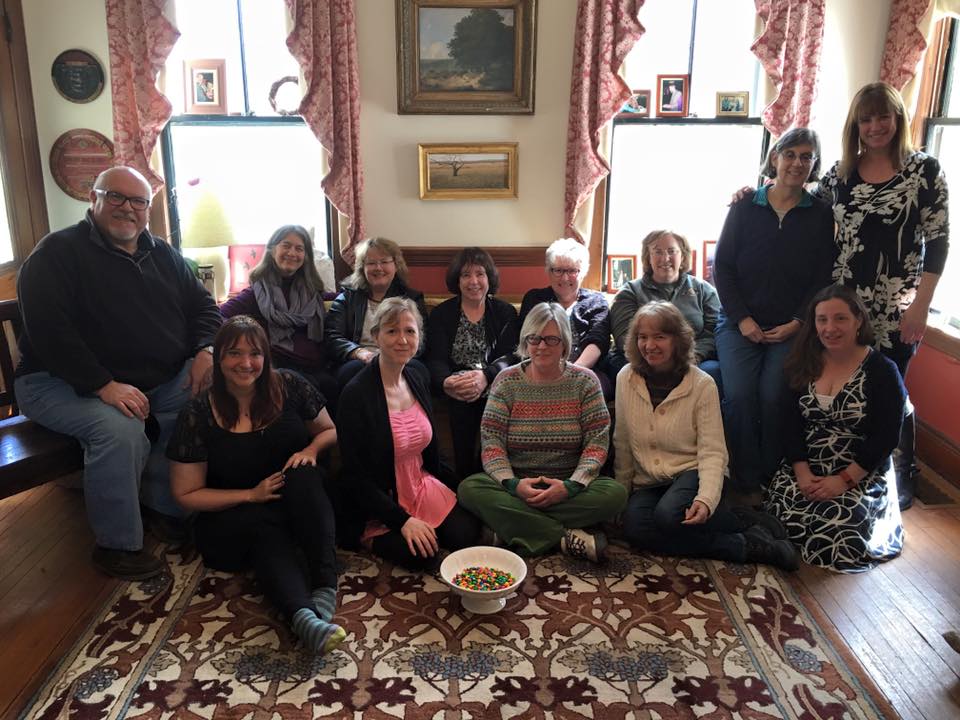
In a classic farmhouse in a small New England town, a dozen writers convened last weekend. No, this isn't the opening of a mystery story . . . or a tale of horror.

Aren't we looking inspired? (Note the candy bowl.)
This was Picture Book Boot Camp. And it was a transformative experience. From Thursday through Sunday, we were hosted by the inimitable Jane Yolen, who shared her bountiful wisdom (and her beautiful home) with us, and the multitalented Heidi Stemple, who had plenty of her own wisdom to share, and who also organized the weekend, cooked mouth-watering meals, and kept us all on track. 
This was the fourth time this mother-daughter team has presented PBBC at Phoenix Farm. Receiving the acceptance letter to PBBC4 felt like getting admitted to Hogwarts.  

Once there, I soaked up enough inspiration, practical pointers, and writerly fellowship to carry me through quite a few rounds of future manuscript revisions. I thought I'd share some highlights and nuggets of wisdom . . . plus a little back matter.

Critiques
A month before PBBC, participants submitted two picture book manuscripts for critique by both Jane and Heidi. Both of them offered perceptive comments, some in an in-person meeting, and some in writing. For many participants, these suggestions resolved longstanding problems or breathed new life into floundering manuscripts. 


Jane is a careful listener
We also had group critiques, with three or four writers reading a manuscript each evening. Those group things can make me crazy: Do I trust these strangers enough to share the creation of my heart? How can I be both honest and helpful? Will they notice if I sneak out of here? 

I needn't have worried. Very soon, we weren't strangers. Everyone brought works-in-progress they thought weren't quite working, and all were generous and supportive in their critiques. And astute! One writer who hadn't planned to read for the group changed her mind when she saw how constructive the suggestions were. She was glad she did -- she received excellent, exciting comments.

I too waited till our last evening to read . . . stayed up late the prior night revising my manuscript based on what I'd learned so far from critiques, lectures, and chats . . . 
and received incredibly helpful advice on my manuscript. Back home on Sunday night, I jumped into my revision with new hope.

Shared Stories
I arrived at Phoenix Farm hoping to improve my craft. I did learn a great deal about the peculiar art of writing picture books. But just as valuable -- perhaps even more so -- were the many tales from the trenches that everyone shared. 
Dinner: delicious food and titillating tales


Jane has published more than 350 books, so it's tempting to imagine publishers racing to accept her latest work. Yet she reminded us repeatedly that she gets rejections, many rejections. There are editors who have failed to respond, ever, to Jane's submissions. (Hey, that happened to me, too!) Publishers have left manuscripts to molder for years. Editors have made changes that have led writers to pull back their manuscripts. It's all part of this crazy business. But if we love writing -- and we do -- we keep at it. 

The boot campers had written all kinds of children's books. Among the group were award-winners and big sellers, writing teachers, ghost writers, and more. I learned from everyone, and everyone had stories to share. We recounted our worst rejections and subsequent triumphs. Some of these made us laugh. Some might have made us spill our wine. We talked about books we love, and books we love to hate. Jane and Heidi were generous in recommending publishing houses and editors they thought could be right -- or wrong -- for particular manuscripts. 

Bedtime Stories
Picture book writers know we should be reading aloud -- both our own manuscripts and great picture books. But how often do we have the pleasure of listening to great books read by Jane Yolen or Heidi Stemple? At PBBC, Jane often read aloud to us from excellent picture books. 


Heidi reads YOU NEST HERE WITH ME
But the best read-aloud was at the end of each long day. After we'd worked together from 7:00 a.m. to 10:00 or so at night, Jane or Heidi read us bedtime stories. We heard author readings of Owl Moon, What to do with a Box, and You Nest Here With Me. Picture book writer heaven!

Three PBBC Nuggets for Picture Book Writers
I absorbed many excellent bits of writing advice at Phoenix Farm. Here are three points that stood out for me:
  • Use good words: Picture book writers shouldn't "dumb down" their writing -- expose children to delicious words.
  • Learn to see: You must observe (faces, nature, settings) before you can show in your writing.
  • Try new things: Re-invent yourself and your writing regularly to stay fresh. Just say, "Yes I can!" 

Back Matter: Nuts and Bolts and Extras
Jane and Heidi have perfected the pacing of PBBC. Although we were exhausted by Sunday, the program never dragged and we had an interesting variety of activities as the weekend built to a satisfying conclusion. 

The first night, we went owling! Heidi led us into the chilly night and called to the owls. You may know that Jane's book, Owl Moon, is a family story, and Heidi is the little girl in that book. Well, Heidi still goes looking for owls. She told us that since it was nesting time, she didn't want to lure the owls away from their trees that night. But when she called, we heard the answering cry of a screech owl in a tree. Sometimes there are owls.

We heard from two guest lecturers: an outstanding editor and an industry expert (a/k/a Big Mouth) who seemed to know everything about every kids' book ever printed. I appreciated these additional perspectives, and the advice these industry insiders were willing to share.

On a field trip to the Eric Carle Museum of Picture Book Art, we were treated to a behind-the-scenes tour. That included entry into the vault, where we viewed original art including a Sylvester picture by William Steig. 
PBBC4 at the CARLE MUSEUM
And those willing and able to get up at 6:00 a.m. could join Jane for her morning walk through town.
Jane and Libby walk the walk


What I Brought Home from PBBC


Coffee, tea, and a view of fresh snow in the morning
My manuscripts are now heading in a great new direction. I learned a ton about writing and selling. But the best part of PBBC was feeling supported by others who are on the same journey. Writers are often hungry for fellowship, and at PBBC we were all well fed, in so many ways.

If you're curious about the other boot campers, you'll find links to their websites listed at the end of this post.
Heidi thought of everything: including this "cheat sheet" so we could remember names
If you're a writer with a traditionally published children's book (or a signed contract), my advice is don't delay, apply to PBBC. Jane and Heidi say they always save a space or two for published children's writers who are new to picture books. I hear they're starting to organize the next PBBC soon. You'll find more information about Jane, Heidi, and PBBC on the links provided in the beginning of this post. 

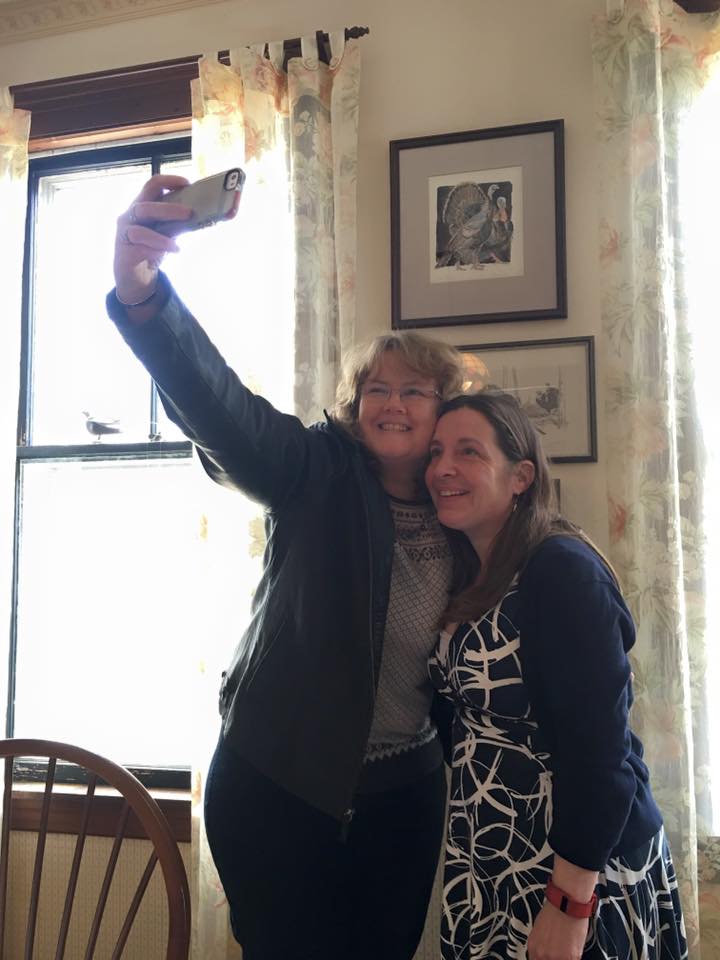
Appreciations: Thank you to Jane and to Heidi (who also took many of these photos) for inviting us into your home and your writing world. Thanks to all my fellow boot campers for their generosity of spirit. And particular thanks to Laurel Neme, who convinced me to apply to PBBC! Great call, Laurel.
Jane, me, Laurel, Heidi


PBBC 4 participants:
Laurie Wallmark
Marcia Strykowski
Rob Sanders
Aimee Reid
Laurel Neme
Libby Koponen
Alethea Kontis
Lynda Mullaly Hunt

Monday, April 4, 2016

Using Pat Hutchins' Picture Books as Mentor Texts by Tina Cho

One of the joys of picture books is that the pictures tell part of the story. As some state, it's a marriage between text and illustrations.

If you're an author/illustrator, this might be easier for you because you already have in mind your illustration and can write with sparse text. But for those of us who aren't illustrators, this technique is more difficult.

A couple weeks ago I was teaching about chicks to my 1st graders, and we read Pat Hutchin's newer book, Where, Oh Where, Is Rosie's Chick? 


I immediately had a "writerly" thought. This is a perfect mentor text for letting the pictures do the talking. Check out this story line:

Spread 1:
"Hooray! Rosie the hen has laid an egg. And, at last her egg is hatching...
[illustration: Hen coming out of coop; chick has fallen over with eggshell on its head.]

Spread 2:
"But oh, no! Where is little baby chick?"
[illustration: Hen and other chickens frantic with worry.]

Spread 3:
"Rosie looked under the hen house."
illustration below.


Do you see what I mean? Pat Hutchins could've said, "The chick had an eggshell stuck on her head and couldn't see where she was going." But the humor of letting the reader in on the secret is what makes this book so fun and interactive!

Pat did the same thing back in 1969 with her first classic picture book, Rosie's Walk.

And in The Doorbell Rang, she employed this again! 

Pat never told the reader how many cookies Mom had baked. The reader has to count the cookies and then understand that 12/2 = 6. This happens throughout the book as more children arrive.

Now in 2016, we're STILL learning about this important technique in picture book writing. If you participated in ReFoReMo, author Janee Trasler also spoke of this very thing. Check out her wonderful post and newer mentor texts. My favorite book from her list is Shh! We Have a Plan. 

I've challenged myself to go through my WIPs and see if I've let the text and possible illustrations complement each other. 

If you'd like to read more about Pat Hutchins, please check these links.


Wednesday, March 30, 2016

Hooray for Henry Herz! ~ by Patricia Toht

Today, we welcome a very IMPortant author to answer some IMPortant questions about his IMPortant new release. Welcome to the GROG, Henry Herz!


Are you a fantasy fan, Henry? Your new book, WHEN YOU GIVE AN IMP A PENNY can be considered a fantasy picture book. What elements of fantasy work well with the brevity of a picture book?

Yes, I've been a big fan of the fantasy genre, ever since reading WHERE THE WILD THINGS ARE repeatedly in elementary school. Then I read THE LORD OF THE RINGS in sixth grade, and I was hooked. Not only do I now read and write fantasy, but I interview fantasy (and sic-fi and KidLit) authors on my blog at www.henryherz.com.

I don't think picture books are uniquely well-suited for fantasy. However, illustrations of fantastical creatures or settings quickly immerse young readers in alternate worlds. And that's what fantasy is all about.


(President Obama is a fan of 
WHERE THE WILD THINGS ARE, too! 
Here's a video clip of him reading it at the 
White House Easter festivities.)

Which came first, the imp or the format of the story?


The format - at this early stage of my writing career, I've chosen to focus on authoring picture books. The imp was a minor character in my first book, MONSTER GOOSE NURSERY RHYMES. Due to its sheer silliness, my favorite rhyme is "Hey Diddle Diddle, the Cat and the Fiddle." In MONSTER GOOSE, my version of that rhyme features a minotaur, centaur, faun, and an imp. The imp's personality really peeks through in the illustration. He made it clear to me that he deserved his own story.

Your publisher is Pelican Publishing in Gretna, Louisiana. What are the perks of working with a smaller publisher?

Let's first distinguish between the terms independent and small publishers. "Independent publishers" (IPs) are those that are not part of a larger corporation (e.g. the Big Five). "Small publishers" are defined in the 2007 WRITER'S MARKET as those that average fewer than ten titles per year. So, while all small publishers are independent, not all IPs are small. Pelican Publishing puts out about 60 titles per year. They are an IP, but not a small publisher.

Excellent distinction, Henry! Thank you!

Having a book put out by a large publishing house, without question, offers some powerful advantages, including greater market reach, publishing industry relationships, more staff, and bigger budgets (and advances), than is the case for smaller publishers. That said, there are significant benefits to working with IPs, including:


* Ease of access *
* Closer relationships *
* Greater influence for author *
* Author's promotional efforts more visible *
* More flexibility *
* Greater speed to the process *


Was the process with IMP different from your first book, MONSTER GOOSE NURSERY RHYMES?

The process was exactly the same, except (thankfully) without the debut author nervousness accompanying my first book!

Illustrator Abigail Larson is perfect for this book. This is the second pairing of your words with her pictures. How did that come about?

Handshake illustration by
Tsahi Levent-Levi.
Most of the time, publishers provide an illustrator for authors that do not illustrate their own stories. However, I broke that rule because I wanted to have illustrations in the event I decided to self-publish MONSTER GOOSE. I found Abi on deviantart.com, and we decided to collaborate. Fortunately, we were able to interest Pelican in our work. After that, a second collaboration seemed like a natural thing to do.


Do you use mentor texts when writing?

I don't use mentor texts when I write. However, I read tons of picture books for inspiration and to hone my craft. WHEN YOU GIVE AN IMP A PENNY is clearly a medieval fantasy homage to Laura Numeroff's IF YOU GIVE A MOUSE A COOKIE, in that it also has a cyclical plot structure and an adorably cheeky protagonist.


I noticed that your sons are co-authors. What do each of you bring to the story? Who has the final say?

I involved them at an early age to spark an interest in reading fantasy. They serve as beta readers, giving me feedback and a kid's perspective on my early drafts. So far, I've been able to maintain creative control...
Henry and his boys

Your top tips for aspiring picture book writers?

I can offer eight tips for picture book writers here. I'd say the top three are:
#1 Have no fear! 
Don't be scared to put words to paper. Don't flee from constructive criticism. Don't be afraid of rejection. They all line the path to traditional publication.

#2 Be tenacious, even on crappy days. 
Becoming published isn't easy. But it won't happen if you stop trying. The journey of a thousand miles begins with one step. Revise, revise, revise. But remember that perfect can be the enemy of good enough. At some point, you need to submit!

#3 You need to be thick-skinned and 
learn to roll with the punches. 
Understand that a publisher's or agent's rejection isn't personal, but it is highly subjective. Many great works of literature were rejected repeatedly before being published, so you're in good company.

How did you score all your amazing interviews with authors and illustrators on your website?

By reading and genuinely admiring their work, building a relationship on social media or in person (I attend SCBWI conferences, WonderCon and San Diego Comic-Con), and by asking nicely.
Henry (and hat) at WonderCon this year.

What's next, Henry?

I'll keep writing! I have three books coming out soon. LITTLE RED CUTTLEFISH (Pelican, Fall 2016) is an aquatic retelling of Little Red Riding Hood, but with a sassy cephalopod protagonist. MABEL & THE QUEEN OF DREAMS (Schiffer, Fall 2016) is a bedtime picture book inspired by Mercurio's soliloquy in Romeo and Juliet. Little Mabel was an expert at not going to sleep. But Mom had the Queen of Dreams in her quiver of bedtime tales. The Queen paints children's dreams, so she only visits when their eyes are closed. DINOSAUR PIRATES (Sterling, Spring 2017) is a comical mashup of two kid favorites. A T-Rex with a pirate-y patois! Cap'n Rex leads his dinosaur pirates in search of booty. As they encounter obstacles in their quest, the apex predator "encourages" his crew to think outside the box. When the treasure is found, Cap'n Rex wants to keep it for himself, but the clever crew turns the tables on him.

Wow, Henry, you're a busy guy! How will we ever be able to keep up with you?

You can always find me at my website. Or follow me on Twitter via @Nimpentoad.

Thanks so much for stopping by Henry. 

Hmm, I wonder what happens if we give Henry a penny...

Monday, March 28, 2016

Monday Musing: Blue Balliet: Author Visit Observations by Kathy Halsey

Author visits? Why, Kathy, you're a pre-pub writer, right? Yes, but  Blue Balliet visited Canal Winchester Elementary School, a 3-5 grade building from which I retired. Blue specializes in MG mysteries and infuses her art history background in her plots. I came along for the ride to learn/observe from this award-winning writer. Even if you are a pre-pub writer, I suggest you tag along on an author visit if the opportunity arises. 


Lessons Learned

1. It's an author "visit." Blue took the time between large group presentations to walk the halls, notice student work posted in anticipation of her visit, and duck into classrooms. She even signed a rocking chair after listening to odes and scripts written by 5th grade gifted students.
2. Be flexible. Blue's visit was scheduled the day before spring break so the entire school schedule flipped that day. Lots of prep and logistics go into a visit, so kids may be keyed up. Blue had extra books to sign during her "down time" and did so graciously.  Motivated students mobbed her to purchase extra books even though pre-ssale books were available. 
3. Hook your audience with your presentation. Writers hook readers with books, but make your presentation is kid-friendly, too. Blue shared her real writing life with us - writing in her laundry room, stacks of drafts piled high, pictures of herself as a kid. 
4. Visuals trump words. Presentations can happen in the gym, the auditorium, anywhere a school can pack in hundreds of students. Canal's kids sat on the floor in a darkened lunchroom. Blue's powerpoint could be seen by all because of the visuals.
5. Let the kids interact with you. Leave time for student questions. Since acoustics weren't the best, Blue repeated the questions for all to hear before answering. 

6. Interact with staff members, too. Teachers/staff help you create an avid readership. Share tidbits about the books and your writing process because teachers will include this "insider" knowledge with their classes. Blue ate lunch with the teachers and posed for pictures with our staff. 
7. Make autographing personal. Blue personalized six different books with messages that matched the theme of each book. Amazing! Why not come up with an autograph for your manuscripts now? It's a great way to distill your WIPs to their true essence. (Plus, it's fun to dream.) Here's my copy of HOLD FAST.

8. Have a memorable website for fans to extend their learning process. Blue's website blew me away. Just like her books, a strong theme appears. It features architecture, art, and discovery. Take a look at this!
9. Curriculum connections are key. Blue makes word mobiles and students did, too. Big questions motivate Blue's writing and Winchester Trail kids asked big questions on word walls.


Friday, March 25, 2016

Story Time ~By Suzy Leopold

Many people love good bookstores. But writers, well . . .  we are enamored with our local indie bookstores as places of wonder.  These brick-and-motor stores are the heart of the community offering much more than books.

The sight of shelves packed with books from all genres, the sound of the children’s enthusiasm, and the rustling of turning pages all warm my heart.
Children's Books
Mrs. Sue shares stories
during story time
My favorite independent bookstore is located in Edwardsville, Illinois. The two-story yellow frame house is inviting and comfortable with numerous spots for adults and children to plop down and read. This bookstore is family owned and operated and offers numerous events including story time for children. At Afterwords Books, Story Time takes place every Tuesday at ten o’clock and Saturday at 11:00am.
Afterwords Books
Edwardsville, Illinois

As a writer under construction, my relationship with LuAnn Locke, owner of Afterwords Books, has become beneficial for both of us. Every Tuesday I spend time with little bookworms and their families sharing the love of literacy during Story Time at Afterwords Books.


Afterwords Books
LuAnn Locke, Owner


Since this community bookstore goes above and beyond to make itself a destination for families to share the love and value of reading, while browsing bookshelves for just the right book, I am excited to participate in story time. 

Reading books to kids in the neighborhood offers me, as a pre-published writer, an opportunity to connect with the children in our community. Story time has become an extension for my writing. Spending time with the kids gives me an insight into books that capture the kids’ attention, their likes and dislikes and most importantly their reaction to the books that I read and share with them. The kids always let me know their thoughts about the books through active participation and positive reactions. If a book is “liked”, the kids share two thumbs up. A thumb held in the horizontal position indicates the listeners “kinda liked” the book and thumbs down, well you know what that means. Thus far, I have noted all thumbs up. 

Many GROG Blog readers know how important it is to read and study stellar picture books. What better way to analyze top notch literature through the eyes of my reading buddies.

My motto is: Read, Write and Create Every Day. 
And that I do try to do each and every day. However, there are times when reading during story time is the best excuse for not writing. 

I can't help but feel I belong here, just as I did in the classroom and just as I do with my after school and summer school reading buddies.
Story Time
Story time helps me to grow as a writer. Support your local indie bookstores.

Wednesday, March 23, 2016

A Peek Behind the Curtain


By Janie Reinart

Have you ever wanted to know what goes on behind the scenes of a kid lit contest?


Here's your chance. A recent post shared how the lovely Vivian Kirkfield came up with the idea for the 50 Precious Words contest. 


Now, you can peek behind the curtain and see how the winning entries were chosen.


What was your process for selecting winners? 

Janie, I had no idea there would be such a tremendous response for the #50PreciousWords Contest. I thought that I’d get maybe a dozen or so entries. As the days went on, and the stories continued to stream in, I was thrilled. 

I had listed several guidelines when I first posted the contest. So as each story came in, I made sure each entry followed those. Amazingly, everyone’s story was 50 words or less.  I read each story – then I read it again out loud. If it made me smile, if it was unique, if it touched my heart…any of those things…I put a star next to it on the list I had made of all the entries. 


If it was well-written with all the important elements of beginning, middle, and end, I put another star next to it. I thought that when all was said and done, I’d have a few stories that had stars. Nope! I had over 100 stories that had stars. 

So then I read each story out loud four times…if I loved it more each time I read it, I put a big check next to the name. I thought I’d have just a few like that. Nope! I had fifty. 

So then I asked my husband if he would listen to the stories…he is a published author, former elementary school teacher, and lover of books and reading. That helped me cut the list down to thirty. 

And for the next four hours, I read and reread those thirty stories…looking for the ones that I would buy if they were at the bookstore. Looking for the ones I would grab from the library to read to my grandchildren. Looking for the ones I thought would appeal to kids the most because they were clever or sweet or unique or funny or inspiring. 

Those were four of the most difficult hours of my life. Now I understand better how difficult it is for editors who fall in love with manuscripts, but can’t take them for one reason or another. Or how hard it is to be an agent and have to turn away a writer who writes really well, but whose work you don’t connect with as much as you feel you need to in order to represent them successfully. 


I had always heard this was a subjective business. YES, IT IS! And being on the other side of the table was heartbreaking. 

 Did you use a rubric?  

If by rubric you mean a weighted system of scoring…then no, I did not. I went with my gut, the overall feeling the story gave me. The problem is that each story was unique…some rhyme, some prose, some free verse. About totally different topics. 

Stories, after all, are about how they engage the reader…a story that my sister raves about might be one that I hate. Just because a book sells a million copies, doesn’t mean it will appeal to me. 

Over a hundred stories in the contest deserved a prize…but I had to whittle it down by what I felt constituted a great story. Which is probably different from how someone else feels. 

Did you have helper elves to help make selections?  


Ah…helper elves…now that would have been a GREAT idea! However, having expected maybe a dozen entries, I didn’t think I would need any help. 

As I mentioned, my husband graciously stepped in to assist. When I do the contest again next year (YES< I will absolutely positively make this an annual event), I plan to enlist the help of a couple of critique buddies…one has already volunteered. 

I think that will give me a sense of peace of mind that the responsibility is not all on me…it wasn’t the time that it took that I objected to. Anyone who knows me well, knows that for me, time spent reading stories is golden, and I could do it 24/7. 


Because I thought I’d only have a dozen entries, I arranged for the winners to be announced the day after the deadline. Oops! I read and reread stories all night long till at least 3am. And of course, I had been reading them all along as they came in. 

Next year, I will definitely give myself a couple of days between deadline and announcing the winners. 

Do you have any tips for writers for next year’s contest? 

I don’t know if the writers needed any tips. The stories were of such a high quality and I was blown away. WHOOSH! Seriously, the entries were wonderful. Many of the writers placed their entry on their own blog and shared the contest on social media channels. 

And I’d love it if people would comment here on the GROG post, email me, or message me on Facebook and let me know how I could improve the 50 Precious Words Contest for next year. 

I really appreciate this opportunity, Janie, to share. It was my first challenge to other writers…and I was honored by the enthusiastic response! No doubt about it…this is the BEST kidlit community ever! 

It was my pleasure.  Everyone give a round of applause for Vivian! Thank you for inviting us to have some fun. 


Monday, March 21, 2016

Pushing On and Why We Write - by Kathy Halsey

"Kathy, I so understand that time of writing in the desert. I feel kinda clogged myself. We must push on, though." This email greeted me yesterday from writer friend, Sherri.

Time in the desert. I actually lived in the Phoenix desert for 4 years, but metaphorically I am living my own writing desert. Maybe you've been to that desert, too. If so, let's chat and throw up a dust storm...out West we call them haboobs! (Funny word for a scary situation.) 
Last year I was on a writer's high. I wrote a draft a month and revised monthly, too. But in 2016, I don't have that drive to create. I'm parched for many reasons - minor health issues, critique group funk, and the general malaise a writer feels after parting with an agent. We don't like to talk about this stuff, but I'm "Chatty Kathy," and I'm talking! 

Just before my agent left, I began writing a story about cats and libraries. I wrote on and off; I had no great ambitions for the manuscript, except I LIKE cats and WAS a school librarian for 15 fantastic years. I just finished my second draft last week and felt thrilled. I found that I could finally write and that the writing soothed me. And I was so proud of myself, I read the story to my long-suffering hubs and the tween I watch/babysit twice a week. I even had my computer read it to me. Then I sent it out for feedback to a few writer friends who have never read my work before. (a big leap for me.)

Now here's the dust-kicking from my desert boots, my Big Oprah "aha" moment. I MADE myself happy by writing. THIS is why I write. I can't describe the pleasure I feel when I finally get into a story and finish it, even if, technically, it's just so-so! I write for myself, to entertain myself, to transcend myself, to exist in a place where there isn't arthritis, medical bills, and all the flotsam of life. Writing gives me power. It's mood-altering. And I had forgotten that!!!!!! (excessive exclamations.) 

So, I'm OK. And if you're in the desert, you'll find your water soon, and you'll be OK. Just dip your toe into a topic you enjoy and write for no other reason than to entertain yourself. Have fun. Giggle at your own puns, your own way with words, your own voice. Tell the story to yourself and soon you will be telling it to others. And, by golly, you'll feel better! 

Usually I post informational topics, but today, I'm revealing my feelings. Sometimes, I think we writers need to reveal feelings to let others know they're NOT alone in the desert. So, this "Chatty Kathy" feels like she's in the cat-bird seat right now and hopes you'll push on, too! Watch out world, I'm priming my pump and writing for ME!