Showing posts with label picture book writing tips. Show all posts

Wednesday, June 15, 2022

Word Choice—Multitasking at Its Best! Guest Post by Beth Anderson

I love welcoming author Beth Anderson back to the GROG Blog because she offers a wealth of information, now welcoming her 6th picture book biography into the world, FRANZ’S PHANTASMAGORICAL MACHINE, illustrated by Caroline Hamel, published by Kids Can Press. Congratulations, Beth!


When I chanced upon the word PHANTASMAGORICAL, I knew I’d struck gold! And it fit the story of Franz Gsellmann’s World Machine perfectly with its meaning, composite nature, and whimsical feel!

Word choice is always an essential piece of writing, but with picture books it can make or break a manuscript. English is said to have the largest lexicon of any language in the world. Where other languages might combine words to express specific ideas, English tends toward individual words with nuanced meanings—connotations. 

connotation [from dictionary.com]

1.     a. the associated or secondary meaning of a word or expression in addition to its explicit or primary meaning…

2.     something suggested or implied by a word or thing, rather than being explicitly named or described

With FRANZ’S PHANTASMAGORICAL MACHINE, I struggled to find a way to showcase the nebulous concept of an inner drive or urge. How could I express that for kids? “Voice” with the idea of hearing voices wasn’t right. “Urge” wasn’t either. When I tried “itch,” it worked as “a secondary meaning”…but a boy with a relentless itch had an “implied” meaning that made it a no-go! I eventually settled on “whisper” for its quiet summoning, using the word in a special way. 

Word choice can be tricky! But paying attention to connotations allows words to multitask, adds rich vocabulary, and cuts word count. Basically, think about ideas incorporated in words. For example, a word can be cut in both “crowded together” and “the crowd gathered” since crowd contains the concepts of together and gathering.

First and foremost, word choice is key to Show Don’t Tell.  An online thesaurus sits at the ready on my favorites bar, offering options to get my vision on the page. Still, I can spend hours finding the right words as I revise a paragraph. A great word choice can often eliminate an illustration note. Consider the implied differences: rode vs. pedaled, talk vs. gossip, laughed vs. snickered vs. giggled. Alternatives to the usual add richness and meaning. What follows are some of the ways word choices impacted FRANZ’S PHANTASMAGORICAL MACHINE.  

Attitude, mood, and tone. Referring to the machine from the public’s point of view as a contraption conveys attitude, and when it has grown—behemoth. Lollygagging and dillydallying, instead of wasting time, serve the whimsical tone of the story. 

Sensory and Imagery Words. Word choices that enhance visuals and share sounds and smells bring the story world to life, helping kids immerse themselves in the experience of the characters. Flutter, click, scratch, jiggled, rumble, roar, whir, vibrated….  

Action. Vivid verbs keep the reader’s mind actively moving along with the characters. He zoomed up its elevator, glided down the escalator and marveled at the colorful lights. 

Pairs or Repetition. An interesting pair of words can offer contrast or connections. In FRANZ’s story, I used the idea of making the ordinary extraordinary in several spots to establish another layer to the story. A distinctive word can help the reader notice a repeated phrase at beginning and end to tighten an idea that loops back.  …eyes twinkled with wonder…

Made up words.  Sometimes, there just isn’t the right word to express an idea strongly and succinctly. In LIZZIE DEMANDS A SEAT, I created what I needed with the pair “late-for-church” and “late-for-equality.” In FRANZ, I didn’t realize I’d pushed the limits until the copy editor came back with a few words that weren’t in the official dictionary of the publishing house. I think zinged was accepted without a problem, but not scrumpled, as in …Franz pondered and paced, sketched and scrumpled, fussed and fretted” required a conversation. To me, it was the perfect word for sound and meaning, a combo of scrunched and crumpled, yet different than either. I found it in another dictionary and declared my love for scrumpled. Sometimes a word choice is worth defending. An unusual word can be fun, interesting, or bring special attention to a spot that deserves pondering.

Specifics are golden. Choosing very specific words helps characterization, setting, and makes the story pop. In Franz’s story, it’s impossible for text and art to share the nearly 2000 parts he used to create the machine, so I included specific pieces of the machine throughout to give the reader a sense of the range, immensity, and uniqueness of his endeavor. Hula-Hoops! Horseshoes! A hair dryer!  In a repeated line, I popped different specifics into the series of three, changing “pulleys, wheels, and lights” to “motors, wires, and gears.” When I wrote, I used word slips with names of parts so I could rearrange them to play with shapes, functions, sounds, and more. Though the specific words of the phrase changed in that repeated line, the rhythm of the sentence stayed the same. Which brings us to sound….because a word brings more than meaning to the page. 

Sounds of Words. There’s so much to play with regarding the sounds of words. I love figurative language like alliteration, consonance, assonance, and onomatopoeia. The rise, fall, and flow of sounds and syllables are vital to a read-aloud. “trinkets and treasures” has alliteration, but also two 2-syllable words. I admit to getting carried away with the sound effects and lost some beauties in cuts for pacing. (Apparently there’s a fine line between enough and excessive, so be careful of overdoing.) Attention to sounds also helps eliminate potential tongue-twisters that arise when reading aloud. 

Choosing the perfect word can cut word count, create mood, show contrast and connections, affect pacing and flow, transform a scene, and make a title sing. It can take many revisions, but when I finally chance upon that perfect word and it settles onto the page, I can feel it—down deep inside. Sigh.

Thank you so much, Beth, for this excellent post about word choice! Now I need to go see to my manuscripts...

Beth Anderson, a former basement tinkerer and educator, has always marveled at the power of books. With curiosity and a love for words, she writes untold tales, hoping to inspire kids to laugh, ponder, and question. She’s the award-winning author of REVOLUTIONARY PRUDENCE WRIGHTTAD LINCOLN’S RESTLESS WRIGGLE, “SMELLY” KELLY AND HIS SUPER SENSES, LIZZIE DEMANDS A SEAT!, and AN INCONVENIENT ALPHABET. Beth has more historical picture books on the way, including CLOAKED IN COURAGE: UNCOVERING DEBORAH SAMPSON, PATRIOT SOLDIER, now available for pre-order; and THOMAS JEFFERSON’S BATTLE FOR SCIENCE: BIAS, TRUTH, AND A MIGHTY MOOSE in fall 2023. 

Follow Beth! https://bethandersonwriter.com  
Twitter • Instagram • FaceBook • Pinterest 


Wednesday, March 30, 2016

Hooray for Henry Herz! ~ by Patricia Toht

Today, we welcome a very IMPortant author to answer some IMPortant questions about his IMPortant new release. Welcome to the GROG, Henry Herz!


Are you a fantasy fan, Henry? Your new book, WHEN YOU GIVE AN IMP A PENNY can be considered a fantasy picture book. What elements of fantasy work well with the brevity of a picture book?

Yes, I've been a big fan of the fantasy genre, ever since reading WHERE THE WILD THINGS ARE repeatedly in elementary school. Then I read THE LORD OF THE RINGS in sixth grade, and I was hooked. Not only do I now read and write fantasy, but I interview fantasy (and sic-fi and KidLit) authors on my blog at www.henryherz.com.

I don't think picture books are uniquely well-suited for fantasy. However, illustrations of fantastical creatures or settings quickly immerse young readers in alternate worlds. And that's what fantasy is all about.


(President Obama is a fan of 
WHERE THE WILD THINGS ARE, too! 
Here's a video clip of him reading it at the 
White House Easter festivities.)

Which came first, the imp or the format of the story?


The format - at this early stage of my writing career, I've chosen to focus on authoring picture books. The imp was a minor character in my first book, MONSTER GOOSE NURSERY RHYMES. Due to its sheer silliness, my favorite rhyme is "Hey Diddle Diddle, the Cat and the Fiddle." In MONSTER GOOSE, my version of that rhyme features a minotaur, centaur, faun, and an imp. The imp's personality really peeks through in the illustration. He made it clear to me that he deserved his own story.

Your publisher is Pelican Publishing in Gretna, Louisiana. What are the perks of working with a smaller publisher?

Let's first distinguish between the terms independent and small publishers. "Independent publishers" (IPs) are those that are not part of a larger corporation (e.g. the Big Five). "Small publishers" are defined in the 2007 WRITER'S MARKET as those that average fewer than ten titles per year. So, while all small publishers are independent, not all IPs are small. Pelican Publishing puts out about 60 titles per year. They are an IP, but not a small publisher.

Excellent distinction, Henry! Thank you!

Having a book put out by a large publishing house, without question, offers some powerful advantages, including greater market reach, publishing industry relationships, more staff, and bigger budgets (and advances), than is the case for smaller publishers. That said, there are significant benefits to working with IPs, including:


* Ease of access *
* Closer relationships *
* Greater influence for author *
* Author's promotional efforts more visible *
* More flexibility *
* Greater speed to the process *


Was the process with IMP different from your first book, MONSTER GOOSE NURSERY RHYMES?

The process was exactly the same, except (thankfully) without the debut author nervousness accompanying my first book!

Illustrator Abigail Larson is perfect for this book. This is the second pairing of your words with her pictures. How did that come about?

Handshake illustration by
Tsahi Levent-Levi.
Most of the time, publishers provide an illustrator for authors that do not illustrate their own stories. However, I broke that rule because I wanted to have illustrations in the event I decided to self-publish MONSTER GOOSE. I found Abi on deviantart.com, and we decided to collaborate. Fortunately, we were able to interest Pelican in our work. After that, a second collaboration seemed like a natural thing to do.


Do you use mentor texts when writing?

I don't use mentor texts when I write. However, I read tons of picture books for inspiration and to hone my craft. WHEN YOU GIVE AN IMP A PENNY is clearly a medieval fantasy homage to Laura Numeroff's IF YOU GIVE A MOUSE A COOKIE, in that it also has a cyclical plot structure and an adorably cheeky protagonist.


I noticed that your sons are co-authors. What do each of you bring to the story? Who has the final say?

I involved them at an early age to spark an interest in reading fantasy. They serve as beta readers, giving me feedback and a kid's perspective on my early drafts. So far, I've been able to maintain creative control...
Henry and his boys

Your top tips for aspiring picture book writers?

I can offer eight tips for picture book writers here. I'd say the top three are:
#1 Have no fear! 
Don't be scared to put words to paper. Don't flee from constructive criticism. Don't be afraid of rejection. They all line the path to traditional publication.

#2 Be tenacious, even on crappy days. 
Becoming published isn't easy. But it won't happen if you stop trying. The journey of a thousand miles begins with one step. Revise, revise, revise. But remember that perfect can be the enemy of good enough. At some point, you need to submit!

#3 You need to be thick-skinned and 
learn to roll with the punches. 
Understand that a publisher's or agent's rejection isn't personal, but it is highly subjective. Many great works of literature were rejected repeatedly before being published, so you're in good company.

How did you score all your amazing interviews with authors and illustrators on your website?

By reading and genuinely admiring their work, building a relationship on social media or in person (I attend SCBWI conferences, WonderCon and San Diego Comic-Con), and by asking nicely.
Henry (and hat) at WonderCon this year.

What's next, Henry?

I'll keep writing! I have three books coming out soon. LITTLE RED CUTTLEFISH (Pelican, Fall 2016) is an aquatic retelling of Little Red Riding Hood, but with a sassy cephalopod protagonist. MABEL & THE QUEEN OF DREAMS (Schiffer, Fall 2016) is a bedtime picture book inspired by Mercurio's soliloquy in Romeo and Juliet. Little Mabel was an expert at not going to sleep. But Mom had the Queen of Dreams in her quiver of bedtime tales. The Queen paints children's dreams, so she only visits when their eyes are closed. DINOSAUR PIRATES (Sterling, Spring 2017) is a comical mashup of two kid favorites. A T-Rex with a pirate-y patois! Cap'n Rex leads his dinosaur pirates in search of booty. As they encounter obstacles in their quest, the apex predator "encourages" his crew to think outside the box. When the treasure is found, Cap'n Rex wants to keep it for himself, but the clever crew turns the tables on him.

Wow, Henry, you're a busy guy! How will we ever be able to keep up with you?

You can always find me at my website. Or follow me on Twitter via @Nimpentoad.

Thanks so much for stopping by Henry. 

Hmm, I wonder what happens if we give Henry a penny...

Monday, April 13, 2015

How to Write a Children's Picture Book: The Home Version by Pat Miller

I didn’t earn an MFA in writing. I simply started writing as a kid, and haven’t stopped. But I have longed for courses in writing. When the cursor blinks relentlessly on the blank page, when my prose is limp and my imagination is indolent, I definitely feel my lack of training.

Then I discovered and read the three-book series, How to Write a Children’s Picture Book by Eve Heidi Bine-Stock. They don’t replace a MFA, but Bine-Stock has definitely schooled me in how to energize my writing and motivate my imagination. You can get the same one-on-one attention with her titles. Let’s take a look.

The first book is How to Write a Children’s Picture Book: Structure. It uses 26 favorites from the New York City Public Library’s list, “100 Picture Books Everyone Should Know” as exemplars. The goal is not to study the plots, characters, settings, and so on. It’s to analyze the underlying story structure so it can be replicated. In fact, if you don’t have the bones of structure underneath, the story elements won’t hang right, no matter how much you revise. No wonder my prose was limp.


Though it has less than 200 under-sized pages, this book is a master’s course. In Part One, she uses books like Ten, Nine, Eight by Molly Bang and Goodnight Moon by Margaret Wise Brown to reveal the two-part structure of many concept books. Use her analysis of these deceptively simple books if you are writing a similar book.

In Part Two, Bine-Stock reveals what she calls the Symmetrical Picture Storybook Paradigm, “which underlies most of the best-loved picture storybooks.” This is such a fresh concept that Bine-Stock developed her vocabulary based on screenwriting. She shows how Leo the Late Bloomer by Robert Kraus has three acts separated by two plot twists. And those acts are symmetrically divided into 7-9-7 pages. This is one of fifteen classics that Bine-Stock deconstructs, and her chart lets you apply what you learn to your own WIPs.

Part Three uses Millions of Cats by Wanda Gag and Mike Mulligan and His Steam Shovel by Virginia Lee Burton to take you through what Bine-Stock calls The Iterative Paradigm. Then she says enough with the showing, now it’s your turn. The last section is a blueprint “to plan and structure your picture story-book before you sit down to write it.” Wow--here's the X on the writer’s treasure map.  

One course does not an MFA make, nor does one book tell you all you need to know as a writer. But wait! There’s more! Volume II: Word, Sentence, Scene, Story is not what you think. Don’t expect to learn about vivid verbs, grabby sentences, convincing scenes, and story arcs—things you probably already know. 


Instead, Bine-Stock talks about focus and rhythm, cohesion, action and reaction. She talks about beginning and ending scenes. She explains storytelling strategies based on problem first, character first, background first, or action first. But Bine-Stock is more than talk. She shows how easily acquired books like Caps for Sale and Harry the Dirty Dog use these techniques. She’s all about showing as well as telling.


The final book in the series is Volume III: Figures of Speech. By now you know to expect the unexpected, the fresh, the truly helpful from Eve Bine-Stock. This is not the book of metaphors, similies, or idioms. 


Instead, you will learn to freshen and intensify your work with figures of speech like epizeuxis, immediate repetition like that found in Lyle, Lyle Crocodile. Or, in the same book, a kind of repetition called anadiplosis—repeating the end of a prior sentence in the beginning of the next.

This is the house.
The house on East 88th Street.
Mr. and Mrs. Primm
and their son Joshua
live in the house
                               on East 88th Street.

Though impressive, the unusual names of these figures of speech aren’t important. But the examples in children’s literature and the possibilities for your own work are immensely important. You will see first-hand how these figures contribute to the emotional power and memorable quality of these classics--and you will have real tools to enrich your own work. 

These books are readily available online, new and used. They are much easier on your budget than tuition in an MFA program, but may very well impact your work as much. Give this three “semester” course on How to Write a Children’s Picture Book a try!

Wednesday, September 17, 2014

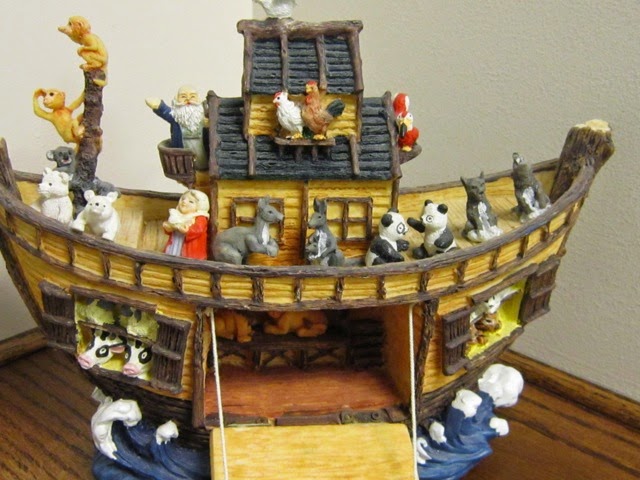
Staying AFLOAT with Picture Book Author Laura Sassi: 4 Writerly Things I Learned From Noah & his Ark (And a GIVEAWAY!)

I want to welcome one of my writing buddies, Laura Sassi, to the Grog blog.  I'm so proud of Laura, because she's on a blog tour for her debut picture book, Goodnight, Ark, published by Zonderkidz. I've had the opportunity to read it, and some special person will win a copy here. (U.S. residents only)

Take it away, Laura...

Thank you for hosting me on my first ever blog tour! I’m so excited that GOODNIGHT, ARK is finally afloat, but the journey to this point was not easy. I spent two years getting my story ready to float. Was all that time worth it? You bet. 

Now, in celebration of the release of GOODNIGHT, ARK, here are four things Noah and his ark have taught me about getting boats, er stories, to float. 

Don’t expect your boat to float overnight. When I first got the idea for GOODNIGHT, ARK my mind whirred with possibilities. Which animals would be scared of what?  How would they get to Noah’s bed? And how would Noah ever comfort them and return them to their bunks?  I knew early on that I wanted to write the story in rhyme but finding the perfect meter and line length did not come easily. So I played around with plot and form again, and again, and again. Each time I finished a draft, I’d put it away and work on other things for several weeks so I could see it with fresh eyes. I repeated this cycle for two years and each time the story improved so much that it ended up with two offers! That experience has taught me not to worry about how long a story is taking me to write. Instead, I relax and let creativity work at its own pace until my stories are buoyant and ready to set sail.

Every ARK needs an ARC. Even with all that revising, my agent thought the initial version of GOODNIGHT ARK I sent her was too quiet. In that early version, the storm escalated and animals kept piling in, but there was no sense of rising action or urgency in resolving the night-time pile up. Except for the fact that the animals changed, the scenes were essentially static. In other words what the ark needed was an arc! The story still needed to be soothing for littlest readers, so I knew any tension/ rising action I infused had to be playful and fun. It took many hours of writing and re-writing, but I hope readers will agree that the final version with its ark tipping, bed crashing buildup and stinky, yet ultimately soothing, resolution is anything but static. I now analyse all my stories for effective rising action, climax, and resolution early on in the writing process. One way I do this is by making a 32-page dummy. That way it’s easy to see if your scenes are static as they build across 14 - 15 spreads or if there’s a sense of rising action etc. Plus, it’s a lot of fun, especially if you have little ones at home who like illustrating your dummies!


Don’t overload the decks. Noah’s ark was sturdy and well-planned with three decks, but though Noah may have been tempted to bring aboard extra animals, thank goodness, he showed restraint and took only two of each. Overcrowding would have put a strain on provisions. Worse yet, the ark might have capsized! Likewise, as a writer, I’m sometimes tempted to overcrowd my story with cute phrases and details that only weigh down the plot. During early stages of a project, I don’t worry about overwriting. My goal at that point is simply to build my story. Before I let it out of the port, however, I make sure to streamline the plot so every word and event pushes the story forward.

Everything’s better with a buddy. Noah didn’t try to build the ark all alone. His family cheered him on and pitched in with the building, providing much needed moral support amid the taunts and jeers of the onlookers. Likewise, I’ve found that the long, hard journey to publication just wouldn’t be the same without a nice support system. For me this includes my family, my lovely agent, and the wonderful network of like-minded children’s writers I’ve connected with over the years, many of whom have become dear friends and trusted critique partners. So, my last bit of ark-themed advice for staying afloat and giving your stories a floating chance, is to find a writing buddy or two to join you on the journey!


BIO:Laura’s poems, stories, articles and crafts have appeared in many publications including Highlights for Children, Cricket, Ladybug, Spider, Focus on the Family’s Clubhouse and Clubhouse Jr., FamilyFun, and Pack-O-Fun. GOODNIGHT, ARK, published by Zonderkidz, a HarperCollins Company, and illustrated by Jane Chapman is her first picture book. She is represented by Lara Perkins of the Andrea Brown Literary Agency. Laura writes from her century-old home in New Jersey where she lives with her awesome husband, two adorable kids, and a black cockapoo named Sophie. You can also find her on her blog, Facebook, and Twitter. 

Leave a comment for Laura here and sign on the Rafflecopter to be entered into a drawing to win her new picture book, Goodnight, Ark. To be eligible, you must be a U.S. resident and have a physical address, not a P.O. Box. Thanks! Drawing will be held Sunday 9/21 after 8 pm CST.
a Rafflecopter giveaway