Friday, January 23, 2015

ReFoReMo ~By Suzy Leopold

Calling all picture book writers! Grab your writer's toolbox, a journal to take notes and your favorite pen. It's time for some picture book research. 

ReFoReMo
WHO? Picture Book Writers 

Fiction and Nonfiction

WHAT? Reading For Research Month

A writing challenge to help you reform your writing and learn how to use mentor texts. 

WHEN? March 1st through March 31st 

Registration opens February 15, 2015


To kick off the event prior to registration and be eligible for some prizes consider spreading the news through social media. To find out how to do so and enter for prizes go to ReFoReMo.

WHERE? Your choice for a favorite place to read and write.

WHY? Whether you are an experienced published author or a writer who is honing the craft of writing, you will find that studying and researching the newest picture books on the market is an excellent tool to have in your writer's toolbox.

HOW? Reading and researching mentor texts. Both fiction and nonfiction picture books. Recently published, highly recommended picture books will be studied.
A Tall Stack of Mentor Texts
Authors, educators, and librarians will share daily posts along with recommendations for five quality picture books. Inspiration, tips and excellent book recommendations will be made.

Read more about this upcoming event at ReFoReMo and find out who the twenty-eight guests are. Wow! What a line up!

Mark your calendars for this upcoming event! You won't want to miss it. Thank you, Carrie! 
Carrie Charley Brown

Wednesday, January 21, 2015

Let's Play: Mentor Texts for Word Play by Marcie Flinchum Atkins

Playing with words. Isn’t that what all writers really enjoy doing? Figuring out the best way to make your words make someone laugh, cry, play a movie in their mind, or just wow them. 

I think WORD PLAY can have a pretty broad definition, but here are some of the things I think are good examples of word play:
  • Puns
  • Made up words
  • The rhythm of the words
  • Unusual words that are just fun 


Puns

A pun is a humorous twist on a common phrase that changes the meaning. Sometimes the use of homophones comes into play or sound-alike words. 

One of the places I’ve seen this frequently is book titles. 

Monstore by Tara Lazar
The Plot Chickens by Mary Jane Auch and Herm Auch
Little Red Writing by Joan Holub
Bawk & Roll by Tammi Sauer
Are We Pears Yet? by Miranda Paul (forthcoming, but when I saw the deal announcement last week, I knew it fit in with title word play)


These punny titles pull the reader in immediately with their humor. 
Other authors use puns right in their texts. Tammi Sauer uses several puns in her book BAWK & ROLL. When the chickens are trying to perform in front of a bunch of cows, one of them says: 

“We’re going to get mooed off the stage.” 

Made Up Words

I love it when an author makes up a word that seems perfect. Even more fun, when they use a familiar word and change the part of speech. 

Phyllis Root makes use of onomatopoeic words in her book ONE DUCK STUCK. She uses words like “pleep” and “sloosh,” which aren’t actual words, but they work. She uses these onomatopoeic words as verbs. 

In THE POUT-POUT FISH IN THE BIG BIG DARK, author Deborah Diesen uses familiar words strung together with hyphens to create a whole new word. This makes the language feel fresh, but familiar enough the that reader will get it. She uses words like “flit-fluttered” and “heap-deep black.” 


Sometimes, the made up words can just be laugh-out-loud-funny. Candace Fleming masterfully creates made up words for the bunnies in her book TIPPY-TIPPY-TIPPY, SPLASH! Mr. Mcgreevy calls the bunnies:
 “pesky pufftails” 

“wily twitchwhiskers” 

“infuriating flopears” 

The onomatopoeia throughout the book also makes this book full of word play. 


Kim Norman changes up the parts of speech on familiar words. She creates some fabulous adjectives in her book PUDDLE PUG including:

 “froggy puddles, deeper-than-a-doggy puddles" 
[emphasis mine] 

She describes the puddles as:
 “Too smelly. Too yelly.” 

Changing the verb yell to a made-up adjective “yelly” works for the rhyme, but it lets the reader into the joke. 


Tammi Sauer strings words together to make interesting verbs in her book MR. DUCK MEANS BUSINESS. 

“Mr. Duck sputtered. He muttered. He tail-a-fluttered.” 

Later she says:

 “Mr. Duck grumbled. He mumbled. He flip-flop-fumbled.” 

All of these use familiar words, then a string of words together to make the reader laugh out loud. 

Rhythm

Rhythm is a whole other thing, but sometimes the rhythm of the story is all about how the author strung the words together and played with them so that you feel like you’ve taken a romp with those words as you read. 

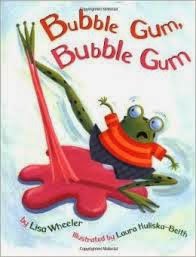
I can think of no other book that does this better than BUBBLEGUM, BUBBLEGUM by Lisa Wheeler. 

“Along comes a shrew…

A bad mood shrew,

A bad mood

—HOW RUDE!—

Tough dude shrew.” 

Isn’t that fun to read aloud? The whole book is like this and full of great word play. 

Unusual Words that Are Just Fun


Take CHICKEN CHEEKS by Michael Ian Black, for example. The whole book is nothing but a list of synonyms for the word “butt.” If synonyms for “butt” weren’t enough to make a kid laugh, he pairs each word up with an animal, increasing the humor. This book is brilliant and full of word play. 

“Duck tail”

“Moose caboose”

“Gnu wazoo” 

“Chicken cheeks”

Sometimes he uses rhyme, sometimes he uses puns, and sometimes he uses alliteration. 

Word Play Works

Word play works in these cases for many reasons. 

1) Readaloudability (How’s that for a made-up word?)

These books are all fun to read aloud. The adult reader and the kid reader can both enjoy them. In fact, these books invite the reader to come visit the books again and again because they are fun to read. 

2) Humor

Word play amps up the humor in the book. These authors could’ve told a story using different words, but it wouldn’t have been nearly as funny. 

3)  Standouts

It is easy to see why these books caught an editor’s eye. They stand out. And as a reader, they stand out in my mind as well. 

Let’s Play with Words

I’d love to know what books you’ve used as mentor texts for word play. Leave a comment. I want to add them to my to-be-read list. 


Monday, January 19, 2015

National Popcorn Day ~By Suzy Leopold

Happy Popcorn Day! What’s your favorite popcorn snack? Do you like Cracker Jack, Kettle Corn or fresh popcorn with melted butter and salt? There are so many flavors of popcorn to enjoy, it is hard to choose.
The
Popcorn
Book
By Tomie de Paola
 
In celebration of Popcorn Day, today’s featured book is The Popcorn Book, by the beloved Tomie de Paola. This book is just another reason why everyone loves Tomie, his stories and his illustrations!

Written with a blend of facts and fun, the story is narrated by brothers Tony and Tiny. Mom gives the boys permission to make some popcorn. Together the boys begin a delightful adventure as they learn about the history of popcorn, many facts and various ways to pop corn, followed by a blizzard of popcorn and two popcorn recipes. Tomie just knows how to write a book that is both entertaining and informative.

The Popcorn Book
Enjoy the You Tube of The Popcorn Book being narrated by Sangah and Sohee.


This picture book lends itself to dozens of lessons and activities for children
ages five and up. Here are half a dozen ideas to use in the classroom or for a 
fun activity at home.

        1. Write a haiku poem about popcorn.

        Kernels of corn. Pop!
        Popcorn is a tasty treat.
        May I have some more?
                         ~By Suzy

        2. Estimate the amount of popcorn kernels in a clear container. Make it           more challenging, for older children, by displaying the popcorn in a bag.

        3. Find words that you know. See how many words can you make from the          title of the book, The Popcorn Book. Challenge kids to write as many words that
 they see and write during a set time.
         *cook
         *no
         *her

        4. Have fun outdoors with a relay race. Pairs of students stand facing each other about six feet away. Student A uses a plastic spoon to carry popcorn kernels to Student B. The popcorn kernels are passed on to Student B and now must return to the designated starting point without dropping a kernel.

5. Play a vocabulary enrichment match with important words to know:
    archeologist, discovered, explorers, kernels, legend, 
    method, moisture, popcorn, refrigerator, tablespoon 
Can you match these words
with their meaning?
6. Use the five senses to describe and write what the popcorn looks 
    like, smells like, tastes like, sounds like and feels like. Write about The Five Ws:

*Who? Who discovered popcorn?
*What? What's the best way to make popcorn?
*When? When do you enjoy eating popcorn?
*Where? Where should popcorn be stored?
*Why? Why does popcorn pop?

Consider making some popcorn with kids today. Since most kids are familiar    
with microwave popcorn only, take some time to introduce children to the old 
fashioned way of popping corn on the stove. Kids love the flavor of popcorn and
adults appreciate the nutritional value.

The story finishes with a feel good ending as Tony and Tiny, exclaim, “The best
thing about popcorn . . . Is eating it!
Such a sweet ending.
I don’t know about you, 
but I think it is time for a snack!
Do you want some?
Oops! I should have saved you some.
Additional Facts:

The Popcorn Board Industry Facts
The Popcorn Book
By Tomie de Paola
Age Range: 5 and up

Grade Level: Kindergarten and up

Lexile Measure 830L

* January 19th Popcorn Day
* October is Popcorn Month
*The corn belt states include the following Midwestern states: 
Illinois [state where I reside], Indiana, 
Iowa [Tina Cho's home state], Kansas, Missouri, and Nebraska.
Cornfields surround our neighborhood
in the summer.
Peek a Boo!
Can you find me in the cornfield?

Friday, January 16, 2015

Miranda Paul Answers Writers' Burning Questions by Kathy Halsey

Cozy up with your tea or cocoa, children's writers. Get comfy as Miranda Paul, an amazing writer friend of the GROG, chats with us about writerly topics as her book One Plastic Bag debuts February 1!

When did you decide you wanted to write for children? How long did it take you to get your first book published -- and how did you end up with 3 or 4 all coming out at once?

I decided in 2010. (Keep in mind that I’d already gotten a degree in English six years before that, and was actively freelancing). It was the same year that a New York Times article declared the death of the picture book. (Ouch.)

I knew trying to write and sell a picture book wasn’t going to be easy. It made me work harder right out of the gate. So to improve my odds I wrote (and revised) about 32 picture books and a bunch of other stuff. If you do the math, that means 4 of every 5 books I write aren’t getting published. It really isn’t easy, people!

Here are some more numbers to throw at you:
2011 - wrote the first draft of One Plastic Bag
2012 - got the offer (December)
2015 - book publication

What is your advice on trying to make a living as a writer?

Write more, get organized, stop making excuses, and learn when/how to shut off the internet. (Also: Eat more dark chocolate.)

What is your favorite thing about being a writer?

Besides the actual writing, it’s a toss up between working in my pajamas and getting letters from kids.

What was the most surprising thing about the industry?

“It’s a small world after all...”

When do you let a manuscript simmer? Stop sending it out?
I almost always let a manuscript simmer before sending it out for critique or to my agent.

I don’t send books out on submission in droves. If it doesn’t sell after maybe five to eight submissions, I stop sending it out. I might make revisions and resubmit, but many times I retire a manuscript that isn’t working. I don’t get sappy about rejection. In fact, sometimes I brag about how many rejection letters I have when I do school visits. Kids are oddly fascinated when grown-ups admit their failures!

Do you have a special time when you write, or how is your day structured?
Right now, I write between 9-3, when the kids are in school. But...this is the first time in 8 years all of my kids are in school. I used to wake up very early and write before everyone got up, during naptime or free period (when I was teaching), and after the kids went to bed. Laundry never got done, but I sure as heck got those books done!

What books are you currently reading?

I’m reading a number of books written by the We Need Diverse Books team members and other diverse authors. Recent titles finished: Ellen Oh’s PROPHECY, e.e. charleton-trujillo’s FAT ANGIE, Lamar Giles’s FAKE ID, and Jacqueline Woodson’s BROWN GIRL DREAMING. Up next: Cece Bell’s EL DEAFO and Andrea Davis Pinkney’s THE RED PENCIL. After that: Aisha Saeed’s WRITTEN IN THE STARS, I.W. Gregorio’s NONE OF THE ABOVE, Kat Yeh’s THE TRUTH ABOUT TWINKIE PIE, and Tracey Baptiste’s THE JUMBIES. And of course, I’m always checking out crates of picture books. Too many to list here, since I’m always “currently reading” about a dozen or more.

What things are you doing to market your new book, One Plastic Bag? How much marketing belongs to the publisher and how much to you, the author?

My publisher has been great. I continue to get emails that the book has been reviewed here or there, which shows me how much goes on behind the scenes. The book has already been named a Junior Library Guild selection, and received a starred review from School Library Journal as well as reviews in Kirkus, Publisher’s Weekly, and The Horn Book. Lerner created a teacher lesson extension activity that will be put on their site. I also received advance galleys and a whole box of bookmarks. They’ve put a bio and listed events for me on their website and have also done some social media posting. I’m sure I’m missing things here like their catalog marketing and in-person sales meetings—good publishers do a lot for the book that even authors aren’t aware of!

On my end, I probably should be doing more. I’m not a natural marketer, but I’ve chosen to be proactive about booking a few events, school visits, and festivals. I also made a very short book trailer and put up a website for the book at oneplasticbag.com. Those are certainly not small feats, but I know that I could have done more. I also know that publishing a book by myself isn’t something I would want to do!

How have travel and your other interests intersected with your writing?

One Plastic Bag wouldn’t exist if I hadn’t ever traveled to/been a teacher in the Gambia. Also, my love for water was fully realized after traveling around the world and realizing how lucky I was to have grown up near the shores of Lake Michigan, with so much access to clean water. That love really comes through in Water is Water, which releases in May. 

Helping Hands, my third book, is inspired by the possibilities of all things kids can be when they grow up. And 10 Little Ninjas was sparked my by husband’s large St. Lucian family (he’s the youngest of 10 children). Even though I write for kids, there’s not a book I’ve got that doesn’t intersect my life or interests in a very real way.

Can you name one/two best conferences/workshops you’ve attended?

Whispering Woods - a private retreat with Jill Esbaum and Linda Skeers. Those two individuals are some of the best teachers/mentors in the business!

I’ve also enjoyed workshops at Highlights, through SCBWI (national and regional), and Kristen Fulton’s WOW picture book retreat.

What is the most challenging thing about being a writer (excluding the slow process of the    industry)?

I could go on about the challenges of being a writer. But, as Isatou Ceesay says (and is quoted on the back cover of One Plastic Bag) - “I didn’t call out the problems—I called out solutions.” I try and focus on overcoming whatever challenges come up at each stage of my writing. There are enough “miserable” and “whiny” writers out there. Count me out of that group, please!

How do you define success as a writer? 

I will call myself successful if I just get to continue doing this for the rest of my life. I’m so happy in my job, and that’s a treasure.

What do you want your writing legacy to be?

I envision my future self as that old cat lady who published 500+ books and now lives peacefully at her cottage in the glen, sipping hot tea.

Seriously, though - my goal is to inspire, entertain, and broaden horizons. If kids come to like reading, our world, each other, or themselves a bit more because of my writing, I’d consider that a job well done.

Thank you, Miranda, for showing us the passion, inspiration, and goals for being truly successful  in our chosen field! To enjoy reading, the world, each other because of children's books, there is no better reward. And don't forget to check out Miranda's book trailer here and We Need Diverse Books, too.

Wednesday, January 14, 2015

Picture Books and Metafiction ~ by Patricia Toht

Recently, as I was trying to stay out of the brutal Chicago cold, I popped into Barnes & Noble to warm up with hot chocolate and a stack of children's books. Entering the kids' section, I was greeted by this sign:


And below the sign, this collection of books:


So what "new kind" of stories are these? They are all works that employ the literary device of metafiction. Metafiction is defined as "fiction that deals, often playfully and self-referentially, with the writing of fiction or its conventions." Or, as Philip Nel, professor of English at Kansas State University explains, metafiction is "fiction about fiction. A book that reflects on what a book is or could be; it self-consciously plays with the form of the book." (Although B&N's displayed titles are newer ones, metafiction is not new -- note some of the publication dates below.)

Have you ever heard of "breaking the fourth wall"? This phrase is what sent me on a search that uncovered the world of metafiction for me. The term derives from the theater, where a stage has a back wall, two side walls, and a transparent fourth "wall" that marks the  separation of actors from their audience. The fourth wall is broken when an actor (or a writer) speaks to or engages the audience. 


The Monster at the End of this Book (1971), by Jon Stone and Mike Smollin, a favorite from my childhood, was probably my first encounter with metafiction. The book breaks the fourth wall as Grover pleads with the reader to not turn the page. 


Chloe and the Lion (2012), by Mac Barnett and Adam Rex is a brilliant example of breaking the fourth wall. In fact, Adam Rex sets the action on a stage, which heightens the effect. In this story, the author and illustrator wreak havoc in the story when they are not happy with each other's work.


Another metafictive device is writing a story in which the main character writes his/her own story. Harold and the Purple Crayon (1955), by Crockett Johnson, is an example, where Harold determines his own storyline with his purple crayon.

Aaron Becker's books Journey (2013) and Quest (2014) utilize this same type of device.


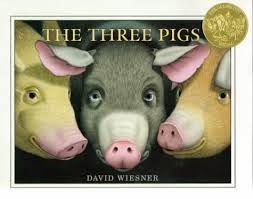
In David Wiesner's The Three Pigs (2001) the characters show an awareness that they are in a story (or blown out of it), which is metafictive.


In some metafictional books, readers of the story force the author to "change" the story. B. J. Novak's hit, The Book With No Pictures (2014), doesn't so much change a story as force the person reading it aloud to say all kinds of crazy things. Watching young children react to this book is a sheer delight!


Spot the Plot: A Riddle Book of Book Riddles (2009), by J. Patrick Lewis and Lynn Munsinger, is an example of a book that references other books through clever riddle poems.


Perhaps my favorite new metafictional release is This book just ate my dog! (2014) by Richard Byrne. Using the physical conventions of the book, characters in the story keep disappearing into the gutter at the center. It takes a hefty shake by the reader to release them.


Why is metafiction so popular? Perhaps it is physical interaction added to the mental interaction that the reader experiences.  Perhaps it is the capacity for quirky humor, as many metafictional books are funny ones. Philip Nel says that "the best metafictional works can encourage readers to reflect upon what they're reading or watching, allowing them to step outside of some of the conceptual boxes that enclose them...[They] invite readers to question rather than accept received realities." I love Mac Barnett's reflection that he works very hard to break the fourth wall in the opposite direction -- he doesn't want the reader to enter into the book, he wants his fiction to leak out into the world.

Check out some of the other books from the B&N display above and search for others on your library shelves. Then tell me, what are your favorite metafictional books, readers?

To hear Philip Nel talk about metafiction, click here.

To hear Mac Barnett's TED talk, click here.