
Today I have a special guest--my critique partner, Carrie Finison! Her picture book, HURRY, LITTLE TORTOISE, TIME FOR SCHOOL! published July 19th from Random House Studio. I've been able to follow this story from draft to picture book. As a kindergarten teacher, I also can't wait to use read it to my students. Welcome, Carrie!

I’m a picture book writer, not an illustrator, but over the years making a picture book dummy has become an essential part of my drafting and revising process.
Picture book dummies are well known in the domain of picture book author-illustrators. When an author-illustrator submits a story for publication, most often the submission includes a full-scale mockup of the book (pages that turn, with rough illustrations), some finished art samples, and the manuscript text. In my first few years of writing picture book texts, it never occurred to me to try and make a dummy. I can’t draw, right? What’s the point?
But once I tried it, I discovered that making a dummy — with pages that actually turn — helped my writing immensely. A dummy allows me to see how my story flows from page to page, whether there is enough change from scene to scene, whether I’m using the suspense and drama of the page turn adequately, whether the amount of text on each page is comparable, and simply put, how it feels to read the story as a “real” book.
Here's an example of how the process of making dummies helped me refine the text of my recently-released book, HURRY, LITTLE TORTOISE, TIME FOR SCHOOL, ultimately illustrated by Erin Kraan, but first illustrated by me with stick figures!

First, some background. The dummies I make are small. I make them by folding 4 pieces of printer paper in half so that I have a booklet that measures 5.5 inches wide and 8.5 inches tall. Then I cut that booklet in half, right in the middle, so that I have two smaller booklets that measure 5.5 inches wide and 4.25 inches tall. Each of these smaller booklets has 16 pages. At this point, I insert one booklet into the other for a 32-page book. Sometimes I staple along the spine, but it’s not really necessary.
(For a little more information on picture book structure, here’s a recent and excellent post from SCBWI Southern California about why picture books are 32 pages)

You could achieve the same thing simply by folding 8 sheets of paper in half. The reason I like to make smaller dummies is so that I can carry them around with me, in my purse or jacket pocket, to read and make changes whenever I have a spare moment, especially while I am waiting around at my kids’ various practices, lessons, and so on.
When I first got the idea for HURRY, LITTLE TORTOISE, TIME FOR SCHOOL, I knew that it would push my dummying skills into overdrive, for a few reasons.
First, I envisioned that the story would actually use the physical structure of the book as part of the storytelling. Little Tortoise begins her journey on the far-left side of the first two-page spread. As the story progresses, she moves, inch-by-inch, toward the far-right side of the scene. This visually mirrors the slowness of her journey.
Second, I wanted to use both dialogue bubbles and onomatopoeia in the story. Both of these needed to appear near the characters that were speaking or making sounds, but also needed to flow from left to right on the page in an order that made sense to the reader.
This is the first dummy I made for the book. At this point, the main character was actually “Mr. Tortoise” and he was hurrying somewhere for reasons that remained mysterious. The fact that he was a teacher and running late for school was not revealed until the end of the story.

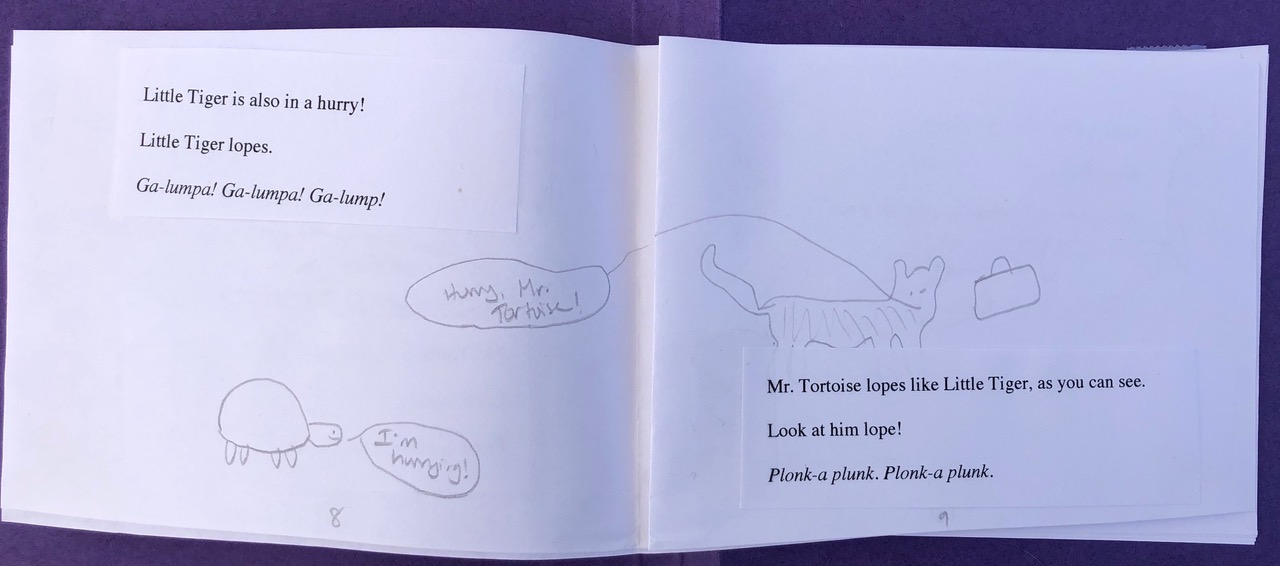
To add the text to my blank dummy booklet, I reformatted the text in my manuscript to have a 1-inch margin on the left side and a 3-inch margin on the right side. This means the text occupies about 4.5 inches in width, and therefore will fit onto the pages of my 5.5-inch wide dummy. Then I print the text and cut out the text blocks for each page, and tape them into the book.
There are probably lots of other ways to do this, but I like the freedom this method gives me to position text on the page, take it out again and cut it up differently, and so on. I also like working with my hands and this method takes some time with all the cutting and taping, which is great for when I need a break from staring at my computer screen!
Usually, I repeat this dummy process two or three times. However, as I mentioned above, HURRY, LITTLE TORTOISE stretched my dummy-making to the limits, because I needed to make sure that the story would work with the physical structure of the book.
In order to make my life a bit easier, I ended up creating a document in Word to contain my dummy. I set a custom paper size in my printer settings (under Page Setup in Word), to 11 x 4.25 inches. This would ensure that the dummy that printed out was the same size as the ones I was used to working with. Then, on each page of the document, I created a two-column table, with borders.

I used stock-photo silhouettes to position my animal characters exactly where I wanted them on the page, and typed my text right into the document, rather than my tried-and-true taping method.
When I printed the dummy, I cut out the “pages.” After that, there was some finagling with taping the front and back of each page together so that the story would flow correctly. But of course, all that taping gave me a break from the computer so that was fine with me.


Finally, after many drafts, suggestions from my critique groups and agent, Mr. Tortoise became Little Tortoise, and Little Tortoise landed a publishing contract (in addition to being on time for school)!


The bottom line is, reading a picture book is a physical
experience. As writers, it can immensely benefit us to recreate that physical
experience, as nearly as possible, as part of the drafting process.
If you have another method for making a picture book dummy, be sure to share it in the comments!
HURRY, LITTLE TORTOISE, TIME FOR SCHOOL!
Written by Carrie Finison
Illustrated by Erin Kraan
Random House Studio, July 19, 2022
Thank you so much, Carrie, for sharing the dummy process for your new book!

Carrie Finison writes picture books with humor and heart, including Dozens of Doughnuts (Putnam, 2020), a Junior Library Guild selection; and Don’t Hug Doug (Putnam, 2021), an ALA Notable Children’s Book, which received starred reviews from both Kirkus and Publishers Weekly. Her most recent picture books are Lulu & Zoey: A Sister Story (Running Press Kids, 2022), and Hurry, Little Tortoise, Time for School! (Random House Studio, 2022). She lives outside of Boston with her husband, son, and daughter, and two cats who permit her to work in their cozy attic office. For updates and giveaways, subscribe to her newsletter, check out her website, or follow on Twitter or Instagram.


