Showing posts with label revising a picture book. Show all posts

Wednesday, February 24, 2021

Talking to Your Reader with Second Person POV--Guest post by Carrie Finison

Today I (Tina Cho) welcome my writing friend and one of my critique partners--Carrie Finison! Her latest picture book, Don't Hug Doug, hit bookstores the end of January. Carrie is sharing some expert advice on writing in second person point of view and benefits of doing so. Take it away, Carrie!


As I shared recently on Beth Anderson’s blog, the early drafts of my picture book DON’T HUG DOUG were all written in the third person, with a traditional narrative arc. An early draft of the manuscript began this way:


One day, when Doug was hammering and gluing and generally minding his own business, some relatives stopped by. They’d been invited to lunch.

Aunt Muriel wrapped him in a pillowy, billowy embrace. “Such twirly curls! And such big, brown, puppy dog eyes!”

“He’s squishier than a jelly doughnut,” said Uncle Hank-the-Tank.

“Dug-ga-hug-ga,” babbled sticky Sukey.

They hugged him and squeezed him and squooshed him and smooshed him.

Their hugs made Doug feel as shriveled and wrung out as a week-old balloon. But he thought it would be rude to say so.

He tried going stiff, but they just hugged him tighter. He tried going limp, but they just hugged him longer…and longer…and LONGER.

I liked the story told this way, but I could not get the ending right. In one version, Doug built a robot for his relatives to hug instead of him. In another version, he adopted a puppy to soak up their attention. In another version, he set up a booby trap with a giant stuffed animal who took on their enthusiastic embraces.


While these endings were fun, and funny, they felt wrong because they didn’t truly solve Doug’s problem. Yes, he managed to avoid his relatives’ hugs — this time. But what about next time? Or the time after that? Eventually, he’d be right back where he started. His real problem wasn’t avoiding a single hug — it was getting his relatives to listen to him and accept the fact that he didn’t want hugs from them.


THAT problem felt insurmountable. How could Doug solve this problem? How could ANY kid solve it? The truth is, adults often don’t listen to children’s wishes when it comes to hugging (and lots of other things, too) — and often they don’t even think to ask in the first place.


Doug, I realized, could not force his relatives to listen to him — but I could. As the writer, I could make readers say things out loud. I could make them say things to each other. I could give them an invitation to interact — with the book, and with each other.


I rewrote the story in the second person point of view, addressing the reader. Here it is in published form:

The beauty of writing from the second person is that you create an interactive experience. In this case, I wanted both child and adult readers to have plenty of practice asking and answering the question, “Do you want a hug?” So I made them say it out loud, right in the text of the book. (Cue writerly cackle.)

And, I could give them a chance to physically practice a high five as an alterative to hugging.


By using the second person perspective, I was not only helping my main character make his wishes clear, but also giving readers space, practice, and opportunity to think about their own wishes, and perhaps verbalize them — the takeaway that I wanted for readers from the beginning.


Thinking more broadly, the second person point of view can be helpful in an array of circumstances:


-        You want your reader’s experience to be interactive — either verbally (the reader says things out loud) or physically (the reader physically interacts with the book in some way).

-        You want to immerse your reader in the experience of the main character. In these books, the narrator addresses the main character of the book as ‘you’ and the reader “becomes” the main character.

-        You want to persuade the reader.

-        You want to convey a familiar childhood experience in a humorous way.

 As always, the best way to get familiar with writing this way is by looking at mentor texts. Here are a few that demonstrate the broad range of what can be done with the second person point of view.

Don’t Feed the Coos by Jonathan Stutzman, illustrated by Heather Fox

Don’t Push the Button by Bill Cotter

The Elephant’s Guide to Hide and Seek by Kjersten Hays, illustrated by Gladys Jose

Flying Deep: Climb Inside Deep-Sea Submersible Alvin by Michelle Cusolito, illustrated by Nicole Wong

How Do You Dance? by Thyra Heder

How to Babysit a Grandpa by Jean Reagan, illustrated by Lee Wildish

How to Wear a Sari by Darshana Khiani, illustrated by Joanne Lew-Vriethoff

If You Decide to Go to the Moon by Faith McNulty, illustrated by Steve Kellogg

If Your Monster Won’t Go to Bed by Denise Vega, illustrated by Zachariah O’Hora

The Iridescence of Birds: A Book About Henri Matisse by Patricia MacLachlan, illustrated by Hadley Hooper

The Secret Code Inside You by Rajani LaRocca, illustrated by Steven Salerno

Warning: Do Not Open This Book! by Adam Lehrhaupt, illustrated by Matthew Forsythe

When Grandma Gives You a Lemon Tree by Jamie L.B. Deenihan, illustrated by Lorraine Rocha

When Your Elephant Has the Sniffles by Susanna Leonard Hill, illustrated by Daniel Wiseman

You DON’T Want a Unicorn by Ame Dyckman, illustrated by Liz Climo


Bio: Carrie Finison writes picture books with humor and heart, including DOZENS OF DOUGHNUTS (2020), DON'T HUG DOUG (2021), and the forthcoming HURRY, LITTLE TORTOISE, and LULU & ZOEY (2022). She lives in the Boston area with her family. For updates and giveaways, subscribe to her newsletter, check out her website or follow on TwitterFacebook, or Instagram.

Monday, April 27, 2015

Save the Scraps: Guest Post by Carrie Charley Brown

Revision ignites my thoughts… Oh, the possibilities!  And with so many directions to turn, why ignore any of them?  As writers, we are quick to dismiss an idea that doesn't sit right. If you are like me, typing most drafts directly into the computer, that little backspace action can permanently erase a perfectly good idea. Fast. But, what if you had kept your nearly dismissed ideas?

Most of us already have a bank for our initial ideas.  We know enough to write them down and stuff them into a special container, folder, or notebook. So, why not do this when revising, as well? It’s easy when we receive a critique back. Even if we aren't initially ready to accept the feedback, we can save it for later when our defense walls have dropped.

When writing first drafts, we all approach them a bit differently. In fact, I don't always do it the same way every time, either. Sometimes, I brainstorm the plot bones first. But mostly, I am a pantser. I just want to get the ideas on the paper and see where it leads me. That’s when I encounter the little angel/devil friends sitting on each shoulder.

Angel:  “Now, now, now…you need to follow the rules.”
Devil:  “Don’t listen to her. You’re going for unique. Live a little.”

Before hitting the delete key, copy and paste that idea and put it in a document dedicated to your manuscript. I use the title of my manuscript followed by the word “brainstorm” or “ideas.” The page looks like a hodgepodge, but at least the ideas are still there. It comes in super handy when revising.

I suppose I’m the same way when critiquing professionallyI like to share all of the ideas that pop into my mind, and the result is a very honest, detailed critique, that takes about two-four hours of my time. I would much rather share things ahead of time with a client. We value those first impression opportunities with agents and editors too much to waste them.

Through it all, you can always turn back to your hodge-podge of deleted phrases, sentences, and ideas. You can also turn to mentor texts and the countless articles that are posted online.  


If you have not yet joined an online writing community of some sort, the support is priceless. My go-to communities are the 12x12 PictureBook Challenge, PiBoIdMo, ReviMo, KidLit 411and my own ReFoReMo . Each community has a Facebook group where writers can ask questions, recommend mentor texts, and share valuable articles found on the Internet.

So, back to that critique we saved for later. Now that the ideas have sat in the back of our minds, we'll be open to experimenting. Don’t be afraid to start a rewrite or let your plot go in a new direction. You’ll never really know if it works unless you try it. You might have 20 different versions that include 3 different points of view, 5 different plots, and varied word lengths. That’s okay. It’s part of getting to know your story and finding the one that clicks. It’s also part of being open to growth and finding your best inner editor. It will take some time. Be patient with the process and enjoy the opportunities that revision places before you.

Carrie Charley Brown is a professional critique mentor with an editorial eye. She is the founder of ReFoReMo, a research challenge for picture book writers. Carrie is a children’s writer and contributor at Writer’s Rumpus and Kids Are Writers. She was a 2014 CYBILS award fiction picture book panelist and was formerly an elementary teacher. You can follow her writing journey at www.carriecharleybrown.com. 


Wednesday, September 17, 2014

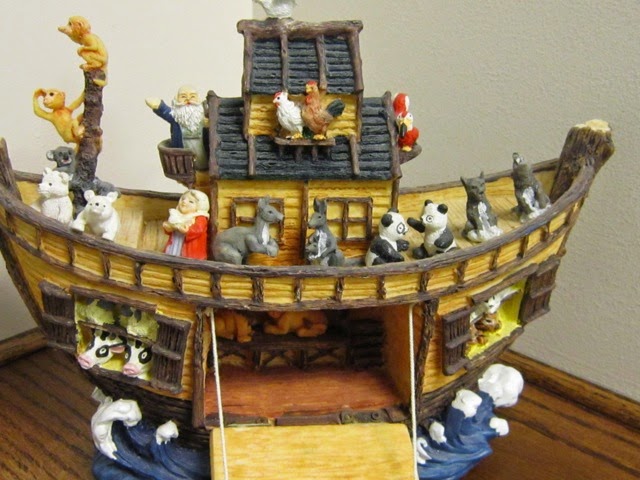
Staying AFLOAT with Picture Book Author Laura Sassi: 4 Writerly Things I Learned From Noah & his Ark (And a GIVEAWAY!)

I want to welcome one of my writing buddies, Laura Sassi, to the Grog blog.  I'm so proud of Laura, because she's on a blog tour for her debut picture book, Goodnight, Ark, published by Zonderkidz. I've had the opportunity to read it, and some special person will win a copy here. (U.S. residents only)

Take it away, Laura...

Thank you for hosting me on my first ever blog tour! I’m so excited that GOODNIGHT, ARK is finally afloat, but the journey to this point was not easy. I spent two years getting my story ready to float. Was all that time worth it? You bet. 

Now, in celebration of the release of GOODNIGHT, ARK, here are four things Noah and his ark have taught me about getting boats, er stories, to float. 

Don’t expect your boat to float overnight. When I first got the idea for GOODNIGHT, ARK my mind whirred with possibilities. Which animals would be scared of what?  How would they get to Noah’s bed? And how would Noah ever comfort them and return them to their bunks?  I knew early on that I wanted to write the story in rhyme but finding the perfect meter and line length did not come easily. So I played around with plot and form again, and again, and again. Each time I finished a draft, I’d put it away and work on other things for several weeks so I could see it with fresh eyes. I repeated this cycle for two years and each time the story improved so much that it ended up with two offers! That experience has taught me not to worry about how long a story is taking me to write. Instead, I relax and let creativity work at its own pace until my stories are buoyant and ready to set sail.

Every ARK needs an ARC. Even with all that revising, my agent thought the initial version of GOODNIGHT ARK I sent her was too quiet. In that early version, the storm escalated and animals kept piling in, but there was no sense of rising action or urgency in resolving the night-time pile up. Except for the fact that the animals changed, the scenes were essentially static. In other words what the ark needed was an arc! The story still needed to be soothing for littlest readers, so I knew any tension/ rising action I infused had to be playful and fun. It took many hours of writing and re-writing, but I hope readers will agree that the final version with its ark tipping, bed crashing buildup and stinky, yet ultimately soothing, resolution is anything but static. I now analyse all my stories for effective rising action, climax, and resolution early on in the writing process. One way I do this is by making a 32-page dummy. That way it’s easy to see if your scenes are static as they build across 14 - 15 spreads or if there’s a sense of rising action etc. Plus, it’s a lot of fun, especially if you have little ones at home who like illustrating your dummies!


Don’t overload the decks. Noah’s ark was sturdy and well-planned with three decks, but though Noah may have been tempted to bring aboard extra animals, thank goodness, he showed restraint and took only two of each. Overcrowding would have put a strain on provisions. Worse yet, the ark might have capsized! Likewise, as a writer, I’m sometimes tempted to overcrowd my story with cute phrases and details that only weigh down the plot. During early stages of a project, I don’t worry about overwriting. My goal at that point is simply to build my story. Before I let it out of the port, however, I make sure to streamline the plot so every word and event pushes the story forward.

Everything’s better with a buddy. Noah didn’t try to build the ark all alone. His family cheered him on and pitched in with the building, providing much needed moral support amid the taunts and jeers of the onlookers. Likewise, I’ve found that the long, hard journey to publication just wouldn’t be the same without a nice support system. For me this includes my family, my lovely agent, and the wonderful network of like-minded children’s writers I’ve connected with over the years, many of whom have become dear friends and trusted critique partners. So, my last bit of ark-themed advice for staying afloat and giving your stories a floating chance, is to find a writing buddy or two to join you on the journey!


BIO:Laura’s poems, stories, articles and crafts have appeared in many publications including Highlights for Children, Cricket, Ladybug, Spider, Focus on the Family’s Clubhouse and Clubhouse Jr., FamilyFun, and Pack-O-Fun. GOODNIGHT, ARK, published by Zonderkidz, a HarperCollins Company, and illustrated by Jane Chapman is her first picture book. She is represented by Lara Perkins of the Andrea Brown Literary Agency. Laura writes from her century-old home in New Jersey where she lives with her awesome husband, two adorable kids, and a black cockapoo named Sophie. You can also find her on her blog, Facebook, and Twitter. 

Leave a comment for Laura here and sign on the Rafflecopter to be entered into a drawing to win her new picture book, Goodnight, Ark. To be eligible, you must be a U.S. resident and have a physical address, not a P.O. Box. Thanks! Drawing will be held Sunday 9/21 after 8 pm CST.
a Rafflecopter giveaway