Showing posts with label writing a picture book. Show all posts

Wednesday, July 27, 2022

Picture Book Dummies for Smart Writers by Guest Author Carrie Finison

Today I have a special guest--my critique partner, Carrie Finison! Her picture book, HURRY, LITTLE TORTOISE, TIME FOR SCHOOL! published July 19th from Random House Studio. I've been able to follow this story from draft to picture book. As a kindergarten teacher, I also can't wait to use read it to my students. Welcome, Carrie!

I’m a picture book writer, not an illustrator, but over the years making a picture book dummy has become an essential part of my drafting and revising process. 

Picture book dummies are well known in the domain of picture book author-illustrators. When an author-illustrator submits a story for publication, most often the submission includes a full-scale mockup of the book (pages that turn, with rough illustrations), some finished art samples, and the manuscript text. In my first few years of writing picture book texts, it never occurred to me to try and make a dummy. I can’t draw, right? What’s the point?

But once I tried it, I discovered that making a dummy — with pages that actually turn — helped my writing immensely. A dummy allows me to see how my story flows from page to page, whether there is enough change from scene to scene, whether I’m using the suspense and drama of the page turn adequately, whether the amount of text on each page is comparable, and simply put, how it feels to read the story as a “real” book.

Here's an example of how the process of making dummies helped me refine the text of my recently-released book, HURRY, LITTLE TORTOISE, TIME FOR SCHOOL, ultimately illustrated by Erin Kraan, but first illustrated by me with stick figures!

First, some background. The dummies I make are small. I make them by folding 4 pieces of printer paper in half so that I have a booklet that measures 5.5 inches wide and 8.5 inches tall. Then I cut that booklet in half, right in the middle, so that I have two smaller booklets that measure 5.5 inches wide and 4.25 inches tall. Each of these smaller booklets has 16 pages. At this point, I insert one booklet into the other for a 32-page book. Sometimes I staple along the spine, but it’s not really necessary.

(For a little more information on picture book structure, here’s a recent and excellent post from SCBWI Southern California about why picture books are 32 pages)

You could achieve the same thing simply by folding 8 sheets of paper in half. The reason I like to make smaller dummies is so that I can carry them around with me, in my purse or jacket pocket, to read and make changes whenever I have a spare moment, especially while I am waiting around at my kids’ various practices, lessons, and so on.

When I first got the idea for HURRY, LITTLE TORTOISE, TIME FOR SCHOOL, I knew that it would push my dummying skills into overdrive, for a few reasons.

First, I envisioned that the story would actually use the physical structure of the book as part of the storytelling. Little Tortoise begins her journey on the far-left side of the first two-page spread. As the story progresses, she moves, inch-by-inch, toward the far-right side of the scene. This visually mirrors the slowness of her journey.

Second, I wanted to use both dialogue bubbles and onomatopoeia in the story. Both of these needed to appear near the characters that were speaking or making sounds, but also needed to flow from left to right on the page in an order that made sense to the reader.

This is the first dummy I made for the book. At this point, the main character was actually “Mr. Tortoise” and he was hurrying somewhere for reasons that remained mysterious. The fact that he was a teacher and running late for school was not revealed until the end of the story.

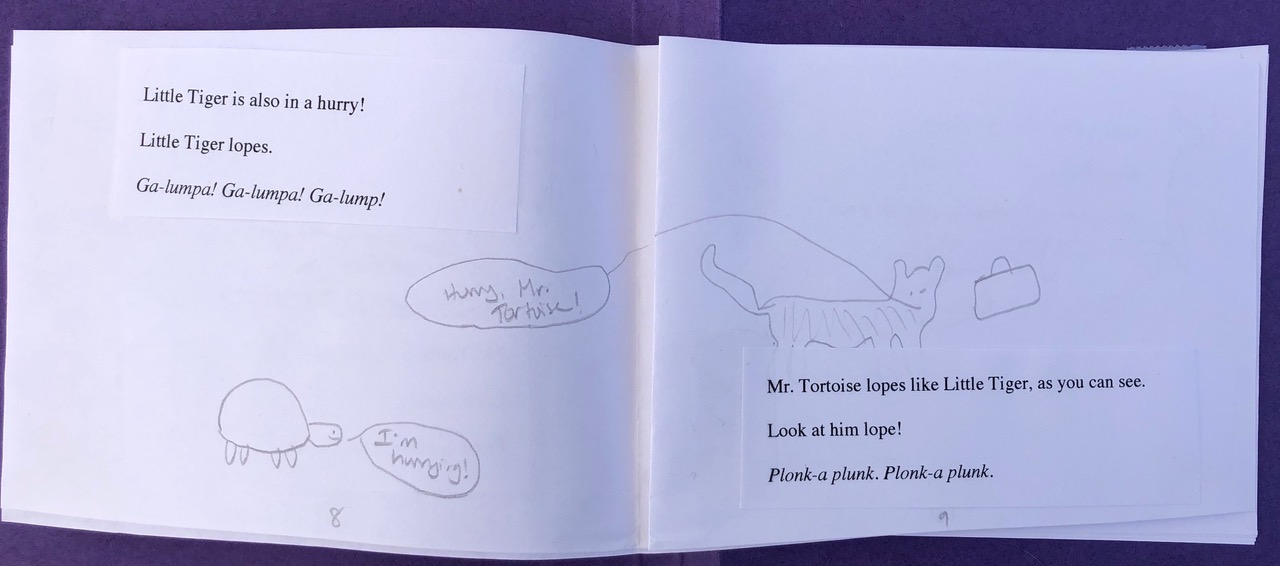
To add the text to my blank dummy booklet, I reformatted the text in my manuscript to have a 1-inch margin on the left side and a 3-inch margin on the right side. This means the text occupies about 4.5 inches in width, and therefore will fit onto the pages of my 5.5-inch wide dummy. Then I print the text and cut out the text blocks for each page, and tape them into the book.

There are probably lots of other ways to do this, but I like the freedom this method gives me to position text on the page, take it out again and cut it up differently, and so on. I also like working with my hands and this method takes some time with all the cutting and taping, which is great for when I need a break from staring at my computer screen!

Usually, I repeat this dummy process two or three times. However, as I mentioned above, HURRY, LITTLE TORTOISE stretched my dummy-making to the limits, because I needed to make sure that the story would work with the physical structure of the book.

In order to make my life a bit easier, I ended up creating a document in Word to contain my dummy. I set a custom paper size in my printer settings (under Page Setup in Word), to 11 x 4.25 inches. This would ensure that the dummy that printed out was the same size as the ones I was used to working with. Then, on each page of the document, I created a two-column table, with borders.

I used stock-photo silhouettes to position my animal characters exactly where I wanted them on the page, and typed my text right into the document, rather than my tried-and-true taping method. 

When I printed the dummy, I cut out the “pages.” After that, there was some finagling with taping the front and back of each page together so that the story would flow correctly. But of course, all that taping gave me a break from the computer so that was fine with me.


Finally, after many drafts, suggestions from my critique groups and agent, Mr. Tortoise became Little Tortoise, and Little Tortoise landed a publishing contract (in addition to being on time for school)!


The bottom line is, reading a picture book is a physical experience. As writers, it can immensely benefit us to recreate that physical experience, as nearly as possible, as part of the drafting process.

If you have another method for making a picture book dummy, be sure to share it in the comments! 

HURRY, LITTLE TORTOISE, TIME FOR SCHOOL!

Written by Carrie Finison

Illustrated by Erin Kraan

Random House Studio, July 19, 2022

Thank you so much, Carrie, for sharing the dummy process for your new book! 


Carrie Finison writes picture books with humor and heart, including Dozens of Doughnuts (Putnam, 2020), a Junior Library Guild selection; and Don’t Hug Doug (Putnam, 2021), an ALA Notable Children’s Book, which received starred reviews from both Kirkus and Publishers Weekly. Her most recent picture books are Lulu & Zoey: A Sister Story (Running Press Kids, 2022), and Hurry, Little Tortoise, Time for School! (Random House Studio, 2022).
She lives outside of Boston with her husband, son, and daughter, and two cats who permit her to work in their cozy attic office. For updates and giveaways, subscribe to her newsletter, check out her website, or follow on Twitter or Instagram.


Thursday, December 1, 2016

The 12 Days of Christmas in Kentucky with Evelyn Christensen--by Tina Cho

I'm so happy to have my good friend, Evelyn Christensen and her debut picture book, The Twelve Days of Christmas in Kentucky, on the blog! Welcome back, Ev! (To see a previous interview with Ev, check here.)

Evelyn Christensen

Could you tell the Grog readers how you landed the contract to write this book?

This is definitely one of those ‘don’t give up hope’ stories. I used to belong to a wonderful, online picture book critique group with Tina. Our group moderator at the time was Nancy Sanders. Nancy, a very successful children’s author herself, is incredibly generous in trying to help other authors be successful. About seven years ago, she shared with our group that Sterling was doing a Christmas state PB series. She thought it would be fun if all of us queried Sterling about authoring one of the books, so I queried about Kentucky. I got no response. For more than five years. Crickets. I had long since written that venture off as one of the many things we writers do in this authoring business that don’t bear fruit. Then, just before Christmas in 2014, I got an email—“I know this will be a bolt out of the blue, but do you remember writing a letter to me....” It was the editor saying they were ready to do Kentucky and asking if I wanted to ‘audition’ to be the author by writing a sample page for the book. Of course, I wanted to! I wrote my sample, and several months later was delighted to hear I had been chosen from among all those auditioning.

Did you have to do much research?

Yes. I did online research, book research, telephone and email research, and actually visiting locations. I wanted to be able to do more visits and go to all the places I wrote about, but the tight timeline the publisher gave me simply did not allow that.

Christmas in Kentucky


How did you decide what special Kentucky places and people to include?

That was hard, because our state has so many wonderful places and people. The publisher had some constraints for the series that guided some of my decisions. For example, all the places the children in the book visited had to be places that could actually be visited during the Christmas season. That cut out a lot of our fun state parks, which are closed in the winter or have very limited activities. The children’s itinerary also had to be ‘doable’ in the time frame described, because, as my editor said, some people use these books as travel guides. So I had to calculate mileage between sites and travel time. I also needed to pick activities that were in as broad a range of places in our state as possible, so the whole state would feel represented.

I was really glad for the bulletin board at the end of the book, where I could include lots of the special places and people in Kentucky that I didn’t have space for in the twelve days.

How long did it take to write the book?

As I said, the publisher had a pretty tight schedule for the book. I had one month to decide on the itinerary and all the gifts Marybeth was giving to her visiting cousin Martin. This had to be approved by the editor. Then I had one month to write the letters, decide on the bulletin board items, write the back matter, and write detailed illustration notes with online links to the places being visited. 

Handmade stockings


Did you have to do many revisions?

Not many revisions to the text. Mostly just line edit sorts of things. One funny example of that—I had referred to a basketball ‘goal.’ The editor changed it to ‘hoop.’ That just didn’t sound right to me, so I asked on the SCBWI Blueboard. Turns out most people do call it a ‘hoop.’ But we don’t in Kentucky. I told my editor, if we want universality we’ll go with ‘hoop,’ but if we want to be true to Kentucky, we’ll leave it ‘goal.’ She loved the variation and ended up including both in the text.

I did do several revisions on the itinerary and gift list. I didn’t want the kids to spend so much time traveling to western Kentucky, and had planned for a friend to visit from there and share with them about quilts and the museum. But my editor felt it was important for them to go there, so that necessitated rearranging a lot of the plans.

What has been a special moment for you in the writing of this book?

A very surprising moment had to do with the Newport Aquarium. I had decided from the beginning that I didn’t want to focus on things that were just commercially fun or special. I wanted everything to have a tie in with Kentucky. At first, that ruled out the aquarium, but then I thought, “Oh, I can have the kids see the Kentucky state fish there.” Since my editors had said everything had to be factual, I emailed the aquarium to make sure they had the state fish. They didn’t. BUT—they said they would stock it just so my book could include it! I thought that was really cool.

Christmas in Kentucky: The real meaning

What's your plan for marketing? Does the publisher help?


This has been a totally different experience for me from writing educational puzzle books, which required no marketing. Since the book came out in October and is a seasonal book, the marketing has been jam-packed into just a few weeks. I’ve had 5 book signings, with 3 more scheduled; 3 blog interviews; a Goodreads giveaway; articles/book reviews in print and online state newspapers/magazines, and, of course, I’ve been using Facebook and Twitter.

Publisher help? My Sterling publicist set up the Goodreads give-away and the four out-of-town book signings. The Marketing Team did a great job of creating an Activity Kit to go with the book that included five puzzles I sent them. (http://evelynchristensen.com/12daysXmasKYactivities.html) They also designed very attractive cards with ordering information on the back that I can give out to managers of gift shops and bookstores when I visit them.

Christmas in Kentucky

What’s it like to have your first picture book published?

It’s been a wonderful experience! People have been amazingly enthusiastic about the book and so encouraging and supportive. I think a large part of it is that it’s not about me. It’s that the book is about their beloved state. And they want to share what’s special about Kentucky with the children in their lives. I handed a signed copy to one friend who’d gotten it for her out-of-state grandchildren, and when she read the inscription, she whispered, “Perfect!” and hugged it to her with tears in her eyes. I’d written, “Hoping this helps you to cherish your Kentucky roots.”

What are you working on now?

Mainly, marketing this book. I did just sign a contract with an ESL publisher for a chapter book. They’ve asked for other books from me, so I’m cogitating on that. I’m also trying to digitally format more of my out-of-print puzzle books so I can make them available in my Teachers Pay Teachers store. (https://www.teacherspayteachers.com/Store/Evelyn-Christensen-Puzzles-math-and-more


"On the 5th day of Christmas, my cousin gave to me....5 golden bars..."


For fun:

Favorite color: yellow
Food: Turtles (chocolate, caramel, pecans)
Children’s author: Dr. Seuss
Children’s book: The Cat in the Hat

If you could travel anywhere in the world, where would you go and why?
New Zealand, because lots of my family have visited there and it sounds beautiful!

Bio:
A former teacher with a doctorate in education, Ev loves to make learning fun for kids. She has designed several math games and authored more than 40 educational puzzle books. She’s also editor of the ezine Writing for Children’s Magazines. Ev lives with her husband Ralph (who’s always been super supportive of her writing career) in Lexington, KY and delights in playing with her five pre-school grandchildren. 


Monday, April 13, 2015

How to Write a Children's Picture Book: The Home Version by Pat Miller

I didn’t earn an MFA in writing. I simply started writing as a kid, and haven’t stopped. But I have longed for courses in writing. When the cursor blinks relentlessly on the blank page, when my prose is limp and my imagination is indolent, I definitely feel my lack of training.

Then I discovered and read the three-book series, How to Write a Children’s Picture Book by Eve Heidi Bine-Stock. They don’t replace a MFA, but Bine-Stock has definitely schooled me in how to energize my writing and motivate my imagination. You can get the same one-on-one attention with her titles. Let’s take a look.

The first book is How to Write a Children’s Picture Book: Structure. It uses 26 favorites from the New York City Public Library’s list, “100 Picture Books Everyone Should Know” as exemplars. The goal is not to study the plots, characters, settings, and so on. It’s to analyze the underlying story structure so it can be replicated. In fact, if you don’t have the bones of structure underneath, the story elements won’t hang right, no matter how much you revise. No wonder my prose was limp.


Though it has less than 200 under-sized pages, this book is a master’s course. In Part One, she uses books like Ten, Nine, Eight by Molly Bang and Goodnight Moon by Margaret Wise Brown to reveal the two-part structure of many concept books. Use her analysis of these deceptively simple books if you are writing a similar book.

In Part Two, Bine-Stock reveals what she calls the Symmetrical Picture Storybook Paradigm, “which underlies most of the best-loved picture storybooks.” This is such a fresh concept that Bine-Stock developed her vocabulary based on screenwriting. She shows how Leo the Late Bloomer by Robert Kraus has three acts separated by two plot twists. And those acts are symmetrically divided into 7-9-7 pages. This is one of fifteen classics that Bine-Stock deconstructs, and her chart lets you apply what you learn to your own WIPs.

Part Three uses Millions of Cats by Wanda Gag and Mike Mulligan and His Steam Shovel by Virginia Lee Burton to take you through what Bine-Stock calls The Iterative Paradigm. Then she says enough with the showing, now it’s your turn. The last section is a blueprint “to plan and structure your picture story-book before you sit down to write it.” Wow--here's the X on the writer’s treasure map.  

One course does not an MFA make, nor does one book tell you all you need to know as a writer. But wait! There’s more! Volume II: Word, Sentence, Scene, Story is not what you think. Don’t expect to learn about vivid verbs, grabby sentences, convincing scenes, and story arcs—things you probably already know. 


Instead, Bine-Stock talks about focus and rhythm, cohesion, action and reaction. She talks about beginning and ending scenes. She explains storytelling strategies based on problem first, character first, background first, or action first. But Bine-Stock is more than talk. She shows how easily acquired books like Caps for Sale and Harry the Dirty Dog use these techniques. She’s all about showing as well as telling.


The final book in the series is Volume III: Figures of Speech. By now you know to expect the unexpected, the fresh, the truly helpful from Eve Bine-Stock. This is not the book of metaphors, similies, or idioms. 


Instead, you will learn to freshen and intensify your work with figures of speech like epizeuxis, immediate repetition like that found in Lyle, Lyle Crocodile. Or, in the same book, a kind of repetition called anadiplosis—repeating the end of a prior sentence in the beginning of the next.

This is the house.
The house on East 88th Street.
Mr. and Mrs. Primm
and their son Joshua
live in the house
                               on East 88th Street.

Though impressive, the unusual names of these figures of speech aren’t important. But the examples in children’s literature and the possibilities for your own work are immensely important. You will see first-hand how these figures contribute to the emotional power and memorable quality of these classics--and you will have real tools to enrich your own work. 

These books are readily available online, new and used. They are much easier on your budget than tuition in an MFA program, but may very well impact your work as much. Give this three “semester” course on How to Write a Children’s Picture Book a try!

Wednesday, September 17, 2014

Staying AFLOAT with Picture Book Author Laura Sassi: 4 Writerly Things I Learned From Noah & his Ark (And a GIVEAWAY!)

I want to welcome one of my writing buddies, Laura Sassi, to the Grog blog.  I'm so proud of Laura, because she's on a blog tour for her debut picture book, Goodnight, Ark, published by Zonderkidz. I've had the opportunity to read it, and some special person will win a copy here. (U.S. residents only)

Take it away, Laura...

Thank you for hosting me on my first ever blog tour! I’m so excited that GOODNIGHT, ARK is finally afloat, but the journey to this point was not easy. I spent two years getting my story ready to float. Was all that time worth it? You bet. 

Now, in celebration of the release of GOODNIGHT, ARK, here are four things Noah and his ark have taught me about getting boats, er stories, to float. 

Don’t expect your boat to float overnight. When I first got the idea for GOODNIGHT, ARK my mind whirred with possibilities. Which animals would be scared of what?  How would they get to Noah’s bed? And how would Noah ever comfort them and return them to their bunks?  I knew early on that I wanted to write the story in rhyme but finding the perfect meter and line length did not come easily. So I played around with plot and form again, and again, and again. Each time I finished a draft, I’d put it away and work on other things for several weeks so I could see it with fresh eyes. I repeated this cycle for two years and each time the story improved so much that it ended up with two offers! That experience has taught me not to worry about how long a story is taking me to write. Instead, I relax and let creativity work at its own pace until my stories are buoyant and ready to set sail.

Every ARK needs an ARC. Even with all that revising, my agent thought the initial version of GOODNIGHT ARK I sent her was too quiet. In that early version, the storm escalated and animals kept piling in, but there was no sense of rising action or urgency in resolving the night-time pile up. Except for the fact that the animals changed, the scenes were essentially static. In other words what the ark needed was an arc! The story still needed to be soothing for littlest readers, so I knew any tension/ rising action I infused had to be playful and fun. It took many hours of writing and re-writing, but I hope readers will agree that the final version with its ark tipping, bed crashing buildup and stinky, yet ultimately soothing, resolution is anything but static. I now analyse all my stories for effective rising action, climax, and resolution early on in the writing process. One way I do this is by making a 32-page dummy. That way it’s easy to see if your scenes are static as they build across 14 - 15 spreads or if there’s a sense of rising action etc. Plus, it’s a lot of fun, especially if you have little ones at home who like illustrating your dummies!


Don’t overload the decks. Noah’s ark was sturdy and well-planned with three decks, but though Noah may have been tempted to bring aboard extra animals, thank goodness, he showed restraint and took only two of each. Overcrowding would have put a strain on provisions. Worse yet, the ark might have capsized! Likewise, as a writer, I’m sometimes tempted to overcrowd my story with cute phrases and details that only weigh down the plot. During early stages of a project, I don’t worry about overwriting. My goal at that point is simply to build my story. Before I let it out of the port, however, I make sure to streamline the plot so every word and event pushes the story forward.

Everything’s better with a buddy. Noah didn’t try to build the ark all alone. His family cheered him on and pitched in with the building, providing much needed moral support amid the taunts and jeers of the onlookers. Likewise, I’ve found that the long, hard journey to publication just wouldn’t be the same without a nice support system. For me this includes my family, my lovely agent, and the wonderful network of like-minded children’s writers I’ve connected with over the years, many of whom have become dear friends and trusted critique partners. So, my last bit of ark-themed advice for staying afloat and giving your stories a floating chance, is to find a writing buddy or two to join you on the journey!


BIO:Laura’s poems, stories, articles and crafts have appeared in many publications including Highlights for Children, Cricket, Ladybug, Spider, Focus on the Family’s Clubhouse and Clubhouse Jr., FamilyFun, and Pack-O-Fun. GOODNIGHT, ARK, published by Zonderkidz, a HarperCollins Company, and illustrated by Jane Chapman is her first picture book. She is represented by Lara Perkins of the Andrea Brown Literary Agency. Laura writes from her century-old home in New Jersey where she lives with her awesome husband, two adorable kids, and a black cockapoo named Sophie. You can also find her on her blog, Facebook, and Twitter. 

Leave a comment for Laura here and sign on the Rafflecopter to be entered into a drawing to win her new picture book, Goodnight, Ark. To be eligible, you must be a U.S. resident and have a physical address, not a P.O. Box. Thanks! Drawing will be held Sunday 9/21 after 8 pm CST.
a Rafflecopter giveaway