Showing posts with label collaboration writing. Show all posts

Wednesday, August 12, 2020

Giveaway and Interview with Picture Book Writer Kirsti Call ~ by Christy Mihaly

A big GROG welcome to picture book author Kirsti Call. Kirsti is offering a signed ARC (advance copy) of her forthcoming picture book, Mootilda's Bad Mood ... just comment and/or tweet to be entered in our giveaway (details below)! 

   GROG:  Welcome, Kirsti! I know that in addition to writing, you co-host the new Picture Book Look podcast, and you're a Cybils judge and co-coordinator of Reading for Research Month (ReFoReMo). 
    Before we talk about your books, please tell us a little about ReFoReMo. What does it involve, and why should GROG readers participate?

    Kirsti: ReFoReMo was originally Carrie Charley Brown’s idea, and when she asked me to join in on the fun, I was thrilled. We had both judged for the Cybils awards, which helped us understand how reading great books helps us write great books. Paying attention to what I love about a story, and attempting to add those elements into my own stories, is one of my favorite ways to improve my writing. We wanted to share that with others.

Well, thanks to you and ReFoReMo for sharing all those mentor text insights. What more should our readers know about ReFoReMo?
    Kirsti: ReFoReMo is not only for writers, but for librarians, teachers, and kids. Though we post every Tuesday all year long, March is our challenge month. That's when authors, educators, librarians, agents and editors share insights and favorite mentor texts that we can read and learn from. 

ReFoReMo is a great resource for anyone who loves picture books. Now, what can you tell us about judging the Cybils?

A: For the last six years, I’ve read all 300-ish nominated picture books for the Cybils award over a two-month period. This picture book overload totally helps me understand the market, what editors love, and what I love about picture books.

Read, read, read, right? Kirsti, you're also a marriage and family therapist. Does that work give you story ideas or otherwise inform your children's books?

Kirsti: I love using bibliotherapy in my work as a therapist. Reading and discussing books in therapy helps people process and heal. This work definitely influences my stories and what I write. In fact, if you read my forthcoming picture book, Mootilda’s Bad Mood (Sept. 1, 2020, Little Bee), you'll notice a very obvious connection between the story and my work as a therapist. 

Spread from Mootilda: "We're in a bad mooooooood!"
Mootilda's Bad Mood is co-written with Corey Rosen Schwartz and illustrated by Claudia Ranucci. It's about a cow in a bad mood. Where did this fun idea come from?
cover

   Kirsti: Corey and I joke about her being in a bad mood and me being in a good mood all the time.  We thought it would be fun to take that dynamic and explore how a cow in a bad mood would approach life ... and overcome all the cow-tastrophes that make her feel worse and worse. 


Uh-oh, cow-pun alert!! Kirsti, how does the co-writing process work differently from solo writing?

MOOTILDA swag!
   Kirsti: Corey and I have written many manuscripts together. In fact, we have another book coming out in the fall of 2021 with Little Brown. It’s called "Cold Turkey!" Writing together involves lots of texts and messaging in google docs and talking on the phone. It’s a much more social than writing solo.

  Big congratulations on Mootilda, Kirsti (and Corey and Claudia). I'm sorry, though, about the timing.
How have you been promoting your new book in the midst of the covid-19 closures and cancellations?
Book Launch in the Time of Covid (Sept.5)

Kirsti: Little Bee is planning a virtual book tour that we’re excited to participate in. We have a couple of virtual events coming up on Sept. 5 at The Writing Barn, and Sept. 8 at An Unlikely Story. We’re also considering a socially distanced book launch at a farm featuring cows and ice-cream. We’ve created some digital assets that we’ll be offering with pre-sales. In fact ...

** ALERT! GROG Bonus! **  


... if any GROG readers pre-order Mootilda, they can DM me on Twitter, Facebook, or Instagram to receive a signed bookplate, sticker, and mood-o-meter coloring page. 

We’re trying to be creative in these uncertain times. But one thing I am certain of, "Mootilda's Bad Mood" is something that will resonate with many people given the pandemic.

    These days it takes extra imagination and energy to get our books into readers' hands. Good luck with your launch! What else would you like GROG readers to know about you and your books?

    Kirsti: I’m super excited about another book that’s coming out with HMH in March—Cow Says Meow. I’m not certain why all of my upcoming books feature farm animals, but I do have a pair of cow shoes I can wear for each release date! 
    
Kirsti Call (whose cow shoe [and foot] appears below) is the co-host of the new Picture Book Look podcast and co-coordinator of ReFoReMo. She reads, reviews, revises and critiques every day as an "elf" for the 12x12 Picture Book Challenge, a blogger for Writer's Rumpus, and a critique group member. She's judged the Cybils award for fiction picture books since 2015. Kirsti has a picture book, MOOTILDA'S BAD MOOD (Little Bee) coming in the fall of 2020. COW SAYS MEOW (HMH) and COLD TURKEY (Little Brown) release in 2021. Kirsti is represented by Emma Sector at Prospect Agency.

For the GIVEAWAY: 

Your name will be entered for a chance to win Kirsti's signed ARC if you: 
(1) comment on this post (below) explaining why you'd like to win the ARC.
(2) tweet about this post, mentioning GROG and Kirsti Call, and tag me (@CMwriter4kids). 
Do both to get two chances!

We'll draw the winning name and post it on the GROG post next week. Good luck!

And remember, if you pre-order Mootilda's Bad Mood, contact Kirsti to get your swag. 

Find her here:
@kirsticall (Instagram)
Kirstine Erekson Call (Facebook)
@kirsticall (Twitter)


Thanks for visiting GROG! 
(And don't forget to leave a comment ...) 
Christy Mihaly

Wednesday, October 10, 2018

Writing as a Team


by Sue Heavenrich and Christy Mihaly

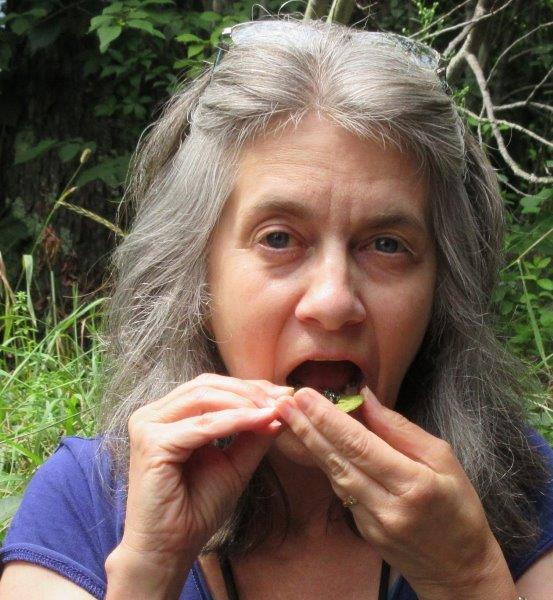
You might not normally think of writing as a team sport. Usually it’s done one-on-one, author wrestling to pin ideas to the page. But a few years back, the two of us decided to team up. The result of our collaboration is Diet for a Changing Climate: Food for Thought (Twenty-First Century Books/Lerner, Oct. 1, 2018). The book, YA nonfiction, tells young readers how our dining choices can make a difference to the earth. Trying unexpected foods – weeds, invasive species, and insects – may help solve the global hunger crisis and, at the same time, reduce agricultural emissions of greenhouse gases.

We had been critique partners for a few years when, talking at a conference, we realized that we had each been developing a book (separately) about entomophagy—the practice of eating insects.  It occurred to us that we might have the perfect project for a collaborative effort. We both wanted something that was fun to read, and also gross enough to capture the interest of middle-schoolers. Being critique partners, we had a good feel for the quality of each other’s writing. More importantly, we trusted one another. So we felt confident that we could work as a team to pull off a book project.

From the beginning, we viewed this book as a joint project. As a biologist (Sue) and environmental lawyer (Christy), both of us were already familiar with collaboration. And we felt that our different backgrounds would enrich the project. It’s also important to note that we stuffed our egos in the bottom drawer of the filing cabinet so we could focus on creating the best work we could.

When you think about writing with a colleague, there’s a good chance you’re visualizing meetings at the local café. Living 345 miles apart made that impossible, but we made good use of modern technology. We scheduled regular phone conversations to go over plans, set goals and deadlines, and keep the lines of communication clear. We divvied up tasks and then shared first drafts of chapter sections via email (rural internet still leaves a lot to be desired). Initially, one person would write a section, and we’d swap files and revise what the other wrote. This helped us develop a uniform voice for the entire book. Rubes that we were, somehow we thought that with two of us working on the project we would each do half the work. Ha! Christy calculates we did twice the amount. But the book is all the better for it.

Phone calls played another role, too. They gave us a chance to get to know each other on a more personal level. Drinking coffee and talking about the dog, the dishes, the kids… and then the BOOK. We did some of our best brainstorming over phone lines.

For more on collaborative writing, check out Tina Cho’s interview with STEM writers, Margaret Albertson and Paula Emick.

Here’s a list of tips for collaborative writing success.


Wednesday, August 22, 2018

Collaboration on a STEAM book: Interview of Dr. Margaret Albertson and Paula Emick by Tina Cho

It's back to school for some folks (like me), and so today I'm interviewing two authors, Dr. Margaret Albertson and Paula Emick, who collaborated on an educational book, Music: The Sound of Science published by Rourke. These ladies are special to me because when I lived in California, we all belonged to an in-person critique group headed by Nancy Sanders. I was blessed to see Margaret again this past summer. 
Nancy, Margaret, Paula, Tina
Tina, Margaret


1. Can you tell us about this book and one of your favorite parts?

Music the Sound of Science is the first in a new series published by Rourke Educational Media called Project STEAM. This acronym is used to describe the marriage of the sciences with the arts: Science, Technology, Engineering, Art (visual and performing), and Mathematics. This book mixed music and physics.

Kids read an introduction to a science concept. For example, music is made up of sound waves. Readers then do an activity. They are asked for the most part to make, play and observe. The text then presents the scientific “why” of what happened.


Paula: I enjoyed taking the lead on the drum project, because I remembered making them as a kid. Anybody can make music with a drum. Plus, the artist in me loves decorating them.

Margaret: Working on the whole project was a lot of fun. If I had to pick only one favorite part, it would be the chapter on making music by buzzing your lips. Musicians play trumpets, trombones and even tubas this way. When I was a kid, I played the trombone in the school band, so I guess I was partial to this chapter.

2. How did you come up with the idea for this book?

Paula: Margaret saw the call out for children’s nonfiction writers. Both of us wanted to try a short nonfiction book. We then submitted a writing example and our resumes to Keli Sipperley, who then became our editor at Rourke. Within six or eight weeks she offered us a contract to write this book. We were given the title and some loose parameters. Because our book was first in a new series, we had no mentor texts. Talk about needing to brainstorm!

Margaret was the music major. We had both taught elementary school and knew how these books were laid out. Since she had the music background and knew the terms she took the lead. The book fell together very naturally. We both had ideas that blended together. When working with a partner no one can be a prima donna. The ego must be put aside and just focus on telling the story. Each person puts in ideas and it all gets blended and molded into the final piece.

3. Why did you decide to write it together? How does that work?

Paula: We were attending the same writer’s group for several years and found we had a common interest in children’s books. Because we had helped each other and edited each other’s work, Margaret suggested we try to publish together. Our work styles complement each other. That is necessary when collaborating on a project.

We often met in person at a local restaurant for an extended lunch. Sometimes we emailed, phoned, and texted back and forth. We’d email a Word document using the markup tools.

4. Do you have any other published articles together or something on submission?

Paula: The music book is the first to be published together. We have a couple other pieces written and are sending them out. 

5. How did the two of you meet, and what got you working together?

Paula: We first met at church many years ago. Margaret and her family moved to another church. I remember her well because she sat behind me. When she sang, it sounded like a host of angels singing with her, the most amazing sound. Years later we met again in Nancy Sander’s writer’s group, CHAIRS, in Chino, CA. We got to know each other as writers and found we worked well with each other. To our amazement we also discovered we lived just a few blocks away from each other!  


Margaret: Paula’s style of writing really impressed me. Her sense of humor spilled out into her writing. I called it her “Paula Pizzazz.” She is very fun to work with. I now consider her a close friend.

6. What are you working on next?

Paula: We are still looking to publish our bilingual alphabet book, and another on prehistoric art.  Currently, we are working on separate projects. I started working full-time as an art teacher and only write part-time.  (I am doing this interview during my prep period.)  There are a few ideas percolating in my brain cells.  I have a couple middle grade mystery/fiction books to rework and send out. 

Collaborative writing sounds interesting. Try it out sometime!

Bios:
Margaret Albertson, Ph.D. began writing a mystery book when she was in fifth grade. Her hopes of being an author were dashed when she read a published book with the same plot. She persisted and by eighth grade she had published an article. Now, in addition to her book, Music: The Sound of Science, Margaret has authored more than thirty-five articles and stories. Some of these have appeared in Clubhouse, Clubhouse Jr., Brio, Brighthub, LiveStrong, and in a textbook for educators. She resides in Southern California with her husband and her dog.
You can find Margaret at http://www.margaretalbertson.com/


Paula Emick is a native Southern Californian. In addition to writing, she teaches art to elementary schoolchildren. She and her husband continue to live in Southern California with their dog and cat. Paula also has authored two pictorial history books, Rancho Cucamonga, and Old Cucamonga  by Arcadia Publishing.