Showing posts with label Corey Rosen Schwartz. Show all posts

Wednesday, August 12, 2020

Giveaway and Interview with Picture Book Writer Kirsti Call ~ by Christy Mihaly

A big GROG welcome to picture book author Kirsti Call. Kirsti is offering a signed ARC (advance copy) of her forthcoming picture book, Mootilda's Bad Mood ... just comment and/or tweet to be entered in our giveaway (details below)! 

   GROG:  Welcome, Kirsti! I know that in addition to writing, you co-host the new Picture Book Look podcast, and you're a Cybils judge and co-coordinator of Reading for Research Month (ReFoReMo). 
    Before we talk about your books, please tell us a little about ReFoReMo. What does it involve, and why should GROG readers participate?

    Kirsti: ReFoReMo was originally Carrie Charley Brown’s idea, and when she asked me to join in on the fun, I was thrilled. We had both judged for the Cybils awards, which helped us understand how reading great books helps us write great books. Paying attention to what I love about a story, and attempting to add those elements into my own stories, is one of my favorite ways to improve my writing. We wanted to share that with others.

Well, thanks to you and ReFoReMo for sharing all those mentor text insights. What more should our readers know about ReFoReMo?
    Kirsti: ReFoReMo is not only for writers, but for librarians, teachers, and kids. Though we post every Tuesday all year long, March is our challenge month. That's when authors, educators, librarians, agents and editors share insights and favorite mentor texts that we can read and learn from. 

ReFoReMo is a great resource for anyone who loves picture books. Now, what can you tell us about judging the Cybils?

A: For the last six years, I’ve read all 300-ish nominated picture books for the Cybils award over a two-month period. This picture book overload totally helps me understand the market, what editors love, and what I love about picture books.

Read, read, read, right? Kirsti, you're also a marriage and family therapist. Does that work give you story ideas or otherwise inform your children's books?

Kirsti: I love using bibliotherapy in my work as a therapist. Reading and discussing books in therapy helps people process and heal. This work definitely influences my stories and what I write. In fact, if you read my forthcoming picture book, Mootilda’s Bad Mood (Sept. 1, 2020, Little Bee), you'll notice a very obvious connection between the story and my work as a therapist. 

Spread from Mootilda: "We're in a bad mooooooood!"
Mootilda's Bad Mood is co-written with Corey Rosen Schwartz and illustrated by Claudia Ranucci. It's about a cow in a bad mood. Where did this fun idea come from?
cover

   Kirsti: Corey and I joke about her being in a bad mood and me being in a good mood all the time.  We thought it would be fun to take that dynamic and explore how a cow in a bad mood would approach life ... and overcome all the cow-tastrophes that make her feel worse and worse. 


Uh-oh, cow-pun alert!! Kirsti, how does the co-writing process work differently from solo writing?

MOOTILDA swag!
   Kirsti: Corey and I have written many manuscripts together. In fact, we have another book coming out in the fall of 2021 with Little Brown. It’s called "Cold Turkey!" Writing together involves lots of texts and messaging in google docs and talking on the phone. It’s a much more social than writing solo.

  Big congratulations on Mootilda, Kirsti (and Corey and Claudia). I'm sorry, though, about the timing.
How have you been promoting your new book in the midst of the covid-19 closures and cancellations?
Book Launch in the Time of Covid (Sept.5)

Kirsti: Little Bee is planning a virtual book tour that we’re excited to participate in. We have a couple of virtual events coming up on Sept. 5 at The Writing Barn, and Sept. 8 at An Unlikely Story. We’re also considering a socially distanced book launch at a farm featuring cows and ice-cream. We’ve created some digital assets that we’ll be offering with pre-sales. In fact ...

** ALERT! GROG Bonus! **  


... if any GROG readers pre-order Mootilda, they can DM me on Twitter, Facebook, or Instagram to receive a signed bookplate, sticker, and mood-o-meter coloring page. 

We’re trying to be creative in these uncertain times. But one thing I am certain of, "Mootilda's Bad Mood" is something that will resonate with many people given the pandemic.

    These days it takes extra imagination and energy to get our books into readers' hands. Good luck with your launch! What else would you like GROG readers to know about you and your books?

    Kirsti: I’m super excited about another book that’s coming out with HMH in March—Cow Says Meow. I’m not certain why all of my upcoming books feature farm animals, but I do have a pair of cow shoes I can wear for each release date! 
    
Kirsti Call (whose cow shoe [and foot] appears below) is the co-host of the new Picture Book Look podcast and co-coordinator of ReFoReMo. She reads, reviews, revises and critiques every day as an "elf" for the 12x12 Picture Book Challenge, a blogger for Writer's Rumpus, and a critique group member. She's judged the Cybils award for fiction picture books since 2015. Kirsti has a picture book, MOOTILDA'S BAD MOOD (Little Bee) coming in the fall of 2020. COW SAYS MEOW (HMH) and COLD TURKEY (Little Brown) release in 2021. Kirsti is represented by Emma Sector at Prospect Agency.

For the GIVEAWAY: 

Your name will be entered for a chance to win Kirsti's signed ARC if you: 
(1) comment on this post (below) explaining why you'd like to win the ARC.
(2) tweet about this post, mentioning GROG and Kirsti Call, and tag me (@CMwriter4kids). 
Do both to get two chances!

We'll draw the winning name and post it on the GROG post next week. Good luck!

And remember, if you pre-order Mootilda's Bad Mood, contact Kirsti to get your swag. 

Find her here:
@kirsticall (Instagram)
Kirstine Erekson Call (Facebook)
@kirsticall (Twitter)


Thanks for visiting GROG! 
(And don't forget to leave a comment ...) 
Christy Mihaly

Monday, January 11, 2016

Fracturing a Fairy Tale ~ by Patricia Toht

Back in July, I wrote a post about creating a picture book text by giving an old theme a new twist. Today I'm going to focus on one popular way of doing this --  


Let's fracture some fairy tales, folks!

Fractured fairy tales are nothing new. From way back in the 1960's comes historic proof:

Obviously there's staying power in fractured fairy tales. So, how exactly do you make a fairy tale dance to a different tune? Here are just three of the moves you can do to change a fairy tale or childhood story/rhyme.

The Two-Step (or Three-Step, Four-Step, Five-Step, ...)

Take a short, simple childhood rhyme or story and add to it, expand it. The crucial factor is to assure that the expansion has a story arc to it that will propel the reader forward. Jim Aylesworth has written picture books in this vein.


THE COMPLETED HICKORY DICKORY DOCK begins with the well-known verse and then the author extends it by following the mouse through twelve hours of the day. The book is written in verse, each stanza opens with a fun-to-say nonsense word. The reader can count up the hours as the mouse moves through the day.


MY SON JOHN ends with the familiar verse. Readers follow an arc from sun-up to sun-down. Each spread depicts another child from the rural area taking part in simple activities. Son John ends the day in bed with his one shoe on.


The Twist


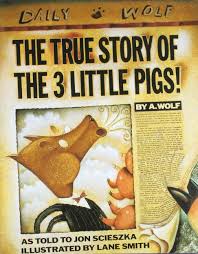
THE TRUE STORY OF THE 3 LITTLE PIGS by Jon Scieszka is a well-known example of a fractured fairy tale. The story is relayed by the wolf, who tells the "true" story of what happened with the pigs from his point of view. According to him, the whole misunderstanding was about a cup of sugar and a case of the sneezes. If you'd like to try writing something similar, take the "bad guy" of a story and examine events from his/her point of view, being sure to add lots of emotion. How does that change the story?


NINJA RED RIDING HOOD by Corey Rosen Schwartz. Corey has written a Ninja trilogy; each one combines a childhood tale with ninja training. The limerick verses in this one are terrifically catchy, and the author manages to work in traditional lines (e.g. "The better to see you with, my dear") with seeming effortlessness. She also dares to even out the match between Wolf and Red -- they've both had ninja lessons! Someone else shows up in a gi to help save the day. To twist like Corey does, select a well-known childhood story and add an element that kids are crazy about. Tara Lazar's "500+ Things that Kids Like" is a great source for brainstorming.


The Mash

What might happen if you mash together a whole bunch of tales or characters? 

Tara Lazar's LITTLE RED GLIDING HOOD is one-part twist and one part mash up. It begins with an amazing title. Obviously "gliding" implies that Red is doing something special -- she's skating. Tara sets a goal for Red that reflects the title. What would a skater want? Why, to win a skating competition, of course. This storyline propels the reader through the story (on a ribbon of ice). But the author adds SO much more! Easily recognized characters are peppered throughout the story, and the feared big bad wolf is not-so-bad after all. Cleverness and puns abound.


The tale in INTERRUPTING CHICKEN by David Ezra Stein combines several childhood stories, but doesn't really scramble them up. As Papa Chicken reads his Chick a bedtime story, Chick keeps interrupting the stories by jumping in them to save characters from harm. 

Penny Parker Klostermann (who won the Best in Rhyme award for THERE WAS AN OLD DRAGON WHO SWALLOWED A KNIGHT) has said that INTERRUPTING CHICKEN was one of the mentor texts for her upcoming mash up, A COOKED UP FAIRY TALE (Summer, 2017). For an interview with Penny about her use of mentor texts, see the interview here.

I hope these examples will give you some ideas for fracturing fairy tales. Start dancing, writers, and see what shakes out!

Friday, May 9, 2014

Twitter for Writers Part 2 with Corey Rosen Schwartz by Tina Cho

Welcome to Twitter for Writers Part 2. If you missed Part 1, you can read it here. Today I'm sharing my interview of Corey Rosen Schwartz, the popular picture book writer, and how she uses Twitter to market her books. Her most recent are The Three Ninja Pigs, Goldi Rocks and the Three Bears, and Ninja Red Riding Hood, out this summer.


Just to show you how great social media is--I even interviewed Corey using Facebook messages back and forth, rather than email! 

As a published author, how do you use Twitter?

Corey: I mainly use Twitter to connect with teachers and school librarians. They are very easy to find through hash tags such as #1stchat, #2ndchat, #titletalk, etc. These are usually educators who are very active on Twitter. I follow as many elementary educators as I can. Most follow back. Sometimes I also check out who THEY follow and follow some of them, too. Once I've made a connection, I offer them bookmarks for their students. This often leads to Twitter Q & A's, handwritten thank-you notes, and Skype visits. The relationships that develop are amazing! Lots of these teachers have already pre-ordered my next book. And I love thinking of new things to send them...stickers, activity guides, etc... 

Do the students send you class Tweets of questions or compliments?

Corey: Yes! I've gotten lots of students' responses. You can see student responses of Ninja Red Riding Hood here. This is the type of thing I get. This came by email. That's definitely that type of thing that Twitter leads to.

Do you think Twitter is better than Facebook for teachers to connect with you?

Corey: ABSOLUTELY! It took me a LONG time to get Twitter, and I still sometimes can feel a little lost there. But I have totally managed to find a way to make it work for me. I am also very lucky because my book is fairly well-known. So when I do follow someone, they often write back and say, "Wow, we've read your book, and my students love it." So that definitely helps. Gives me an "in" to say, "Oh, well would you like Ninja Pig stickers?" 

Facebook or Twitter?

Corey: For me, I ENJOY Facebook much more. But Twitter is an incredibly useful tool for reaching the "influencers" in the school community. 

You mentioned previously you have a manageable system for Twitter. Can you share that system with us?

Corey: Not sure I actually have a "system," but I have managed to find a way to connect with educators. I read a ton of PBs and MG so I use Twitter to spread book love. I look for and make book recommendations and once relationships have developed, I OFFER educators some type of swag, stickers, bookmarks, and activity pages. I mail them out a package and this often leads to Twitter Q & A's, Skype sessions, etc... 


Teachers will often tweet back pics of their classes holding the swag I sent. 

Or they will tweet a photo of the swag to thank me. (This helps create more buzz for the book.)

Thanks so much, Corey, for answering my questions and helping us get a better idea of how authors and illustrators can use Twitter. 

You can find Corey here:
blog
Twitter: @CoreyPBNinja

Corey is the author of THE THREE NINJA PIGS (Putnam 2012), GOLDI ROCKS AND THE THREE BEARS (Putnam 2014), and NINJA RED RIDING HOOD (Putnam 2014). Corey has no formal ninja training, but she can sure kick butt in Scrabble. She lives with three knuckleheads in Warren, NJ.