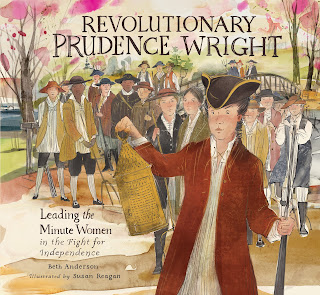
Beth Anderson is back with us this time with another new picture book biography--Revolutionary Prudence Wright: Leading the Minute Women in the Fight for Independence, published by Calkins Creek, February 1, 2022. Beth shares her expertise, this time, in the area of imagery.
I’m a big fan of imagery – as a teacher, reader, and writer!
Imagery elevates the narrative, invites lyricism, strengthens theme, and
enhances heart. It’s a much used tool in my writer’s toolbox.
What exactly is imagery? Literarydevices.net defines it this
way:
Imagery is a literary device
that refers to the use of figurative language to evoke
a sensory experience or create a picture with words for a reader. By utilizing
effective descriptive language and figures of speech, writers appeal to
a reader’s senses of sight, taste, smell, touch, and sound, as well as internal
emotion and feelings. Therefore, imagery is not limited to visual
representations or mental images, but also includes physical sensations and
internal emotions.
Wow! Makes you just want to pour it on! But…imagery should
be subtle and not waste words. It should flow naturally and not feel contrived.
It should be sprinkled, like spices or herbs, to enrich what’s already
there.
In AN INCONVENIENT ALPHABET, I placed “battle” words
throughout to reinforce the idea that a revolution is more than a military
battle. “Breaking free of old ways” involves many areas of our lives.
The imagery in TAD LINCOLN’S RESTLESS WRIGGLE was also in
word choice. I powered the story with his wriggle as an irrepressible force of energy.
This doesn’t rob him of his dignity or impose a negative judgement for the
reader.
In SMELLY KELLY AND HIS SUPER SENSES, I interwove super-hero
imagery with details, words, and phrases. Sensory images abound for this
character with super senses.
In LIZZIE DEMANDS A SEAT!, imagery went deeper than word
choice. Footsteps echo through the story—a ticking clock, heartbeats, a stranger’s
approach, and, in the culmination of the heart thread, others stepping up to
carry forward social justice.
I think everything I write uses alliteration, onomatopoeia,
and sensory language. But when a story lends itself to using a metaphor, that’s
something special! And REVOLUTIONARY PRUDENCE WRIGHT invited the opportunity…
When I dive into a story, I try to think about the different
angles I might tell it from, or look for something in the setting that might
ring through the story. Then I consider those ideas along with themes and the
heart thread, and I start generating word lists that I can draw from as I
write. This preps my brain and frames my thinking.
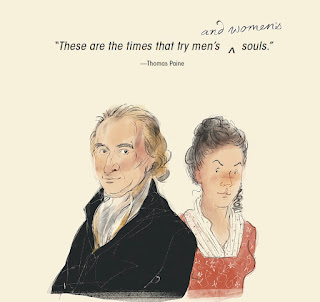
As I researched Prudence Wright, I collected words and phrases in my spiral, beginning with those related to revolution and independence. One of the first items I wrote was the Thomas Paine quote that starts the story: “These are the times that try men’s souls.” I saw it as a truth, but also as leaving out women. Thus, the addition of “and women’s” seemed to fit Prudence and her story perfectly. That’s where her voice first emerged.
I created a word bank of military and revolution words. I
wanted to show that the women’s actions were as powerful as the men’s.
Since the main event occurs in April, one of my first ideas
for the “big picture” imagery of a metaphor was that of spring, gardens, and
planting the seeds of independence. But, though it fit the home front idea, I
knew immediately that it didn’t fit the concepts and had the wrong tone.
One of my Pepperell contacts had shared photos of a few
artifacts from Prudence’s life, including her love box and lantern that could
easily be used in the story. Prudence designed and created beautiful quilts,
but there were no pictures available. Learning about and seeing personal items
from my subject’s hands connected me in a special way. Could I use them in the
story?
I listed words associated with a lantern and fire, and I also
jotted down words about quilts. Could either serve as a metaphor? The idea of
quilts really fit the story, not only because Prudence made them, but because
they are from the hands, often involve a community of women, are made from
remnants of lives, and handed down as family history.
Metaphors fall into place as I write. Lizzie’s footsteps came through during the revision process when I realized I had the pieces and just needed to connect them better. Prudence’s story was about women bound together as community and breaking old patterns. And as I worked to transition scenes, I realized that their boycott actions were like scraps for a quilt, of little consequence until joined with others. Organizing the pattern of resistance was like the larger design of a quilt. Suddenly the quilt idea popped and became powerful! And paired with the scene of the women quilting, it emphasizes that this rebellion is coming from homes. Yahoo! Don’t you just love it when it all comes together!
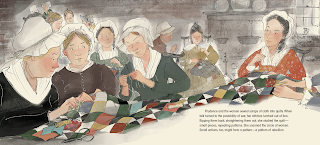
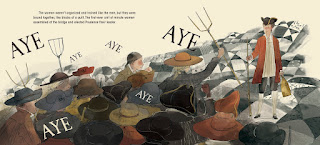
Illustrator Susan Reagan brought back the quilt image in the art at the end, reflecting the simile on the page, “The women weren’t organized and trained like the men, but they were bound together, like blocks of a quilt.” Use of imagery also opens up potential with illustration, and the merging of art and text tightens and strengthens the story.
Though we think of imagery as evoking images, as the
definition above says, imagery is more than visual or sensory. It touches us
internally, emotionally. No wonder it’s so powerful!
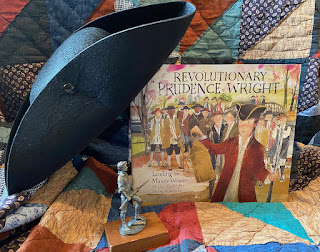
Thank you, Beth! I love this new story and the image of the quilt since my mom quilts. I love how you find unique angles on all your picture book subjects.
You can find more about Beth here! And more blog posts from Beth here and here.
 Bio: Beth Anderson, a former English as a Second Language teacher, has always marveled at the power of books. With linguistics and reading degrees, a fascination with language, and a penchant for untold tales, she strives for accidental learning in the midst of a great story. Beth lives in Loveland, Colorado where she laughs, ponders, and questions; and hopes to inspire kids to do the same. She’s the award-winning author of TAD LINCOLN’S RESTLESS WRIGGLE, “SMELLY” KELLY AND HIS SUPER SENSES, LIZZIE DEMANDS A SEAT!, and AN INCONVENIENT ALPHABET. Beth has two more picture books on the way in 2022: FRANZ’S PHANTASMAGORICAL MACHINE, illustrated by Caroline Hamel, and CLOAKED IN COURAGE: THE STORY OF DEBORAH SAMPSON, PATRIOT SOLDIER, illustrated by Anne Lambelet.