Showing posts with label poetry month. Show all posts

Wednesday, April 3, 2024

Celebrating Poetry Month ... and Civic Engagement ~by Christy Mihaly

2024 Poetry Month poster:
Art by Jack Wong, words from Lucille Clifton poem

Happy National Poetry Month! It's time to celebrate poetry again!

Many poetry-loving writers, educators, and organizations post suggestions for elevating poetry this month. Reading Rockets has a great collection of resources here. Of course, we can celebrate poems all year long -- but it's nice to have a whole month to focus on bringing more poetry into our lives. 
Music-themed poetry in music store window

One of my favorite celebrations is "Poem City," a month-long event in Vermont's capital, Montpelier, during which the shop windows are filled with poems and libraries, coffee shops, and general stores resound with poetry readings. I'm so pleased to have one of my poems included in the collection, along with many others by poets from near and far. More about Poem City here.

Poetry can engage learners, not only in learning reading and writing, but in lessons about history, science, math, and my personal passion: civics. In Free for You and Me: What Our First Amendment Means, I turned to writing poems as a way to simplify constitutional concepts and make reading about them fun. 

It has turned out to be an effective way to communicate the concepts. Recently, on one hand, an editorial in a local paper reiterated the importance of teaching civics in our schools, and cited my books; and I did a read-aloud of this book with an engaged 5th-grade class as part of a workshop on civics and poetry -- more on that below. 

Spread from FREE FOR YOU AND ME on Freedom of Assembly

Of course you can find and write poems for all kinds of kids and all kinds of interests. 

In their anthology Hop to It: Poems to Get You Moving, poets Sylvia Vardell and Janet Wong collected 100 poems by 90 poets (including me!) that incorporate movement. Many of the poems relate to STEM themes. But this book, published in 2020, also includes several poems about civic engagement. Here's mine: 

STAND UP

by Christy Mihaly

Be a friend when someone's hurting
Give a smile or helping hand
Don't be shy about asserting
what is right: just take a stand.
Stand up!

If you want to make things better,
think of things that you can do.
Make a call or send a letter.
Illustrate your point of view.
        Stand up!

In a tizzy, feeling nervous?
Know your rights and learn your laws.
Join a march or day of service.
Find some friends to join your cause.
                STAND UP!

Don't just sit there on the sidelines 
when you know there's work to do.
If you think we need new guidelines,
write them up--it's up to you!

                                    STAND UP!

Lisa Powell created a fun video to go with this poem, posted here.

And yes, this month I've been working with an amazing fifth grade class to explore poetic forms and write poems in a series of workshops exploring freedom of expression and engagement in our democracy. Big concepts -- but we make it concrete through writing haiku, Fibonacci poems, and other poems about topics of concern to the students. 

Poetry can be magic! 

For more ideas and resources, check out GROG's Poetry Month posts from years past: here, or here, or here. (You can search for past poetry posts for lots more good stuff from 10 years of GROG archives!)

And happy month to all!


Monday, April 11, 2016

A Poem for Writers -- by Christy Mihaly

For Poetry month, here at GROG we've reached back into the vaults. 

Where did that muse go?
Today's poem is dedicated to all those writers who worry, from time to time, that their muse has gone missing; and all those writers who keep on writing despite the distractions at hand.

Enjoy! And keep the faith.


MUSE 


Inspiration, where’s thy flow?
My Muse, elusive, just won’t show.

Butt in chair, and hands on keys,
My mind floats off upon the breeze.

Clearly I’m no good at this,
My composition’s hit-or-miss.

As the minutes tick on by
My story line begins to die.

Why keep up this “writer” pose?
My verses simply decompose!

Then, I hear a small voice call:
My baby’s crying, down the hall.

Right on cue, a brainstorm comes,
My babe wakes up, and my head hums!

Hurry, quick! I’ve no more time –
My words begin to rush, and rhyme!

“Coming, Sweetie Pie,” I shout;
My fingers fly, thoughts tumble out.
No, Cheddar. That's BUTT in chair.

Naptime’s done! I shake my head,
My little Muse is out of bed.

-- by Christy Mihaly

©2014 Christy Mihaly 
all rights to poem reserved


Monday, April 14, 2014

Learning How to Write Using Poetry Mentor Texts by Marcie Flinchum Atkins Featuring SHE SANG PROMISE by Jan Godown Annino


It’s Poetry Month! Reading poetry and using it as a mentor text is a great way to absorb spare and specific language. 

This month, I’m featuring a book by one of our own GROGGER bloggers, Jan Godown Annino. Her picture book biography SHE SANG PROMISE: THE STORY OF BETTY MAE JUMPER, SEMINOLE TRIBE LEADER, was already on my radar because I’m working on a full-length mentor text lesson plan for this book. 

Whether you are an adult writing children’s literature, a teacher teaching young writers with mentor texts, or a young writer who uses mentor texts, SHE SANG PROMISE is full of language that packs a punch. 

I personally love “herstories,” histories of strong women. This is one of those stories. 


Illustrated by Lisa Desimini
National Geographic, 2010

The book shares the life story of Betty Mae Jumper, a Seminole woman in Florida. She was an everywoman, a student, a nurse, a champion for educating her people, a storyteller, a leader, and voice for her people. 

What Writing Skills Can You Improve by Studying this Book?

* Lyrical, poetic language
* Vivid Verbs
* Sensory words
* Imagery
* Specificity of Language 

The word choice in this book is specific to Betty Mae Jumper’s life and her world. 


Application to My Own Writing


As you work on your own writing, take a look at your language. Make a list of some of your specific language. Does it convey a particular setting? Does is reveal a uniqueness of character? Does show action that is distinct to the topic or story at hand? 

Jump In

What are some of your favorite books with lyrical or poetic language? Share your favorites in the comments. 

Friday, April 4, 2014

Poetry + Fact = Picture Book Fun! by Patricia Toht

I confess.

I have a crush.

Oh my! Not this -  


            This -                  


My crush is lasting.

It began in 2006, when the Caldecott committee awarded an Honor medal to the picture book, Song of the Water Boatman & Other Pond Poems. 


I bought a copy and discovered not only wonderful woodblock, hand-colored illustrations by Beckie Prange, but also page after page of witty poems and fascinating facts.

What? Poetry and nonfiction? Together? In one book?

A pairing as perfect as peas and carrots! Strawberries and cream! Chocolate and more chocolate! I was smitten.

The book's author is Joyce Sidman, whom I consider to be the queen, the Grand High Poobah, the doyenne of this style of writing. (Too much? Am I gushing?) My personal favorite of her books is Dark Emperor & Other Poems of the Night (a Newbery Honor book, illustrated by Rick Allen).


This collection of poems explores the nighttime forest. The opening poem invites the reader to:

"Come feel the cool and shadowed breeze,
come smell your way among the trees,
come touch rough bark and leathered leaves..."

Each spread combines a clever poem with a column of factual information. The length and language of the lyrical and nonfiction parts are in perfect balance. Her observations are amazing. Wonderful for elementary school students and poetry lovers, too.

But watch out, Joyce Sidman! Others are vying for my attention.

Laura Purdie Salas has authored two books that fit the mold:


A Leaf Can Be...                     and                     Water Can Be...


For a younger-aged reader, each book consists of a single poem - a few luscious words per page that tease readers to discover the diverse and amazing uses of leaves and water. Illustrations by Violetta Dabija are as soft and cozy as a cashmere sweater. Factual information is left to the end of the book, so it doesn't interrupt the flow of the poems.

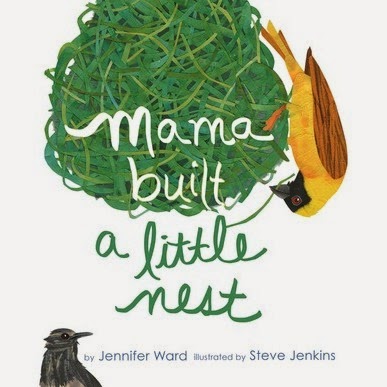
I also recently picked up Jennifer Ward's Mama Built a Little Nest. 

Another great book for younger ages! Snappy four-line poems describe different types of nests being built, and snippets of facts expand the information. Realistic paper collage illustrations by Steve Jenkins had me thinking a bird might actually hop off the page and into my hands. 

April is poetry month and the perfect excuse to read a book that combines poetry and fact. Maybe you'll develop a crush, too! 

Find Joyce Sidman here, Laura Purdie Salas here, and Jennifer Ward here.
(And don't forget to sign up for our party prizes!
              On this side >>>>>>>>>>>>>>>>>>>>>>>>>>>>>>>)