Showing posts with label National Poetry Month. Show all posts

Wednesday, April 3, 2024

Celebrating Poetry Month ... and Civic Engagement ~by Christy Mihaly

2024 Poetry Month poster:
Art by Jack Wong, words from Lucille Clifton poem

Happy National Poetry Month! It's time to celebrate poetry again!

Many poetry-loving writers, educators, and organizations post suggestions for elevating poetry this month. Reading Rockets has a great collection of resources here. Of course, we can celebrate poems all year long -- but it's nice to have a whole month to focus on bringing more poetry into our lives. 
Music-themed poetry in music store window

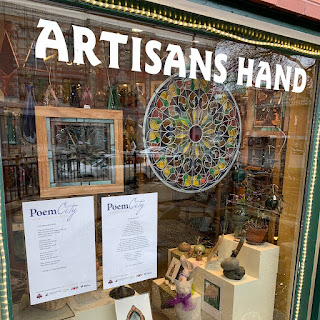
One of my favorite celebrations is "Poem City," a month-long event in Vermont's capital, Montpelier, during which the shop windows are filled with poems and libraries, coffee shops, and general stores resound with poetry readings. I'm so pleased to have one of my poems included in the collection, along with many others by poets from near and far. More about Poem City here.

Poetry can engage learners, not only in learning reading and writing, but in lessons about history, science, math, and my personal passion: civics. In Free for You and Me: What Our First Amendment Means, I turned to writing poems as a way to simplify constitutional concepts and make reading about them fun. 

It has turned out to be an effective way to communicate the concepts. Recently, on one hand, an editorial in a local paper reiterated the importance of teaching civics in our schools, and cited my books; and I did a read-aloud of this book with an engaged 5th-grade class as part of a workshop on civics and poetry -- more on that below. 

Spread from FREE FOR YOU AND ME on Freedom of Assembly

Of course you can find and write poems for all kinds of kids and all kinds of interests. 

In their anthology Hop to It: Poems to Get You Moving, poets Sylvia Vardell and Janet Wong collected 100 poems by 90 poets (including me!) that incorporate movement. Many of the poems relate to STEM themes. But this book, published in 2020, also includes several poems about civic engagement. Here's mine: 

STAND UP

by Christy Mihaly

Be a friend when someone's hurting
Give a smile or helping hand
Don't be shy about asserting
what is right: just take a stand.
Stand up!

If you want to make things better,
think of things that you can do.
Make a call or send a letter.
Illustrate your point of view.
        Stand up!

In a tizzy, feeling nervous?
Know your rights and learn your laws.
Join a march or day of service.
Find some friends to join your cause.
                STAND UP!

Don't just sit there on the sidelines 
when you know there's work to do.
If you think we need new guidelines,
write them up--it's up to you!

                                    STAND UP!

Lisa Powell created a fun video to go with this poem, posted here.

And yes, this month I've been working with an amazing fifth grade class to explore poetic forms and write poems in a series of workshops exploring freedom of expression and engagement in our democracy. Big concepts -- but we make it concrete through writing haiku, Fibonacci poems, and other poems about topics of concern to the students. 

Poetry can be magic! 

For more ideas and resources, check out GROG's Poetry Month posts from years past: here, or here, or here. (You can search for past poetry posts for lots more good stuff from 10 years of GROG archives!)

And happy month to all!


Wednesday, April 5, 2023

PoemCity, Madness!Poetry and More for Poetry Month ~ by Christy Mihaly

Happy National Poetry Month! 

It's April! Time to celebrate poetry. 
Are you looking for Poetry Month ideas? I've surveyed some poets and rounded up a few suggestions (with many links for more resources). 

Feel free to share other ideas in the comments. And be poetic! ❤
PoemCity Reading 2023

PoemCity 

I am feeling very fortunate that Vermont's state capital, Montpelier, is hosting its annual "PoemCity." It's an April-long shindig organized and run by volunteers and the hard-working staff of Kellogg-Hubbard Library. Poets from around Vermont are invited to submit poems. Selected works are printed and posted in shops, restaurants, and other establishments around town. These poems will also be compiled into a PoemCity anthology. (I'm happy that my poem, "Who Cooks for You?" -- about a barred owl -- appears in the Capital Kitchen cooking supply store.)
Shop window poetry


Second grade haiku -- can't beat it!
"Brazil nuts irk me.
All they do is take up space,
and they taste like dirt."

 
Work by local students appears in a special display, always a highlight. (Check out that Brazil nut haiku!) 
PoemCity also offers free events, including readings, lectures, workshops, craft projects, ekphrasis (using artworks to inspire poetry in an improvisational collaboration), and  parties. 
Poetic paradise!
Montpelier's beloved Kellogg-Hubbard Library

Madness! Poetry

If you can't make it to Montpelier, you can still join in the fun at Madness! Poetry. This online poetry tournament, created by poet Ed DeCaria, is a wild competition modeled after March Madness. "Kids' poetry under pressure!"
Brackets begin with 64 poets ... er ... "authletes." Each pair of competitors is assigned a word, and each individual must write and post an original poem for children, using the word, by a posted deadline in 48 hours or so. When the poems are posted, readers review them and cast their votes to determine which poet will move to the next bracket and repeat the process with a new word. See this year's schedule, here. Special programs encourage teachers and classes to participate. Sign up, as an authlete, a class, or a voter, here.

I can attest from experience that being an authlete is a bit of a sleepless ordeal, but, in the end, a great deal of fun. Anyone who appreciates poetry can sign up to read, vote, and cheer the competitors to greatness. This year, the application deadline is April 16, so there's still time. 

Poets Doing Madness! and Other Things

I asked a few compatriots at the Poets' Garage how they plan to celebrate this month. I'm happy to introduce them here (look out for their poems and books!), and share their thoughts:

Children's poet Kelly Conroy says she is going for the Madness! -- "I'll be consumed with all things Madness! Poetry: reading, critiquing, encouraging, commenting, voting, and possibly competing...eek! It's fast paced, it's for kids, and it is so much fun!" Mad good luck to you, Kelly!

Kelly's poems have appeared in two wonderful anthologies published by Wee Words for Wee Ones, 10.10 and Two Truths and a Fib; three anthologies --Things We Eat, Things We Feel, and What is a Friend? -- by Pomelo Books; and in online publications Better Than Starbucks and Poetry As Promised. We'll be watching for Kelly's poems, this month and beyond!

Poet and novelist Helen Kemp Zax, who recently completed writing a YA novel in verse, says: "I found the experience of writing in this form so satisfying, I’m planning to rewrite another of my novels during April in verse form. My writing days will look like NaNoWriMo but filled with poetry. Of course, I’ll be writing shorter poems to submit to blogs, magazines, and anthologies." Best wishes with the new novel, Helen!


Her poem “Wish” will be published this month in the Sylvia Vardell/Janet Wong anthology What Is a Family? Helen says, "I plan to support this anthology in April by taking part in Rochelle Melander’s 'Play with Poetry' blog posts. As always, I’ll share copies of this anthology with Reading is Fundamental." 

"Basant Panchami" by Helen Zax,
art by Nayantara Surendranath
CRICKET Magazine, April 2020
 
Helen is co-winner of the 2021 YorkMix International Children’s Poetry Prize, 2018 MG Katherine Paterson Prize winner, and 2019 Finalist. Her poetry appears in anthologies including Imperfect II, chasing clouds, and What is a Friend? and in magazines including Cricket, Hello, High Five, Launchpad, Touchdown, Hunger Mountain, The Caterpillar, and The Dirigible Balloon. She is particularly proud that her poem “Belly Butterflies” was chosen for a Poetry Teaching Programme anthology to be published by Oxford University Press. Helen lives in Washington, D.C. with her husband, and Aussiedoodle Huckleberry Finn. 

Children’s author and award-winning poet B.J. Lee say she plans to "celebrate National Poetry Month by doing a blog post(s) with one or more of my poems to [Sylvia Vardell's] Poetry Friday, and sharing to social media." Thanks, B.J.-- and all the Poetry Friday poets! 

B.J. has published poems with Macmillan, National Geographic, Little Brown, Bloomsbury, Penguin, Wordsong, Otter-Barry, Pomelo, Cricket, Highlights, and others. Her latest poem to be included in an anthology is “Box Turtle: Pet for a Day,” in Blessings for Pets, edited by the late Lee Bennett Hopkins and due out from Eerdmans next spring. 
B.J. has also published a picture book,There Was an Old Gator Who Swallowed a Moth (Pelican Publishing, 2019). She is now hard at work on a YA verse novel. View B.J.'s poetry performances at her website here.

And finally, for Suzy Levinson, a talented New York-based children's author and poet, April means welcoming spring. She says, "One of my favorite things about Poetry Month is it coincides with Awesome Weather Month (aka April), when trees are blossoming, birds are chirping, and New York City looks halfway decent. I like to go on a lot of walks around my neighborhood and take it all in, finding inspiration for new poems wherever I look." Yay for Springtime strolls!

Also this April: Suzy is celebrating her debut picture book, Animals in Pants (Cameron Kids/Abrams, illus. by Kristen and Kevin Howdeshell). It is a collection of silly poems about -- you guessed it -- animals wearing pants! It hits shelves April 11 -- check out this amazing cover.

Suzy's poems have appeared in such magazines as HighlightsCricket, and the School Magazine, and poetry anthologies A World Full of Poems (DK Children), I Am a Jigsaw (Bloomsbury), and Shaping the World (Macmillan). 

A very Happy Poetry Month, Suzy!

And Happy Poetry Month to all! May you find poetry all around you, this month and always.

Wednesday, April 6, 2022

Celebrate Poetry Month ~by Christy Mihaly

April has arrived

bringing sunshine and poems.

Welcome! Celebrate!

April took me by surprise this year. (The passage of time seems to have stopped following the rules of order ... but that's another topic.) But here we are ... so welcome to Poetry Month! 

The Academy of American Poets created National Poetry Month in 1996. As they (poetically) put it, the goal is to remind us "that poets have an integral role to play in our culture and that poetry matters." 

I've been thinking about poetry's power. My nonfiction writing often involves sifting through piles of notes, sources, facts, and figures. When I'm stuck, one way out of the "stuckness" is to write a poem. 

A poem is an antidote to writer's block in two ways: First, it can be completed quickly (I mean a draft ... polishing a poem is a different story). Completing a poem helps me restart my writing momentum.

Second, a poem helps me find the heart of my topic. A poem boils down a complex idea into its essence. I've written poems about the First Amendment, for example. A poetic metaphor, an image, a figure of speech, or a silly rhyme might show me a new way to illuminate my topic, a path around writer's block.

For similar reasons, I love sharing poems with kids. A poem is short -- a plus in these days of short attention spans. And a poem gets right to the heart of a topic, often right into a young reader's heart. 

This photo shows me getting some elementary school students excited about a poem from the wonderful anthology, "Hop to It: Poems to Get You Moving." Created by Sylvia Vardell and Janet Wong, it's full of lively verse guaranteed to get readers on their feet.

So, whether for yourself or for some young people in your life, here are a few ideas to celebrate Poetry Month!


CELEBRATING POETRY MONTH: some ideas

Begin each day with a poem.
Read an old favorite from a dog-eared anthology or surf online for a new favorite. Or, join one of the poetry projects that blossom this month. For example, poet Michelle Schaub hosts a delightful blog, Poetry Boost, offering many resources and poems. Every weekday this month she'll post a video of a poet reading a poem they wrote. Check it out -- you may spot several GROG poets this year.

Take your poetry outside: write poems in chalk on your driveway or sidewalk or playground. (Get permission first ...) Poems should be out where they can be seen -- not stuck in dusty books, right?

Memorize a poem
Montpelier's PoemCity celebration
. Recite it for fun, or for a group. This is a nice way to internalize the meter, the feeling of poetry--and to share it.

Join public Poetry Month events. Find out what's happening in your area. Montpelier, the capital of Vermont, hosts a PoemCity celebration, posting poems city-wide on walls and windows of local businesses. (I'm excited that one of mine was accepted this year.) Many libraries host April poetry events. Attend a poetry slam! Find a poem-writing workshop! And if you can't find an event ... post your own poems. Or create a poetic celebration with your classroom, friends, or family.

Pair pictures with poems. Choose one or more poems to illustrate. Or use a poem as inspiration for another art project. Your images can show what the poem describes, or respond to the poem by illustrating the feelings it invokes. Or anything else! Or, reverse the process: use a photo or work of art to inspire a new poem. That's an ekphrastic poem!

Put a poem in your pocket. Carry it with you and share it with folks you meet. This year's "Poem in Your Pocket Day" is April 29. You can share a poem in socially distanced ways, too: post it, read it aloud and share the video, or add it to your email footer.

Finally, my personal favorite:

Try writing a poem each day. Capture the magic of Poetry Month by writing a poem a day! Explore different forms. Some formal poems quite brief. You probably know about haiku. Why not experiment with a fibonacci poem? (Following the fibonacci sequence, this 6-line poem has lines of 1, 1, 2, 3, 5, and 8 syllables.) Or a list poem, a diamonte, an acrostic, a limerick.... You can find explanations of many poetry forms online. The Writer's Digest listing is a good starting point.

More online poetry resources: 

Poetry Daily offers a contemporary poem each day.
Poetry 180, a Library of Congress poem-a-day hosted by Billy Collins.
The Poetry Foundation: so much stuff here!
Poetry Out Loud: student-oriented poems and programs.
Poetry4Kids: funny poems and more.
Poem Generator: generates poems in different forms from words you suggest.

Happy Poetry Month! May poetry make your heart glad, this month and always. ❤


Wednesday, June 27, 2018

Poetic Ponderings ~ by Christy Mihaly


POETRY
When I set my writing goals for the year, a big one was to write more poetry. I've dabbled in poems, and published a few. I offered some poetry ponderings in past GROG posts (one is here) but mostly I write nonfiction books. This year I wanted to develop my poetic side. I joined an online poetry critique group, and I've tried to find inspiration for a new poem every day.  I've also started submitting more poems to anthologies and magazines. It takes persistence! Here are some thoughts after a half-year of paying attention to poetry.

What's so great about writing poetry? Consider these points:

 The right words: In a poem, the selection of each word is crucial. Each word affects the rhythm, the meter, the "mouth feel" of the poem. Writing poetry helps strengthen my word choices in other writing.

 Playful words: Poetry encourages the writer to play with words. A poem doesn't need a plot. Its words may simply evoke a feeling, or describe an object or a moment, or entertain. Developing this in-the-moment mindset can enliven your prose writing too.

 A few words: You can easily write a poem in a morning--and it might even be publishable (after a little polishing). Of course you can write a poem just for the pleasure of it. But, if a writer is struggling through year seven of revising a major work in progress, selling a poem--and seeing it in print--can be a big boost. Kids' magazines, in print and online, often seek kid-friendly poems – the Cricket magazines have been particularly interested lately. (Check out their active calls for submissions, here.) 

Plus, a special bonus for aspiring authors: A  series of related poems can become a published collection, like Fresh-Picked Poetry, about farmer's markets by Michelle Schaub, or Rainy Day Poems, by James McDonald -- and so many others that kids love.
And once in a while, a poem grows into an entire picture book. Think of Jane Yolen's How Do Dinosaurs Say Goodnight? It's basically an expanded poem, like many other Jane Yolen books.

The text of Snow Sisters, published this year by Kerri Kokias, is a mirror poem, or palindrome poem, in which the same words are used in the first half and the second half, but in reverse order. Simple? Yes! Hard to write? Yes, to get it right. Brilliant picture book? Absolutely!

My debut picture book, Hey, Hey, HAY! (coming August 14) got its start as a simple rhyming poem about making hay. You never know! 

For more examples of picture books that are poems, check out Marcie Atkins's GROG post, here.

Interested but unsure how to begin? Some writers have a  practice of writing a poem every morning. I can't always make this happen, but when I do, it starts my writing day off with a creative splash. It's a great habit to cultivate. Your morning poem doesn't have to be great literature. It's good practice to just do it. 

If poetry still seems intimidating, try working within the structure of an established poetic form. I've found that experimenting with different forms often helps me get a poem started. Here are a few fun forms to try:

Acrostic

In an acrostic poem, a word or phrase is spelled vertically down the page. This word is the poem's theme or topic. Each line begins with the next letter in your topic word. Rhymes are not required.
(Variations: Each line of poetry ends with the letter of the topic word, or the topic word runs down the middle of the lines.)

Here's a simple example, using "Cat":

Content to snooze
and soak up the sun ...
till Songbird shows up.

© Christy Mihaly

Diamante
A diamante is seven lines long and is printed so that it forms a diamond shape. Again there are variations, but here's the basic idea: The first half describes one subject and the second half describes a different subject, which is often the antonym of the first but may be a synonym. 

The diamante's lines are prescribed as follows:

1: Starting subject
2: Two adjectives about line 1
3: Three gerunds (or -ing verbs) about line 1
4: Four words, consisting of two about line 1, and two about line 7. (This line sometimes has more words, and may be written as one or two short phrases.)
5: Three gerunds/-ing verbs about line 7
6: Two adjectives about line 7
7: End subject

Here's a quick diamante that I posted one recent sunny day—the end of April—when confronting a persistent pile of snow atop my long-suffering garden: 


Double dactyl
I'm a big fan of the double dactyl, which can produce some very entertaining light verse. (A "dactyl" is a three-syllable word with the accent on the first, such as "holiday.")

In a double dactyl, there are eight lines broken into two quatrains, or 4-line stanzas. Each of the first three lines of the quatrain consists of two dactyls. The fourth line contains one dactyl plus another stressed syllable. The last syllable of each quatrain rhymes with the other.

Other requirements: Line 1 is a nonsense phrase; line 2 is a proper name of a person or place. One of the other lines, usually line 6, is a single word that is double dactylic. (And, technically, it should never have been used in a double dactyl poem before.)

It's easier to see how this works by reading an example. Here's one of mine published in April in Imperfect: Poems About Mistakes, an anthology for middle schoolers edited by Tabatha Yeatts. This wonderful collection contains a broad range of middle-school-friendly poems about making mistakes (and learning from them). I included a factual note with this poem in the book – because, as most GROG readers know, it's nonfiction!

Rejecting Harry Potter

Hippogriff, schnippogriff,
Salazar Slytherin.
Publishers dissed Rowling’s
Sorcerer’s Stone.

“Magic won’t sell; we need
marketability!”
They’d be much richer, had
they only known.


© Christy Mihaly

Of course there are many more poetic forms, including the mirror poem, mentioned above, and one I've been meaning to tackle but haven't yet tried myself: the roundel. Children's writer B.J. Lee wrote about roundels recently over on Michelle Barnes's blog "Today's Little Ditty" recently, and rather than try to repeat what B.J. said, I urge you to check out her post here.

If you are interested in writing more poetry, you can read and listen to poems--in books and online--and talk with others who are writing them. Attend poetry readings and other events, and/or seek out a poetry group to join--or form one. Consider taking a class or two. I learned so much from Renee LaTulippe's wonderful "Lyrical Language Lab" online course. 

For more pointers on poetry resources and how to get started, see poet-author Patricia Toht's  GROG posts here and here. Other prior GROG posts about poetry include guest posts by Margarita Engle and Penny Parker Klostermann. And GROG poetry maven Jan Annino offers ideas about prompts, poetry month, and Lee Bennett Hopkins.

Go forth, poets, and good luck. If you're so inclined, please leave a favorite poem in the comments. And happy writing!