Wednesday, August 24, 2022

Battle of the Books Review and Craft Chat with Melanie Ellsworth by Kathy Halsey


Book Review: Battle of the Books

As a former school librarian, my idea of a “Battle of the Books” was a book-based quiz  competition with student teams. (think spelling bee only cooler.) Imagine my surprise to learn BATTLE OF THE BOOKS is also a delightful picture book with anthropomorphized books who aspire to be the coveted bedtime story. 


This clever tale by Melanie Ellsworth, illustrated by James Rey Sanchez, introduces the idea of book genres: poetry, joke, pirate, humor, pop-up, dinosaur in a magical way. Illustrator Sanchez gives them distinct personalities and author Ellsworth adds extra punch with definitive dialogue for each book character/type. As the books fight to be read, the pushy pirate book is forced to walk the plank. But, below lurks a shark under the bed. The books rally to help Pirate in their own unique ways, only to find that no one can beat Grammie with her beloved childhood favorite. Who will win the day? A satisfying ending makes every book the winner.


BATTLE OF THE BOOKS (little bee books) launched yesterday for children ages 4-8, but parents, librarians, and teachers will enjoy sharing this book that celebrates teamwork and the love of reading. 
Craft Chat with Melanie


Kathy: The book characters are such fun. How did you come up with the personalities and make them distinctive? Did any characters you brainstormed in earlier drafts get cut? Why?


Melanie: Thank you, Kathy! I had lots of fun thinking about popular picture book genres and character types that kids see so often - dinosaurs, pirates, poetry, fantasy/fairy tale, humor, and space - and then imagining those books coming alive and embodying those characteristics. Dinosaur Book has great bravado, but its feelings are easily hurt by the overly confident Pirate Book (who secretly has a sensitive side); Space Book is over-the-top enthusiastic; Pop-up Book is a bit snooty about its design awards; and Poem Book wants to help everyone understand their feelings and come together as a community. Much of the book is dialogue, so I was able to use fun pirate expressions and space terminology to distinguish those characters, and Poem book only speaks in rhyme (a suggestion from editor Courtney Fahy). The editorial and art teams chose to use different fonts that match the characters’ personalities, which also helps set them apart.


Some characters evolved into others in the writing process; Dragon Book became Dinosaur Book, and Castle Book turned into Pirate Book, which made the dialogue funnier and the character more appealing to illustrate. (I love how James gave Pirate Book an eyepatch!) Comic Book became Joke Book after the illustration process started, in part because James chose to illustrate it with a microphone, like a stand-up comic.


Other characters, like Old Book and New Book, were completely cut from the book early in my drafting process. Originally, BATTLE OF THE BOOKS had more of a Velveteen Rabbit feel, with an older, tattered book pushed to the back of the shelf and ignored by the other books as they battled over who would be chosen for story time. And while I liked the ending of the child needing comfort and turning to Old Book, the character of Old Book didn’t have a lot of agency, New Book wasn’t super likeable, and the story wanted to be sillier rather than somber, so out they (and that ending) went! (Don’t tell anyone, but I miss them a tiny bit.) My very first draft also had Number Book and Snowy Owl Book that didn’t make the final cut. I had completely forgotten about them until you asked this question – and now you’ve given me an idea for another book…

Kathy: Love that explanation of how the characters “auditioned” to be kept in the story! You have so many hooks in this clever story: bedtime, intergenerational, book genres, love of reading. In creating BATTLE OF THE BOOKS did you specifically think about hooks or did that happen organically or with the help of your critique group or agent?


Melanie: The concept of BATTLE OF THE BOOKS came from watching my young daughter pick books at bedtime; she had her favorites, but sometimes she surprised me with her choices, or I’d try to sneak in a genre she wouldn’t normally read (such a mom move). Then I wondered how that whole process would feel from the books’ perspective – all wanting to be the ones chosen by the child. So I think many of the hooks were there from the beginning – bedtime, story time, love of reading, choosing books, book genres, and the feeling kids can relate to of wanting to be picked first for something. Themes of friendship, forgiveness, and cooperation evolved as I wrote the story. The intergenerational hook came a little later in the writing process when I switched out the mom for the grandmother. I wanted the grandmother to bring her own favorite childhood bedtime story to share with her grandson because that amped up the tension/conflict for the books on the shelf who are all hoping to be picked! Grammie’s book took the role that New Book had played in my earlier drafts. I’m grateful to my critique groups and agent because they are always helpful in identifying more hooks and amplifying existing ones.

Kathy: This is your third picture book. How has your writing process changed over time with each book?


Melanie: In connection with your previous question, now that I’ve written and published a few books, I tend to get more excited about ideas that have multiple hooks. If I can’t see how an idea might have several layers, I’m not as likely to write a first draft anymore. I have a lot of ideas and not enough time to write them all, so I like to focus on those ideas which get my heart racing a little, and those ideas usually have multiple layers. I also gravitate towards ideas with word play potential.


Kathy: I noticed from your website that you won a 2017 Writing with The Stars mentorship with author Beth Ferry. How can writers take advantage of these mentorships? In what ways did working with Beth affect your work?


Melanie: That mentorship was a turning point for me in my writing career, so I absolutely encourage writers to seek mentorships like “Writing with the Stars” and enter competitions. There are many good opportunities, and I’ve known writer friends who’ve entered Susanna Leonard Hill’s “Valentiny” and “Halloweensie” writing contests and Vivian Kirkfield’s #50 Precious Words contest. Kate Messner also has a free “Teachers Write” on-line summer writing camp for teachers and librarians – not a contest, but an excellent learning opportunity. Look for the opportunities that excite you and join in! One of the biggest benefits of these contests is the connections you make with others in the writing community, so you can support each other on your journeys. I’m still connected with other winners from that 2017 Writing with the Stars contest, and it’s fun to see each of their new book announcements.


My mentorship with Beth Ferry was especially helpful because it gave me confidence that I was on the right track with my work. It often feels like you’re writing and submitting into a big void, so helpful feedback and support at the right time is a huge boost for a creator. My mentorship with Beth was for three months, so we had time to discuss and revise several of my manuscripts. BATTLE OF THE BOOKS was one of the books we worked on revising together, and I’m thrilled it’s finally coming out. I wrote my other two published picture books CLARINET AND TRUMPET and HIP, HIP…BERET! shortly after the mentorship ended. Beth Ferry is such a master of writing funny, punny, heartwarming friendship stories, and working with her inspired me to write the friendship story that became CLARINET AND TRUMPET.  


Some of Beth’s most helpful advice was to make sure your story isn’t just funny but also has heart. She asks herself, “Why do I care?” as she’s writing each story. Beth also helped in very specific ways with BATTLE OF THE BOOKS. I had originally written the whole book in rhyme, and it had more of a gentle bedtime feel, but Beth encouraged me to try it in prose because in places the rhyme felt forced. The prose version gave me the freedom to play more with the characters and their voices, and the final result was funnier but still has heart (I hope!). Thank goodness for the kindness of the children’s lit community – Beth and many others have given so many hours of their time to emerging writers, and it’s just the kind of encouragement we all need to keep going!


Kathy: What do you enjoy most about being a children’s writer?


Melanie: I think it’s the permission the job gives me to think more like a child. I can be silly, think outside the box, see the potential for ideas everywhere, and be curious about everything. There’s a certain freedom in the ability to create within that mindset.


Kathy: Great answer! I like to keep in touch with my inner kid! What are you working on now?


Melanie: I have a few picture books I’m revising, several on submission with my agent, and a few new ones I’m working on now. Promotion, especially with a new book coming out, is always part of the writing process, too. (Many thanks to you and all the bloggers who help authors and illustrators promote our books!) Marketing is a different kind of writing, but worthwhile, and sometimes it feels good to exercise different writing muscles. I recently wrote an early graphic reader, and it was fun to try something new.


More About Melanie

Melanie Ellsworth writes in an old barn in Maine, surrounded by books. Her picture book titles include Hip, Hip…Beret!, Clarinet and Trumpet, and Battle of the Books. As a former ESOL teacher and literacy specialist with a Masters in Language and Literacy, Melanie loves creating books that make kids laugh while they learn! Visit Melanie at MelanieEllsworth.com, on Twitter @melanieells, or on Instagram @melaniebellsworth.

Wednesday, August 17, 2022

Yes, I Can! ~ by Christy Mihaly


You've probably been told that it's good to say "yes." (Not the kind of "yes" when someone tries to bully you into doing something that is not good for you. Rather the "yes, I can" that Shonda Rhimes pursued during her
Year of Yes -- accepting invitations to do things that scare you.) 

Why should a writer say "yes"? The first reason is because that's how we grow. When I started writing, my fantasy of the writerly life involved sitting in glorious solitude and letting the deathless prose pour forth spontaneously, with no need to interact with actual people. 
This notion was, shall we say, incomplete. If you're writing for kids, interacting with young people helps bring your writing to life. And being a "real writer" requires interacting with adults. It means working with editors. It may mean agreeing to write something that you didn't expect to write, or providing critiques to colleagues, or promoting yourself to sell your darn book, or giving presentations to kids and adults. (It may even mean, ahem, writing a last-minute blog post despite worrying that you have nothing original or worthwhile to share.) 

Many of these things are scary. But I've learned that saying "yes" to scary things--things that weren't in my initial vision of "writing"--has made me feel more like a "real writer."

In addition, recently, I've experienced one of the best reasons to say "yes:" it's that a single "yes" can catapult you into whole new oceans of possibilities. "Yes" makes good things happen -- and offers more chances for more "yeses." Here's the story of my chain of yeses.

A Chain of YESes: The power of a "yes"

In early 2020 I received an email asking if I would like to write a book about water. Well, that was not on my to-do list. (A book about water??) But I soon realized it was an interesting idea, and that I had some relevant background. The more I considered it, the more I realized my answer should be "yes."

My "yes" led to a happy, year-long collaboration with Barefoot Books editor Emma Parkin and an amazing team of editorial and book design staff, along with super-talented illustrator Mariona Cabassa. Despite various setbacks, supply chain issues, and a ship blocking the Suez Canal, Barefoot Books WATER: A Deep Dive of Discovery came out in the fall of 2021.

Serendipitously, around the same time as publication, the national 2022 library summer reading program theme was  announced by CLSP: "Oceans of Possibilities." So in early 2022, because of Barefoot Books Water, the Vermont Department of Libraries contacted me with an invitation: Would I deliver the keynote to kick off their "Oceans of Possibilities" summer reading training program for state librarians? Yikes. That was definitely outside my comfort zone, and my introvert brain screamed "no!" But it would be a virtual presentation, and I knew I should say "yes." So, my mouth said "yes," and my introvert brain went into panic mode to write (and practice!) the keynote.

Creating the slideshow for the Department of Libraries was a ton of work. And it was worth it. It made me delve deeply into Water and revisit what I'd learned in writing it. It helped me think anew about how librarians and educators could use the book to engage kids in discussing Earth's water, the almost magical properties of this element, how we use it, and how we can protect it. 

When it came time to deliver the talk, I was pleasantly surprised. It was fun! I love librarians, they appreciated hearing about the book, and I enjoyed sharing ideas for activities with them. We had some lively Q and A and I think we all came away feeling inspired.

But wait, there's more! Several librarians who saw the keynote contacted me afterward. Some invited me to do author visits at their schools. Others asked me to participate in their summer library programs. I don't consider myself a natural performer and I have no background in education. My brain said "no!" But these folks thought I could present an entertaining program, and I knew I had just developed a bunch of good program ideas. So I said "yes!" 

From the talk that I'd written for the Department of Libraries, I created a series of school visits. Then I adjusted it for library visits. I experimented with different activities from the book. Each new group of kids reacted differently, and I figured out more about how to get them engaged. I was learning and having fun. 

That wasn't the end of it. Last month at one of my summer library visits, a representative of the school district attended (because the local district had funded the program). A couple days later, the woman directing the district's after-school program asked if I'd do after-school workshops during the school year. Clearly outside my comfort zone, right? Brain says "no," right? She and I brainstormed some possibilities, and I said "yes." I'll be visiting each of the seven schools in the district to present poetry workshops. I'm excited! It's a chance to talk with kids about poetry, guide them in writing their own, learn more about what kinds of poems they love, and do some deep thinking about how to write better poems myself. 

(And ... it's about something other than water!) 

So ...

Lessons learned: 

👉 Say "yes" to get out of your comfort zone and learn. It can be a lot of work and make you nervous. But it's also energizing and fun.

👉 Say "yes" to expand your writing life and engage in different ways with kids, readers, educators, and librarians. It's inspiring! 

AND

👉 Say "yes" to create new opportunities for yourself and your writing. And when one "yes" leads to another, say "yes" again! 


As we head into a new school year, where can "yes" take you?

I'd love to see your comments: Do you have a good story about saying "yes"?


Wednesday, August 10, 2022

Summer Beauty

  We're enjoying one more week of summer break, with this gorgeous meadow of flowers photographed by Leslie Colin Tribble. We'll return next week to our regularly scheduled programming with author Chris Mihaly and her post on "getting out there and sharing the books." 


Wednesday, August 3, 2022

Ahhhh, summer!

 We're taking a couple weeks of summer break. So instead of lots of words, you get a scenic view. Where will your summer take you?


Wednesday, July 27, 2022

Picture Book Dummies for Smart Writers by Guest Author Carrie Finison

Today I have a special guest--my critique partner, Carrie Finison! Her picture book, HURRY, LITTLE TORTOISE, TIME FOR SCHOOL! published July 19th from Random House Studio. I've been able to follow this story from draft to picture book. As a kindergarten teacher, I also can't wait to use read it to my students. Welcome, Carrie!

I’m a picture book writer, not an illustrator, but over the years making a picture book dummy has become an essential part of my drafting and revising process. 

Picture book dummies are well known in the domain of picture book author-illustrators. When an author-illustrator submits a story for publication, most often the submission includes a full-scale mockup of the book (pages that turn, with rough illustrations), some finished art samples, and the manuscript text. In my first few years of writing picture book texts, it never occurred to me to try and make a dummy. I can’t draw, right? What’s the point?

But once I tried it, I discovered that making a dummy — with pages that actually turn — helped my writing immensely. A dummy allows me to see how my story flows from page to page, whether there is enough change from scene to scene, whether I’m using the suspense and drama of the page turn adequately, whether the amount of text on each page is comparable, and simply put, how it feels to read the story as a “real” book.

Here's an example of how the process of making dummies helped me refine the text of my recently-released book, HURRY, LITTLE TORTOISE, TIME FOR SCHOOL, ultimately illustrated by Erin Kraan, but first illustrated by me with stick figures!

First, some background. The dummies I make are small. I make them by folding 4 pieces of printer paper in half so that I have a booklet that measures 5.5 inches wide and 8.5 inches tall. Then I cut that booklet in half, right in the middle, so that I have two smaller booklets that measure 5.5 inches wide and 4.25 inches tall. Each of these smaller booklets has 16 pages. At this point, I insert one booklet into the other for a 32-page book. Sometimes I staple along the spine, but it’s not really necessary.

(For a little more information on picture book structure, here’s a recent and excellent post from SCBWI Southern California about why picture books are 32 pages)

You could achieve the same thing simply by folding 8 sheets of paper in half. The reason I like to make smaller dummies is so that I can carry them around with me, in my purse or jacket pocket, to read and make changes whenever I have a spare moment, especially while I am waiting around at my kids’ various practices, lessons, and so on.

When I first got the idea for HURRY, LITTLE TORTOISE, TIME FOR SCHOOL, I knew that it would push my dummying skills into overdrive, for a few reasons.

First, I envisioned that the story would actually use the physical structure of the book as part of the storytelling. Little Tortoise begins her journey on the far-left side of the first two-page spread. As the story progresses, she moves, inch-by-inch, toward the far-right side of the scene. This visually mirrors the slowness of her journey.

Second, I wanted to use both dialogue bubbles and onomatopoeia in the story. Both of these needed to appear near the characters that were speaking or making sounds, but also needed to flow from left to right on the page in an order that made sense to the reader.

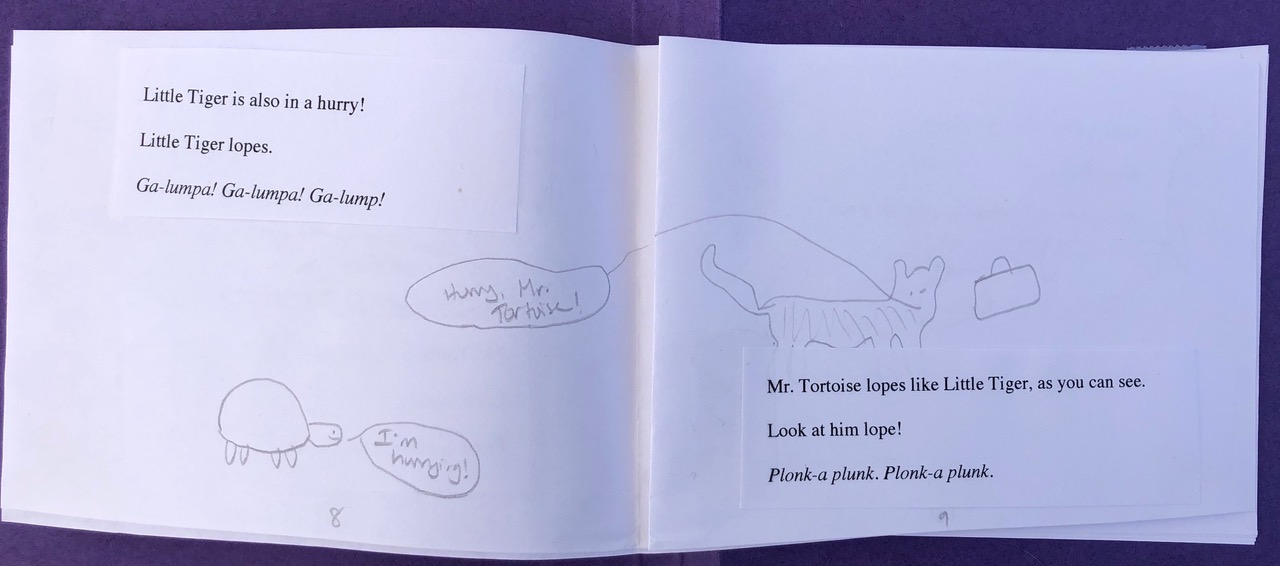
This is the first dummy I made for the book. At this point, the main character was actually “Mr. Tortoise” and he was hurrying somewhere for reasons that remained mysterious. The fact that he was a teacher and running late for school was not revealed until the end of the story.


To add the text to my blank dummy booklet, I reformatted the text in my manuscript to have a 1-inch margin on the left side and a 3-inch margin on the right side. This means the text occupies about 4.5 inches in width, and therefore will fit onto the pages of my 5.5-inch wide dummy. Then I print the text and cut out the text blocks for each page, and tape them into the book.

There are probably lots of other ways to do this, but I like the freedom this method gives me to position text on the page, take it out again and cut it up differently, and so on. I also like working with my hands and this method takes some time with all the cutting and taping, which is great for when I need a break from staring at my computer screen!

Usually, I repeat this dummy process two or three times. However, as I mentioned above, HURRY, LITTLE TORTOISE stretched my dummy-making to the limits, because I needed to make sure that the story would work with the physical structure of the book.

In order to make my life a bit easier, I ended up creating a document in Word to contain my dummy. I set a custom paper size in my printer settings (under Page Setup in Word), to 11 x 4.25 inches. This would ensure that the dummy that printed out was the same size as the ones I was used to working with. Then, on each page of the document, I created a two-column table, with borders.

I used stock-photo silhouettes to position my animal characters exactly where I wanted them on the page, and typed my text right into the document, rather than my tried-and-true taping method. 

When I printed the dummy, I cut out the “pages.” After that, there was some finagling with taping the front and back of each page together so that the story would flow correctly. But of course, all that taping gave me a break from the computer so that was fine with me.


Finally, after many drafts, suggestions from my critique groups and agent, Mr. Tortoise became Little Tortoise, and Little Tortoise landed a publishing contract (in addition to being on time for school)!


The bottom line is, reading a picture book is a physical experience. As writers, it can immensely benefit us to recreate that physical experience, as nearly as possible, as part of the drafting process.

If you have another method for making a picture book dummy, be sure to share it in the comments! 

HURRY, LITTLE TORTOISE, TIME FOR SCHOOL!

Written by Carrie Finison

Illustrated by Erin Kraan

Random House Studio, July 19, 2022

Thank you so much, Carrie, for sharing the dummy process for your new book! 


Carrie Finison writes picture books with humor and heart, including Dozens of Doughnuts (Putnam, 2020), a Junior Library Guild selection; and Don’t Hug Doug (Putnam, 2021), an ALA Notable Children’s Book, which received starred reviews from both Kirkus and Publishers Weekly. Her most recent picture books are Lulu & Zoey: A Sister Story (Running Press Kids, 2022), and Hurry, Little Tortoise, Time for School! (Random House Studio, 2022).
She lives outside of Boston with her husband, son, and daughter, and two cats who permit her to work in their cozy attic office. For updates and giveaways, subscribe to her newsletter, check out her website, or follow on Twitter or Instagram.


Wednesday, July 20, 2022

My Summer Reading is for the Birds!

 Birds abound all around us. So this summer my sit-under-a-shady-tree reading includes a collection of books about birds. They are equally suitable for reading beneath a beach umbrella.


National Geographic Kids bird guide of North America 
There’s always room to tuck a field guide (and even a pair of binoculars) into your beach tote or backpack. The NGK field guides are kid-friendly and filled with more than bird IDs. Check out this review by the Celebrate Picture Books team. Of course, you can always leave the field guide at home and load the Merlin app to your phone.


Backpack Explorer: Bird Watch, by Editors of Storey Publishing 
This book leads kids through the basics of birding – from how to identify common birds to learning about migration, where birds live, and even their songs. There are lots of hands-on activities as well as interactive mini-field guides for such things as eggs, bird tracks, and what sorts of nests birds build. And there’s a birding log where kids can record their bird sightings, and stickers for completing activities. Pairs well with binoculars, a granola bar, and water bottle.

On Gull Beach, by Jane Yolen
What’s a beach without gulls? If you’re headed to the ocean, or a lake, make sure you take this for a read-along. Check out my review here.

Odd Birds: Meet Nature's Weirdest Flock (Board book), by Laura Gehl 
This board book just hit bookshelves last month and is a fun way to introduce littles to some unusual birds. 
Eight birds are featured: the frigatebird, with a bright red throat pouch; the blue-footed booby, with feet as advertised; the shoebill stork, ostrich, a very stinky hoatzin, and oilbird; the California condor – the largest flying birds in North America; and the burrowing owl, possibly the cutest. Gentle rhymes introduce the birds, and photos with more information are included at the back.

Chickenology : the ultimate encyclopedia, by Barbara SandriDepending on where you live, chickens may well be part of the local bird fauna. This book is aimed at the 7-and-up crowd, and is fun to browse. Who knew chickens are so cool? Check out this review by fellow author, Jilanne Hoffmann


So You Want to Be an Owl, by Jane Porter 
If you want to be an owl, you have to go to Owl School. That’s where you learn everything you need to know about hunting, seeing in the dark, and flight. No wings? A shame… but you can practice hooting, toe swivels, and being alert. A fun way to learn more about owls.


Bird Show, by Susan Stockdale
Imagine if birds held a fashion show! This book is the next-best thing. Check out my review here.

A Peek at Beaks: Tools Birds Use, by Sara Levine
Wings are nice to have, but beaks can’t be beat. That’s because beaks are built-in tools that can help comb your feathers, scoop up food, and even show how you feel – if you’re a bird. Check out my review here


How to find a bird, by Jennifer Ward
If you’re going to watch birds, you need to find them. And Jennifer Ward shares all the secrets. Check out this review by fellow author, Carol Baldwin

Birds don’t build blanket forts or sand castles. They build nests. Here are two fun-to-read books about building bird nests.
The Nest That Wren Built, by Randi Sonenshine - check out my review here


This is the nest that Robin built : with a little help from her friends, by Denise Fleming
Check out this review by fellow book-lover, Joanna Marple


Lovebird Lou, by Tammi Sauer
There are tons of stories about birds. Here’s one published just a few months ago. I love it because my husband’s name is Lou. You’ll love it because it’s a sweet story about family and finding yourself. Check out this review by friend and fellow STEM Tuesday blogger, Maria Marshall


Wednesday, July 13, 2022

Summer Fun: ESCAPE TO PLAY: Becky Gehrisch and Independent Publishing by Kathy Halsey


Book Review

Summer time! Wouldn't you like to be with these adorable pups and escape and play? Doesn’t that bubble bath look perfect on a hot summer’s day? Escape to Play is a summer treat that combines three mischievous dogs who create loads of unsupervised fun while the farmer is hard at work. 

Author- illustrator Becky Gehrisch ’s charming art and bouncy rhyme combine with an “Easter egg” in the character Norman, a mouse. Add the surprise elements of classic paintings such as Van Gogh’s sunflowers and  Munch’s The Scream, and you have an engaging, interactive read. This picture book has a great “re-readability” factor, too. I give this one "four paws up."


Craft Chat with Becky and Kathy


 Kathy:  How did ESCAPE TO PLAY become the book it is now? Did you at one time think of legacy publishing as opposed to independent publishing? 

Becky: Escape to Play was a fifteen-year process—your writing audience might know how that goes! It can sometimes take a while to see an idea to fruition. I spent years writing and illustrating while I worked at home raising kids. In that time, I joined SCBWI and studied the art of picture book making and storytelling. I am glad that I took the time to research so that my story and book was as polished as possible.

After graduating from the Ohio State University with a degree in art, I was burned out. Escape to Play came about organically. I had started with a painting of my dogs in a bubbly bathtub. This painting was the first painting in a year after graduation where I decided to have fun and make art for myself. Each page was a 40-hour painting that followed the dogs’ day on the farm while the farmer left for the day. If you look closely, the clocks on the wall have the correct time of day!

Originally, I had submitted Escape to Play to over 40 publishing houses. During this time, a different publishing house approached me to illustrate for them, but I looked at the contract and decided I wanted to have complete control over my work. More importantly, I wanted to retain full intellectual rights over my creations. Because of this, I stopped my submission process. I slowly began planning and eventually started my own publishing company, Bookling Media. 

Kathy:  What’s the best thing about being the publisher, art director, author/illustrator of your book? What’s the hardest part? 

Becky: Bookling Media was designed to be an independent publishing company so I am thankfully not wearing all the hats that a self-published author might wear. I hired an art director/typographer, editor, and used off-set printing (as opposed to print on demand). I do not have all the skills as an individual to produce a high-quality book on my own. I created the publishing company not to do things myself, but to control the publication of my book and give others the same opportunity to keep the full rights to their books.

Having two businesses, Bookling Media (publishing company) and Gehrisch Arts (artist and author company) has been challenging. When I am ready to take on author-illustrators through Bookling, the process will be straight-forward: They are the author-illustrator, and I am the publisher. The hardest part currently is knowing when I am publisher and when I am the artist because the lines get blurred. Two sets of accounting, two sets of inventories, two of everything to keep separate. Now that I’ve done it once, these details have fallen into place for future book productions. 

Can you name these classic paintings? They're in the book!

Kathy: I love the added book elements you created: back matter, the art that kids discover, and Norman, the mouse. All add interactivity to the book. How did they come about?

Becky: Thank you! I am thrilled that I took the time to add these elements. The educational addition is a wonderful way share my love of art history. Fun fact: I almost had an art history minor! Having the backmatter section explain art styles in a simple but not in a patronizing way, was important to me. I feel that kids can handle big concepts as well as detailed illustrations. I love details, as evident in my illustrations! Having a reason for the reader to go back and absorb the details as they search for the artwork on the walls has been very rewarding for me.

Norman came about for the similar reasons as the real-life artwork. The inspiration for him came from books I read as a kid where you could find something again and again throughout the book. However, instead of just Norman being on each page, I wanted the reader to know to find him. On the title page, Norman invites the reader to find him.

Kathy:  What’s your biggest takeaway you’d like to share with those who may want to start their own publishing company?

Becky: Great question! It is important to decide if you want to self-publish or start an independent publishing company. Starting an Independent publishing company has meant that I have a team of long-time industry professionals working together to produce a book. The intention of Bookling Media has always been to publish other author-illustrator’s work. If you want to start a business, it requires investment and an entrepreneurial spirit.

Kathy:  Tell us about your upcoming events and what you’ve learned re: author visits.

Becky: I will be at several summer author-events around Ohio from libraries to bookstores to teaching at the Thurber House! The author visits I’ve done this spring have taught me to continue to have fun with the kids. They have great questions and love interacting with my Norman puppet. In preparation for my visit, kids get to use art to color images from the Escape to Play Coloring Book. This has been a great asset to author visits.

Something for author/illustrators to consider is to have a good visual presentation. I include my childhood artwork, original drafts of the story, and art process videos. The kids realize that art can sometimes take a while to make but just like a puzzle, the challenge is rewarding! At the end of the day, encouraging students to enjoy art and reading is what it is all about for me!

Folks can see my upcoming events here.

Kathy: What are you working on now?

Becky: In my author-illustrator role, I am working on lesson plans for teaching art and writing classes this summer. I have several picture book ideas, but they are on hold as I do book events and build up Bookling Media. In my Bookling Media role, I am working on marketing and distribution for Escape to Play and preparing to open submissions for author-illustrators to submit this fall.

Becky’s Bio:

Becky Gehrisch is the founder and Executive Director of Bookling Media, an independent press redefining the kidlit publishing industry, book by book! Bookling Media focuses on picture books created by author-illustrators. Becky has an art degree from The Ohio State University. She has served as the Illustrator Coordinator for the Central and Southern Ohio SCBWI chapter. Since Bookling Media’s start in 2020, Becky has built and led the team through the publication of their premiere title and is now focusing on maturing the company’s supply chain and distribution capabilities.


Becky's social media handles and website:


@Booklingmedia (Facebook, Instagram, Twitter)

@GehrischArts (FB, Instagram, Twitter)

www.booklingmedia.com/books

www.gehrisch-arts.com/author