Wednesday, June 27, 2018

Poetic Ponderings ~ by Christy Mihaly


POETRY
When I set my writing goals for the year, a big one was to write more poetry. I've dabbled in poems, and published a few. I offered some poetry ponderings in past GROG posts (one is here) but mostly I write nonfiction books. This year I wanted to develop my poetic side. I joined an online poetry critique group, and I've tried to find inspiration for a new poem every day.  I've also started submitting more poems to anthologies and magazines. It takes persistence! Here are some thoughts after a half-year of paying attention to poetry.

What's so great about writing poetry? Consider these points:

♦ The right words: In a poem, the selection of each word is crucial. Each word affects the rhythm, the meter, the "mouth feel" of the poem. Writing poetry helps strengthen my word choices in other writing.

♦ Playful words: Poetry encourages the writer to play with words. A poem doesn't need a plot. Its words may simply evoke a feeling, or describe an object or a moment, or entertain. Developing this in-the-moment mindset can enliven your prose writing too.

♦ A few words: You can easily write a poem in a morning--and it might even be publishable (after a little polishing). Of course you can write a poem just for the pleasure of it. But, if a writer is struggling through year seven of revising a major work in progress, selling a poem--and seeing it in print--can be a big boost. Kids' magazines, in print and online, often seek kid-friendly poems – the Cricket magazines have been particularly interested lately. (Check out their active calls for submissions, here.) 

Plus, a special bonus for aspiring authors: A  series of related poems can become a published collection, like Fresh-Picked Poetry, about farmer's markets by Michelle Schaub, or Rainy Day Poems, by James McDonald -- and so many others that kids love.
And once in a while, a poem grows into an entire picture book. Think of Jane Yolen's How Do Dinosaurs Say Goodnight? It's basically an expanded poem, like many other Jane Yolen books.

The text of Snow Sisters, published this year by Kerri Kokias, is a mirror poem, or palindrome poem, in which the same words are used in the first half and the second half, but in reverse order. Simple? Yes! Hard to write? Yes, to get it right. Brilliant picture book? Absolutely!

My debut picture book, Hey, Hey, HAY! (coming August 14) got its start as a simple rhyming poem about making hay. You never know! 

For more examples of picture books that are poems, check out Marcie Atkins's GROG post, here.

Interested but unsure how to begin? Some writers have a  practice of writing a poem every morning. I can't always make this happen, but when I do, it starts my writing day off with a creative splash. It's a great habit to cultivate. Your morning poem doesn't have to be great literature. It's good practice to just do it. 

If poetry still seems intimidating, try working within the structure of an established poetic form. I've found that experimenting with different forms often helps me get a poem started. Here are a few fun forms to try:

Acrostic

In an acrostic poem, a word or phrase is spelled vertically down the page. This word is the poem's theme or topic. Each line begins with the next letter in your topic word. Rhymes are not required.
(Variations: Each line of poetry ends with the letter of the topic word, or the topic word runs down the middle of the lines.)

Here's a simple example, using "Cat":

Content to snooze
and soak up the sun ...
till Songbird shows up.

© Christy Mihaly

Diamante
A diamante is seven lines long and is printed so that it forms a diamond shape. Again there are variations, but here's the basic idea: The first half describes one subject and the second half describes a different subject, which is often the antonym of the first but may be a synonym. 

The diamante's lines are prescribed as follows:

1: Starting subject
2: Two adjectives about line 1
3: Three gerunds (or -ing verbs) about line 1
4: Four words, consisting of two about line 1, and two about line 7. (This line sometimes has more words, and may be written as one or two short phrases.)
5: Three gerunds/-ing verbs about line 7
6: Two adjectives about line 7
7: End subject

Here's a quick diamante that I posted one recent sunny day—the end of April—when confronting a persistent pile of snow atop my long-suffering garden: 


Double dactyl
I'm a big fan of the double dactyl, which can produce some very entertaining light verse. (A "dactyl" is a three-syllable word with the accent on the first, such as "holiday.")

In a double dactyl, there are eight lines broken into two quatrains, or 4-line stanzas. Each of the first three lines of the quatrain consists of two dactyls. The fourth line contains one dactyl plus another stressed syllable. The last syllable of each quatrain rhymes with the other.

Other requirements: Line 1 is a nonsense phrase; line 2 is a proper name of a person or place. One of the other lines, usually line 6, is a single word that is double dactylic. (And, technically, it should never have been used in a double dactyl poem before.)

It's easier to see how this works by reading an example. Here's one of mine published in April in Imperfect: Poems About Mistakes, an anthology for middle schoolers edited by Tabatha Yeatts. This wonderful collection contains a broad range of middle-school-friendly poems about making mistakes (and learning from them). I included a factual note with this poem in the book – because, as most GROG readers know, it's nonfiction!

Rejecting Harry Potter

Hippogriff, schnippogriff,
Salazar Slytherin.
Publishers dissed Rowling’s
Sorcerer’s Stone.

“Magic won’t sell; we need
marketability!”
They’d be much richer, had
they only known.


© Christy Mihaly

Of course there are many more poetic forms, including the mirror poem, mentioned above, and one I've been meaning to tackle but haven't yet tried myself: the roundel. Children's writer B.J. Lee wrote about roundels recently over on Michelle Barnes's blog "Today's Little Ditty" recently, and rather than try to repeat what B.J. said, I urge you to check out her post here.

If you are interested in writing more poetry, you can read and listen to poems--in books and online--and talk with others who are writing them. Attend poetry readings and other events, and/or seek out a poetry group to join--or form one. Consider taking a class or two. I learned so much from Renee LaTulippe's wonderful "Lyrical Language Lab" online course. 

For more pointers on poetry resources and how to get started, see poet-author Patricia Toht's  GROG posts here and here. Other prior GROG posts about poetry include guest posts by Margarita Engle and Penny Parker Klostermann. And GROG poetry maven Jan Annino offers ideas about prompts, poetry month, and Lee Bennett Hopkins.

Go forth, poets, and good luck. If you're so inclined, please leave a favorite poem in the comments. And happy writing!

Wednesday, June 20, 2018

CAN I TOUCH YOUR HAIR? A UNIQUE POETRY COLLABORATION


     I was blessed to have met Irene Latham and Charles Waters


at a recent SCBWI event in Birmingham. When they read from their new book, Can I Touch Your Hair?


I was hooked. Such a powerful book that will be talked about for some time. It is getting good reviews and was recently featured in a 12 x 12 webinar as one of  librarian Betsy Bird's Top Twelve Books of 2018. They were gracious to answer some questions about their collaboration for readers of The GROG. (You can view an earlier post here interviewing Charles:
https://groggorg.blogspot.com/2018/03/debut-author-charles-waters.html )

     Post a comment and you will be entered in a drawing to win a free copy of their book. 

     Sherri: I think I head you say you "met" through your poetry publications, but can you tell us how you two came together for this project?

     Irene:  We knew each other and each other's poetry through Poetry Friday, which is a weekly online meetup of poetry folks sharing poetry posts and resources. We'd also been featured together in a couple of anthologies. Charles has always been kind and enthusiastic in our interactions, so when Carol Hinz suggested the book would work best as a conversation between a white poet and a black poet, and who would I like to work with,  I instantly thought of Charles.

     Sherri:  Did you pitch the idea, or did someone pitch it to you? 

     Irene:  It was actually our editor Carol Hinz's idea, and she recruited me and then I brought Charles on board.

     Sherri:  Did you meet before you started work on the book?

     Irene: We didn't meet until after the book was finished. We relied on Google Docs, Microsoft Word, emails, texts, and the occasional phone call.

     Sherri:  How did you decide on the premise of the teacher giving an assignment?

     Irene and Charles:  We thought that made the most sense of getting a shy kid and an overactive kid together to get to know each other in the hopes of them becoming friends. Also, there should be poetry projects in all of humanity once a month!

     Sherri: Tell us about the poem titles.

     Irene: We each decided those on our own, as much as I can remember. (It's possible our editor helped us tweak a few...the thing I do remember is that at one point it was suggested that maybe the poems didn't need titles at all, and Charles and I were both attached to our titles! In fact, it's hard for me to imagine calling it a poem if it doesn't have a title. (Fortunately, the publisher supported our choice.)

     Sherri:  How long did it take from start to publication?

     Charles: If I remember correctly, it was two years. However, we did get Carol a working manuscript to send to the acquisitions meeting in about three weeks.

     Sherri:  Charles, I heard you used the real name of a teacher. Can you tell us about her?

     Charles:  Becky Vandenberg was my high school teacher in English and math in 10th, 11th, and 12th grades. My first day of school at Penn Wood High in September of 1988 was her second day of school. I felt a bond with her from the beginning because we were both newbies to Penn Wood. She's taught and mentored scores of students coming up on 30 years. I used her name in our manuscript and after a series of drafts, Irene asked me where did I get the name Mrs. Vandenberg. Once I told her about Becky, she said, "Well, we're definitely keeping the name now!"

     Sherri:  What would you like to see happen with this book? I could almost see a teacher using it in the classroom with different readers.

     Irene and Charles:  We hope it sparks conversations. We don't have all the answers, except to be kind to one another. As far as teachers using the book in their classrooms, we would be honored. Teaching artist/Musician/Playwright Lacresha Berry created a Teacher's Guide that is full of ways to implement the book into one's classroom.

Teacher's Guide:
https://docs.wixstatic.com/ugd/b9444ae3a57c6491174b13bc2c4bfdbdd005cd.pdf

     Sherri:  Can each of you share something you learned while working on this project?

     Irene:  We were both acolytes in the Episcopal church when we were kids.
    Charles:  We both grew up one of five kids within our respective families.

     Sherri:  Are the illustrations of each of you based on fifth grade photos?

     Irene:  We did send our 5th grade pics to Sean and Selina so they'd have a starting point. We love what they did!

     Sherri: Do either of you have a favorite poem? Is there one you labored over?

     Charles: My favorite poem in the book is Irene's poem "News."


which is written with such detail and sensitivity. When I do solo author visits, I try my best to read this poem to the audience. #lathampower.


     Irene:  And I love Charles' "Officer Brassard" poem.


 It really shows how confusing and complicated humans can be. As for a poem I labored over, I don't think any went through more drafts than "Summer Reading," It was tough to hit the right note for the narrative thread, and there are still things I'd like to change about it.

     Sherri: I especially liked the art. Every page turn had something new in color, format, or design. How did you react to the illustrations?

     Charles: There may have been dancing involved for me. Thank goodness no one saw it. One of the skills I do not possess is the dancing skills of the late Fayard and Harold Nicholas or the musicianship of the late Cab Calloway.

     Sherri:  Is there another collaboration in the works?

     Irene and Charles: You never know. :-)

 - - - - - - - - - - - - - - - - - - - - - - - - - - - - - - - - - - - - - - - - - - - - - 

     Irene Latham is the author of more than a dozen current and forthcoming books including two novels for children--Leaving Gee's Bend and Don't Feed the Boy. Winner of the 2016 Lee Bennett Hopkins Promising Poet Award, her poetry books for children include Dear Wandering Wildebeest, When the Sun Shines on Antarctica, and Fresh Delicious and Can I Touch Your Hair? (with Charles Waters). She lives in Alabama with her family where she does her best to "live her poem" every single day. Visit her online atwww.irenelatham.com.

     Charles Waters is a children's poet, actor, and author. His poems have appeared in various anthologies including Amazing Places, One Minute till Bedtime and The National Geographic Book of Animal Poetry. Charles performs his one person show, as well as conducts poetry performance and writing workshops for elementary and middle school audiences. Can I Touch Your Hair? Poems of Race, Mistakes, and Friendships is his first book. He lives in New York.


Wednesday, June 13, 2018

Monica Kulling, Author Extraordinaire

By Janie Reinart

We are honored to have the charming, resourceful, award-winning children’s author, Monica Kulling visit with us on the GROG today. Monica is the author of over 50 books for children including  picture books, poetry, and biographies. 

Her straightforward storytelling incorporates colorful anecdotes, exquisite details, and authentic voices. I love this story and own my own copy.  Monica has graciously gifted us with a copy of Mary Anning's Curiosity for a giveaway. (Rafflecopter will pick the winner.)

1.   Who is your agent? 
I don’t have an agent representing my work in Canada. The publishing community in Toronto is small and one can approach them on one’s own; however, in the United States, I’m represented by Red Fox Literary Agency.
2.   How did you get the idea for your story?
I was reading Tracey Chevalier’s engrossing historical novel Remarkable Creatures. Chevalier imagines Mary Anning’s adult life—her friendships with the famous geologists of the time and with Elizabeth Philpot and including Mary’s further significant fossil finds. That set me off on the road to reading everything I could about Mary Anning.

I was drawn to Mary Anning’s native intelligence and tenacity—to be this way at such a young age amazed me. When you consider the poverty in which Mary lived and her lack of formal education, what she accomplished is astounding. Mary’s story seemed perfect for kids, given that she made her first major discovery, the Ichthyosaur, at age twelve, and that her curiosity remained with her all her life.

3.   What is your favorite part of the story?
As strange as it may sound, I’m fond of the back matter. Maybe because it took me so long to write!


I also enjoy the scene where Mary comes home with a goodly coin for an ammonite she’s sold to a tourist and Joe bursts in with news of his great find, the eye of the mythological Lyme Regis dragon.
4.   How long did it take to write? Get to a publisher?
I had a working relationship with the publisher at Groundwood Books, Sheila Barry. I pitched the idea and she liked it, but wanted to see it as a novel rather than another picture-book biography. Because I’d never before completed a novel for kids, it took me some time to research, draft an outline, and revise several times. It took about a year, and because I knew that Groundwood Books wanted it, I didn’t have to peddle it anywhere else.

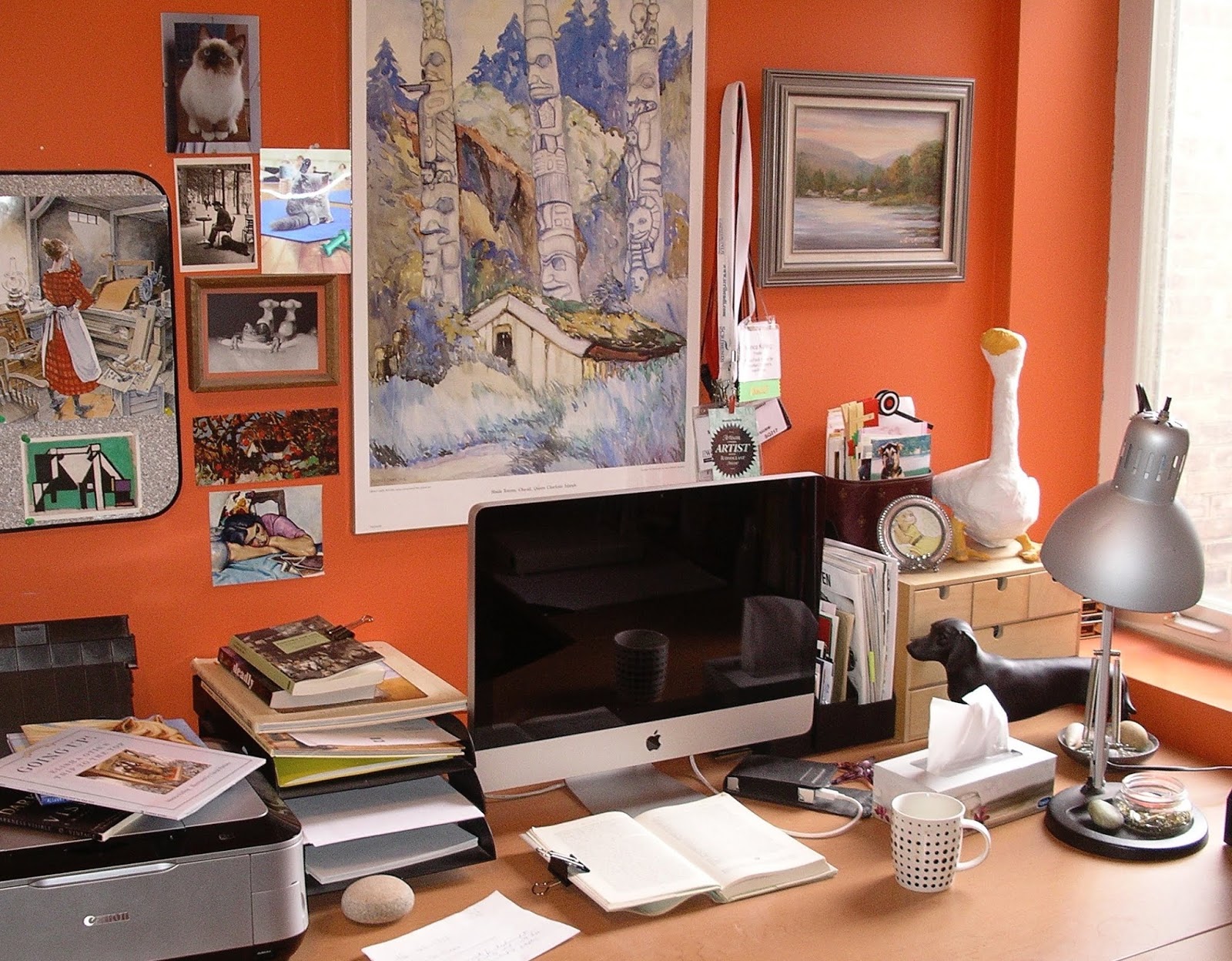
Monica's workspace.

5.   What is your writing routine?
I’ve been writing regularly for decades now, so it’s become habit. I find mornings the best time for fresh writing, and afternoons for editing what I’ve written the day before. Writing flies when you’re inspired, but I’ve found that showing up encourages inspiration.

6.   What is your favorite writing craft book?
Collecting books about writing was once a hobby of mine, so I have many such books on my shelves. I still purchase the odd one here and there, but a book about writing has to offer me more than “story starters” and cheap advice.

I am encouraged by the struggle other writers have faced in getting words on the page, and there are many great classics on that theme. I’ve reread the following four books a few times:
Louise DeSalvo, The Art of Slow Writing
Bonnie Friedman, Writing Past Dark
Ralph Keyes, The Courage to Write
Brenda Ueland, If You Want To Write
7.   What inspires you to write?
These days, character—that is, the quirkiness of human nature—is a catalyst for me. How people interact with one another is grist for my mill.
8.   What are you working on now?
I’ve just finished a sequel to Happy Birthday, Alice Babette. The new story depicts another chapter in the life of the lovable American expats Gertrude Stein and Alice B. Toklas.

I’ve also been trolling through my archives of material I wrote decades ago and found the first three chapters of a novel that actually has a spark, which I may complete this summer. I’m fond of middle-grade fiction.

9.   Words of advice for writers.
Show up on a regular basis. Don’t wait to be inspired. If you’ve got a passion for writing, you’ll write despite the rejections. Or you might not wish to push publication. No harm in that. Publication isn’t all it’s cracked up to be. Writing for oneself has a certain joy that publication often tramples on.


Monica Kulling
Thank you, Monica for your words of wisdom and inspiration. I look forward to reading the craft books you recommended. You can find Monica on Facebook. 

From Kids Can Press: Monica Kulling was born in Vancouver, British Columbia, and grew up in the Fraser Valley, surrounded by mountains. She studied creative writing at the University of Victoria, where her focus was poetry. When Monica enrolled in a course about children's literature, she was immediately hooked. 
You can purchase Mary Anning's Curiosity here.

a Rafflecopter giveaway

Wednesday, June 6, 2018

Cover to Cover, Part II ~By Suzy Leopold

During the month of April, I shared a post, Cover to Cover, Part I. I began identifying the parts of a book beginning with the cover. The book jacket, followed by interesting endpapers were identified along with front matter elements. 

Let's proceed with Part II and continue identifying the parts of a published book. The featured book is: 
THE GIRL WHO DREW BUTTERFLIES: 
HOW MARIA MERIAN'S ART CHANGED 
SCIENCE 
by Joyce Sidman.

THE GIRL WHO DREW BUTTERFLIES

Book Jacket and End Papers

First, I'll begin with these thoughts . . . 

  • Writers understand the importance of reading and studying picture books in the genre one writes. It is a sound idea. 
  • Writers request stacks of books from the library to read and study. 
  • Picture book writers visit local indie bookstore and inspect picture books from cover to cover. Writers examine recently published picture books. 
  • Writers read to hone their craft . . . The craft of writing for children.
From cover to cover, there are various parts of a picture book. Picture book terminology various from book to book. As previously stated, not all picture books include all elements described in the previous post and today's post. Every book does not include the same parts. These variants are based on the topic or theme, the genre, and the audience the book is intended for. Writers choose elements that support the story being told, offering the reader additional information.

As an educator, a writer of children’s picture books, and a Story Teller Extraordinaire, I feel text features are essential parts of a nonfiction book. These story elements can even be included in the genre of fiction. Including various text features and back matter that’s done well are useful components that can support the main text of a well written story. 


I enjoy sharing books during story time at Afterwords Book Store on Tuesdays. Not only do I read books with the littles, I take time to include various book elements. The names of the author and illustrator are read. The front and back covers or book jacket are shown. Interesting end papers are featured. After the story is read, I may point out several components of the Back Matter based on the age group of the audience.

In Part I of Cover to Cover, many elements of Front matter. I left off with the gutter of a book.

Let's continue with another part of a picture book found on the verso [left hand page] and recto [right hand page] pages of a book.

Sidebars or Inset Boxes
Sidebars step away from the story to share additional facts throughout the main story. These could include quotes, definitions, and additional information to enhance the story. These informative inset boxes [sometimes called breakout boxes or fact boxes] are written on the same pages as the book's main text. This element provides a way to grab the reader's attention by presenting interesting ideas and concepts related to the main text. Sidebars are set off in a different font to stand apart. 

Nancy Sanders, author, explains the format of sidebars further on her blog Blogzone: Practical Tips to Help Your Writing Come True . . . 

Fellow GROGger, Marcie Flinchum Atkins, author wrote an excellent post about inset boxes with a catchy title, Sidebars: Not for Skipping.

Moving beyond the story . . . What can a reader discover in Back matter?

As an educator and a writer of children’s picture books, I feel back matter can be an essential part of a nonfiction book. It can be an excellent tool for the genre of fiction, too. Back matter that’s done well is a useful component that supports the story. 

Outstanding back matter not only supports the story, it improves the quality of the book. When back matter is included in a picture book, its like two stories in one.

Back matter supports literacy skills defined in Common Core Standards and the STEAM [Science, Technology, Engineering, Art, Mathematics] movement. It encourages critical thinking.
Back matter may include several or some of the following elements:

Index 
An index is a useful tool. An alphabetical list to help the reader find a page number with specific information. 
Index
Glossary
A glossary or key words is a list of important words to know. Students can read the definitions to understand an unknown word. The glossary or mini-dictionary may include specific history, science, or math related words to tie in Common Core Standards.
Glossary
Author's Note
Author's Note
Author & illustrator notes

These notes are often seen in nonfiction picture books. The purpose is to add a few facts that do not fit into the main text of the main text. These notes are compared to "footnotes" and are often personalized about the subject of the book.

Diagrams, Graphs, Maps, and Timeline
A great way to visually display facts and information about the story and topic. Using a timeline helps students connect the events of history and see the "big picture".
Timeline

Bibliography
A page with references and sources used.
Bibliography
Activities
This section may include crafts, experiments, recipes, and building ideas for the reader. Teachers and parents always appreciate these extended activities to build critical thinkers.

Epilogue
When considering an epilogue, ask this question: 
1. Is there anything else left to be said?
For additional information read this blog post by Hannah Gordon for more questions and information.

Afterword or Note from the Author
Additional facts and information.

Many picture books include Resources for further learning. Listed are my additional suggestions for more information.

Melissa Stewart Celebrate Science, Behind the Books: Three Melissas and Nonfiction Text Features.

Michelle J. Kelley and Nicki Clausen-Grace Reading Rockets, Guiding Students Through Expository Text with Text Feature Walks.

Valerie Peterson asks "What are the parts of a printed book?" Read her thoughts on this blog: The Parts of a Book.

From front matter to back matter, a writer chooses the parts of a book to best convey the message of the story and the facts of the main text. These elements are some of the basic parts of a published book. While you won't include every single element described, you may want to consider including those that enhance your story.