Wednesday, January 20, 2016

A Celebration of Picture Books ~By Suzy Leopold


The kid lit world always seems to be buzzing with news. The good news includes announcements of book birthday celebrations that debut new books, awards for distinguished and deserving books, along with many amazing events happening at bookstores, and much more.

Last week many outstanding books were recognized by American Library Association, ALA. The Caldecott Medal is defined by the ALA as:

The Caldecott Medal was named in honor of nineteenth-century English illustrator Randolph Caldecott. It is awarded annually by the Association for Library Service to Children, a division of the American Library Association, to the artist of the most 
distinguished American picture book for children. 


As everyone knows the committee presented the 2016 Caldecott Medal to: 

FINDING WINNIE: THE TRUE STORY OF THE MOST FAMOUS BEAR by Lindsay Mattic with illustrations by Sophie Blackall.


FINDING WINNIE:
THE TRUE STORY OF THE WORLD'S MOST FAMOUS BEAR
This is a remarkable story named after the Canadian city of Winnipeg that inspired the story of Winnie-the-Pooh. You can read more about the illustrator Sophie Blackall in TIME for Kids.

And now on to the 2016 Caldecott Honor Books . . . 
TROMBONE SHORTY


TROMBONE SHORTY is a stunning autobiography about Troy Andrews. He is a legendary artist from the New Orleans Jazz Fest. Growing up in the New Orleans' district of Tremé, Troy lead his own band at the age of six. The illustrations by Bryan Collier are a combination of paintings and collage and received the 2016 Coretta Scott King Book Illustrator Award.
WAITING
An pig, a bear, a puppy, a rabbit and an owl are waiting. What are they waiting for as they look out the window sill? Kevin Henkes is a master picture book creator and has written many beloved books. WAITING was also recognized for the Theodore Seuss Geisel Award. For more information about Kevin Henkes click on his name to read his bio.
VOICE OF FREEDOM
FANNE LOU HAMER

VOICE OF FREEDOM celebrates the life and legacy of Fannie Lou Hammer [1917-1977]. Fannie Lou was an American voting rights activist, civil rights leader and philanthropist. Find out more about Fannie Lou in an article on the History web site. Her tombstone in Mississippi indicates, "I am sick and tired of being sick and tired." In addition to receiving the Caldecott Honor Award, this book with a message of hope received a 2016 Robert F. Sibert Honor Book. A 2016 Steptoe New Talent Illustrator Award Winner was given for the illustrations of mixed media and collage by Ekua Holmes. 

LAST STOP ON MARKET STREET
LAST STOP ON MARKET STREET, by Matt de la Peña and illustrated by Christian Robinson received many awards and include: 2016 Coretta Scott King Illustrator Honor Book, a New York Times book Review Notable Children’s Book of 2015, A Wall Street Journal Best Children’s Book of 2015 and the prestigious John Newbery Medal.

The reader will appreciate the beautiful moments between CJ and his Grandma as they spend their time together on a Sunday afternoon. The illustrations are a mix of acrylics and collage. Carter Higgins shares an excellent post about the Design of the Picture Book along with her excitement that we share for the awards presented to LAST STOP ON MARKET STREET.

In case you missed it, two fellow GROGgers recently shared information on the title of LAST STOP ON MARKET STREET and the award. You can find a GROG post by Kathy Halsey this past Monday. Last week, Tina Cho wrote a post about the prestigious Caldecott Award. The information shared by Kathy and Tina are both great posts, so make sure you check them out if you haven't already done so.

Along with the good news of these prestigious awards, comes those who grumble and scratch their heads. There are those who question the judges' decisions to recognize and honor these picture books. For myself, I am pleased and excited to celebrate each one of these titles.

Those who write for children know the challenges that come with being a writer. The journey to publication is most often a long journey. There is no need to question the decision of the judges. This is time to celebrate books! It is a time to recognize all the hard work the creators-authors, illustrators, editors, and many more, strive for in the world of publishing. All are deemed award winners. 

Monday, January 18, 2016

Diversity Via the Lens of Immigrants & Poverty-Part 1 by Kathy Halsey

"Let us turn our thoughts today to Martin Luther King and recognize that there are ties between us, all men and women living on the Earth. Ties of hope and love, sister and brotherhood, that we are bound together in our desire to see the world become a place in which our children can grow free and strong." 
James Taylor, Shed a Little Light

Last week Youth Media Awards honored writers, illustrators, and themes that shed a greater light on diversity. Matt de la Pena's Newbery winner, LAST STOP ON MARKET STREET, isn't just about those who must use public transportation or children whose parents are not present, but it addresses those issues. When I shared this winner with some suburban fifth grader writers, many told me they had never ridden a public bus. They wondered, too, why CJ spoke in a different vernacular then they did. They deemed the book full of "heart," "emotion," and noted how CJ and Nana served others at the soup kitchen. So much said and not said, but implied in LAST STOP that will generate great conversation and understanding.

This great interview w/ David Levithan at BookCon 2015 sheds more light on Matt's thinking as he wrote this gentle story.


In celebration of Dr. King's birthday, I'd like to spotlight another book that open windows and doors for intermediate/middle grade  audiences. Stay tuned for Part 2, Friday, January 22, for a review of a picture book on immigrants.
Cynthia Lord's heartfelt A HANDFUL OF STARS, focuses on the friendship of Lily, raised by French Canadian grandparents, and Salma, daughter of migrant workers. Lord has deftly set up a friendship between these two that highlights their differences and similarities while covering typical tween coming-of-age issues.

Lily makes it clear on page one that, "the only reason I ever spoke to Salma Santiago was because my dog ate her lunch." Neither group, the townies or the migrant families talk to each other. Lily continues, "I don't usually talk to those kids, and they don't usually talk to me. They don't stay here long enough for us to be friends." 

Yet friends they become because they help each other become stronger and better. Examples abound:
  • Lily conquers her fear of being noticed as she helps Salma compete in the annual blueberry queen contest. 
  • Lily empathizes with Salma since her French-Canadian mother broke barriers as queen three years running; she rails against pageant officials who unwittingly act in a condescending manner to Salma.
  • Salma uses her artistic talent to paint mason bee houses with Lily at her grandparents' general store to raise money for Lucky, the blind dog who evokes memories of Lily's dead mother.
  • Salma's mother draws Lily into a tender mother-daughter moment, too. "I looked up to see Mrs. Santiago holding her other arm open to me. My feet ran without me even telling them to."
Readers learn of the French-Candian culture and the migrant culture, both mostly overlooked in children's literature. Both families are of meager means, yet they share blueberry enchiladas and a growing awareness of each others talents and gifts. Salma paints yellow stars on her purpleberries to adorn the bee houses. (Lord explains that berries can be purple, red, black or even striped, but consumers only want the blue ones.)  

Salma says, Stars are one of my favorite things. I love how when you look up at the night, it doesn't matter if you're in Florida or Maine or Michigan or anywhere, it's the same stars. So when I miss someone, I look at the stars and imagine that person seeing same ones as me. No matter where I go, I can think of them, and they can think of me. They're my star friends."  Salma's sadness in never having permanent home is eloquently stated throughout the book in terms that children can understand. (Missing friends, missing pets.)

A HANDFUL OF STARS may have been a dark horse in the Newbery contest, but I give it many stars in the sky for illuminating diverse groups we don't usually see in our canon.

Continue the conversation. Share in the comments some of your Newbery dark horses and diverse favorites. 


Wednesday, January 13, 2016

Appreciations, Kate! Hello Gene! by J.G. Annino


In many U.S. states & other places where this
blog reaches, it is cold and wet.
Any gray blahs of winter can be banished by
a warm welcome for the new National Young
People’s Literature Ambassador affiliated
with the Library of Congress.

On January 7, 2016 the successor to Ambassador
Kate DiCamillo visited room L-119 in the
Thomas Jefferson Building of the Library of
Congress to accept the honor.   
                                                      
Widely popular author/comics illustrator Gene Luen Yang met widely popular author
Kate DiCamillo, who praised him in this statement from the Library of Congress -

“Gene Yang is a talented writer. He is a brilliant artist. 
His stories are thought-provoking, genre-bending, utterly original 
examinations of the human heart. In short, Gene Yang is a 
renaissance man. I am so honored to pass the torch of this sacred 
task to Gene. No one is better suited for bringing us all together.” 

So, appreciations outgoing laureate, KATE DICAMILLO.
Here is a lovely visit with her conducted for
The Horn Book in November 2015. We are glad you will
have more time to imagine, create, & write more books. And, did everyone
here at Group Blog have a chance to read her August, 2015 release? Go!

GENE LUEN YANG is familiar with kids+reading+schools, as he
has enlivened many hours in the classroom for students
as a Bay Area computer science, math and art teacher.
He now is an educator, not only as the U.S. Young
People's Literature Ambassador for the next two years, but
also but with Hamline University’s Children’s and 

He says his focus is the intersection of stories and
illustration. Although he is famous for award-winning graphic novels,
he says he is interested in what makes most readers of this blog
pay attention - picture books. 
Although I couldn't find that he has published a picture book, I'm hoping
that the youngest readers will be gifted with his first children's picture
book not too far away.

Gene re-invented the Pat-A-Cake child’s
rhyme for his contribution in NURSERY RHYME COMICS &
he is one of the cut-ups who contributed to COMICS SQUAD.


In addition to our welcome today, Gene has been applauded 
in many articles posted online & here are only two.


One of his many honors is that he earned Young
People's Literature category finalist status, in the National Book Awards
in the same year that his AMERICAN BORN CHINESE graphic
novel (not autobiographical as
many people assume) of three stories,
won the coveted ALA teen book honor,
the Michael L. Printz Award (named for a Topeka, Kansas librarian
and active children's literature specialist, who
in his short life, discovered author Chris Crutcher.)

I hope during his two years, Gene Luen Yang is able to visit a school, bookstore, library
or book conference near you - and me :) Thank you for taking on this important job, Gene!
While waiting for him to visit, you can listen to this podcast.

                                      official photo of Gene Luen Yang, from First Second Books


Monday, January 11, 2016

Fracturing a Fairy Tale ~ by Patricia Toht

Back in July, I wrote a post about creating a picture book text by giving an old theme a new twist. Today I'm going to focus on one popular way of doing this --  


Let's fracture some fairy tales, folks!

Fractured fairy tales are nothing new. From way back in the 1960's comes historic proof:

Obviously there's staying power in fractured fairy tales. So, how exactly do you make a fairy tale dance to a different tune? Here are just three of the moves you can do to change a fairy tale or childhood story/rhyme.

The Two-Step (or Three-Step, Four-Step, Five-Step, ...)

Take a short, simple childhood rhyme or story and add to it, expand it. The crucial factor is to assure that the expansion has a story arc to it that will propel the reader forward. Jim Aylesworth has written picture books in this vein.


THE COMPLETED HICKORY DICKORY DOCK begins with the well-known verse and then the author extends it by following the mouse through twelve hours of the day. The book is written in verse, each stanza opens with a fun-to-say nonsense word. The reader can count up the hours as the mouse moves through the day.


MY SON JOHN ends with the familiar verse. Readers follow an arc from sun-up to sun-down. Each spread depicts another child from the rural area taking part in simple activities. Son John ends the day in bed with his one shoe on.


The Twist


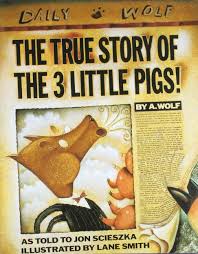
THE TRUE STORY OF THE 3 LITTLE PIGS by Jon Scieszka is a well-known example of a fractured fairy tale. The story is relayed by the wolf, who tells the "true" story of what happened with the pigs from his point of view. According to him, the whole misunderstanding was about a cup of sugar and a case of the sneezes. If you'd like to try writing something similar, take the "bad guy" of a story and examine events from his/her point of view, being sure to add lots of emotion. How does that change the story?


NINJA RED RIDING HOOD by Corey Rosen Schwartz. Corey has written a Ninja trilogy; each one combines a childhood tale with ninja training. The limerick verses in this one are terrifically catchy, and the author manages to work in traditional lines (e.g. "The better to see you with, my dear") with seeming effortlessness. She also dares to even out the match between Wolf and Red -- they've both had ninja lessons! Someone else shows up in a gi to help save the day. To twist like Corey does, select a well-known childhood story and add an element that kids are crazy about. Tara Lazar's "500+ Things that Kids Like" is a great source for brainstorming.


The Mash

What might happen if you mash together a whole bunch of tales or characters? 

Tara Lazar's LITTLE RED GLIDING HOOD is one-part twist and one part mash up. It begins with an amazing title. Obviously "gliding" implies that Red is doing something special -- she's skating. Tara sets a goal for Red that reflects the title. What would a skater want? Why, to win a skating competition, of course. This storyline propels the reader through the story (on a ribbon of ice). But the author adds SO much more! Easily recognized characters are peppered throughout the story, and the feared big bad wolf is not-so-bad after all. Cleverness and puns abound.


The tale in INTERRUPTING CHICKEN by David Ezra Stein combines several childhood stories, but doesn't really scramble them up. As Papa Chicken reads his Chick a bedtime story, Chick keeps interrupting the stories by jumping in them to save characters from harm. 

Penny Parker Klostermann (who won the Best in Rhyme award for THERE WAS AN OLD DRAGON WHO SWALLOWED A KNIGHT) has said that INTERRUPTING CHICKEN was one of the mentor texts for her upcoming mash up, A COOKED UP FAIRY TALE (Summer, 2017). For an interview with Penny about her use of mentor texts, see the interview here.

I hope these examples will give you some ideas for fracturing fairy tales. Start dancing, writers, and see what shakes out!

Friday, January 8, 2016

The Caldecott Medal by Tina Cho

I remember last January being glued to my computer screen watching the American Library Association (ALA) awards live. The Caldecott Medal was awarded to Dan Santat for The Adventures of Beekle: The Unimaginary Friend. I was happy because I owned a copy of that very book!

Next Monday January 11th, 2016, the new recipient of the Randolph Caldecott Medal will be awarded. And I hope to be there virtually!

You might be like me wondering—just who was Mr. Caldecott? And how is the picture book determined? I dug into some web sites and found some nitty-gritty.


Randolph was born in 1846 in England and was the third child of a family of thirteen children. (His father married twice.) As a little kid he drew mostly animals. He left school at age fifteen to work in a bank. During his free time he walked and rode the countryside which is depicted in many of his illustrations. After six years he moved to another bank and attended a night school at the Manchester School of Art. Some of his illustrations landed in London newspapers and publications. At age 26, he quit his job and supported himself as an illustrator. In 1877, he did illustrations for two Christmas children’s books for Edmund Evans which were very successful and led to two each Christmas until he died in 1886. He is most famous for illustrations in Nursery Rhymes. His illustrations were unique to his time due to their humor, vitality, and sense of movement. The illustration on the Caldecott Medal is an example of this from his illustration in “The Diverting Story of John Gilpin.” Due to poor health in his old age, he and his wife took tours in warmer climates. During of tour of New York and down the coast to Florida, he took sick and passed away.

1887 Illustration from This Is the House that Jack Built

Who & what can win the medal?

*an artist who is a citizen or resident of the U.S.
*a distinguished American picture book by an American publisher

This is the definition of a picture book according to the Caldecott Manual:

1. A “picture book for children” as distinguished from other books with illustrations, is one that essentially provides the child with a visual experience. A picture book has a collective unity of story-line, theme, or concept, developed through the series of pictures of which the book is comprised

2.    A “picture book for children” is one for which children are an intended potential audience. The book displays respect for children’s understandings, abilities, and appreciations. Children are defined as persons of ages up to and including fourteen and picture books for this entire age range are to be considered.

And this is taken straight from the Caldecott Manual:

In identifying a “distinguished American picture book for children,” defined as illustration, committee members need to consider:
·         Excellence of execution in the artistic technique employed;
·         Excellence of pictorial interpretation of story, theme, or concept;
·         Appropriateness of style of illustration to the story, theme or concept;
·         Delineation of plot, theme, characters, setting, mood or information through the pictures;
·         Excellence of presentation in recognition of a child audience.

Who selects the winner?

An elite committee of fifteen members works year round to read picture books. According to the manual, in October, the first preliminary nominating ballot is due. And second ballot is due in November and the final ballot in December. In January, “late suggestions for books published in December” are offered, and awards are given.


Who won in the last five years?

2015 Dan Santat wrote and illustrated The Adventures of Beekle: The Unimaginary Friend
2014 Brian Floca wrote and illustrated Locomotive
2013 Jon Klassen wrote and illustrated This Is Not My Hat
2012 Chris Raschka wrote and illustrated A Ball for Daisy
2011 Erin E. Stead illustrated and husband wrote A Sick Day for Amos McGhee

Hmm, I see a pattern the past four years. Do you?

Who and which book do you think will win this year? If you’re unable to attend the ALA Mid-Winter Conference, I hope you can watch it live.

Where: Boston Convention Center

When: Monday, January 11th

Time: 8:00 a.m. EST


For me, that’s Monday night in Korea 10 pm. So I can grab a bowl of popcorn while you grab your breakfast! See you there.


Wednesday, January 6, 2016

5 Tips to Stay Motivated in 2016

by Leslie Colin Tribble


It's a brand new month in a brand new year! Are you a resolution setter? Do you set lofty goals for the year? How well do you keep those grand goals and resolutions?

Janie Reinart had a great post on Focus to start the GROG off for 2016. Now it's time to talk about motivation to help you achieve that Focus. I did a little Internet research and found some fun tips to help you stay motivated for the year.

1. Set Small Goals

I know you want to get those books published this year, but that's a huge goal that might be overwhelming. Give yourself something to work for that's more manageable, like setting yourself to write a certain number of words each day. Instead of saying, "I'll write for 2 hours a day," shoot instead for an exact word count. That way, you might write for only 20 minutes if the words are flowing and you've achieved your goal, instead of staring at the computer waiting for inspiration for 2 long and dreary hours.


2. Publicize your Efforts

I read that some people resort to Twitter to stay motivated by tweeting their desired word count for the day, then tweeting again when the goal is accomplished. This is accountability married to instant gratification. You can't let your followers down, plus it's great to get those virtual pats on the back as reward.


3. Monetary Motivation

This crazy idea says to give someone you trust $100 and they pay you $10 for every day you meet your writing goals.This would work especially well if you really need that money, say around Christmas.


4.Give Yourself Better Rewards

Bad habits are more compelling simply because the rewards feel greater. How much more satisfying is it to munch a bunch of chips or eat ice cream than it is to feast on carrot sticks? In order to keep you on task, you'll need a stronger motivator. It can be small, but the best motivators are something you can touch and that are intensely personal. Do you love wine? Buy a few bottles of your very favorite and enjoy a glass after reaching your goal. How about expensive, exquisite chocolate? Or maybe you love the sun and can reward yourself with uninterrupted sunbathing. For this to work the reward has to be something you can do immediately after finishing your work - train your mind to associate the work and the reward. 


5. Break Up the Effort

Something I've discovered that works for me is breaking up a big chunk of writing time with other activities. If I know I have to crank out a certain number of words, or articles or whatever, I give myself "butt out of chair" breaks. I'll work for one or two hours, then do something else for an hour that's active or movement oriented. That way I can vacuum the house, play with the dogs, bring in firewood, or go for a quick walk. The activity keeps me awake and reduces the feeling that I'm spreading physically while I'm spreading my writing wings. 

How do you stay motivated with your goals and resolutions for a new year?

Monday, January 4, 2016

Focus


By Janie Reinart


I love opening a new pack of crayons, note cards, or a new journal.  You can imagine how excited I am for a new year. Then I saw a short paragraph in a magazine. . .

"Increase your chance for success by focusing on what matters most . . . This free program empowers you to identify and work toward improvements promising the greatest satisfaction."

So I took a look at LifeReimagined.org/renew


The first activity was to come up with seven or more goals. Each card has a space to type in your objective. When you finished typing in your ambition, the program has you select what goal you would choose to do first between two of your cards. 

Would you do this first or this?

After cycling through all your goals, you end up with your #1 goal. You can repeat the process with new ideas.  

This turned out to be my #1 goal. Not what I expected. 


Next the program gives you a chance to journal about what you can change to accomplish your goals.

I am going to try to go to bed earlier and get up earlier. There never seems to be enough hours in a day!


Another step says,"This activity helps you put everyone else’s needs aside for a while and reflect on your own priorities.

As a mom of five children and grandmommy to thirteen grandchildren, I admit this step was difficult for me. I don't think about my priorities. More time to reflect and journal. 

I am going to have to work at this. I am considering setting a timer to make sure I get my writing time in each day.


The program goes on, "Get to the root of who you are to determine if the goals you want to accomplish are what will make you happy.  


Wishing all of you great success in the new year and hoping you all accomplish what will make you happy. Share your goals so we can cheer you on.